
A Bettor's Guide to the Odds Calculator for Horse Racing
Unlock Profits with betting tips!
An odds calculator for horse racing is the tool that instantly translates the cryptic language of betting odds into a simple, hard number: probability. It's your financial calculator for the racetrack, turning fractions (like 5/1), decimals (6.0), or American odds (+500) into a clear percentage that tells you what the market thinks a horse's chances are. This lets you instantly assess risk and see beyond the potential payout.
Your Essential Tool for Smarter Horse Racing Bets
Staring at a race card can feel like trying to solve a puzzle, with a sea of numbers that seem to demand some kind of sixth sense. But here's the thing: successful betting isn't about hunches or getting lucky. It’s about making calculated decisions based on solid data, and a good odds calculator is the first, most fundamental tool you need to do that.
Think of it this way: when you see a horse listed at 4/1, those odds don't just promise a certain payout. They carry an implied probability of winning of 20%. The calculator does that quick conversion for you, turning a confusing fraction into a straightforward percentage you can actually work with. This simple translation is the first real step you take from casual punting toward strategic, informed wagering.
Before we dive deeper, here's a quick snapshot of what an odds calculator brings to the table.
Odds Calculator At a Glance
| Core Function | Key Benefit | Who It's For |
|---|---|---|
| Instantly converts betting odds (fractional, decimal, American) into implied probability percentages. | Removes guesswork and mental math, providing a clear, data-driven view of a horse's chances. | Any bettor looking to move beyond gut feelings and make smarter, more strategic wagers. |
This table boils it down, but the real power of the calculator becomes clear once you start using it to shape your decisions.
Why a Calculator is Non-Negotiable
For anyone serious about betting, using an odds calculator for horse racing isn't just a nice-to-have; it's absolutely essential for a few key reasons:
- Clarity and Speed: It kills mental math errors and gives you instant conversions. This is crucial when odds are bouncing around in the final minutes before a race.
- Strategic Insight: It helps you understand the real risk tied to a bet, not just the flashy potential reward.
- Foundation for Value: Once you know the implied probability, you can start comparing it to your own analysis to hunt for "value bets" - those golden opportunities where the odds are better than the horse’s actual chances.
This strategic approach is only becoming more important. The global horse betting market is a massive powerhouse, valued at $47.18 billion in 2025 and set to grow significantly through 2033. This explosion highlights just how indispensable tools like odds calculators have become for bettors trying to find an edge.
The core purpose of an odds calculator isn't to predict a winner. It's to reveal what the market thinks the chances are, empowering you to decide if you agree or if you've spotted an opportunity everyone else has missed.
Decoding the Numbers Behind the Odds
Ever stared at a race card and just seen a jumble of numbers? Figures like 5/1 or +500 aren't just plucked out of thin air; they're different languages all saying the same thing: implied probability. A good odds calculator is your universal translator, turning these confusing formats into a simple, clear percentage.
You'll run into three main dialects: fractional odds (the UK standard), decimal odds (big in Europe), and American odds. For example, a horse priced at 5/1, 6.00, or +500 is, in the bookmaker's eyes, carrying a 16.7% chance of winning the race. An odds calculator does that math in a blink, giving you instant clarity. If you want a deeper dive into these formats, check out our guide on how to read horse betting odds.
What is Implied Probability?
At its heart, implied probability is just the chance of something happening, according to the odds. It’s the bookie's professional opinion on a horse's chances, neatly packaged as a percentage.
Think of it like a weather forecast. A meteorologist says there's a 20% chance of rain, and you immediately get a feel for the risk. An odds calculator does the same thing for a horse, turning 4/1 odds into that same 20% chance. It lets you weigh the risk against the potential reward in a way that makes sense.
Mastering this concept is the first real step you take from just guessing to betting with a plan.
This diagram shows you exactly how a calculator connects the dots between the odds, the probability, and your stake.
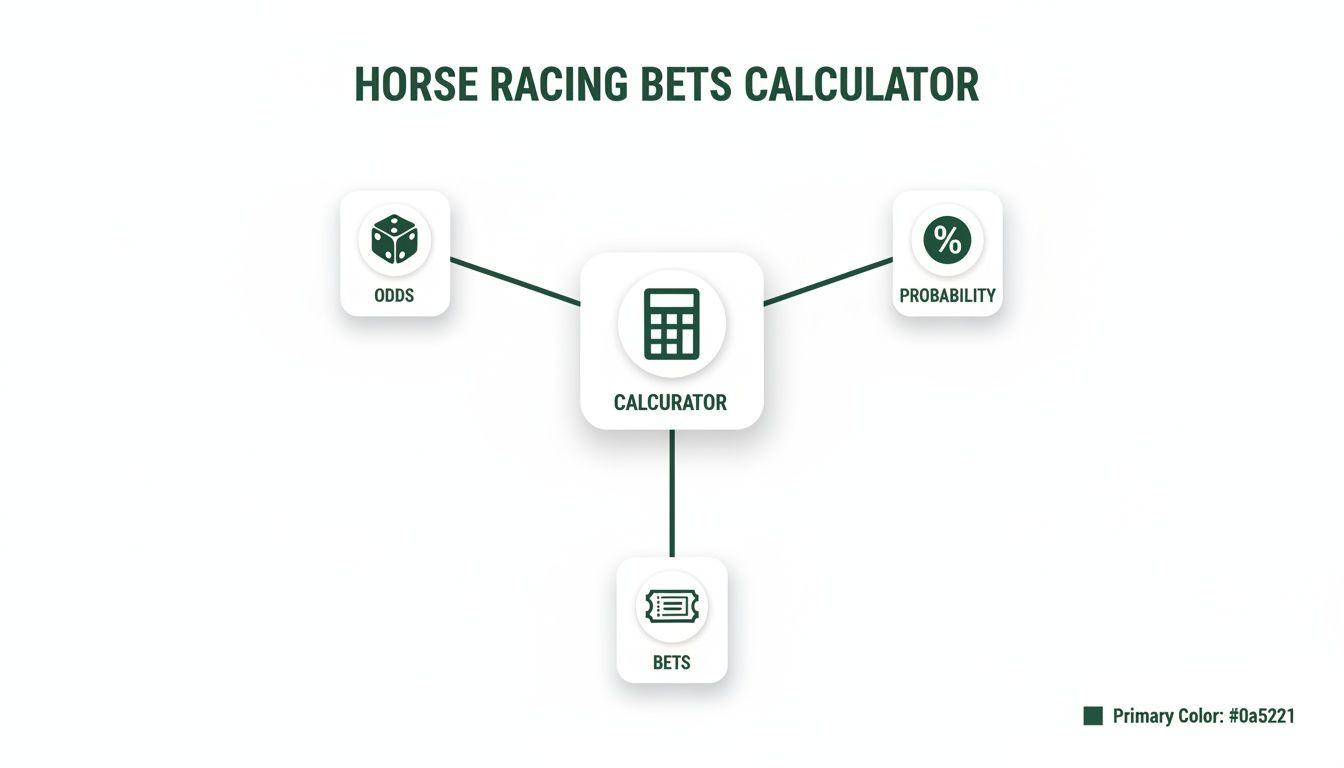
It’s the tool that sits right in the middle, making sense of all the numbers flying around in horse racing.
Uncovering the Bookmaker's Margin
But there’s a crucial catch hidden inside those odds: the bookmaker's margin. You might hear it called the overround or the vig. If you took the implied probabilities of every horse in a race and added them all up, the total will always be more than 100% - something like 115%, for example.
That extra 15% is the bookie’s built-in profit. It's their service fee, woven directly into the prices to make sure they come out ahead no matter which horse crosses the finish line first.
A horse racing odds calculator shines a spotlight on this overround. By calculating the total book percentage, you can see exactly how big of a cut the bookmaker is taking. This is absolutely fundamental, because to find any real value, you first have to see past this artificial inflation and get a clearer picture of a horse's genuine chances.
This is especially powerful when you consider the scale of the market. Horse racing makes up nearly 20% of the entire global betting scene, with wagers soaring past $100 billion every year. For bettors in major hubs like the US, Australia, and Japan, that hidden margin is a massive factor in whether you win or lose long-term. Stripping away the overround is your first step toward spotting where the bookies might have gotten it wrong.
Putting Your Calculator to Work on Different Bets
Theory is one thing, but the rubber really meets the road when you start plugging in real numbers. Let's walk through how an odds calculator for horse racing handles three common betting scenarios, starting with the simple stuff and working our way up. Each example will show you how to turn raw odds into clear, actionable insights.
Simple Bet Example A Classic Win Bet
We'll begin with the most fundamental wager out there: a single Win bet. Let's say you've picked a horse named Sandman, who is listed at 5/1 odds. You decide to put $20 on him to win.
Pop those two simple inputs into your calculator, and it instantly spits out the crucial details:
- Implied Probability: 16.7%
- Total Payout: $120.00
- Total Profit: $100.00
Right away, the calculator tells you that 5/1 odds translate to a 16.7% chance of winning, at least according to the bookmaker. If Sandman crosses the line first, you get your original $20 stake back plus a cool $100 in profit. This quick check solidifies your understanding of the risk versus the potential reward.
Intermediate Bet Example The Each-Way Wager
Now for something with a bit more nuance: an Each-Way (EW) wager. This is really two separate bets bundled into one - a Win bet and a Place bet. Let's say you put $10 Each-Way (for a total stake of $20) on a horse named Sovereignty at 9/1 odds. The bookmaker's place terms are 1/5 of the odds for a top-three finish.
This is where a calculator really starts to shine, as it neatly breaks down the two distinct parts of the bet for you:
- The Win Bet: A $10 stake at 9/1 odds. If the horse wins, this half of the bet pays out $100 ($90 profit + your $10 stake).
- The Place Bet: A $10 stake at 1/5 of the 9/1 odds. The calculator figures out the place odds are 1.8/1. If the horse finishes in the top three (but doesn't win), this part pays $28 ($18 profit + your $10 stake).
An Each-Way calculator separates the two potential outcomes, showing you precisely what you stand to win or lose. If Sovereignty wins, your total return is $128. If the horse only places, you still make a profit, getting $28 back from your original $20 stake.
Advanced Bet Example An Exotic Exacta
Finally, let's tackle an Exotic bet like an Exacta, where you have to pick the first and second-place finishers in the correct order. This kind of bet can offer huge rewards, but it comes with a much lower probability of actually hitting.
Imagine you've picked two horses for your Exacta:
- Horse A (to win): Journalism at 7/2 odds.
- Horse B (to place second): Citizen Bull at 12/1 odds.
Figuring out the true odds and payout for an Exacta is tricky because the probabilities of each horse finishing in a specific spot are linked. However, using a calculator to find the individual implied probabilities still gives you a vital strategic perspective.
Journalism (7/2) has an implied probability of 22.2% to win. Citizen Bull (12/1) has an implied probability of 7.7%. While it isn't a direct calculation of the Exacta's chances, an advanced calculator helps you weigh the high potential payout against the very low combined probability. This is essential for deciding if the potential reward is worth the significant risk these longshot bets involve.
A calculator is more than just a number cruncher; it's a tool for translating odds into a language you can use to make smarter decisions. Here’s a quick breakdown of how it handles different bet types.
Comparing Bet Types with a Calculator
| Bet Type | What the Calculator Needs | What the Calculator Tells You |
|---|---|---|
| Win Bet | Your stake amount and the horse's odds. | Your total potential payout, profit, and the implied probability. |
| Each-Way | Stake, odds, and the place terms (e.g., 1/5, top 3). | Payouts for both the win and place parts of the bet, showing returns for all scenarios. |
| Exotic Bet | Odds for each horse in the combination. | Individual implied probabilities to help you assess the overall risk vs. reward. |
As you can see, the more complex the bet, the more a calculator helps you break down the moving parts. It takes the guesswork out of understanding what's at stake and what you stand to gain, no matter how intricate the wager.
Finding True Betting Value Beyond Basic Math
An odds calculator does a lot more than just turn fractions into percentages. Think of it as the key that unlocks the door to strategic betting. Its real power is in helping you uncover Expected Value (EV), a concept that draws a sharp line between casual punters and genuinely profitable bettors. This is how you figure out if a bet is a smart investment over the long haul.
Let's break it down with a simple coin toss. You know it's a 50/50 shot for heads or tails. If someone offered you 6/4 odds (a 40% implied probability) on heads, you'd instinctively know that's a terrible deal. But what if they offered you 3/1 odds (a 25% implied probability)? You'd take that bet every single time.
Why? Because the odds on offer are way better than the actual probability of it happening. That, in a nutshell, is the core of value betting.
The Search for Profitable Wagers
Your goal is to hunt for spots where a horse's real chance of winning is higher than the implied probability baked into the bookmaker's odds. When you find that mismatch, you've found a value bet. It’s not about just picking winners; it's about finding odds that are priced incorrectly in your favor.
This strategy is especially powerful in horse racing, where public opinion can massively warp the market. While offline betting still makes up a huge slice of the pie - with a market size of $219.80 billion back in 2019 - the whole sector is growing like crazy. Technavio reports the horse and sports betting market is set to grow by USD 252 million from 2025-2029. Odds calculators are essential tools for navigating this booming online world.
Take a big event like Royal Ascot, for example. History tells us that favorites win around 33-37% of the time. But they are almost always over-bet by the public, which crushes their odds and squeezes out any potential value. A sharp bettor uses a calculator to find the real value hidden in mid-priced runners, where the bookie might have underestimated their chances.
Comparing Implied vs. True Probability
The entire process boils down to one simple comparison:
- Get the Implied Probability: First, pop the bookmaker's odds into an odds calculator for horse racing. It’ll instantly spit out the implied probability.
- Figure Out the True Probability: This is where your own skill comes in. You have to form your own opinion of the horse's chances by analyzing its form, the jockey, the track conditions, and everything else.
- Find the Value: If your "true probability" is higher than the calculator's "implied probability," congratulations - you've just found a positive EV bet.
Positive EV = Your Probability > Implied Probability
This simple formula is the bedrock of long-term betting success. It means that, on average, you will come out ahead by making that same bet over and over again.
Of course, a crucial part of this process is accounting for the bookmaker's margin, or "vig." To see how this affects the numbers, you can dive into our detailed guide and use our no vig odds calculator to see the true odds without the bookie's built-in cut.
More advanced platforms take this a step further by automating the entire hunt. They constantly scan thousands of markets, comparing odds across dozens of bookmakers to automatically flag these profitable value opportunities and send real-time alerts right to you. This saves countless hours of manual work and ensures you never miss a golden opportunity.
A Quick Start Guide to Integrated Betting Tools

Knowing the theory behind implied probability and expected value is one thing. Actually using it to make money is a whole different ball game. This is where integrated platforms like ValueBetFactory come in, connecting all the dots and turning abstract concepts into profitable action.
These systems do the heavy lifting for you, sniffing out potential opportunities 24/7. But - and this is the important part - they also give you the tools to double-check every single bet before you part with your cash.
Let's walk through how it actually works, moving from a system-generated tip to a smart, calculated wager.
From Alert to Analysis in Seconds
The process doesn't start with you buried in race cards for hours. It starts with an automated alert. The platform is constantly scanning the market, flagging value bets in real-time so you don't have to.
Get the Alert: Your phone pings. The system has spotted a horse, Citizen Bull, whose current odds of 12/1 look way too generous compared to its real chances of winning.
Run the Numbers: Instead of just blindly trusting the tip, you pop open the built-in odds calculator for horse racing. You plug in the 12/1 odds, and it instantly tells you the implied probability is just 7.7%. This single click turns abstract odds into a concrete risk assessment you can actually understand.
Decide Your Stake: The final piece of the puzzle is smart bankroll management. Based on the value you've confirmed and your own comfort level with risk, you can decide on the right stake. It’s a disciplined approach that stops you from making emotional decisions and protects your capital for the long haul.
This workflow is what makes an integrated system so powerful. It automates the soul-crushing search for value but still leaves you in the driver's seat, armed with the tools to validate every move.
Think of an integrated platform as your co-pilot. It scans the messy world of horse racing odds to flag potential destinations (value bets), but you're still the one who checks the flight plan with the calculator before deciding to take off.
Making Advanced Strategy Simple
This seamless process makes professional-level betting strategies accessible to anyone, not just the pros with their complex spreadsheets and years of experience. You no longer have to spend hours doing manual research just to find a slight edge. The system flags the opportunity; the calculator gives you the clarity to act on it.
If you want to see how a professional-grade tool feels, you can play around with an advanced sport odds calculator that handles all sorts of formats and bet types.
It's this combination of automated alerts and on-demand verification tools that creates a powerful and efficient betting experience. It ensures every wager you place is backed by solid data, not just a gut feeling.
A Few Final Questions
Even with the best tools in hand, a few questions always pop up. Let's tackle some of the most common ones that come up when you first start digging into odds calculators.
Can a Horse Racing Odds Calculator Actually Predict Winners?
Absolutely not, and that's a classic misunderstanding. A calculator doesn’t have a crystal ball; its real job is to be a translator. It takes the bookmaker's odds and instantly converts them into an implied probability percentage.
This number tells you the chance of winning as suggested by the bookie's price, not the horse's actual, real-world chance of crossing the finish line first. Its true power is giving you a hard number to stack up against your own analysis of a horse's form, the jockey's record, and the track conditions. It’s a tool for making informed decisions, not a prediction machine.
Think of it this way: the calculator reveals what the market thinks will happen. This empowers you to decide if you agree or if you've spotted an opportunity everyone else has missed.
How Do I Account for the Bookmaker's Margin?
A sharp odds calculator will often show you the "overround" or "book percentage." This is a crucial piece of the puzzle. When you add up the implied probabilities for every horse in a race, the total will always be more than 100%, maybe landing somewhere around 115%. That extra 15% is the bookmaker’s built-in profit margin.
While trying to manually calculate the "true" odds without this margin is a complex headache, just being aware that it exists gives you a massive advantage. Better yet, advanced platforms that send out value betting alerts automatically factor this overround into their calculations. They do the heavy lifting to ensure the value they've spotted is genuine, not just a phantom created by the bookie's margin.
What’s the Difference Between Implied and True Probability?
Getting your head around these two ideas is the absolute key to long-term betting profit. They are the two sides of the value coin.
- Implied Probability: This is the chance of something happening according to the bookmaker's odds. For example, fractional odds of 4/1 translate directly to an implied probability of 20%. An odds calculator spits this number out for you in a heartbeat.
- True Probability: This is your own, more accurate assessment of a horse's actual chances. You arrive at this number through your deep analysis of everything that matters - recent performance, ground conditions, trainer form, and so on.
Profitable betting lives and breathes in the gap where your assessment of a horse's true probability is higher than the bookmaker's implied probability. The calculator is essential because it instantly gives you one half of that critical equation, freeing you up to focus on finding your edge.
Ready to stop guessing and start making data-backed bets? The suite of tools at ValueBetFactory gives you the calculators, real-time alerts, and educational resources you need to find your edge. Explore our platform and start betting smarter today.