
How to Read Horse Betting Odds A Complete Guide
Unlock Profits with betting tips!
Horse racing odds are designed to tell you two things: how likely a horse is to win, and what you’ll get paid if it does.Horse racing odds are designed to tell you two things: how likely a horse is to win, and what you’ll get paid if it does. That's it. Low odds like 2/1 mean the horse is a favorite-it has a good shot, but the payout won’t be huge. On the other hand, high odds like 30/1 signal a longshot. It’s a riskier bet, for sure, but the potential reward is much, much bigger.
Your Quick Guide to Horse Betting Odds
Getting a feel for this simple trade-off between risk and reward is the first real step you take from just guessing to placing smart, strategic bets. Once you learn to read the odds, you can walk up to the tote board and instantly understand what all those numbers mean. It's the foundation for everything else we're going to cover.
Think of this as your cheat sheet for cracking the code at the track. Remember, it’s not always about picking the fastest horse; it’s about finding the best value.
Before we dive deep, let's get a quick snapshot of the different ways you'll see odds displayed. This little table is a handy reference for the three main formats you'll run into.
Quick Overview of Horse Betting Odds Formats
| Odds Type | Example | What It Means |
|---|---|---|
| Fractional | 5/1 | For every $1 you bet, you win $5 in profit (plus your stake back). |
| Decimal | 6.00 | For every $1 you bet, you get $6 back in total (including your stake). |
| Moneyline | +500 | A $100 bet wins you $500 in profit. |
Each format tells you the exact same thing, just in a slightly different language. Getting comfortable with all three will make you a much more versatile bettor.
What the Numbers Really Mean
At its heart, a horse’s odds are just a numerical snapshot of its chances to win the race. This number is shaped by the bookmaker's expert opinion and, just as importantly, by how the public is betting.
In the UK and Ireland, you'll almost always see fractional odds, like 5/1. This simply means that for every 1 unit you bet, you’ll win 5 units of profit if the horse comes in first. You also get your original stake back, of course. For more on finding real value in the numbers, HorseRaceInsider.com has some great articles on the topic.
This simple ratio is packed with information. It’s a direct signal of the horse's perceived rank in the race. A horse with short odds is a major contender, while one with long odds is seen as the underdog.
Key Takeaway: The odds aren't just about your potential winnings. They are a direct reflection of the market's collective opinion on each horse's chance to cross the finish line first.
Favorites vs. Longshots: A Balancing Act
Every single race presents you with a spectrum of choices, from the odds-on favorite all the way down to the hopeful longshot. Knowing where you want to play on that spectrum is key.
- Favorites: These are the horses with the lowest odds (think 2/1, 5/2). They have the highest implied chance of winning, but the payout is pretty modest. Betting on favorites is a classic lower-risk, lower-reward strategy.
- Longshots: These are the underdogs with big odds (like 20/1 or 50/1). Their chances of winning are slim, but if they pull off an upset, the payout is massive. This is your high-risk, high-reward approach.
Your job as a bettor is to figure out where you feel most comfortable. Are you someone who prefers to grind out frequent, smaller wins, or are you willing to wait for that one big score? Learning to interpret the odds is what allows you to make that choice with confidence, moving you beyond random picks and into the world of betting with a clear purpose.
Cracking the Code on Different Types of Odds
To really learn how to read horse betting odds, you need to speak the language of the track. While all the numbers might look like a foreign language at first, they're all telling the same story-just in different dialects.
Let's break down the three main odds formats you'll run into. Once you get these down, you'll be able to read any tote board or online betting slip with confidence.
Fractional Odds: The UK Classic
Fractional odds are the old-school format, the kind you'll see everywhere in the UK and Ireland. They're written with a slash, like 5/1 or 7/2. The logic behind them is beautifully simple once it clicks.
The first number shows you the potential profit, and the second number shows the stake you need to put down to get that profit.
Let's use a real-world example. Say you put a $10 bet on a horse with odds of 5/1.
- Calculation: (Your Stake x First Number) / Second Number = Profit
- In Action: ($10 x 5) / 1 = $50 profit
If your horse wins, you get your original $10 stake back plus that $50 in profit, for a total return of $60. It's a straight-up ratio of profit to stake.
You'll also see "odds-on" favorites, where the first number is smaller than the second, like 1/2. This is a dead giveaway for a heavy favorite. A $10 bet at 1/2 would only net you $5 in profit.
Decimal Odds: The European Standard
Decimal odds are the go-to in Europe, Australia, and Canada, mostly because they're so straightforward. They are always shown as a single number with a decimal, like 6.00 or 4.50.
The key difference here is that decimal odds show your total return from a winning bet, not just the profit. That means your original stake is already baked into the number.
Let's take our same scenario, but with decimal odds. The fractional 5/1 is the same as a decimal 6.00. So, if you bet $10 on a horse at 6.00:
- Calculation: Your Stake x Decimal Odds = Total Return
- In Action: $10 x 6.00 = $60 total return
This $60 return is made up of your $50 profit and your original $10 stake. A lot of bettors prefer this format because the math is just one quick multiplication, making it easy to see your full payout without any extra steps.
Pro Tip: An easy way to spot an even money bet (1/1 in fractional) is to look for decimal odds of 2.00. Anything below 2.00 tells you it's an odds-on favorite, where your profit will be less than your stake.
American Odds: The Moneyline Format
Finally, there are American odds, also called moneyline odds, which are standard in the United States. They look totally different because they always have a plus (+) or minus (-) sign out front, like +500 or -200.
Those little signs tell you everything about the horse's chances and how your payout works.
Positive (+) Odds: This number shows how much profit you'll make on a $100 bet. Odds of +500, for example, mean a $100 wager would net you $500 in profit. So, a $10 bet would profit $50. Positive odds are for the longshots.
Negative (-) Odds: This number shows how much you must bet to win $100 in profit. Odds of -200, for instance, mean you have to wager $200 just to win $100. A $10 bet would profit just $5. Negative odds are reserved for the heavy favorites.
Let's see how our 5/1 and 6.00 odds translate. In the American format, they're equivalent to +500. A $10 bet at +500 is calculated like this:
- Calculation: (Your Stake / 100) x Odds Number = Profit
- In action: ($10 / 100) x 500 = $50 profit
Once again, the result is the same: a $50 profit for a total return of $60. Each format is just a different way of looking at the same risk-reward ratio.
Jumping between these formats can be a headache at first, but using a reliable tool makes it a breeze. To make life easier, you can use an online tool to quickly flip between formats; check out our free odds converter calculator to see how any set of odds looks in all three styles. Getting these conversions down is a fundamental step in learning how to read horse betting odds like a pro, no matter where you're betting.
Calculating Your Payouts and Implied Probability
Alright, so you’ve got a handle on the different odds formats. That’s the first big step. Now, let's turn those numbers into something you can actually use-calculating your potential winnings and, more importantly, understanding what the odds are really telling you about a horse's chances.
Knowing your potential payout is obviously key for managing your bankroll, but it's the concept of implied probability that will shift you from a casual punter to a strategic bettor.
How to Calculate Your Potential Winnings
Let's run through a few quick examples to see how the math works in the real world. We'll stick with a simple $10 stake to see how the same bet pays out across the different formats.
Fractional Odds (7/2): The formula here is
(Stake x Numerator) / Denominator. For a $10 bet on a horse at 7/2, you're looking at ($10 x 7) / 2 = $35 profit. Add your original $10 stake back, and your total return is $45.Decimal Odds (4.50): This is the easiest one, hands down. Just multiply your stake by the odds:
Stake x Decimal Odds. A $10 bet at 4.50 odds gives you $10 x 4.50 = $45 total return. This figure already includes your stake.American Odds (+350): For positive odds, the calculation is
(Stake / 100) x Odds. A $10 bet at +350 works out to ($10 / 100) x 350 = $35 profit. Your total payout, once again, is $45.
See? It's the exact same profit, just expressed in a different language. Once you get the hang of it, you'll be able to glance at the tote board and know your potential return instantly.
This infographic breaks down how the three main odds formats relate to each other.
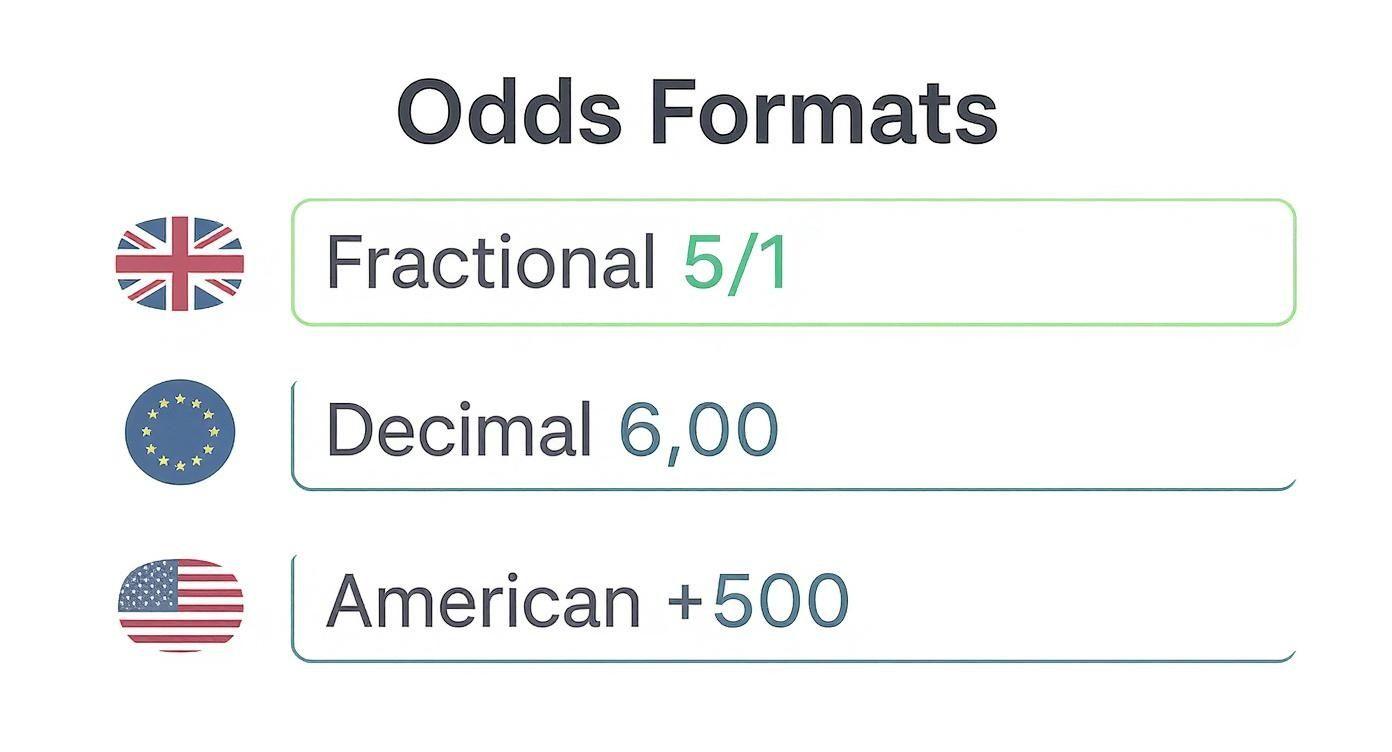
The main thing to remember is that no matter how they look, they all point to the same payout.
The Power of Implied Probability
Calculating payouts is just arithmetic. The real game-changer for any serious bettor is understanding implied probability. This is the percentage chance of winning that the bookmaker's odds are suggesting.
Every set of odds can be reverse-engineered into a percentage. This skill is the absolute foundation for spotting good value. It lets you compare the bookie's opinion (the odds) with your own handicapping.
Key Insight: Implied probability is not the true probability of a horse winning. It's the probability suggested by the odds after the bookmaker has baked in their profit margin. Your job is to find horses where you believe the true probability of winning is higher than what the odds imply.
Let's see how to quickly convert odds into a percentage. The formulas are simple, but the insight they provide is huge.
Converting Odds to a Percentage
Going beyond the payout and into the probability is what separates the pros from the rest. It helps you quantify risk and make much smarter, more analytical decisions.
Here are the formulas you need to commit to memory:
For Fractional Odds (e.g., 4/1):
- Formula:
Denominator / (Numerator + Denominator) - Example: 1 / (4 + 1) = 1/5 = 20%
- Formula:
For Decimal Odds (e.g., 5.00):
- Formula:
1 / Decimal Odds - Example: 1 / 5.00 = 0.20 = 20%
- Formula:
For American Odds (e.g., +400):
- Formula:
100 / (Odds + 100) - Example: 100 / (400 + 100) = 100 / 500 = 20%
- Formula:
Notice that 4/1, 5.00, and +400 all translate to the same 20% implied probability. This percentage is your new baseline. If you've done your homework and believe that 4/1 horse actually has a 25% chance to win, you've just found what's known as a "value bet."
This is the core principle that separates strategic wagering from pure guesswork. For a deeper look at the mechanics, you can learn more about how to convert odds to probability and build it into your betting process.
This single skill moves you from being a passive bettor to an active analyst, hunting for those valuable gaps between the odds on offer and a horse's real potential.
To make this even easier, here's a handy chart that lays out some of the most common odds conversions you'll come across.
Odds Conversion and Implied Probability Chart
| Fractional Odds | Decimal Odds | American Odds | Implied Probability |
|---|---|---|---|
| 1/5 | 1.20 | -500 | 83.3% |
| 1/2 | 1.50 | -200 | 66.7% |
| 4/5 | 1.80 | -125 | 55.6% |
| 1/1 (Evens) | 2.00 | +100 | 50.0% |
| 6/4 | 2.50 | +150 | 40.0% |
| 2/1 | 3.00 | +200 | 33.3% |
| 5/2 | 3.50 | +250 | 28.6% |
| 4/1 | 5.00 | +400 | 20.0% |
| 9/1 | 10.00 | +900 | 10.0% |
| 20/1 | 21.00 | +2000 | 4.8% |
Keep this table in mind or bookmark this page. Being able to quickly translate odds into a probability percentage is a skill that will serve you well on every single bet you place.
Diving Into Advanced Betting Concepts
Once you've got the hang of calculating payouts on a basic win bet, you're ready to peel back the curtain and see where the real action in horse racing lives. We're moving beyond picking a single horse to win and diving into a world of complex wagers, constantly shifting odds, and the unique system that makes it all tick. This is where you can really start to make some sophisticated plays.
The concepts we're about to cover are the foundation for understanding why the numbers on that tote board are always in flux. More importantly, they're your key to placing bets that can offer much larger payouts-though they come with higher risk, of course.
Exploring Exotic Wagers
A simple "win" bet is exactly what it sounds like: you pick one horse, and if it finishes first, you cash your ticket. It's straightforward. But the real buzz-and the potential for those life-changing payouts-often comes from exotic wagers.
These are bets that require you to predict the finishing order of multiple horses, either in one race or across a series of them. Because you have to be so much more precise, the odds are naturally much higher. It's one thing to pick a winner; it's another thing entirely to nail the top three horses in the exact order.
Some of the most popular exotic bets you'll see are:
- Exacta: You pick the first and second-place horses in the correct order.
- Trifecta: You pick the first, second, and third-place horses in the correct order.
- Superfecta: You pick the first four horses in the correct order. Get one of these right, and the payouts can be massive.
The rise of exotic betting has completely changed how horse racing odds work. Wagers like the Pick 6, where you have to pick the winners of six straight races, are so difficult that a single winning ticket is rare. This leads to jackpot-level payouts that can roll over for weeks. The complexity forces oddsmakers to account for countless combinations, moving way beyond simple win probabilities. You can dig into more of the fascinating impact on horse racing history on SportsBettingDime.com.
The Parimutuel Betting System Explained
Here’s the biggest difference between betting on horses and betting on a football game. Unlike sports betting where you're up against a bookmaker, horse racing in the United States runs on a parimutuel system.
What does that mean? In simple terms, you're betting against everyone else. All the money wagered on a specific bet type-like a "win" bet-goes into one giant pool. The track takes its cut (known as the "takeout"), and the rest of the money is divided up among all the people holding a winning ticket.
Grasping this is crucial because it’s the reason the odds are never fixed.
The odds you see flashing on the tote board aren't set by an oddsmaker; they are a direct reflection of how much money is being bet on each horse compared to the total pool. They are constantly changing right up until the horses leave the starting gate.
This system creates a living, breathing market where the collective opinion of the betting public sets the final price. A sudden surge of money on one horse will cause its odds to drop, while the odds on every other horse in the race will rise to compensate.
Morning Line vs. Live Tote Board Odds
When you first open a race program, you'll see the Morning Line (M/L) odds. It’s critical to understand that these are not the official odds. They are simply a prediction.
A track handicapper creates the morning line to give bettors an early idea of how they think the public will bet the race. Think of it as an educated guess at what the final odds will look like when the gates finally spring open.
The real odds are the ones you see on the live tote board. These are the parimutuel odds, actively changing as money flows into the betting pools. The morning line is a useful starting point, but you should always base your final decisions on the live odds.
A big difference between the morning line and the live odds can be a powerful signal. For example, a horse with M/L odds of 10/1 that is being bet all the way down to 3/1 is getting a ton of attention from sharp bettors. That's a horse you need to take a second look at.
How to Find True Value in Betting Odds
This is where you graduate from simply reading odds to actually interpreting them like a pro. The real skill in horse betting isn't about the impossible task of picking every winner. It’s about consistently finding value bets.
A value bet is simple in theory: it’s an opportunity where you believe a horse's real chance of winning is better than the probability the odds suggest.
Imagine a horse is on the board at 9/1. We know this implies a 10% chance of winning. But after you've done your homework, you believe its true chances are closer to 15%. That 5% gap between the bookie’s odds and your analysis? That’s pure value.
Spotting these opportunities is the single biggest thing that separates casual punters from bettors who grind out a consistent, long-term profit.
The Search for Overlays
Your mission, should you choose to accept it, is to find an overlay. This is the industry term for when a horse's odds are more generous than they should be, offering a payout that outweighs the actual risk. It’s the polar opposite of an underlay-an over-hyped horse (usually the favourite) whose odds are too short to offer a fair return on your money.
To find overlays, you have to develop your own opinion. You can't just follow the money and trust the odds on the screen. You have to become your own handicapper.
This means looking at angles the casual betting public might ignore:
- Recent Form: Look past the simple win/loss record. Did the horse face a much tougher class of competition in its last race? Was it struggling on a muddy track that won’t be an issue today?
- Jockey/Trainer Combos: Some jockeys just click with certain trainers, and their combined win rate can be a powerful, often overlooked, factor.
- Pace Scenarios: You have to visualize how the race will unfold. Is there a lone front-runner in a field of closers? That horse might just get an easy lead and steal the race at huge odds.
By doing your own assessment, you can confidently decide if a horse at 12/1 is a true longshot or a serious contender the market completely missed.
Avoiding the Underlay Trap
Just as critical as finding good value is knowing when to walk away from bad value. Underlays are everywhere, especially when a fan-favourite or "media darling" horse is running. The public piles money on, driving their odds so low that the potential reward no longer justifies the risk.
A horse at 6/5 (implying a 45.5% chance to win) might look like a sure thing on paper. But if your analysis says its real chances are closer to 35%, that’s a terrible bet-even if the horse goes on to win. Consistently betting on underlays is one of the fastest ways to drain your bankroll.
Spotting value is a two-way street. It's about recognizing when the market has underestimated a horse (an overlay) and when it has overestimated another (an underlay). True discipline means having the confidence to pass on a likely winner if the price isn't right.
Historical Odds and the "Dark Horse" Effect
History shows us time and time again that favourites are far from invincible, which is fantastic news for value seekers. A historical analysis of five major U.S. races going back to 1984 found that the average winning odds were over 9/1.
This simple statistic shows how often longshots come in and completely shatters the myth that you have to bet on the "chalk" to win. The sport is filled with legendary "dark horses," like Donerail's incredible +9100 upset in the 1913 Kentucky Derby. These moments are proof that understanding odds and historical patterns can help you cash in on undervalued horses.
The key is to stay objective. Don't let public hype or a short price fool you into thinking a horse is a better bet than it really is. One of the best signals for shifting market sentiment is tracking odds movements. For a deeper look, check out our guide on understanding the significance of dropping odds in betting. Spotting a sharp, late drop can often be a sign that smart money is coming in on a potential overlay.
Horse Betting Odds FAQs
Now that you've got the basics down, let's jump into some of the questions that always pop up at the track. Getting a handle on these will clear up the confusion and help you read the tote board like a seasoned pro.
Why Do Horse Racing Odds Fluctuate Before a Race?
If you've ever watched the odds on the tote board, you've seen them jumping around like crazy right up until post time. This happens because most horse racing uses a parimutuel betting system.
What does that mean? It means you aren't betting against the house or a bookie. You're betting against everyone else who has money on that race. The odds are a direct reflection of where the money is going.
When a flood of cash comes in on one horse, its odds drop. To keep the betting pool balanced, the odds on every other horse have to go up. The numbers you see aren't locked in until the very second the betting windows close.
What’s the Difference Between Morning Line and Final Odds?
Think of the Morning Line (M/L) odds as the track handicapper's best guess. It's an educated prediction of where the odds will likely end up, designed to give bettors a starting point before the real money starts flowing in. It's a forecast, nothing more.
The final odds are what actually matter. These are the live odds determined by the parimutuel pool, and they can be wildly different from the morning line. This is especially true if a horse gets a ton of late action or if a major contender gets scratched. Your payout is always based on these final, official odds.
A horse's odds dropping hard from the morning line-say, from 12/1 down to 5/1-is a massive tell. It’s often a signal that sharp, well-informed money is pouring in, making that horse one to watch very closely.
What Do "Odds-On" and "Evens" Mean in Racing?
You'll hear these terms thrown around by announcers all the time. They're actually pretty simple.
- Evens: This is just another way of saying 1/1 odds (or 2.00 in decimal). If your horse wins at evens, your profit is exactly the same as your stake. A $10 bet gets you back $20 total-your $10 stake plus $10 in profit.
- Odds-On: A horse is "odds-on" when it's a heavy favorite, with fractional odds less than evens (like 1/2 or 4/5). A winning bet on an odds-on horse will pay back a profit that's less than your original stake.
How Do Scratches Affect the Odds?
When a horse is scratched (meaning it's withdrawn from the race), any single-race bets you placed on that horse are fully refunded. That money is pulled right out of the betting pool.
Removing that money forces the odds on the remaining horses to adjust. Generally, the odds on the other runners will dip slightly because the total pool is now being split among fewer competitors. The effect is much more dramatic if the scratched horse was a favorite, since a much bigger chunk of money is being returned to bettors and redistributed across the field.
Ready to stop guessing and start finding real value? ValueBetFactory uses powerful algorithms to scan the odds and alert you to potential value betting opportunities in real-time. Turn your knowledge into a strategic advantage and make more informed decisions today. Explore our tools and sign up for a free trial at ValueBetFactory.