
Using an Odds Boost Calculator to Find Profitable Bets
Unlock Profits with betting tips!
An odds boost calculator is a tool that helps you figure out the real profitability of a sportsbook's promotional offer by calculating its Expected Value (EV). It lets you see past the flashy marketing and decide if a boosted bet is actually worth taking from a mathematical standpoint. This way, you can quickly tell the difference between a genuine value opportunity and a simple trap designed to get more action.
Decoding Sportsbook Promos with an Odds Boost Calculator

Sportsbooks are always pushing promotions like odds boosts and profit boosts. They’re designed to be eye-catching, promising bigger payouts on everything from a simple moneyline to a complex parlay. But here’s the thing: not all boosts are created equal. Many are just clever marketing ploys to get you to bet on markets that might otherwise not see much interest.
The real challenge for any bettor is telling a genuinely valuable opportunity apart from a dud. A sportsbook might boost the odds on a player to score the first touchdown from +800 to +1000. It looks great on the surface, but if that player's true probability of scoring first is incredibly low, even those boosted odds could still represent terrible value.
This is exactly where an odds boost calculator becomes one of the most important tools in your arsenal. It cuts through all the promotional hype and gives you a clear, mathematical verdict on a bet's potential long-term profitability.
Finding the Real Value in a Boost
Instead of just guessing or going with a gut feeling, a calculator uses a few key inputs to give you an objective assessment. It compares the boosted odds against the true or fair odds of an outcome. To pull this off, it first has to account for the sportsbook's built-in margin-you might know it as the vig or juice.
The process of finding these "fair" odds is the critical first step. For bettors who want to get a better handle on this, you can learn more about finding the true probability with a no vig calculator, which is really the foundation of the whole thing. Once you have those fair odds, the calculator can determine if the promotional odds offer positive Expected Value (+EV).
Key Takeaway: A positive EV bet is one that, if you could make it over and over again, would result in a net profit over time. The calculator’s main job is to sniff out these +EV opportunities hidden inside sportsbook promos.
This guide will walk you through exactly how to use this tool. But more importantly, it will break down the principles that make it work. By understanding concepts like Expected Value, you'll stop being a casual bettor and start thinking like a strategic one who can consistently spot and capitalize on profitable situations. The goal isn't just to use a calculator; it's to think like one.
Don't let the name fool you. An "odds boost calculator" sounds complex, but the engine running under the hood is actually pretty simple. There are no secret formulas or magic involved-just solid, established math that helps you figure out if a bet is actually profitable in the long run. Getting a handle on this foundation is the key to trusting what the calculator tells you and making bets with confidence.
The whole thing starts with a concept called implied probability. Every set of odds you see, whether it's +150 or -200, is just the sportsbook's way of stating the chances of something happening. An odds boost calculator simply translates those odds into straightforward percentages, cutting through the bookie's built-in profit margin to get closer to the "true" odds.
Uncovering Expected Value (EV)
Once the calculator knows the true probability of an outcome, it gets to work on the single most important number for any serious bettor: Expected Value (EV). In simple terms, EV tells you how much you stand to win or lose on a bet, on average, if you could place it over and over again.
A positive EV (+EV) means the bet is a long-term winner, even if you lose some of them along the way. A negative EV (-EV) is a mathematical guarantee that you'll lose money over time. The calculator's main job is to hunt down those +EV gems hidden inside promotional boosts.
Think of it like a coin flip. If someone offers you 2-to-1 odds (+200) on heads, you've got a +EV deal. You'll still lose 50% of the time, but the bigger payouts on your wins make it a smart bet to take repeatedly. The calculator just applies that same logic to sports.
How a Boost Flips a Bet's Value
This is where an odds boost calculator really shines-showing you exactly how a promotion can turn a bad bet into a great one. Sportsbooks use boosts to attract action, knowing that a flashy payout gets people clicking. The calculator lets you measure precisely how much value that boost is adding.
For example, a bookie might have a team at +150 odds, which implies they have about a 40% chance of winning. If your own homework (or the odds from a sharp bookmaker) suggests their real win probability is closer to 43%, that bet already has a tiny bit of positive EV. But when the sportsbook boosts those odds to +175, the whole picture changes. According to the experts at Medlock Partners, these promotions are designed to drive engagement, but a calculator helps you see if they offer real value.
That small jump in odds can almost double the EV, turning a borderline bet into a must-take opportunity. It’s this kind of precise calculation that separates strategic betting from just guessing.
The EV Formula in Action
To really see what the calculator is doing, it helps to look at the formula it uses. It might look a little academic at first, but the idea is simple.
EV = (Win Probability x Potential Profit) - (Loss Probability x Amount Staked)
Let's walk through a real-world scenario to make it concrete.
- The Bet: You want to bet $10 on the Kansas City Chiefs to win.
- Your Analysis: You believe their true win probability is 55%.
- Original Odds: The book offers them at -110. A $10 bet would win you $9.09 in profit.
- Boosted Odds: A promotion boosts the odds to +120. Now, a $10 bet wins you $12 in profit.
Let's plug these numbers into the formula to see what that boost actually did.
1. EV at Original Odds (-110)
- Win Probability: 0.55
- Potential Profit: $9.09
- Loss Probability: 0.45 (which is 1 - 0.55)
- Amount Staked: $10
- EV = (0.55 * $9.09) - (0.45 * $10) = $4.99 - $4.50 = +$0.49
At the original odds, this is a +EV bet. You'd expect to make an average profit of 49 cents for every $10 wagered over time. Not bad, but not amazing either.
2. EV at Boosted Odds (+120)
- Win Probability: 0.55
- Potential Profit: $12.00
- Loss Probability: 0.45
- Amount Staked: $10
- EV = (0.55 * $12.00) - (0.45 * $10) = $6.60 - $4.50 = +$2.10
The odds boost cranked the expected value from $0.49 all the way up to $2.10. Your expected return on investment (ROI) shot up from 4.9% to a massive 21%.
While you could grind out this math by hand, an Expected Value calculator does it all for you in a split second. This simple math is the engine that makes an odds boost calculator an essential tool for any bettor serious about finding real value.
How To Actually Use an Odds Boost Calculator
Alright, now that you get the math humming away under the hood, let's get our hands dirty. An odds boost calculator is a simple tool on the surface, but using it like a pro means knowing exactly what to feed it and-more importantly-how to read the results to make a sharp bet.
Think of it as a quick, three-part workflow: plug in the numbers, let the calculator do the heavy lifting, and then analyze the output to decide if you should pull the trigger.
Getting the Numbers Right: Your Inputs
Before you can figure out if a boost is any good, you need to give the calculator the right ammo. Most tools are pretty straightforward and just need three key pieces of info.
- Original Odds: This is your anchor, the baseline for what "fair" odds look like. The gold standard here is the no-vig line from a sharp bookmaker like Pinnacle, since their market is incredibly efficient. If you can't get that, the original, pre-boost odds from the sportsbook offering the promo are a decent second choice.
- Boosted Odds: This one's the easy part. It’s the shiny new price the sportsbook is dangling in front of you. If a bet was originally +200 and they've pumped it up to +250, that's the number you pop in here.
- Your Stake: This is just how much you're planning to bet. Tossing your stake into the mix helps the calculator frame the Expected Value in real money terms, which makes the whole concept feel a lot less abstract.
Once you’ve got these three numbers lined up, you’re ready to see if the bookie is offering you a gift or just a gimmick.
Pro Tip: Always, and I mean always, check the max stake on these boosts. Sportsbooks love to cap them at $25 or $50. Knowing this limit is crucial for managing your bankroll and calculating your actual potential profit.
The whole process is pretty simple. The calculator takes the odds, figures out the implied probability, and then measures the boosted offer against that baseline to see if there’s any real value to be had.
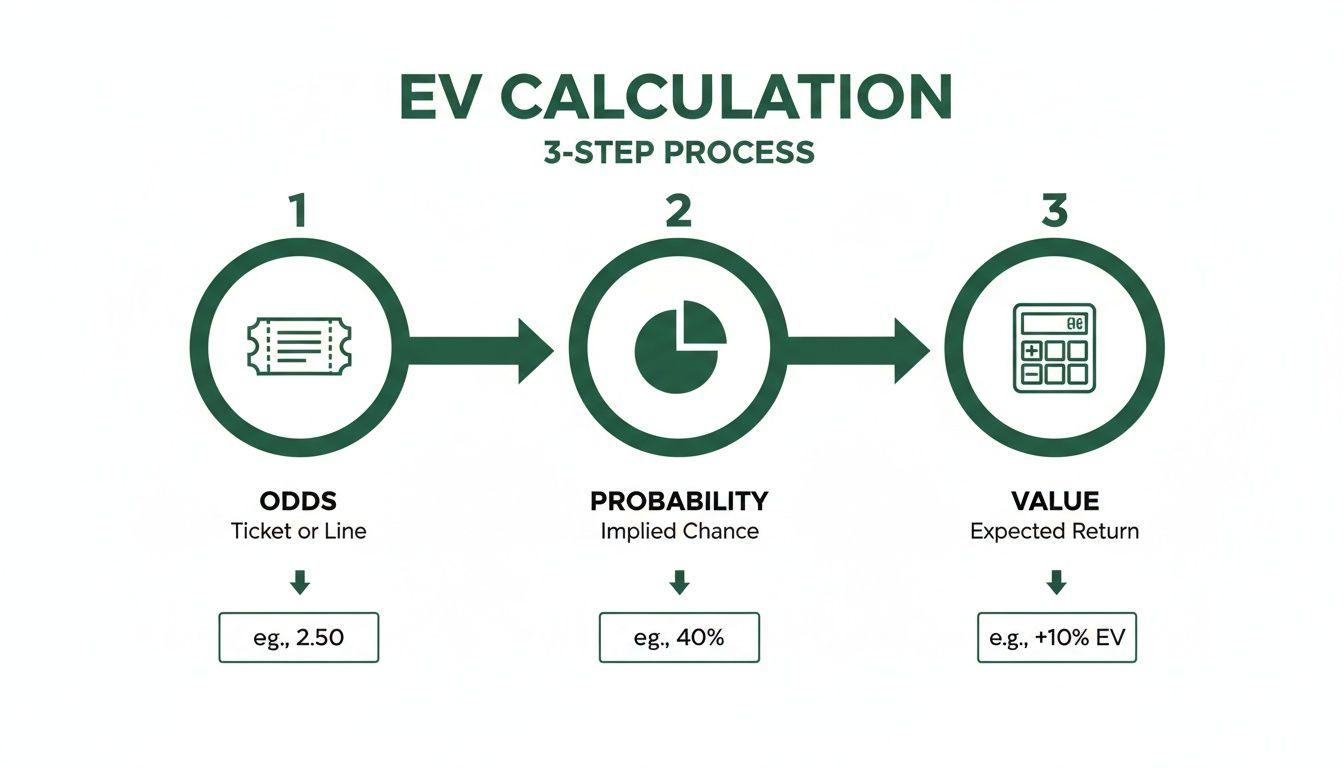
This quick diagram shows how the calculator turns raw odds into a clear, actionable Expected Value figure. It's all about comparing the promotional price to the true probability of the event.
What the Calculator Needs (And What It Gives You)
To make this crystal clear, here’s a breakdown of the inputs you'll provide and the outputs the calculator will spit back at you. Think of it as a simple "garbage in, garbage out" system-good data is key.
| Calculator Field | What It Is | How to Use It |
|---|---|---|
| Original Odds | The "fair" market price before the boost is applied. | Find the no-vig line from a sharp book, or use the pre-boost odds from the sportsbook offering the promo. |
| Boosted Odds | The promotional odds you're being offered. | This is the headline number of the promotion. Just type it in as you see it. |
| Stake | The amount of money you plan to wager on this bet. | Enter the amount you're comfortable risking, up to the sportsbook's max limit for the boost. |
| Expected Value (EV) | The average profit you can expect to make over the long term. | This is your go/no-go signal. If this number is positive, the bet is a good long-term play. |
| Expected ROI | Your EV expressed as a percentage of your stake. | This helps you quickly compare the value of different boosts. A higher ROI means a better return. |
Understanding these five fields is pretty much all you need to master any odds boost calculator out there. They turn a tempting offer into a simple mathematical decision.
A Real-World Walkthrough: Player Prop Boost
Let's run through a classic example. Say a sportsbook is pushing an NBA player prop boost for tonight's Lakers vs. Celtics game.
The Offer: LeBron James to score over 25.5 points, boosted from -110 to +130. You decide you're willing to put $20 on it.
Here’s how you’d punch that into an odds boost calculator:
- Original Odds: You'd enter -110. The calculator immediately converts this into a baseline implied probability of 52.38%.
- Boosted Odds: Next, you enter +130. This is the promotional price you're getting.
- Your Stake: Finally, you pop in $20.
The moment you enter that last number, the calculator does its magic.
Reading the Results: Is This Bet Worth It?
This is the moment of truth. Entering the numbers is easy, but understanding the output is what separates sharp bettors from the rest. The calculator will give you two critical numbers.
- Expected Value (EV): This is the bottom line. For our LeBron example, the EV would be around +$4.15. This means that if you could make this exact bet a thousand times, you'd come out ahead an average of $4.15 for every $20 you staked.
- Expected ROI (Return on Investment): This puts your EV into percentage terms. Here, the expected ROI is a juicy 20.77% ($4.15 profit / $20 stake). An ROI like that is a massive green flag.
The decision rule couldn't be simpler: if the Expected Value is positive, the bet is mathematically profitable over time. If that EV number is negative, you walk away, no matter how good the boosted odds look on paper. An odds boost calculator strips away the emotion and the hype, giving you a clean, data-driven "yes" or "no."
Advanced Strategies for Profit Boosts and Parlays

Once you get comfortable spotting value in a simple odds boost, you can start digging into the more powerful stuff. Sportsbooks get creative with their promotions, and knowing how to handle each type opens up a whole new world of profitable opportunities. Mastering these next few strategies is what separates the casual bettor from someone who can systematically profit from almost any offer a bookie throws their way.
A really common one is the profit boost. This is different from an odds boost. Instead of changing the price of the bet itself, a profit boost is just a percentage bonus tacked onto your winnings. For example, a 25% profit boost on a winning +200 bet doesn't change the odds you bet at; it just pays you out as if the odds were +250. More cash in your pocket without any extra risk.
The good news? Your odds boost calculator can still handle these. All you have to do is figure out the "effective odds" with the boost applied and plug that new number into the calculator. It's a simple conversion that lets you use the same EV principles across a much wider range of promos.
Locking in Guaranteed Profit
This is where things get really interesting. One of the sharpest tactics out there is using these promotions to create an arbitrage or hedge situation. The idea is to bet on every possible outcome of a game across different sportsbooks, guaranteeing you make money no matter who wins. A boost on one side of a game can create a temporary pricing mistake in the market that you can pounce on.
Let's say FanDuel offers a boost on the Lakers to win at +150. At the same time, you see DraftKings has the Celtics at -130. An odds boost calculator can instantly tell you if that gap is wide enough to bet both sides and lock in a small, completely risk-free profit.
Key Insight: This strategy, known as arbitrage betting, is all about exploiting price discrepancies. Boosts act as a catalyst, creating temporary and highly profitable imbalances that a sharp bettor can leverage for guaranteed returns.
Tools like profit and odds boost calculators are becoming essential for anyone serious about squeezing every last drop of value from these offers. A dedicated profit boost calculator will even tell you the exact amount to stake on each side to perfectly balance the bets for a guaranteed return.
Decoding Boosted Parlays
Bookies love to dangle boosted parlays in front of us. The massive potential payouts are hard to ignore. But let's be honest, they're a nightmare to evaluate properly. A three-team parlay might get juiced from +500 to +650, but is that actually a good bet?
The only way to know for sure is to break it down, leg by leg. You have to find the "fair" or no-vig odds for each individual outcome in the parlay. Once you have those, you can calculate the parlay's true probability by multiplying the individual probabilities together.
- Leg 1: True probability of 50%
- Leg 2: True probability of 30%
- Leg 3: True probability of 70%
Let's do the math: 0.50 * 0.30 * 0.70 = 0.105, which is a 10.5% true probability. This translates to fair odds of around +852. So, even with the bookie's generous boost to +650, it's still a massively negative EV bet. For anyone wanting to really get into the weeds on these complex wagers, our guide explains how a parlay calculator works to uncover their true value.
Sizing Bets with Bankroll Management
Finding a +EV bet is only half the job. How much you wager on it is just as important. Solid bankroll management is what keeps you in the game long enough to see your mathematical edge pay off, smoothing out the inevitable ups and downs of betting.
A proven method is the Kelly Criterion, a formula that calculates the optimal stake size based on your perceived edge. While the full formula can be a bit much, a simplified version is to simply risk a small, consistent percentage of your bankroll-say, 1-3%-on every +EV bet you find.
The higher the EV, the more you might lean towards the top of that range, but you never go beyond your set limits. This disciplined approach is how you maximize growth while protecting yourself from the risk of ruin.
Common Mistakes Bettors Make with Odds Boosts
Having a powerful odds boost calculator is one thing, but actually profiting from it means steering clear of the subtle mental traps that catch even seasoned bettors. The tool gives you the math, but your discipline is what ultimately determines your success.
Many bettors stumble not because the calculator is wrong, but because their whole approach is flawed. This can turn a potential edge into a guaranteed loss pretty quickly.
Assuming Every Boost Is a Gift
One of the most frequent errors is the simple assumption that every boost is a gift from the sportsbook. Sportsbooks are masters of marketing; they know how to dress up an average bet in flashy promotional packaging.
A boost from +200 to +250 feels like a huge jump, but if the bet's true odds are closer to +300, you're still taking a bad deal. Never place a bet just because it's boosted. The promotion itself is not an indicator of value. The only thing that matters is the final price compared to the true probability of the outcome.
Using Unreliable Fair Odds
The most critical mistake you can make is feeding your calculator bad information. The entire Expected Value calculation hinges on having an accurate baseline for the "fair" odds. If your starting point is garbage, every number the calculator spits out will be misleading.
A lot of bettors make the mistake of using the pre-boost odds from the same sportsbook as their fair line. While it's convenient, this is a huge problem because that line already has the book's vig baked in. A much sharper approach is to use the no-vig odds from an efficient market, like those found at a professional-grade sportsbook like Pinnacle.
Crucial Takeaway: Your EV calculation is only as good as the fair odds you use. Garbage in, garbage out. Using a flawed baseline will trick you into thinking you have an edge when you're actually making a negative EV bet.
This small change in process makes a world of difference. It shifts you from evaluating a promotion in a vacuum to measuring it against the sharpest opinion in the entire betting market.
Ignoring Bankroll Management Principles
Finding a bet with a massive +20% EV is genuinely exciting. The temptation to bet big and cash in on such a golden opportunity is strong. However, this is precisely where so many bettors go wrong, abandoning disciplined bankroll management in a moment of greed.
A single positive EV bet is still just one wager. Variance is a real and powerful force in sports betting; even a bet with a fantastic edge can, and will, lose. Over-staking on one opportunity, no matter how good it looks on paper, exposes your entire bankroll to unnecessary risk.
To sidestep this pitfall, stick to a structured staking plan:
- Set a Unit Size: Define one "unit" as a small percentage of your total bankroll, usually 1%.
- Bet to Your Edge: You might risk 1 unit on a standard +EV play, but maybe bump it to 1.5 or 2 units on an exceptional one with very high EV.
- Never Exceed Your Limits: Never risk more than 3-4% of your bankroll on a single wager, no matter how confident you feel.
This disciplined strategy ensures you can withstand a losing streak without wiping out your capital. It keeps you in the game long enough for your mathematical edge to finally materialize into real profit. An odds boost calculator identifies the opportunities, but your bankroll strategy is what turns those opportunities into sustainable growth.
A Few Final Questions
Even once you've got a handle on the math, a few practical questions always pop up when you start using an odds boost calculator in the real world. Let's clear up some of the most common ones so you can jump in with confidence.
Getting these details right will help you lock in the core concepts and troubleshoot anything that feels off along the way.
How Do I Find Reliable "Fair" Odds?
This is the million-dollar question, and honestly, it's the most critical part of the entire process. Your whole calculation is only as good as the "fair" odds you use as a baseline.
The best place to find these is a sharp sportsbook. Think of bookmakers like Pinnacle, which are known for razor-thin margins and efficient markets. They welcome professional action, so their lines are considered the most accurate reflection of an event's true probability.
Your process should be to find their line, use a no-vig calculator to strip out the juice, and plug that result into your odds boost calculator. This gives you a far more accurate EV reading than if you just used the pre-boost odds from the same bookie offering the promo.
Can I Use an Odds Boost Calculator for Any Sport?
Absolutely. The math doesn't care if it's a field goal, a corner kick, or a three-pointer. The principles behind the calculator are universal and work for any sport or betting market you can think of.
Whether you're looking at an NFL touchdown scorer, an NBA player prop, or a Premier League match, the steps are always identical:
- Find the original "fair" odds from a sharp market.
- Plug in the boosted odds being offered.
- Enter your intended stake.
As long as you can find a reliable baseline for the true odds, the calculator will do its job perfectly.
What's a Good Positive EV to Look For?
There's no single magic number here. Technically, any bet with a positive EV is a good bet in the long run. But let's be realistic-not all +EV bets are created equal. An EV of +0.5% is profitable on paper, but it might not be worth your time or locking up your capital.
Most serious bettors hunt for opportunities with an Expected ROI of at least 3-5%. That's where you start to see a meaningful return. When you stumble upon boosts offering 10% or more, you've found a golden opportunity that you should absolutely prioritize, as long as it fits within your bankroll rules.
The higher the positive EV, the bigger your mathematical edge over the sportsbook. Consistently finding and betting on these high-value promotions is the fastest way to grow your bankroll.
Is It Possible to Lose Money on a +EV Bet?
Yes, and it's absolutely critical to understand this. Expected Value is a long-term average, not a crystal ball for a single game.
A bet with a massive +20% EV doesn't guarantee a win. It simply means that if you could place that exact same bet an infinite number of times, you would average a 20% profit per wager.
In the short term, variance is king. You could place ten straight +EV bets and lose every single one of them. This is precisely why disciplined bankroll management is non-negotiable. It acts as your shield, protecting you from the natural downswings and keeping you in the game long enough for your mathematical edge to pay off. Never, ever confuse a positive expectation with a guaranteed win.
Ready to stop guessing and start making data-driven betting decisions? The tools at ValueBetFactory are designed to help you spot these profitable opportunities instantly. Our platform provides real-time alerts and calculators to give you the edge. Join ValueBetFactory today and start betting smarter.