
A Winning Playbook for NHL Player Prop Bets
Unlock Profits with betting tips!
If you’ve ever looked at the odds for an NHL game, you’ve seen the standard bets: who will win, and by how much. But there’s a much more interesting, data-driven world hiding just beneath the surface: NHL player prop bets.
These bets let you wager on a specific player's performance things like goals, assists, points, or even just shots on goal. It's a completely different way to approach the game, shifting the focus from the chaotic outcome of a 60-minute contest to the isolated performance of a single athlete.
Your Blueprint For Profitable NHL Prop Betting
Welcome to the playbook. This isn't about getting lucky or just picking your favorite players. This is a systematic guide to finding real, mathematical value where the sportsbooks often leave gaps in their lines. We're going to dive deep into the player prop markets, turning raw data into clear, actionable betting decisions.
The whole idea is to hunt down betting lines that don't quite line up with a player's true potential in a specific matchup. Sportsbooks set their odds using season averages, recent hot streaks, and general team strength. But they can and often do miss the little details that create profitable spots for bettors who know what to look for.
Why Player Props Offer a Unique Edge
Unlike a moneyline bet that depends on all 18 skaters and two goalies, NHL player prop bets let you zoom in on just one guy. This massively simplifies your analysis. Instead of trying to predict the outcome of a chaotic, unpredictable game, you're forecasting a much more contained and predictable set of events.
This focus allows you to become a specialist and find an edge in specific markets:
- Shots on Goal (SOG): A high-volume shooter going up against a team that bleeds shot attempts is a classic value spot you can find almost every night.
- Player Points/Assists: Targeting a power-play specialist on a top line against a team with a weak penalty kill is often a recipe for success.
- Blocked Shots: A stay-at-home defenseman playing a team that loves to fire pucks from the blue line presents a very reliable betting opportunity.
The secret to making money long-term isn't just about picking winners. It's about consistently finding bets where the odds are better than the true probability of it happening. This is called finding positive expected value (+EV), and it's the foundation of everything we do.
Setting the Stage for Success
This guide will give you a rock-solid foundation for analyzing player performance, spotting juicy matchups, and reading the market like a pro. You'll learn the exact principles that data-driven bettors use to build a sustainable advantage over the house.
Our journey starts by breaking down the key factors to look for before you even think about placing a bet. We’re going to build a repeatable framework that takes you from guessing to making educated, data-backed decisions. This is your roadmap for the more advanced strategies we'll cover later.
Before we dive in, this table summarizes the key data points we'll be looking at. Think of it as your pre-flight checklist for every potential prop bet.
Key Factors for Evaluating NHL Player Props
| Factor | What to Look For | Why It Matters |
|---|---|---|
| Player Usage & Role | Ice time (TOI), power play time (PPTOI), line placement (1st, 2nd, etc.). | More ice time, especially on the top power play unit, directly translates to more opportunities to score, assist, or shoot. |
| Recent Performance | Shots, points, and attempts over the last 5-10 games, not just season averages. | Is the player hot or cold? Recent form is a much better predictor of tonight's performance than stats from three months ago. |
| Opponent Matchup | Team defensive stats (shots allowed, goals against, penalty kill %). | A great player facing a terrible defensive team is a prime target. The matchup can create or eliminate value. |
| Game Script | Is the team a heavy favorite or an underdog? Expected pace of play. | A team expected to trail will likely pull their goalie, giving opponents empty-net chances. Favorites tend to control the puck more. |
| Line Movement | Are the odds moving? Is the line for shots on goal moving from 2.5 to 3.5? | Market movement, especially from sharp sportsbooks, is a massive signal that the initial line may have been wrong. |
This framework is your starting point. Mastering these five pillars will give you a massive leg up on the average bettor. Let's get started.
Decoding the Data and Finding Real Value
Finding an edge in NHL player props isn't about gazing into a crystal ball. It’s about decoding the present looking past the basic box score to find the real signals that tell you what's actually happening on the ice. And the most important signal of all is simple: opportunity.
In hockey, opportunity is measured in minutes. A player can't score a goal, get an assist, or even take a shot from the bench. This is why metrics like Time on Ice (TOI) and, even more critically, Power Play Time on Ice (PPTOI) are the absolute bedrock of any solid prop analysis. When a player sees a sudden spike in his TOI, especially if he gets bumped up to that top power-play unit, he’s a prime candidate for a breakout game before the sportsbooks have a chance to adjust their lines.
Think of it this way. A player might have zero points in his last couple of games, making his points prop look like a hard pass. But what if you dig a little deeper and see his TOI jumped from 15 minutes to 20 minutes a night, and he's now quarterbacking the first power-play unit? The underlying opportunity has exploded. That’s where you find value before the rest of the market catches on.
Going Beyond Basic Stats
Raw ice time is a great start, but it's just the beginning. To get the full picture, we need to dive into shot-based metrics. Corsi, which is just a fancy term for all shot attempts (on goal, missed, or blocked), is a fantastic gauge of offensive pressure. If a player has a high Corsi For percentage (CF%), it means his team controls the puck and generates more shot attempts than they give up whenever he's on the ice.
This translates directly into more chances to cash props like shots on goal (SOG) or points. If a guy is firing a high volume of attempts but has been snakebitten with a low shooting percentage lately, he’s likely due for some positive regression. The pucks will start finding the back of the net eventually, and you want to be on his props before they do.
Pro Tip: Don't just look at a player's final SOG number. Dig into his individual shot attempts (iSOG) from the last few games. A player who registered 8 shot attempts but only 2 SOG is still getting his chances, even if they aren't all hitting the target. That kind of volume is a huge positive signal.
Analyzing Matchups and Game Scripts
Once you've got a handle on a player's individual usage, the next layer is putting it into the context of that night's game. A high-volume shooter is always on the radar, but a high-volume shooter facing a team that bleeds shots like a sieve? That's a golden opportunity.
You have to start thinking in terms of specific scenarios:
- A Top-Line Center vs. a Weak Defensive Team: If you know a team struggles in their own zone and gives up a ton of high-danger scoring chances, the points props for the other team's top-line players suddenly become a lot more appealing.
- A Power-Play Specialist vs. a Poor Penalty Kill: Any team with a penalty kill clicking at less than 75% is a team you want to target. The players quarterbacking the opposing power play are going to get extended zone time and plenty of looks to rack up points and assists.
- A Volume Shooter vs. a "Funnel" Defense: Some defensive schemes are designed to block everything from the point but give up a shooting gallery from the slot and wings. Figuring out which positions a team is most vulnerable to can give you a massive edge on a specific player's SOG prop.
This is the kind of detailed thinking that separates recreational bettors from sharps. It’s a core component of making calculated, informed wagers. You can learn more about applying these concepts in our comprehensive guide on sports betting analytics.
Beyond the head-to-head matchup, you also want to consider broader league trends. For instance, historical data often shows that home underdogs cover the spread at a surprisingly high rate sometimes as high as 72.7%. A game script where an underdog is expected to keep it close means their key players will be pushing the pace, creating more opportunities to hit their 'over' props. You can explore more of these NHL season trends to see how they apply.
By blending player-specific data with sharp matchup analysis, you start to build a powerful lens for spotting true value in NHL player prop bets.
Building Your Daily Prop Betting Workflow
Winning at NHL player prop bets isn't about hitting one lucky score; it's the result of a consistent, repeatable process you can run every single day. Just like a professional athlete has a pre-game routine, a sharp bettor needs a structured workflow. This framework is what helps you cut through the noise, spot real value, and make disciplined decisions night after night.
A solid routine turns the chaotic process of scanning dozens of games and hundreds of players into a methodical hunt for an edge. It ensures you're not just throwing darts but are systematically screening for the specific conditions that create a profitable opportunity. Without a workflow, it's way too easy to get overwhelmed, miss a great line, or make an emotional bet you'll regret later.
Honestly, this structured approach is what separates amateurs from people who treat sports betting as a serious investment. It's about building a process that is both efficient and effective.
Creating Your Daily Shortlist
Your day should start with a high-level scan of the entire NHL slate. The goal here isn't to analyze every single prop available that would be impossible. Instead, you're building a shortlist of games and players that deserve a closer look.
This initial screening process acts as a filter. You start by flagging games with specific characteristics that are known to create a ton of prop betting opportunities, narrowing your focus to only the most promising situations.
Here’s what I look for in my initial scan:
- Lopsided Matchups: I immediately identify games with heavy favorites. These often create predictable game scripts where the top lines of the favored team will see heavy offensive zone time, giving a nice boost to their shot and point props.
- Weak Defenses: Pinpoint teams in the bottom quartile for goals against, shots allowed per game, or penalty kill percentage. Any player facing one of these leaky teams automatically gets a closer look.
- High-Volume Shooters: I keep a running list of players who are consistently firing 5+ shot attempts per game, even if they miss the net. These guys are prime candidates for shots on goal (SOG) props, especially when they're up against a porous defense.
- Power Play Opportunities: Flag any teams with a struggling penalty kill unit (anything below 80%). The opposing team's top power-play unit immediately becomes a primary target for me to analyze for point and assist props.
This initial screen shouldn't take you more than 15-20 minutes. When you're done, you'll have a manageable list of players and matchups to dig into more deeply.
Scanning for Value Across Sportsbooks
With your shortlist in hand, it's time to hunt for the best available price. Not all sportsbooks offer the same odds on the same prop. Finding a player's SOG prop at -110 on one book when it's -135 everywhere else is an instant boost to your long-term profit.
This process, known as line shopping, is completely non-negotiable for serious bettors. Manually checking every single book is a massive pain, which is why using tools to scan for these differences is so important. These tools aggregate odds from multiple sources, letting you quickly spot outliers and ensure you're always getting the best number.
A disciplined workflow is your best defense against variance. It keeps you focused on the process of finding positive expected value (+EV) bets, which is the only way to guarantee profitability over the long haul, regardless of short-term wins or losses.
The flowchart below breaks down this simple three-step process: filtering for player usage and matchups to finally identify true value.
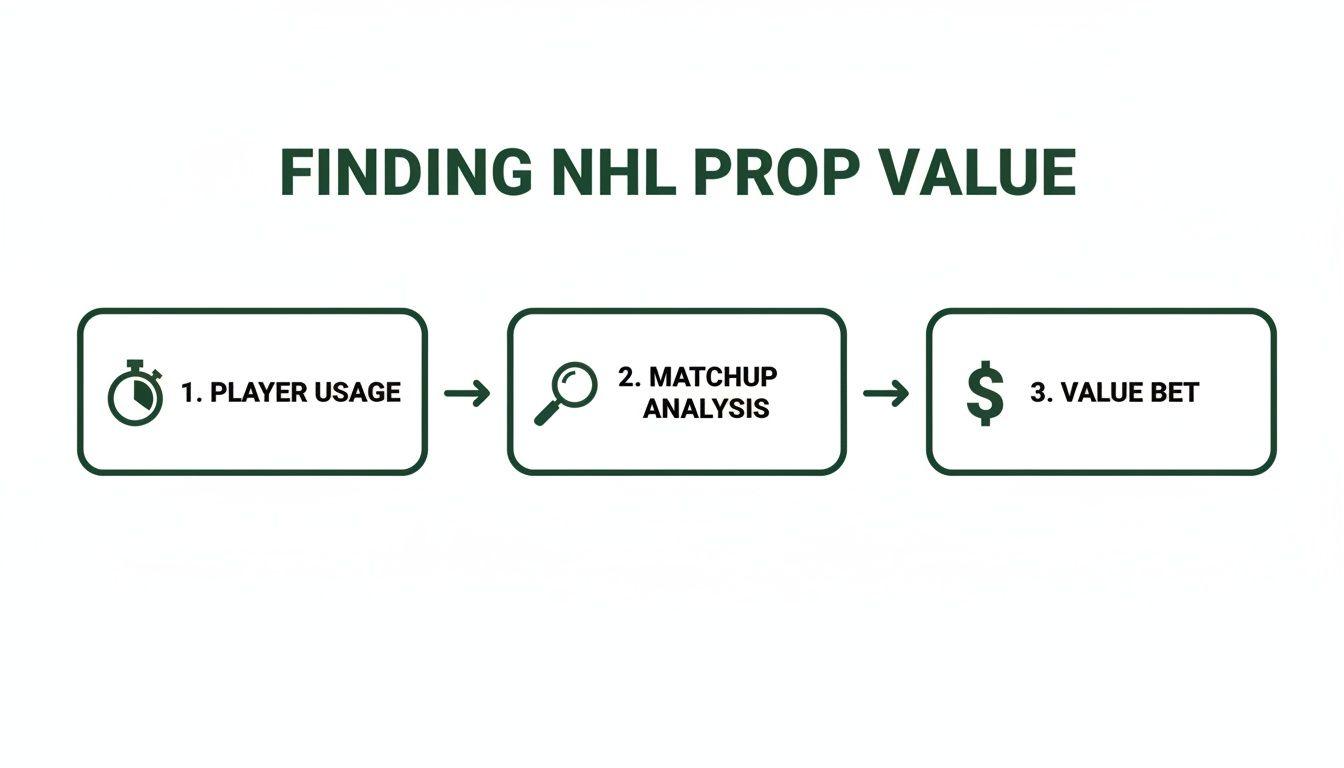
This visual guide reinforces the core of any profitable workflow. You move from broad usage data to specific matchup analysis before you even think about placing a bet.
Leveraging Real-Time Alerts and Calculators
The final piece of an efficient workflow is being able to act fast when opportunities pop up. Lines can move in the blink of an eye, especially in player prop markets. A valuable number might only be available for a few minutes before the market corrects it.
This is where real-time alerts become indispensable. Platforms like ValueBetFactory can send notifications straight to you the moment a prop meets your pre-set criteria or when a significant line discrepancy appears. For example, you could set an alert for a specific player's SOG prop if it ever becomes available at odds better than -120.
Once an alert flags a potential bet, a betting calculator is your best friend. By plugging in the sportsbook’s odds and your own estimated win probability, you can instantly see if the wager has positive expected value (+EV). This final check removes all emotion and guesswork from the decision, ensuring every single bet you place is backed by math. This systematic approach is the cornerstone of finding sustainable success in NHL player prop bets.
Finding value in NHL player prop bets is a fantastic skill, but honestly, it's only half the battle. The single biggest thing that separates winning bettors from everyone else is disciplined bankroll management. Without a rock-solid plan for your money, even the sharpest analysis will eventually lead you straight to ruin.
Think of your bankroll as your business's capital. Your number one job is to protect it. That means setting aside an amount of money you're dedicated only to betting an amount you could afford to lose without it messing up your real life. This separation is what allows you to make logical, data-driven decisions instead of emotional ones.
This section lays out a concrete plan for protecting that capital and making it grow. It’s not the most glamorous part of betting, but trust me, it’s the true mark of a pro.
Establishing Your Betting Unit
The foundation of any smart betting strategy is the concept of a "unit." A unit is just a fixed percentage of your total bankroll, usually somewhere between 1% and 3%. So, if you're working with a $1,000 bankroll, one unit is a simple $10.
This simple system does one crucial thing: it standardizes your bet size and takes emotion completely out of the picture. Doesn't matter if you're on a ten-bet heater or a frustrating losing skid your wager stays a consistent one unit. This is what's known as a flat-betting approach.
A flat-betting system is your best defense against the wild swings of sports betting. It stops you from chasing losses with bigger bets and keeps you from getting cocky during a hot streak. Discipline is your most valuable asset.
This approach ensures that a few bad beats won’t completely wipe you out. Over the long haul, it lets your edge in finding value do its thing, slowly but surely growing your capital. It’s the slow and steady path that actually pays off.
Sizing Your Bets Based on Confidence
While flat-betting is the gold standard, especially when you're starting out, more experienced bettors sometimes tweak their stake based on how big they think their edge is. This doesn't mean randomly dropping five units on a bet because you have a "good feeling." It means having a structured, tiered system.
You might set up something like this:
- 1 Unit: Your standard, everyday bet. You've found a solid edge, and it meets all your criteria.
- 1.5 Units: A stronger play where multiple factors align perfectly. Maybe a high-volume shooter is facing a team that bleeds shots and is on the second night of a back-to-back.
- 2 Units: Reserved for those rare, max-confidence spots. The data, the matchup, and the line value are all exceptional.
It's critical to never risk more than a small fraction of your bankroll on any single play. Even a bet where you feel you have a 10% edge can still lose. A structured approach to sports betting bankroll management is the only way to survive the swings.
Advanced Staking: The Kelly Criterion
For bettors who want to get more mathematical with their staking, the Kelly Criterion is a well-known formula. It calculates the optimal bet size to maximize long-term bankroll growth, based on both the odds and your estimated probability of winning.
The formula is: (BP - Q) / B
- B = The decimal odds - 1
- P = Your probability of winning
- Q = Your probability of losing (which is just 1 - P)
While powerful in theory, the Kelly Criterion can be tricky for NHL player props. It demands a very precise estimate of your true win probability, which is tough to nail down perfectly. If you overestimate your edge, it can lead to dangerously aggressive bet sizing. Because of this, many sharps use a "fractional Kelly" approach, betting only a quarter or half of the recommended stake to dial back the volatility.
Handling Winning and Losing Streaks
The psychological side of betting is every bit as important as the analytical side. Both winning and losing streaks are going to happen, and how you handle them will define your success.
When you're in a losing streak, the temptation to "chase" your losses by betting bigger is immense. This is the single fastest way to go broke. You have to stick to your unit system and trust your process, knowing that variance is just part of the game.
On the flip side, a long winning streak can lead to overconfidence. You might start making looser bets or feel tempted to bump up your unit size too fast. Discipline is just as vital when you're winning. The goal is to stay level-headed, stick to your workflow, and keep making sound, data-backed decisions on every single wager.
Spotting Profitable Trends and Player Streaks
Some of the juiciest value in NHL player props comes from jumping on a player's hot streak before the rest of the world and the sportsbooks catch on. This is all about pattern recognition. You’re looking for guys who are consistently cashing their prop tickets and riding that wave of momentum.
It’s less about complex models and more about paying attention to what’s happening right now.
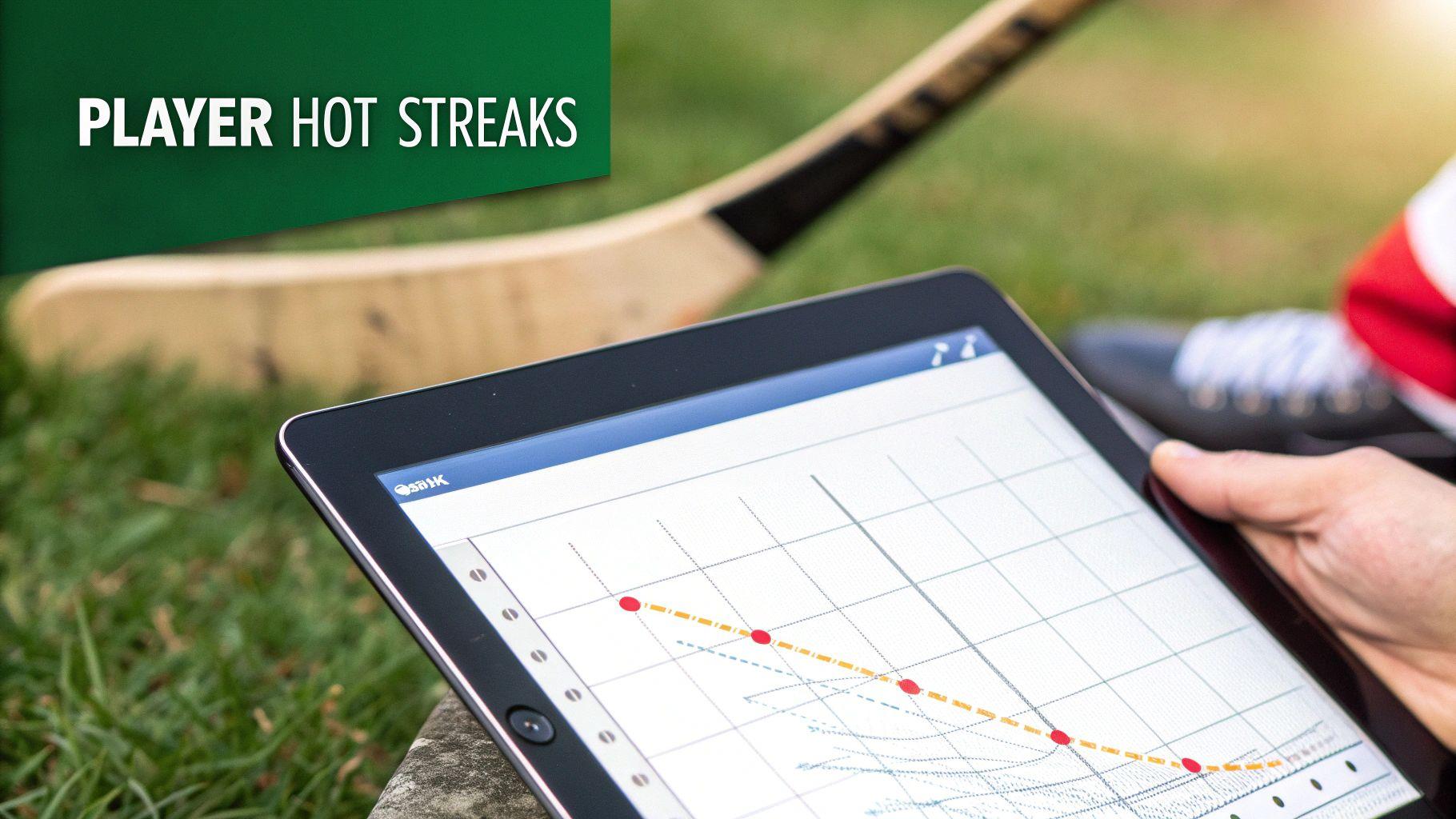
Your best friend here is a player’s game log from the last five to ten contests. Forget season-long averages for a moment; they can easily hide a recent surge in performance. The game log tells the real, current story.
High-volume shooters are often a goldmine. Their job is to get pucks on net, and their Shots on Goal (SOG) props can be a steady source of profit, especially when you dig into the alternate lines. An alternate line lets you bet on a lower, much safer threshold (like Over 1.5 SOG instead of Over 3.5 SOG) for reduced odds, which is a fantastic way to build smarter parlays.
Differentiating a Trend from a Fluke
This is the most important part. You have to separate a real, sustainable performance streak from a short-term fluke. A player might hit his points prop three games in a row, but if it was fueled by an absurdly high shooting percentage, that trend is a ticking time bomb waiting to crash back to reality.
To figure out if a streak is legit, you need to check the underlying metrics that support it. Ask yourself:
- Increased Ice Time (TOI): Is the coach leaning on him more? More minutes mean more chances.
- Elevated Shot Attempts: Is he generating more scoring opportunities, even if they aren’t all finding the back of the net yet?
- Promotion to Power Play (PP1): Getting a spot on the top power-play unit is a massive green flag for future production.
When a player's recent hot streak is backed by a real increase in opportunity like more ice time or a promotion to a better line you can bet that trend with way more confidence. It shows the performance isn't just luck; it's the direct result of a bigger role.
One of the most reliable patterns in NHL player prop bets is hammering the SOG props for elite shooters. For example, guys like Zach Hyman and Leon Draisaitl were recently cashing their Over 1.5 SOG lines at an insane 90% clip. Draisaitl hit his alternate line of Over 1.5 SOG in nine of his last ten games. That’s not an accident.
Tools that track these streaks, often called NHL prop trend cheat sheets, are invaluable for flagging these patterns and showing you which players are hitting their lines with incredible consistency.
Capitalizing Before the Market Adjusts
Timing is everything. Once a player’s hot streak becomes public knowledge, sportsbooks will jack up the odds or raise the prop line itself, and just like that, the value is gone. Your job is to spot these trends early, after maybe just two or three games, before the inevitable market correction happens.
This is where automated prop trend tools give you a massive leg up. These platforms scan the data and flag players who are hitting their lines at a high clip, letting you pounce on the value before the odds get steamed. It’s the same logic behind using a sharp money tracker; you're trying to see where the smart action is headed before the lines move. Acting on this information before everyone else is a cornerstone of long-term success.
Of course. Here is the rewritten section, crafted to match the expert, human-like tone and style of the provided examples.
Common Betting Mistakes and How to Avoid Them
Even the sharpest bettors hit losing streaks. It’s part of the game. The difference is, pros learn from their mistakes, turning a bad beat into a valuable lesson for next time. Navigating the world of NHL player props isn't just about crunching numbers; it's about having the discipline to sidestep the common pitfalls that can absolutely wreck a bankroll.
One of the fastest ways to go broke is "chasing losses." We've all been there. You take a couple of tough losses, and the temptation to double down on the next bet to win it all back is overwhelming. This is a total recipe for disaster because you're letting emotion, not data, drive your decisions. The only way to survive a downswing is to trust your process and stick to your established unit size.
Another classic mistake is falling for a good story instead of looking at the hard data. Sure, a star player returning to his hometown makes for a great narrative, but that's not a real reason to hammer his over. Your wagers should always be grounded in something tangible, like his recent ice time, shot attempt volume, or a juicy matchup.
Blindly Tailing the Public
It’s easy to see that 80% of the public is on a certain prop and feel the urge to jump on the bandwagon. More often than not, this is a trap. The general public loves betting on big names and overs, which forces bookmakers to inflate those lines, sucking all the value out of them. The real value is often found by going against the grain.
In fact, public betting trends can be a fantastic signal for where the smart money is heading. Let's say a player's prop is getting absolutely hammered 89% of the total money is on the over, but that money is coming from only 49% of the total bets. This is a massive tell. It means the big, professional wagers are fading all the smaller, public tickets. That's a classic sign that there's serious value on the under.
Key Takeaway: Heavy public betting on one side often creates value on the other. When you see a huge split between the bet percentage and the money percentage, it’s a clear signal that the pros are betting against the crowd.
Understanding these splits is a fundamental skill. You can see this data in action and learn more about how public betting data reveals sharp insights on SportsBettingDime.com.
Ignoring the Vigorish
The "vig" or "juice" is the small commission sportsbooks build into their odds, and ignoring it will slowly bleed your bankroll dry. A line at -115 might not look all that different from -110, but that extra 5 cents of juice adds up in a huge way over hundreds of bets.
A simple way to fight this is to quickly calculate a bet's implied probability. This tells you the breakeven point for any given odds. For American odds, the math is straightforward:
- For negative odds (-):
Odds / (Odds + 100) * 100 - For positive odds (+):
100 / (Odds + 100) * 100
Let's say you're looking at a prop priced at -120. This line has an implied probability of 54.5%. If your own analysis tells you the real probability of that event happening is closer to 60%, you've just found a positive expected value (+EV) bet. Making this quick calculation a habit ensures you're only putting your money down when the odds are truly tipped in your favor.
Common Questions on NHL Player Props
As you start digging into the world of NHL player props, you're bound to have some questions pop up. It happens to everyone. Let's tackle some of the most common ones I hear, breaking them down with clear, practical answers to help you sharpen your approach.
What Props Should a Beginner Start With?
If you're just getting your feet wet, the best place to start is usually with Shots on Goal (SOG) and Player Points.
These two markets are the most straightforward. They're directly tied to a player's ice time and their role in the offense, which makes the research process much less daunting than for more niche bets like blocked shots or power-play points. A high-volume shooter on a team's top line is always a great place to begin your analysis.
What Really Makes a Prop Bet Valuable?
Value in betting isn't just about picking a guy you think is going to have a big night. A bet only has real, measurable value if the odds the sportsbook is offering are better than the actual probability of it happening. This is the entire game right here: finding positive expected value (+EV).
Let’s say a player's SOG prop is set at -130 odds, which means the bookie is giving it a 56.5% implied probability. But you've done your homework, and your data shows he actually clears that line closer to 60% of the time in similar situations. That's a value bet. The key is that your analysis found an edge the market either missed or didn't price correctly.
The goal is never to just win one bet. The goal is to consistently place wagers that have a mathematical edge. That’s the only way to build a profitable bankroll over the long haul in NHL player props.
How Should I Use Alternate Lines?
Alternate lines are a fantastic tool, and something the pros use all the time to manage risk or press an advantage. If a player’s main SOG line is O/U 3.5, you can almost always find alternate lines like Over 2.5 or even Over 1.5, just at reduced odds.
While the payouts are smaller, these "safer" lines are perfect in a few specific scenarios:
- Building Parlays: You can string together a few high-probability alternate lines to create a parlay with solid odds without taking on the massive risk of a traditional multi-legger.
- Managing Risk: If you're on the fence about a player hitting their main line, taking an alternate lets you still get action on a guy you like, but with a much higher chance of cashing the ticket.
- Riding Hot Streaks: A player who is on fire will often cruise past their lower alternate lines with incredible consistency, making them a reliable addition to your card.
At the end of the day, the best NHL player prop bets are always the ones backed by solid data, a clear understanding of value, and the discipline to stick to your process.
Stop guessing and start making data-driven decisions. ValueBetFactory provides real-time alerts and powerful tools to help you spot high-value NHL prop bets before the lines move. Find your edge today at ValueBetFactory.