
A Winning NFL Betting Strategy That Actually Works
Unlock Profits with betting tips!

A solid NFL betting strategy is all about a repeatable process that focuses on identifying value, not just trying to pick winners. It means moving past gut feelings and embracing a data-driven approach to find odds that are in your favor. Honestly, making that mental shift is the first real step toward long-term profit.
Building Your Foundational NFL Betting Strategy
Let's get one thing straight: forget trying to predict every game correctly. It's impossible. The real goal is to build a systematic approach that gives you a consistent, mathematical edge over the long run.
A winning NFL betting strategy is built on a few core pillars: deep research, sharp analysis, and disciplined execution. It’s all about creating your own evaluation of a game and then hunting for discrepancies between your numbers and what the market is offering. This usually means developing your own power ratings or analytical models to put a number on team strength. When your analysis shows a different outcome than the sportsbook's line, that's where potential value lives. This is the cornerstone of how a sharp bettor operates.
Before we dive deeper, let's summarize the key pillars that hold up any successful betting framework. Every component in this table is crucial; if one is weak, the entire structure can crumble.
Core Components of a Successful NFL Betting Strategy
| Component | Objective | Key Action |
|---|---|---|
| Deep Research | Go beyond surface-level stats to understand team dynamics, matchups, and coaching tendencies. | Analyze advanced metrics, injury reports, weather, and situational trends. |
| Value Identification | Compare your own assessed probabilities against the bookmaker's odds to find value. | Develop personal power ratings or use analytical models to create your own lines. |
| Specialization | Gain an expert-level advantage by focusing on a specific niche within the NFL. | Concentrate on a single division, conference, or a specific market like player props. |
| Bankroll Management | Protect your capital from inevitable losing streaks and ensure long-term sustainability. | Implement a strict staking plan (e.g., flat or proportional staking). |
| Disciplined Execution | Stick to your strategy without letting emotion dictate your betting decisions. | Avoid chasing losses, getting overconfident, and deviating from your plan. |
Each of these elements feeds into the others, creating a feedback loop that, over time, refines your approach and sharpens your edge against the books.
Specialization Is Your Secret Weapon
The NFL is a massive league. Trying to be an expert on all 32 teams is a fast track to mediocrity and burnout. A far more powerful technique is to specialize. By focusing your energy on a specific division, conference, or even a particular type of bet, you can develop a much deeper understanding than the general market or even the oddsmakers themselves.
Think about carving out a niche for yourself:
- Become a Division Expert: Zero in on the AFC North or NFC West. You'll quickly gain an intimate knowledge of the teams, their coaching tendencies, player matchups, and even the local media narratives that can subtly influence lines.
- Be a Bet Type Specialist: Master a specific market like player props, first-half totals, or live betting. These niche markets often have softer, less efficient lines than the main point spreads.
- Focus on Situational Betting: Concentrate on unique scenarios that the market might misprice, such as teams playing on a short week (Thursday Night Football), traveling across the country, or coming off a bye week.
By narrowing your focus, your research becomes more targeted and your analysis gets sharper. This is how you gain a real, sustainable advantage.
The Three Pillars of Success
At the end of the day, a profitable strategy always boils down to a simple, repeatable workflow. This diagram visualizes the three pillars that every single effective NFL betting strategy is built on.
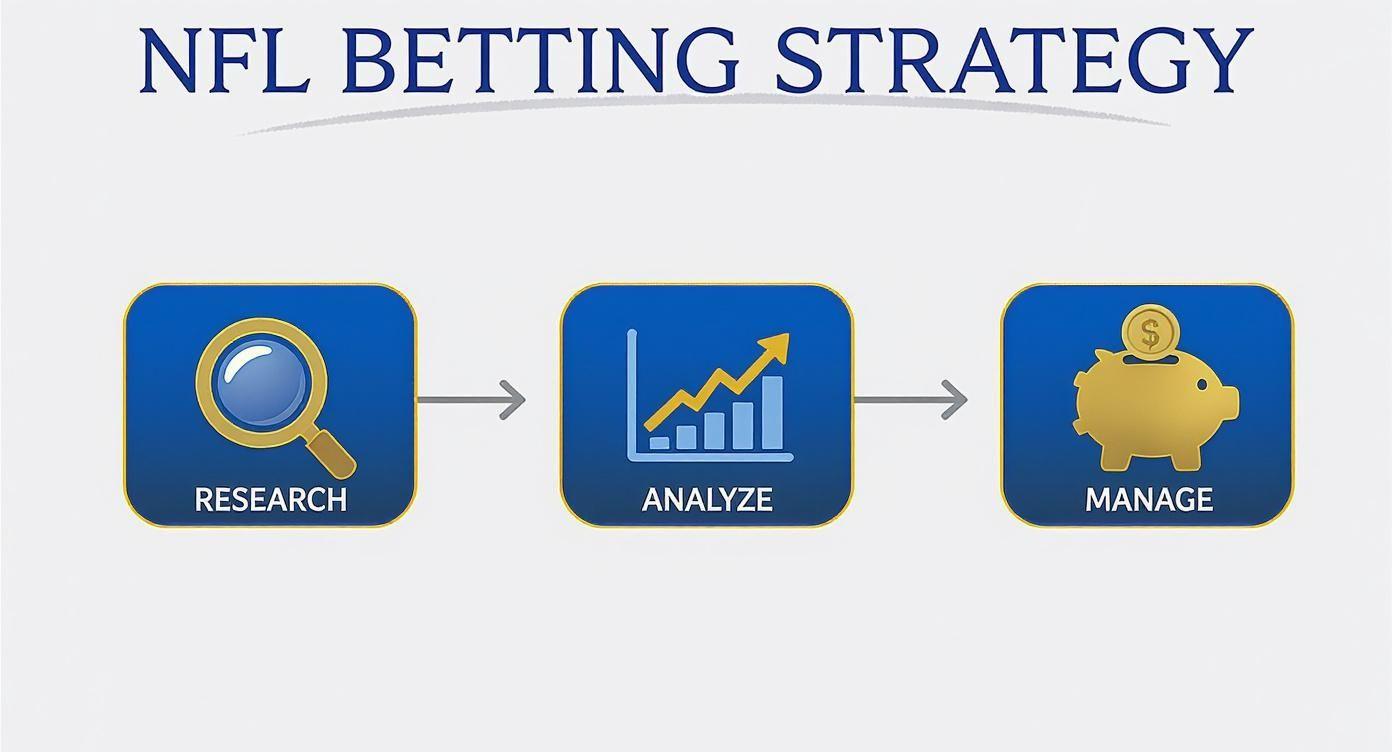
This workflow hammers home a crucial point: brilliant research and sharp analysis are useless without disciplined management of your funds to see you through the ups and downs. None of these pillars can stand on their own; they have to work together as a single, cohesive unit.
That final pillar, management, is arguably the most critical and, funny enough, the most overlooked. A brilliant analytical mind is completely worthless without a structured plan for your money. You can dive deeper into the non-negotiable rules in our detailed guide on sports betting bankroll management.
Key Takeaway: Profitability isn't born from a single lucky bet or one great weekend. It's the direct result of a consistent process that you follow and refine over time. Your ability to stick to the plan during both the thrilling winning streaks and the brutal losing streaks will ultimately define your success.
Mastering Pregame Research and Analysis
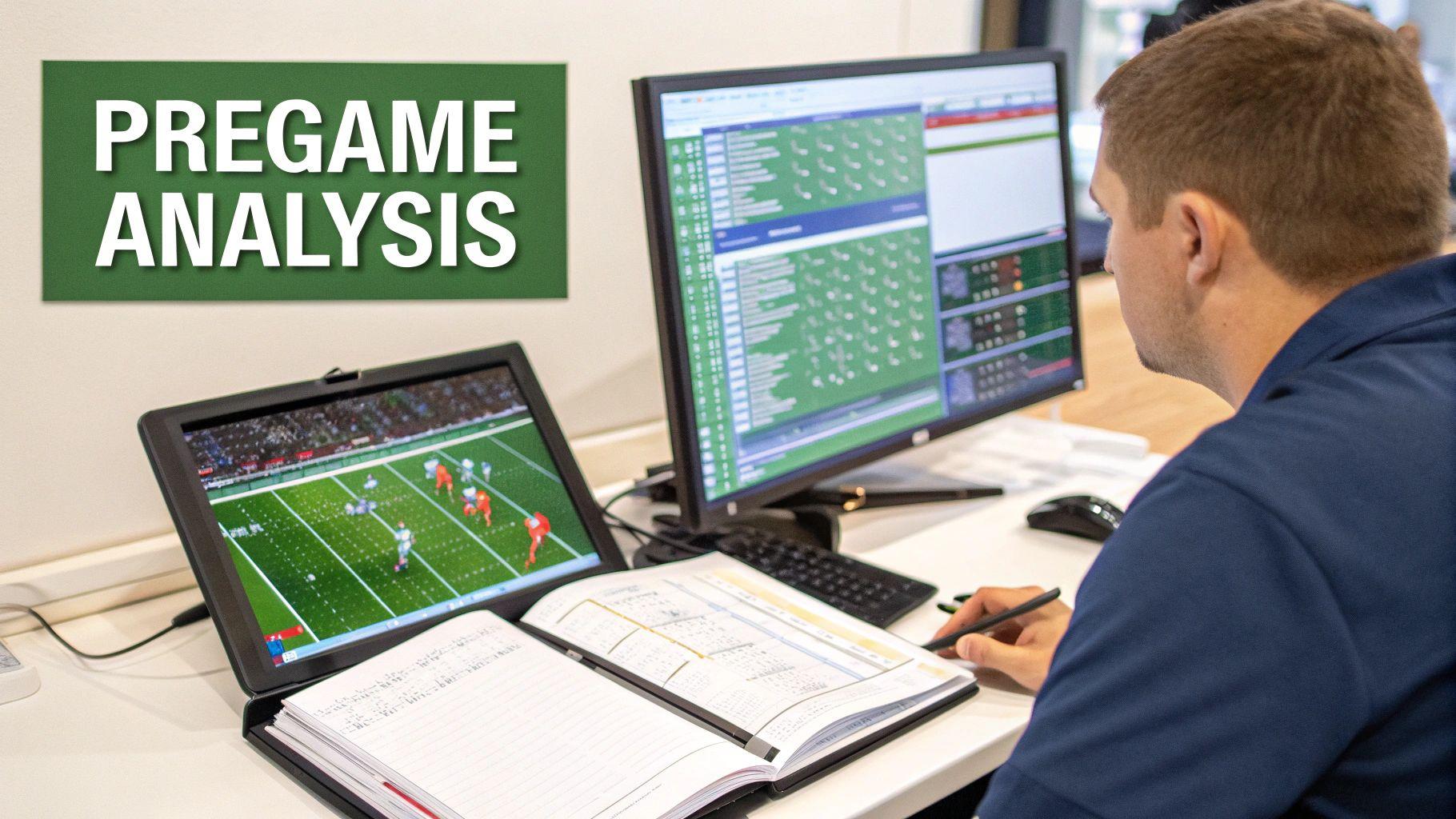
A profitable NFL betting strategy is built long before kickoff. It’s all about peeling back the layers of a matchup to find the data that really drives outcomes, moving far beyond simple win-loss records and surface-level stats. This is where you find your analytical edge.
The goal is to paint a complete, data-driven picture of a game before you even look at the odds. By digging into advanced metrics and situational context, you form an opinion independent of the market, and that’s the secret to spotting real value.

Going Deeper Than the Box Score
Box score stats can be incredibly misleading. A team that racks up 400 yards of offense but only scores 17 points isn't efficient; they’re just leaving opportunities all over the field. To build a sharp NFL betting strategy, your focus needs to shift to metrics that measure efficiency and per-play performance.
Start by upgrading how you evaluate quarterbacks. Instead of relying on the old Passer Rating, incorporate QBR (Total Quarterback Rating), which actually accounts for situational context like down, distance, and the score. It’s also smart to look at how a quarterback performs under pressure, as this often reveals who can truly carry their team when it matters most.
For defenses, sacks look great on the highlight reel, but pressure rate is far more predictive. A defense that consistently hurries the opposing QB, even without getting the sack, is constantly disrupting the offense's timing and forcing bad decisions. That sustained pressure is a much better indicator of future success than a few splashy plays.
Unpacking Advanced Football Metrics
To really sharpen your analysis, it's time to bring some advanced statistics into your process. These metrics give you a more nuanced view of a team's true strength and can highlight hidden advantages that casual bettors completely miss.
- DVOA (Defense-adjusted Value Over Average): This is one of the most powerful tools out there. It measures a team's efficiency on every single play compared to a league-average baseline, all while adjusting for the situation and the quality of the opponent. A high DVOA rating means a team is performing exceptionally well against tough competition. You can get the full rundown in our guide explaining what DVOA is and how to use it.
- EPA (Expected Points Added) per Play: This metric calculates how many points a team is expected to score on any given play based on the down, distance, and field position. A big gain on 3rd-and-2 adds way more value (EPA) than the same gain on 1st-and-10, giving you a much clearer picture of which teams are truly effective.
- Red Zone and Third-Down Efficiency: These are the classic "leverage" situations. Teams that consistently convert in the red zone or on third down have a massive advantage. On the flip side, a team with a poor red-zone touchdown percentage might be a great candidate for an under bet if they're facing a stingy red-zone defense.
This deeper level of analysis is where strong betting opinions are forged. It isn’t about finding one secret stat; it’s about weaving multiple data points together to create a well-rounded assessment of a matchup.
The Critical Role of Situational Analysis
Data is only part of the puzzle. The context surrounding the game often provides the final piece you need to make a confident decision. Situational factors can have a massive impact on a team's performance, and oddsmakers don't always adjust for them perfectly.
Think about these real-world scenarios:
- The Short Week Turnaround: A team playing on Thursday Night Football after a physical Sunday slugfest, especially if they have to travel, is often at a huge disadvantage. Their recovery time is shot, which can really show up in the second half.
- Post-Bye Week Performance: Some coaches are masters at using the extra week off to prepare, while others consistently come out looking flat. Tracking a coach's record after a bye can reveal a surprisingly profitable trend.
- Key Injuries Beyond the Stars: Everyone knows a starting QB injury is a game-changer. But what about a top cornerback, a starting left tackle, or a disruptive interior defensive lineman? The absence of a key player in a specific matchup (like a shutdown corner against an elite receiver) can easily swing a point spread, creating value where others don't see it.
For example, imagine the Green Bay Packers are playing the Detroit Lions, and the Packers' top cornerback is ruled out. If the Lions' entire offense runs through their star wide receiver, this single injury dramatically changes the matchup dynamics. Suddenly, there might be serious value on the Lions' spread or that receiver's prop bets.
By combining deep statistical analysis with this kind of situational awareness, you stop guessing and start making highly informed wagers. This is the engine that drives every profitable NFL betting strategy.
Finding Value and Reading Market Trends
The heart of any winning NFL strategy isn't just about picking the team you think will win; it's about consistently finding odds that don't quite tell the whole story. This is a subtle but massive shift in thinking. You're no longer just betting on a team; you're investing in a price you believe is wrong.
This all starts by turning sportsbook odds into cold, hard numbers. Every single betting line, from a point spread to a moneyline, has an implied probability baked right into it. Think of it as the bookmaker's estimate of how likely an outcome is. Learning to see this number is the first real step toward viewing the market like a pro.
Calculating Implied Probability
The math here is a lot simpler than it sounds. For any standard American moneyline, you can use a quick formula to instantly see the probability the sportsbook is assigning to an outcome.
- For favorites (negative odds):
Odds / (Odds + 100) * 100 - For underdogs (positive odds):
100 / (Odds + 100) * 100
Let's say the Dallas Cowboys are priced at -150 to win their game. The implied probability is 150 / (150 + 100), which comes out to 60%. Now, if your own research and analysis tell you the Cowboys actually have a 65% chance of winning, you've just found potential value. That gap between your number and the market's is your edge.
This simple calculation transforms betting from a guessing game into a mathematical exercise. You stop asking, "Will the Cowboys win?" and start asking the much smarter question: "Are the Cowboys' chances of winning better than 60%?"
Key Insight: Value exists when your assessment of an outcome's probability is higher than the implied probability offered by the odds. Finding this gap is the entire goal of a successful NFL betting strategy.
Using Public Betting Trends as a Contrarian Indicator
Once you get a feel for value, you can start digging into why lines move. A huge driver of line movement is the betting public. Most casual bettors gravitate toward big-name teams, star quarterbacks, and heavy favorites, often betting with their gut instead of their head.
Sportsbooks count on this. When a lopsided amount of public money floods in on one side of a game, they'll often inflate the line on that popular team to encourage action on the other side and balance their liability. This predictable reaction creates a massive opportunity for sharp, contrarian bettors.
This classic strategy is known as fading the public. It's not about blindly betting against every popular team. It’s about recognizing when a wave of public money has artificially pushed a line to a point where it no longer makes sense, creating value on the less popular side.
For instance, if the Kansas City Chiefs open as -6.5 point favorites and 80% of all bets come pouring in on them, the book might move that line to -7.5 or even -8. That inflated number might have very little to do with the actual matchup, creating a prime spot to bet on the underdog.
When Fading the Public Is a Smart Move
Knowing when to fade the public is what separates a calculated contrarian from someone just betting against favorites for the thrill of it. The key is to hunt for games where public sentiment is overwhelming and has clearly warped the line.
Keep an eye out for these specific scenarios:
- Primetime Games: Sunday Night and Monday Night Football are magnets for casual bettors, who almost always pile onto the nationally recognized teams.
- "Public Darling" Teams: Teams with huge, passionate fanbases like the Cowboys, Packers, or Chiefs consistently draw heavy public action, which can bloat their lines week after week.
- Big Underdogs: The public hates betting on teams they think have zero shot. When a big underdog gets almost no public support, it can be a sign that the line has been over-adjusted.
Fading the public is a cornerstone of any sharp NFL strategy because it often aligns you with the sportsbooks themselves. You’re essentially betting alongside the "house," capitalizing on the predictable biases of the general betting population. Learning to track these movements is crucial, and our guide on spotting sharp money moves in the NFL will give you an even deeper look into this tactic.
Challenging Common Betting Myths with Data
Every bettor has heard them. "Always bet the home team." "Never fade a heavy favorite." These old adages get passed around so often they start to sound like gospel. But a truly sharp NFL betting strategy isn't built on hand-me-down wisdom or gut feelings. It’s built on data.
It's time to put these common assumptions under the microscope. While it feels intuitive that a team playing in their own stadium should have a massive edge, the reality is that sportsbooks are experts at pricing that factor into the line. Home-field advantage is real, but it’s not a secret weapon; it's a known variable that's already baked into the odds you see.
Home Teams and Favorites Against the Spread
The most stubborn myth in betting revolves around the blind reliability of home teams and favorites. Sure, these teams win games outright more often than not. But winning a game and covering the point spread are two completely different things, and the data tells a much tighter story.
Historical NFL trends consistently show that while home teams and favorites are great at winning straight-up, their performance against the spread (ATS) is far less impressive. In one recent NFL season, home teams racked up a 98-79 (55.1%) straight-up record, and favorites won a whopping 125 of 178 games (70.6%).
But when it came to covering the spread? The results were basically a coin flip. Home teams managed just a 50.9% ATS record, and favorites were only slightly better at 52.6%. You can explore more detailed NFL season trends and see how these numbers evolve over time.
This tells us one thing loud and clear: blindly backing favorites or home teams is a one-way ticket to a busted bankroll. A 52.6% win rate isn't nearly enough to overcome the standard -110 juice charged by the books. Real value is found by digging deeper and figuring out which home teams or favorites are being mispriced by the market, not by betting on them as a general rule.
The Overtime Over Anomaly
While broad myths often crumble under scrutiny, data can also uncover niche, situational trends that give you a genuine edge. A fascinating example is how overtime impacts the game total. A casual bettor might not think twice about it, but those extra minutes of play can have a huge effect on whether a game goes over or under its closing number.
Interestingly, the same data set showed that 80% of games that went to overtime also went over the point total. This is a powerful, specific insight. It suggests the market often undervalues the possibility of an extra period when setting pregame totals.
Pro Tip: This doesn't mean you should jam the over in every game you think might be close. Instead, use it as a powerful tiebreaker. If your analysis already points toward an over and you also project a tight, back-and-forth battle, the potential for overtime adds another strong data point in your corner.
Applying Data to Debunk Narratives
The key takeaway here is to constantly question the narratives you hear. Data is the objective truth that slices right through the noise of public opinion and media hype. A successful betting strategy is built on this kind of objective approach.
Myth: "Team A is an absolute fortress at home."
Data-Driven Question: "How does Team A perform against the spread at home? Has the market over-adjusted for their home-field advantage?"Myth: "This powerhouse team is going to blow them out."
Data-Driven Question: "What is this favorite's record ATS when laying more than a touchdown? Do they tend to win comfortably but fail to cover huge spreads?"
By consistently asking these kinds of questions, you shift your focus from popular storylines to statistical realities. This is the mindset that separates casual bettors from those who build a profitable, long-term strategy. The data doesn't lie, and learning how to listen to it is the most powerful tool you have.
Bringing Your Strategy to Life with Discipline
All the brilliant research and sharp analysis in the world mean nothing without disciplined execution. This is where a solid NFL betting strategy goes from a plan on paper to a real, long-term operation. It all boils down to one thing: smart, unemotional bankroll management.
Your bankroll is the lifeblood of your betting career. Think of it as a dedicated pool of money set aside only for wagering. Its main job? To soak up the inevitable losing streaks that every single bettor runs into. Without strict rules for how you use it, even the sharpest strategy is doomed to fail.
Setting Up Your Bankroll and Unit Size
The first rule of bankroll management is painfully simple: only bet with money you can truly afford to lose. Once you've got that number nailed down, the next step is to define your betting unit. A unit is just a fixed percentage of your total bankroll, and it becomes your standard bet size.
Most disciplined bettors I know stick to a unit size between 1% and 2% of their total bankroll. I know, that sounds small. But trust me, it’s the key to survival.
- If your bankroll is $1,000: A 1% unit is $10, and a 2% unit is $20.
- If your bankroll is $500: A 1% unit is $5, and a 2% unit is $10.
The Single Most Important Rule: Sticking to a consistent unit size makes sure a bad run of luck won't wipe you out. It forces discipline and stops you from making those rash, oversized bets trying to win it all back in one go.
Picking a Staking Plan
With your unit size locked in, you need a staking plan, a set of rules that tells you how much to risk on each bet. The goal is to apply a consistent method that fits your strategy and how much risk you're comfortable with. A few common approaches work well.
Flat Betting
This is the simplest plan and the one I recommend for most bettors. You risk exactly one unit on every single bet. It doesn't matter how confident you are or what the odds are. A one-unit bet is a one-unit bet. Period.
This method pulls all emotion out of your bet sizing. It stops you from getting cocky after a win and betting more, and it prevents you from upping your stakes to chase losses. Its beautiful simplicity is its greatest strength, promoting steady, disciplined betting over the long haul.
The Kelly Criterion
For more advanced bettors, the Kelly Criterion offers a dynamic way to stake your bets. This formula calculates the optimal bet size based on both the odds and your perceived edge (the gap between your probability and the bookie's). In short, you bet more when you think your edge is bigger and less when it's smaller.
While it's mathematically optimal, the full Kelly Criterion can be extremely aggressive and lead to some wild bankroll swings. Many sharp bettors use a "fractional Kelly" (like a half or quarter Kelly) to calm down the volatility while still varying their stake based on the value they’ve found. This method demands a very accurate read on your edge to be effective.
The Psychology of Disciplined Betting
Let me be blunt: your biggest opponent isn't the sportsbook. It's your own emotional reaction to winning and losing. A disciplined NFL betting strategy requires you to think like a cold, calculated investor, not a passionate fan. Two huge psychological traps will destroy even the most well-funded bankroll.
Chasing Losses: After a tough loss or a bad Sunday, the urge to immediately win your money back is powerful. This is when people make impulsive, poorly-researched bets on the Sunday or Monday night game, jack up their stake size, or start betting on sports they don't even follow. You have to find the discipline to just walk away and trust your plan, knowing that losses are just part of the game.
Emotional Biases: Never, ever let your fandom cloud your judgment. Betting on your favorite team to win or against a rival you hate is a one-way ticket to disaster. Your analysis has to stay objective and driven by data. If your model points to value on a team you can't stand, a disciplined bettor grits their teeth and places the wager.
Your Questions on NFL Betting Answered
Even with the best strategy in hand, questions are going to pop up as you get into the weeds. It's just part of the process. Let's tackle some of the most common questions that bettors run into when they start building a serious NFL betting plan.

How Much Money Do I Need to Start an NFL Betting Strategy?
Honestly, there's no magic number here. The only rule that matters is to use discretionary funds, money you can genuinely afford to lose. For one person, that might be $250; for another, it could be $1,000.
What's far more important than your starting bankroll is establishing a "unit size." A unit is typically 1-2% of your total bankroll. So, if you're working with $500, your standard 1% unit is just a $5 bet.
This disciplined approach is what keeps you in the game. It prevents a bad losing streak from wiping you out and gives you the breathing room to withstand the natural ups and downs of sports betting.
What Is the Single Most Important Stat for NFL Betting?
If only it were that easy. There's no single "magic bullet" stat that unlocks everything. The pros build their edge by combining multiple advanced stats to paint a complete picture of a team's real strength.
Instead of chasing one number, start by focusing on stats that measure efficiency on a per-play basis. These are far more predictive than old-school metrics like total yards.
- For Offenses: Dive into metrics like 'Expected Points Added' (EPA) per play and 'Success Rate.' These tell you how effectively a team moves the ball, not just how many yards they rack up.
- For Defenses: Pressure rate and EPA allowed are where the story's at. They show you a defense's ability to consistently disrupt what the other team is trying to do.
Should I Pay for NFL Betting Picks?
My advice? Learn to do your own analysis. Paying for picks might feel like a shortcut, but it creates a dependency and teaches you absolutely nothing about how to succeed long-term.
Think about it, most of these "tout" services have records that are impossible to verify and zero transparency. The entire point of the strategies in this guide is to empower you to find your own value. That's a skill that pays off for years, unlike blindly following someone else's selections.
Key Takeaway: Your goal should be to become self-sufficient. Learning the process of analysis and value identification is the real long-term investment here, not paying for picks.
How Do I Know If My NFL Betting Strategy Is Working?
The only way to know for sure is to track everything. Meticulous record-keeping isn't optional; it's the foundation of any sharp approach. You need to log every bet: the date, teams, line, your stake, and the final outcome.
A winning strategy will show a positive Return on Investment (ROI) over a large sample size, and I mean at least 200-300 bets. Don't get rattled by a bad week or even a bad month; variance is just part of the game.
Ultimately, your goal is to beat the sportsbook's built-in cut, the vigorish (or "juice"). For standard -110 spread bets, that means you need to win more than 52.4% of the time just to break even. If you're consistently hitting 54-55% or higher over a large volume of bets, you've built an effective and genuinely sharp strategy.
Ready to put these strategies into action? ValueBetFactory uses powerful tools to scan the market for you, identifying odds discrepancies and highlighting value opportunities in real time. Stop guessing and start making data-driven decisions by visiting ValueBetFactory.