
Winning MLB betting strategy Guide
Unlock Profits with betting tips!
A winning MLB betting strategy is built on one simple, powerful idea: you find value in the odds, not just winners on the field. This means shifting your mindset from a casual fan to a savvy investor. You're no longer just guessing who will win; you're hunting for wagers with a positive expected value (+EV), much like a stock trader scours the market for undervalued companies. It’s about ditching the gut feelings and embracing a disciplined, mathematical approach that drives long-term profit.
Foundations Of A Winning MLB Betting Strategy
To consistently beat the sportsbooks at baseball, you need to adopt a philosophy that separates you from the 97% of bettors who ultimately lose money. Winning isn't about luck or getting on a "hot hand." It's about executing a structured game plan grounded in proven principles. Forget trying to predict every game correctly, the real goal is to make mathematically sound investments, one bet at a time.

This approach reframes betting from a simple hobby into a strategic business. And just like any good business, success comes from finding opportunities where the potential reward consistently outweighs the risk. In our world, that opportunity is called value.
The Core Pillars of Profitable Betting
At its heart, any sustainable MLB betting strategy rests on three non-negotiable pillars. Mastering these concepts is the first real step on the road to becoming a profitable bettor. Without them, even the most sophisticated statistical models are doomed to fail in the long run.
These core concepts are the bedrock of everything we do. Think of them as the three legs of a stool, if one is missing, the whole thing comes crashing down.
Pillars Of A Profitable Betting Approach
This table breaks down the three core ideas every successful MLB bettor must master. Internalizing these concepts is what separates disciplined betting from pure gambling.
| Concept | Why It Matters | Simple Analogy |
|---|---|---|
| Finding Value | This is your profit engine. You only bet when the odds are more generous than the true probability of an outcome. | It's like finding a $20 bill on sale for $15. You'd buy it every single time, even if you sometimes misplaced the cash later. |
| Defining Your Edge | This is how you find value. It's your unique method, whether it's a stats model or deep situational knowledge. | It's your secret recipe. Other people can buy the same ingredients, but only you know how to combine them to create a winning dish. |
| Understanding Variance | This is your mental armor. It’s accepting that good bets will still lose, and bad bets will sometimes win, due to short-term luck. | It's like flipping a coin. You know it's 50/50, but you could still get six heads in a row. That doesn't mean the coin is broken. |
Grasping these pillars allows you to think like the house. A casino has a mathematical edge on every spin of the roulette wheel. Even when a player hits a big win, the casino knows its edge guarantees a profit over thousands of spins. Your job as a bettor is to flip that script and only place wagers where you hold that same mathematical advantage.
The Power of Line Shopping
One of the easiest yet most powerful ways to put this value-first strategy into practice is line shopping. This is the simple habit of having accounts at multiple online sportsbooks and always comparing the odds they offer for the exact same game.
You wouldn't buy a new TV without checking the price at a few different stores, right? The same logic applies here, but the stakes are much higher.
The single biggest and easiest adjustment a bettor can make to increase their profitability is to shop for the best line. Over the course of a 162-game MLB season, even small differences in odds compound into significant gains.
For instance, finding a team at +125 instead of +120 might seem trivial. But those small, incremental advantages are the lifeblood of a professional bettor. This practice directly puts the principle of value into action, ensuring you always get the best possible price for every investment you make. It's a fundamental habit that will immediately improve your bottom line.
How Analytics Transformed Baseball Betting
Baseball betting wasn't always a game of spreadsheets and algorithms. For decades, it was a much simpler affair. Wagers were placed on a team's reputation, their recent win-loss record, and a healthy dose of pure gut instinct. Bookmakers often set their odds with a similar intuition, creating a market driven more by public perception than any kind of objective analysis.
But that old-school approach was bound to change. Major events, like the infamous 1919 Black Sox Scandal, exposed just how vulnerable a system tied to informal wagering really was. The scandal forced the industry toward tighter regulations and a more transparent, numbers-focused framework. It was a slow evolution, but it set the stage for a monumental shift. You can explore a deep dive into how odds and betting trends evolved throughout baseball history.
The real game-changer, however, didn't come from the betting world, it came from inside the sport itself.
The Sabermetric Revolution
The turning point was the sabermetric revolution, a movement sparked by pioneers like Bill James in the latter half of the 20th century. Sabermetrics introduced the radical idea of using objective, evidence-based analysis to evaluate player and team performance. It tossed aside traditional stats like batting average and pitcher wins in favor of metrics that were far more predictive.
This new way of thinking didn't just change how front offices built championship rosters; its impact rippled out and completely transformed the betting landscape. Bettors who embraced this analytical mindset suddenly had a massive advantage. They weren't just guessing anymore, they were calculating.
Understanding the history of baseball analytics is key to grasping why modern betting strategies prioritize advanced statistics. It’s the difference between looking at a team’s simple record and understanding the underlying processes that lead to wins and losses.
From Instinct to Data-Driven Insights
This shift from instinct to data is what empowers the modern bettor. Today, any successful MLB betting strategy is built on the very principles that sabermetrics introduced. We now have access to powerful data and tools that were unimaginable just a few decades ago, allowing us to find value in ways early bettors never could.
This history is crucial because it explains why simply "picking winners" is a fundamentally flawed approach today. The market has become incredibly efficient, and sportsbooks are armed with immense analytical power. To even compete, let alone win, bettors must adopt a similar data-driven approach, focusing on the key performance indicators that genuinely predict future outcomes.
The game has changed, and so have the methods for beating it.
Mastering Situational Handicapping Factors
While advanced statistics are the bedrock of any modern MLB betting strategy, the box score only ever tells part of the story. The best bettors I know consistently look beyond the numbers to analyze factors that data alone just can't capture. This is called situational handicapping, and it's where a real, sustainable edge can be found.
It’s all about digging into the specific context of each game, from the umpire behind the plate to the air pressure in the stadium. These subtle influences can have a massive impact on how a game plays out, yet they're almost always ignored by the casual betting public. By adding this layer of analysis, you can spot value that even the sharpest statistical models might miss.
Going Beyond the Basic Matchup
Every single game presents a unique set of circumstances that create small advantages and disadvantages for each team. The real skill is knowing which factors matter most and how to read their potential impact. This is what elevates your analysis from a simple "Team A vs. Team B" comparison to a complete assessment of the game's entire environment.
Here are a few of the most critical situational factors you should be looking at:
- Umpire Tendencies: Every home plate umpire has a unique strike zone, and it matters. Some are known as "pitcher's umps" with wide zones that lead to more strikeouts and lower scores. Others have tight zones, forcing pitchers into the heart of the plate and giving hitters a huge boost. Data on umpire tendencies is easy to find and can give you a significant edge on totals (Over/Under) bets.
- Weather Conditions: Baseball is uniquely exposed to the elements. Wind is a huge one. A strong wind blowing out can turn routine fly balls into home runs, while a stiff wind blowing in can knock them down for easy outs. Even things like air density at high-altitude parks like Coors Field in Denver have a measurable effect, causing balls to travel roughly 5% farther than they do at sea level.
- Travel and Fatigue: The 162-game season is an absolute marathon. Teams are constantly flying across time zones, and fatigue is very real. A classic situational spot to look for is a West Coast team playing an early 1:00 PM game on the East Coast. Their body clocks are still on Pacific time (10:00 AM), which often leads to sluggish starts and creates a potential edge for the home team.
Fading The Public Mindset
One of the most powerful angles in situational handicapping is simply understanding public perception. Most people bet with their hearts, backing popular teams, star players, and recent winners without digging any deeper. This emotional betting inflates the lines on favorites and creates hidden value on the other side.
The art of "fading the public" means identifying games where the majority of bettors are piling onto one side, and then betting against them. This contrarian approach is a cornerstone of how many professional bettors operate.
By looking at public betting percentages, you can see where the casual money is flowing. When a line starts moving in the opposite direction of that public money, it’s often a huge signal that sharp, professional bettors are hitting the other side hard, creating a valuable opportunity to follow their lead.
Ultimately, situational handicapping adds a rich, qualitative dimension to your analysis. It forces you to think like a detective, piecing together clues that pure statistics might overlook. When you combine this nuanced approach with solid data analysis, you build a far more complete and profitable MLB betting strategy.
Using Data To Build A Predictive Betting Model
At some point, you have to move past situational factors and gut feelings. Turning theory into a real, sustainable advantage means stepping into the world of predictive modeling. This isn't about becoming a data scientist overnight. It’s about understanding how data can forecast game outcomes far more accurately than traditional handicapping ever could.
A solid model is the engine of any modern MLB betting strategy.
The whole idea is to use historical performance data to find gaps between your projections and the market's odds. One deep-dive study looked at 24,301 MLB games over a decade, using game logs and moneylines to build forecasting models. The takeaway? Models built on the right data consistently beat intuition, creating a structured, analytical framework for finding value.
But everything hinges on using the right data.
Choosing Predictive Metrics Over Traditional Stats
Here’s where many bettors go wrong. They lean on familiar but deeply flawed stats like Earned Run Average (ERA) or batting average. These numbers tell you what happened in the past, but they're terrible at predicting what will happen next. Why? Because they’re full of noise, things outside a player's direct control, like shoddy defense or just plain bad luck.
Advanced metrics are designed to strip all that noise away, isolating a player's true, repeatable skill. These are the building blocks of an effective model. For a more detailed walkthrough, check out our guide on how to build a sports betting model that covers these concepts in depth.
Here are the essential stats you should be focusing on:
- For Pitchers (Instead of ERA): Use xFIP (Expected Fielding Independent Pitching). This metric estimates what a pitcher's ERA should have been based only on the things they can control: strikeouts, walks, and fly balls allowed. It cuts through the randomness of defense and batted-ball luck to give you a much clearer picture of a pitcher’s actual talent.
- For Hitters (Instead of Batting Average): Use wRC+ (Weighted Runs Created Plus). This is an all-in-one offensive stat that measures a player’s total run contribution, adjusting for things like the ballpark they play in and the league average. A wRC+ of 100 is perfectly average. A player with a 125 wRC+ is creating 25% more runs than the average hitter. Simple and powerful.
A Simple Modeling Framework
Your model doesn't need to be some complex algorithm running on a supercomputer. It can be as straightforward as comparing the xFIP of the two starting pitchers and the overall team wRC+ for both lineups.
Just that basic comparison gives you a more accurate power rating for each team than what most of the betting public is using. From there, your handicapping process involves layering in other key factors.
This flowchart breaks down a simple process for integrating data points into your game analysis.
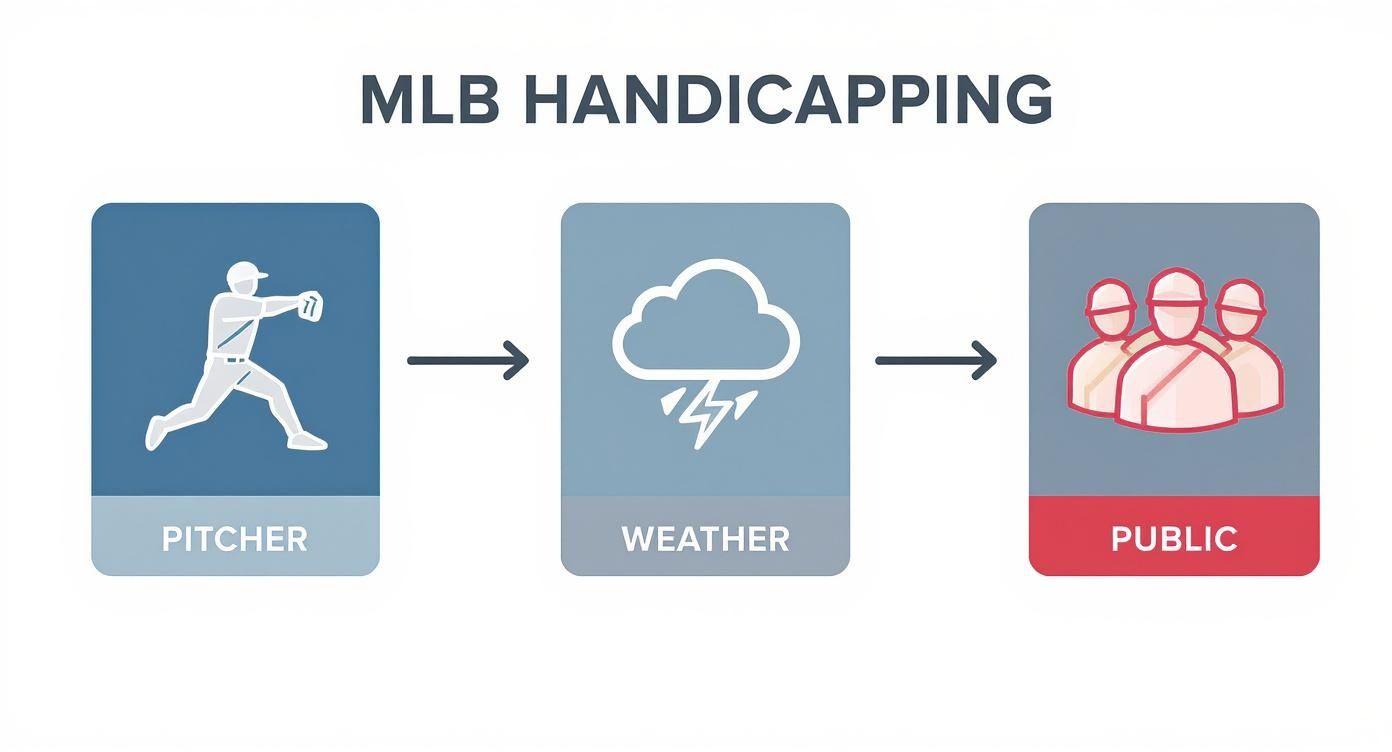
As you can see, a strong analysis combines a deep dive into the starting pitchers with situational factors like weather and a smart read on public betting sentiment.
By translating these advanced statistics into your own projected win probability, you can compare your number directly against the implied probability offered by the sportsbook's odds. When your projection shows a higher chance of winning than the odds suggest, you have found a value bet.
This is the entire point of building a model. It’s a tool designed to systematically identify value. Over the long haul, consistently betting on these discrepancies is how you build a lasting edge and achieve profitability.
Finding Value By Fading Public Betting Trends
One of the most powerful angles in any MLB betting strategy is simply knowing where the crowd is putting its money. Most casual bettors don't dig deep; they follow simple, comfortable narratives. They’ll back popular teams, big-name pitchers, and hot streaks, often without giving a second thought to the actual price.
This predictable behavior creates a massive opening for anyone paying attention. This contrarian approach, known as "fading the public," is built on a simple premise: when the vast majority of bets flood in on one side of a game, sportsbooks will often move the line to limit their own risk. That adjustment inflates the price on the less popular side, creating fantastic potential value for those willing to bet against the herd.
Bet Percentage vs. Money Percentage
To fade the public effectively, you have to understand the difference between two critical pieces of data: bet percentage and money percentage. Bet percentage tells you the raw number of wagers placed on each side, while money percentage shows you where the actual cash is going.
A big gap between these two figures is a massive clue about where the "sharp" money has landed. Sharps are professional bettors who wager large, calculated sums and have the power to move lines. Following their trail is the core of this strategy.
When you see a team getting only 30% of the total bets but 70% of the money, it's a giant red flag. This tells you that while tons of small, public bets are on one side, a few huge, professional wagers are on the other. This discrepancy often points directly to the value.
Spotting Sharp Money in Action
Let's walk through a real-world scenario. Imagine the popular New York Yankees are playing the underdog Tampa Bay Rays. The public sees the Yankees' brand and star players, so 75% of the bet tickets come pouring in on them. But when you check the money percentage, you see it's split right down the middle, 50/50.
What does that tell you? The average bet size on the Rays is much, much larger than on the Yankees. While casual fans placed small bets on the favorite, sharper bettors likely saw a flaw in the line and hammered the underdog Rays with serious cash. You can learn more about how sharp money influences the market by studying our detailed guide on betting line movement.
A fascinating example popped up in a game between the Toronto Blue Jays and Los Angeles Dodgers. The Blue Jays, sitting as +120 underdogs, received 51% of the moneyline bets, a near-even split. However, they attracted a whopping 69% of the total money wagered, showing that the bigger, sharper bets were backing the underdog. Discover more insights about these public betting trends.
By analyzing these betting splits, you're essentially getting a glimpse into the minds of the pros. Fading the public isn't just about blindly betting against the most popular team. It’s a calculated move that uses public bias to find inflated lines and pounce on the value that the sharps have already spotted. This makes it a cornerstone of any well-rounded MLB betting strategy.
Bankroll Management For Long Term Success
You can have the most brilliant MLB betting strategy in the world, but without disciplined bankroll management, it’s completely worthless. Even with a proven edge, the natural chaos of sports guarantees that losing streaks will happen. Your ability to protect your capital during those downturns is what separates a flash-in-the-pan gambler from a long-term, successful bettor.
This is the blueprint for making sure your betting career is a marathon, not a sprint.

Think of your bankroll as the inventory for your business, if you run out, you’re done. The goal isn't just to grow it, but to shield it from catastrophic loss. This means ditching emotional, gut-based bet sizing for a structured approach to how much you risk on every single wager.
Defining Your Unit And Staking Plan
The bedrock of smart bankroll management is the "unit." A unit is simply a fixed percentage of your total bankroll, typically between 1% and 2%, that acts as your standard bet size. For a deeper dive, check out our complete guide to sports betting bankroll management, which breaks down these principles in more detail.
By tying your bet size to a percentage of your bankroll, you create a system that scales with you. Your wagers get bigger when you're winning and smaller when you're losing, giving you an essential buffer against going broke.
This disciplined approach yanks emotion out of the equation. It stops you from falling into the single most destructive habit in betting: "chasing losses" by throwing down bigger and bigger bets to try and win back money after a bad day. Sticking to your unit size, no matter what, is the most important rule of the game.
There are a few popular staking plans out there, each with its own pros and cons. The two most common are the flat-betting approach, where every bet is one unit, and the Kelly Criterion, a more advanced method that adjusts your bet size based on your perceived edge.
Comparing Bet Sizing Strategies
Picking the right staking plan is all about finding a method that matches your risk tolerance and betting style. This table gives you a quick overview of the most common techniques MLB bettors use to manage their money.
| Strategy | How It Works | Pros | Cons |
|---|---|---|---|
| Flat Betting | Wager the same amount (e.g., 1 unit) on every single bet, regardless of confidence or odds. | Extremely simple to follow, offers maximum protection against losing streaks. | Doesn't capitalize on high-value opportunities where you have a larger edge. |
| Percentage Staking | Wager a fixed percentage (e.g., 1%) of your current bankroll on each bet. The dollar amount changes as your bankroll does. | Automatically adjusts for wins and losses, promotes steady growth. | Requires constant recalculation and can feel slow during winning periods. |
| Kelly Criterion | A formula calculates the optimal bet size based on both the odds and your specific, quantifiable edge. | Mathematically proven to maximize bankroll growth over the long term. | Highly aggressive, requires an exact edge calculation, and can be very volatile. |
In the end, the best strategy is the one you can actually stick with, day in and day out. Consistency and discipline are your greatest assets. By putting a strict bankroll plan in place, you give your analytical edge the time it needs to overcome variance and, ultimately, deliver profit.
Common Questions About MLB Betting Strategy
To wrap things up, let's tackle some of the most common questions that pop up when you're trying to build a winning MLB betting strategy. Getting straight answers to these can save you a lot of headaches and costly mistakes, whether you're just starting out or have been at this for years.
The idea here is to clear up any confusion and build your confidence. Nailing these concepts is how you turn good ideas into a process that actually works in the real world.
What Are The Most Predictive Statistics For MLB Handicapping?
While everyone knows stats like ERA and batting average, the pros have moved on to advanced metrics that give a much truer picture of a team's potential. If you want a real edge, you have to use the right tools.
Here’s where you should focus your energy:
- For Pitchers: Look past ERA and zero in on FIP (Fielding Independent Pitching) and xFIP (Expected FIP). These stats are brilliant because they strip away the luck and defensive performance, isolating what a pitcher can actually control. It's a measure of pure, repeatable skill.
- For Hitters: Forget simple batting average. wOBA (Weighted On-Base Average) and wRC+ (Weighted Runs Created Plus) are your best friends. These numbers measure a player’s total offensive value, giving you a much clearer sense of a lineup's true power.
Leaning on these advanced stats gives you a massive analytical advantage over the average bettor who is still stuck on the basics.
Is It Better To Bet On Favorites Or Underdogs In Baseball?
There’s no magic rule that says one is always better. A winning strategy isn't about just picking the team more likely to win; it’s about finding value in the odds. The real goal is to find games where you believe a team's real chance to win is higher than what the moneyline odds are telling you.
A successful MLB betting strategy is not about simply picking winners. It is about identifying and betting on mispriced odds, regardless of whether that value lies with the favorite or the underdog.
You'll often find fantastic value betting on underdogs, especially home underdogs. Why? Because the general public loves to bet on big-name favorites. This forces sportsbooks to adjust the odds, inflating the price on the other side and creating a golden opportunity for a sharp bettor to step in.
How Much Bankroll Do I Need To Start MLB Betting?
Honestly, the dollar amount you start with is far less important than the discipline you use to manage it. Your starting bankroll should be an amount of money you are completely comfortable losing. From day one, the most critical thing is to lock in a strict staking plan.
A simple and highly effective method is to define one "unit" as 1% of your total bankroll. For instance, if you start with $1,000, your standard unit size would be a flat $10. This approach is your best defense against the losing streaks that are an inevitable part of betting. It takes the emotion out of your bet-sizing and protects your capital for the long haul.
Ready to put these strategies into action? ValueBetFactory uses powerful analytics to scan the market for you, sending real-time alerts on +EV betting opportunities. Stop guessing and start making data-driven decisions by exploring our tools at ValueBetFactory.