
Mean Betting A Practical Guide to Finding Betting Value
Unlock Profits with betting tips!

Staring at a page of betting odds can feel like trying to crack a code. But what if there was a way to know, with mathematical certainty, whether a bet is a smart long-term investment or just a costly gamble? That's exactly what "mean betting" is all about.
The term has nothing to do with being unkind. Instead, it’s a calculated strategy focused on the mathematical mean, or the long-term average outcome of a bet. Grasping this concept is your first real step toward shifting from hopeful guessing to making calculated, professional-level betting decisions.
Understanding the Core of Mean Betting
At its heart, mean betting is all about finding an edge by mastering a fundamental concept called Expected Value (EV). It’s a powerful idea that helps you see the true, long-term profitability of any wager you make.
Think about a simple coin toss. A fair coin has a 50% chance of landing on heads and a 50% chance on tails. If someone offered you even money on a flip (bet $10 to win $10), the wager is perfectly balanced. Over thousands of flips, you'd come out pretty much dead even. This is what we call a neutral Expected Value.
But what if they offered you slightly better odds? Imagine you win $11 for every $10 bet on heads. Suddenly, the math is tilted in your favor. Even though you'll still lose half the time, those bigger payouts on your wins will more than make up for the losses over the long run.
That slight advantage is precisely what mean betting aims to identify and exploit.
How Bookmakers Create the Market
Here's the catch: bookmakers never offer perfectly fair odds. They're a business, and to make a profit, they build in a margin-often called the "vig" or "juice"-on every single market.
They do this by setting odds that imply a total probability of more than 100%.
Let's look at how a bookie would handle that same coin toss. Instead of even money, they might offer odds of -110 on both heads and tails. This means you have to risk $11 just to win $10. That extra dollar is their built-in advantage, ensuring they have a mathematical edge.
The table below breaks down the key components of a typical bet, showing how these elements interact.
Breaking Down a Standard Bet
This table shows the key elements of a bet, illustrating how odds, probability, and the bookmaker's margin interact to define its value.
| Component | Description | Example (Coin Toss) |
|---|---|---|
| True Probability | The actual, real-world chance of an outcome happening. | 50% for heads. |
| Implied Probability | The probability suggested by the bookmaker's odds. | Odds of -110 imply a 52.38% chance. |
| Bookmaker's Margin | The "juice" or "vig" a bookmaker adds to guarantee their profit. | The implied probability for both heads and tails at -110 adds up to 104.76%, creating a 4.76% margin. |
| Stake | The amount of money you risk on the bet. | You risk $11 to place the bet. |
| Potential Profit | The amount you win, not including your original stake back. | You win $10 in profit. |
This table shows exactly how a bookmaker builds their advantage into the odds. A mean betting strategy is all about turning the tables on them.
A mean betting strategy is about finding those rare instances where a bookmaker's odds are incorrect relative to the true probability of an outcome. When you find one of these pricing errors, you've located a positive Expected Value opportunity for yourself.
A bet's true worth isn't determined by whether it wins or loses, but by the mathematical value it holds at the moment it's placed. Consistently finding bets with a positive expected return is the only sustainable path to long-term betting success.
In short, you're hunting for pricing mistakes. By focusing on the "mean" or average return, you can pinpoint wagers that, just like our favorable coin toss example, are mathematically profitable over time. This transforms betting from pure speculation into a disciplined, analytical process.
Calculating Expected Value to Find Your Edge
To consistently find an edge, you have to learn to think in terms of Expected Value (EV). This concept is the engine that drives a successful mean betting strategy, turning what feels like guesswork into a calculated, data-driven approach. Honestly, it’s the single most important calculation for figuring out a bet's long-term profitability.
The formula itself is actually pretty straightforward:
EV = (Probability of Winning x Profit per Bet) - (Probability of Losing x Stake)
A positive EV (+EV) tells you that a bet is profitable over the long run, even if you lose some of them along the way. A negative EV (-EV) is a clear signal that it's a losing proposition over time. The entire goal of mean betting is to only place bets that you've calculated to have a positive Expected Value.
A Practical Tennis Match Example
Let's apply this to a real-world scenario to see how it works. Imagine a tennis match between Player A and Player B. A bookmaker is offering odds of +120 on Player A to win.
First, you need to figure out the implied probability hidden inside those odds. For positive American odds, the formula is simply 100 / (Odds + 100).
- Implied Probability: 100 / (120 + 100) = 45.45%
The bookie's odds are telling us that Player A has a 45.45% chance of winning. But here's where your expertise comes in. After your own analysis, you believe Player A's true chance to win is closer to 50%. This gap between your assessment and the bookmaker's is where your potential edge lives.
Now, let's plug these numbers into the EV formula, assuming a $100 stake.
- Stake: $100
- Potential Profit: $120 (that's what you win at +120 odds)
- Your Probability of Winning: 50% (or 0.50)
- Your Probability of Losing: 50% (or 0.50)
EV Calculation:EV = (0.50 x $120) - (0.50 x $100)EV = $60 - $50EV = +$10
This quick calculation reveals that for every $100 you bet on Player A, you can expect an average return of $10 over the long haul. This is a clear +EV bet and a perfect example of what mean betting is all about finding. For a deeper dive into these calculations, check out our complete guide on how to calculate expected value.
This whole process shines a light on how bookmakers build their profit margin-often called the "vigorish" or "vig"-into every single market they offer.
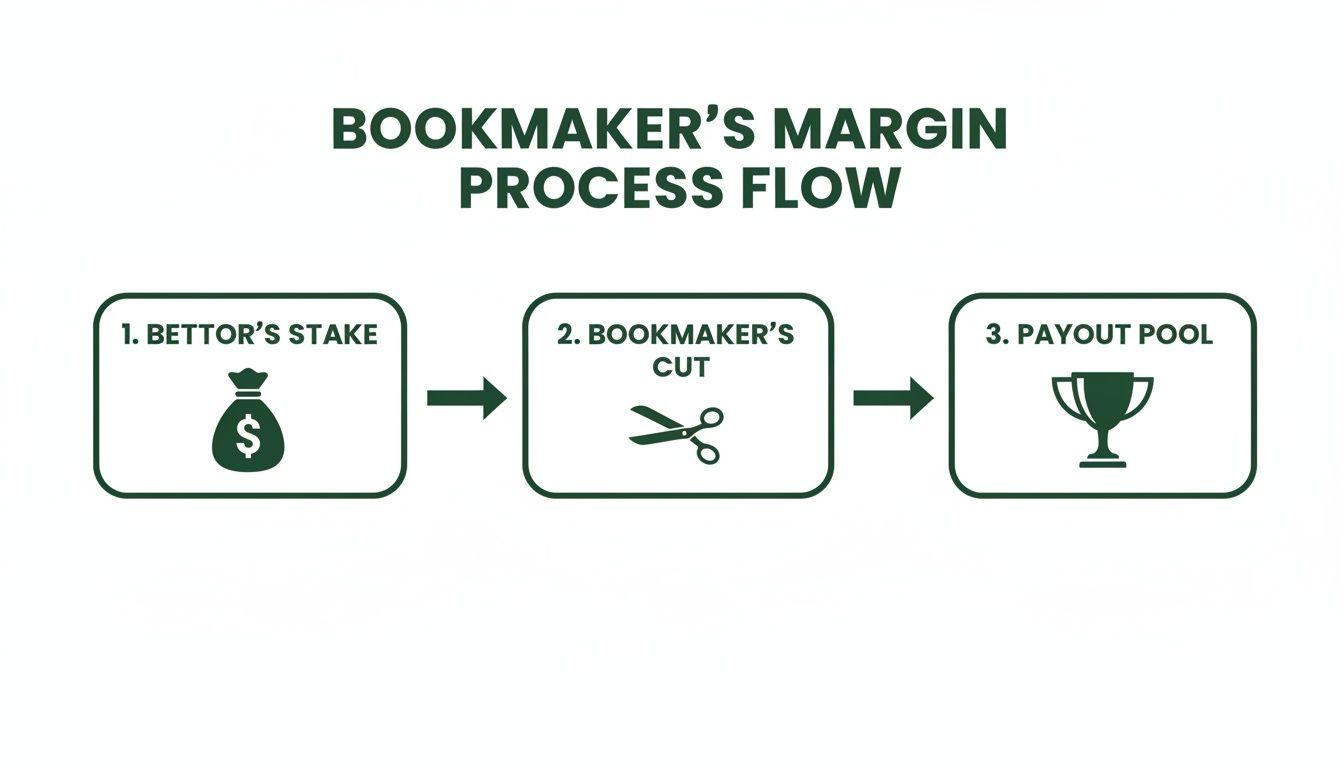
The bookie's margin is the main reason why most bets have a negative EV right out of the gate. In modern regulated markets, this built-in edge for the house usually sits somewhere between 5% and 12%, depending on the sport. By mastering EV, you learn how to flip that script and find the rare opportunities where the odds are actually tilted in your favor.
How to Spot Overpriced Odds in the Market
The real art of mean betting has very little to do with flawlessly predicting winners. It’s all about spotting moments when a bookmaker’s odds don’t line up with an outcome's true probability. These pricing mistakes are the fertile ground where your long-term profits will grow.
Finding these opportunities requires training your analytical eye. You have to learn to see beyond simple wins and losses and focus on one thing: the mathematical value a bet offers. A +EV bet on a heavy underdog might lose nine times out of ten, but if you could place it a thousand times, the math says you'd come out ahead.
This shift in perspective is what separates casual bettors from strategic ones. Your goal is to become a value hunter, constantly scanning the market for these mispriced odds.
Strategies for Uncovering Value
Finding overpriced odds isn't about luck; it's about having a proactive approach and a sharp eye for detail. Bookmakers aren't perfect, and their errors are your opportunities. Consistently applying a few key strategies will dramatically increase your chances of spotting these valuable discrepancies.
Here are a few practical methods you can start using today:
Compare Odds Across Bookmakers: No two bookmakers price an event identically. By opening accounts at multiple sportsbooks, you can "line shop," comparing odds to find the absolute best price for the bet you want to make. Even a tiny difference in odds can be enough to flip a negative EV bet into a positive one.
Focus on Niche Sports: Major leagues like the NFL or the Premier League are scrutinized by armies of expert oddsmakers, which makes errors rare. In contrast, smaller sports or lower-league competitions often get far less attention. This is where oddsmakers are much more likely to make mistakes, creating some incredible value opportunities.
React Quickly to New Information: The betting market moves fast, especially when news breaks. A star player's surprise injury, a sudden change in weather, or a last-minute lineup swap can drastically alter the real probabilities of an outcome. If you can act on this information before the bookies adjust their lines, you can lock in amazing value.
The core of value hunting is understanding that odds aren't static predictions but dynamic prices in a fluid market. Your job is to identify when that price is wrong and act on it before the market corrects itself.
Getting a feel for the mechanics of pricing is key. To get a better sense of the oddsmaker's process, our guide on how do bookies set odds offers a detailed look behind the curtain. Mastering these techniques is the first step in transforming your approach from passive betting to active value investing.
Using Modern Tools for Mean Betting
Trying to calculate Expected Value by hand while hopping between dozens of bookmaker sites is a one-way ticket to burnout. While the theory behind mean betting is pretty straightforward, putting it into practice can be a serious grind.
This is where technology gives you a massive, almost unfair, advantage. Instead of dedicating hours to hunting down a handful of opportunities, you can let specialized tools do all the heavy lifting. This frees you up to focus on making smart decisions, not getting lost in the weeds of manual calculations.
The Power of Automation in Betting
The right tools can turn a complex, time-sucking strategy into something you can manage efficiently. They're built to scan a huge amount of data in real-time, instantly flagging the exact value bets you’re looking for.
Here’s how they give you an edge:
- Instant Odds Comparison: These platforms scan odds from dozens, sometimes hundreds, of bookmakers all at once. You see the best price available in seconds, which beats manually checking every site.
- Automatic EV Calculation: The software crunches the numbers for you, calculating the Expected Value on thousands of potential bets and showing you only the ones with a positive EV. This eliminates human error and saves a ridiculous amount of time.
- Real-Time Alerts: Get notified the second a value bet that fits your criteria pops up. Speed is everything here, as overpriced odds often get corrected by the market in a matter of minutes.
By automating the discovery process, you can find significantly more value bets than you ever could on your own. This increased volume of +EV wagers is fundamental to building a bankroll over the long term.
Adapting to a Changing Market
The betting world has changed. The shift to mobile and in-play betting has made the market faster and more chaotic than ever, making manual analysis a near-impossible task.
In many major markets, mobile bets now make up over 80% of all wagers, often placed on fast-moving events with high built-in margins. If you want more detail on U.S. betting trends, rg.org offers some great statistics.
This high-speed environment makes technology a necessity, not a luxury. Tools that offer value betting software are no longer just a convenience-they're essential for anyone serious about mean betting. They level the playing field, helping you pounce on market mistakes before they disappear.
Protecting Your Bankroll with Smart Strategy
Finding bets with a positive Expected Value is a massive first step, but honestly, it’s only half the battle. Without intelligent money management, even the sharpest mean betting strategy can lead you straight to ruin. Smart bankroll protection is what separates a few fleeting wins from long-term, sustainable growth.
The first rule is absolutely non-negotiable: create a dedicated betting bankroll. This is a specific pot of money set aside purely for betting, completely separate from the funds you use for bills, savings, or daily life. This separation creates a psychological and financial firewall that you can’t afford to be without.
That buffer ensures that a losing streak-which is an inevitable part of this game-doesn't blow a hole in your personal finances. It transforms betting from a source of potential stress into a controlled, strategic investment.
Choosing Your Staking Method
Once you have your bankroll, you need a disciplined staking plan. This is your rulebook for how much to risk on each bet. Just "winging it" is a recipe for disaster. A structured approach is the only way to make sure you can withstand the natural ups and downs of sports betting.
Here are two popular and effective methods to get you started:
Flat Staking: This is the simplest method out there and the one I always recommend for beginners. You decide on a fixed percentage of your total bankroll, typically 1-2%, and that becomes your standard "unit" size. Every single bet you place is for that exact amount, regardless of how confident you feel or what the odds are. This method is fantastic for taking emotion out of the equation and protecting your capital during a rough patch.
Simplified Kelly Criterion: For those a bit more advanced, the Kelly Criterion is a formula that calculates the optimal stake size based on both your perceived edge and the odds. A simplified version of this might mean risking a slightly higher percentage on bets where you've identified a larger +EV. It's potentially more profitable, but it's also riskier and demands very accurate probability assessments.
Bankroll management isn't about trying to avoid losses; it's about making sure you have the capital to keep betting when the inevitable losing streaks hit. Discipline is your single greatest asset.
The Psychology of Mean Betting
Ultimately, your success hinges on your ability to stay disciplined and trust the math. Emotional decisions, like chasing losses after a bad beat or getting overconfident after a big win, are the number one cause of bankroll destruction. Mean betting is a game of probability, not a game of certainty.
You have to accept that you are going to lose bets, even when you have a clear mathematical edge. The key is to maintain your strategy, stick to your staking plan, and keep your focus on making positive EV decisions over the long haul.
The global sports betting market is a massive ecosystem, with industry estimates placing its size somewhere between USD 78–108 billion in 2024. The operators thrive on bettors who make emotional, negative-EV choices. You can find more insights on sports betting market growth on GlobeNewswire. By staying disciplined and logical, you give yourself a real chance to beat the market.
Common Mean Betting Myths Debunked
To build real confidence in any strategy, you first have to clear away the noise and misinformation. The world of sports betting is filled with myths, and mean betting is no exception. Let's tackle some of the biggest misconceptions head-on to give you a clear, realistic picture of how this all works.
By understanding what mean betting is-and just as importantly, what it isn’t-you build a much stronger foundation for long-term success.
Myth 1: A +EV Bet Is a Guaranteed Win
This is probably the most dangerous myth out there. Let's be perfectly clear: a positive Expected Value (+EV) does not mean a bet is a sure thing. In fact, you will lose plenty of +EV bets, especially when you're backing longshot underdogs.
Expected Value is all about the long game; it's a mathematical average, not a crystal ball for a single match. Think of it like a casino's edge in blackjack. The house loses individual hands all the time, but its slight mathematical advantage guarantees a profit over thousands of hands. A +EV bet works the same way, promising profitability over a large volume of wagers, not on any one specific outcome.
Myth 2: Value Betting Is a Form of Cheating
Absolutely not. Finding value is just smart shopping. It’s the betting equivalent of finding an item on sale or identifying an undervalued stock in the market.
Mean betting isn't about having secret insider information. It's about using publicly available data, odds, and basic math to identify when a bookmaker's price for an event is a good deal. It’s an analytical skill, not an unfair advantage.
You are simply capitalizing on pricing errors in the market, which is the very essence of sharp, strategic betting.
Myth 3: You Need to Be a Math Genius
While mean betting is rooted in mathematics, you don't need a degree in statistics to pull this off. The core concepts, like calculating EV, are based on simple arithmetic you can do with any basic calculator.
More importantly, modern tools do all the heavy lifting for you. Software like the kind we've built at ValueBetFactory automates the entire process:
- It constantly scans the market for odds discrepancies.
- It calculates the EV for you instantly.
- It sends you alerts in real-time when an opportunity pops up.
These tools handle the complex calculations, freeing you up to focus on making smart, strategic decisions. Your job is to understand the principles behind the strategy, not to manually crunch every single number yourself.
Got Questions About Mean Betting? We’ve Got Answers.
Even after you get the hang of the theory, a few practical questions always pop up. It's totally normal. Let's tackle some of the most common ones head-on to clear up any confusion and get you ready to bet with confidence.
Think of this as a quick, no-nonsense FAQ for the stuff that actually matters when you're starting out.
How Big Does My Bankroll Need to Be?
This is the million-dollar question, but the answer has less to do with the total dollar amount and more to do with your unit sizing. A bettor with a $10,000 bankroll who risks $500 per bet (5%) is in way more danger than someone with a $1,000 bankroll risking just $10 per bet (1%).
Start with an amount you're genuinely comfortable losing. From there, your focus should be on a strict, flat-staking plan. Risking only 1-2% of your total bankroll on any single wager is the golden rule for staying in the game long enough for your edge to show.
Can I Use Mean Betting for Parlays?
Honestly, it's a terrible idea. Parlays suck you in with the promise of a massive payout, but they do it by compounding the bookmaker’s margin with every leg you add. Each selection multiplies the house edge against you, making your odds of long-term success vanish.
Finding a single bet with a real mathematical edge (+EV) is hard enough. Finding several and stringing them together is next to impossible. Stick to single bets where you can isolate and attack a clear, quantifiable advantage.
What’s a Realistic +EV Percentage to Aim For?
Don't get caught up chasing bets that promise a 15-20% edge. They're incredibly rare and often too good to be true. The real sweet spot for sustainable value betting is in the 2-6% +EV range. Consistency in hitting these smaller, reliable edges is what actually builds a bankroll over time-not swinging for the fences on a lottery ticket.
Ready to stop hunting for value and start having it sent directly to you? ValueBetFactory uses powerful technology to scan the market and alert you to +EV opportunities in real-time. Start your free trial today and turn theory into profitable action.