
Lay The Odds A Bettor's Guide To Exchanges
Unlock Profits with betting tips!
To lay the odds is to bet on something not to happen. Forget cheering for a horse to win; when you lay a bet, you're betting that it won't win. You collect your winnings if any other horse crosses the finish line first.
Understanding the Shift in Perspective
When you lay the odds, you’re essentially stepping into the shoes of the bookmaker. You are taking a bet from someone else on the exchange who is convinced an outcome will happen. If they turn out to be wrong, you pocket their stake.
This fundamental flip in perspective is the engine that drives every betting exchange. It breaks you out of the simple "win or lose" box of traditional betting and unlocks a whole new world of strategic possibilities.
Backing vs. Laying: A Clear Comparison
This ability to bet both for and against outcomes has fueled massive interest. The global gambling market was valued at an eye-watering $546.85 billion in a recent year, with projections showing continued growth. With roughly 26% of the world's population about 1.6 billion people placing some kind of wager, a clear understanding of your options is more crucial than ever.
So, what's the real difference between a traditional "back" bet and a "lay" bet? It all boils down to what you need to happen to win.
When you back a selection, you need it to win. When you lay a selection, you just need it not to win. This simple concept is what powers every single transaction on a betting exchange.
To really nail this down, let's break down the core components of each action. This table highlights how, when you decide to lay the odds, you are betting against another person, not a faceless company.
Backing a Bet vs. Laying a Bet: A Quick Comparison
| Concept | Backing a Bet (Traditional Betting) | Laying a Bet (Betting Exchange) |
|---|---|---|
| Your Goal | You bet on a specific outcome to happen (e.g., a team to win). | You bet on a specific outcome not to happen (e.g., a team to not win). |
| Who You Bet Against | The bookmaker. | Another user on the exchange who is backing the outcome. |
| How You Win | Your chosen selection must win. | Your chosen selection must not win. Any other result is a win for you. |
As you can see, laying a bet opens up a more flexible and strategic way to engage with the market. For a deeper look into the mechanics of this, you can learn more about the differences between back and lay odds in our detailed guide.
How Betting Exchanges Make It All Possible
To lay a bet, you need a different kind of playing field than your typical bookmaker. This is where betting exchanges step in. They aren't bookies at all; think of them more like a peer-to-peer marketplace for wagers, in the same way eBay is for goods or the stock market is for shares.
On a betting exchange, you aren't betting against "the house." Instead, you're placing your bet directly against another person who holds the exact opposite view. It creates a dynamic ecosystem where one bettor wants to back an outcome, and another is happy to lay it.
The Power of a Peer-to-Peer Marketplace
This peer-to-peer model is the engine that makes laying possible. When you decide to lay a horse, convinced it won't win, the exchange's job is to find someone out there who believes that very same horse will win. It seamlessly "matches" your lay bet with their back bet.
This simple concept has fueled an incredible shift in the betting world. The online gambling market has exploded, hitting $95.3 billion in a single year and on track to nearly double. Much of that growth comes from smartphones and better internet making innovative platforms like exchanges accessible to everyone. You can see the full market forecast on Business Wire to get a sense of this incredible expansion.
It’s this matching system that lets you step into the bookmaker's shoes, setting your own terms and taking bets from others in the marketplace. For a more detailed look at the mechanics, check out our guide on what a betting exchange is and how it functions.
A Transparent Business Model
So, if the exchange isn't taking your money when you lose, how do they turn a profit? The answer is beautifully simple and transparent: commission. Instead of padding the odds with a hidden profit margin like a traditional bookie, an exchange takes a small percentage of a player’s net winnings on an event.
This commission-based model means the exchange is a neutral party. It couldn’t care less who wins or loses. Its only mission is to match as many bets as possible, which fosters a fair and competitive environment for everyone.
This approach brings some huge benefits to you as a bettor:
- Better Odds: With no built-in bookmaker margin, the odds are almost always more favorable than what you’ll find at a standard sportsbook.
- Greater Control: You get to request the odds you want, not just take what you're given.
- Transparency: The business model is refreshingly straightforward. You know exactly how they make their money, which builds trust.
By connecting bettors directly and just taking a small service fee, exchanges provide the essential framework that makes laying the odds possible. This setup creates a fairer, more flexible, and often more profitable experience, putting the power firmly back into the hands of bettors.
Understanding Your Financial Risk or Liability
When you decide to lay a bet, you’re stepping into the bookmaker's shoes. This flips the usual financial commitment on its head. This new commitment is called liability, and getting a solid grip on this concept is non-negotiable if you want to succeed on a betting exchange.
Simply put, your liability is the amount of money you stand to lose if the outcome you're betting against actually happens. It's the cash you need to have in your account to cover your side of the wager. It's not a complicated idea, but getting it right is absolutely critical before you even think about placing a lay bet.
The Simple Formula for Calculating Liability
Figuring out your potential loss is thankfully straightforward. This formula is a fundamental piece of knowledge for anyone looking to lay the odds, and it ensures you never risk more than you intend to.
Liability = (Lay Odds - 1) x Backer's Stake
Let's quickly break that down. The "Backer's Stake" is what the other person is betting. Your liability is the amount you'll have to pay them if they win. Your potential profit, on the other hand, is simply their stake (minus any exchange commission, of course).
Liability in Action: A Football Match Example
Let's make this real. Imagine Manchester United are playing Arsenal, and you're convinced Manchester United will not win. You hop on the exchange and see someone wants to back them to win for £10 at odds of 3.0. You decide to lay this bet.
Here’s how the numbers stack up:
- Lay Odds: 3.0
- Backer's Stake: £10
Using our formula: Liability = (3.0 - 1) x £10 = £20.
This means you must have £20 sitting in your account to cover this bet. If Manchester United wins, you lose your £20 liability. But if the match is a draw or Arsenal wins, you pocket the backer's £10 stake.
Liability in a Horse Race
Let's try another one. In an upcoming horse race, a horse named 'Speed Demon' has lay odds of 5.5. You don't fancy its chances and are willing to accept a backer's stake of £25.
- Lay Odds: 5.5
- Backer's Stake: £25
Your liability would be: (5.5 - 1) x £25 = £112.50.
To win £25, you're putting £112.50 on the line. This example is a perfect illustration of how liability can balloon with higher odds, which is why doing the maths every single time is so essential.
Lay Betting Calculators: Your Best Friend
While the formula is easy enough, doing manual calculations in a hurry can lead to costly mistakes. This is where a lay betting calculator becomes your most trusted tool. These online calculators get rid of any guesswork and give you instant, accurate figures.
You just punch in the backer's stake and the lay odds, and the calculator instantly spits out the two numbers that matter most:
- Your Liability: The exact amount you stand to lose.
- Your Potential Profit: The amount you stand to win.
Using a calculator gives you complete clarity on every bet you place. It helps you dodge expensive errors and manage your financial risk with precision a true cornerstone of responsible, long-term betting.
Your First Lay Bet: A Step-by-Step Walkthrough
Okay, enough with the theory. You understand how liability works and that you're betting against other people, not the house. Now it’s time to actually put that knowledge into practice. Placing your first lay bet can feel a little backward at first, but once you walk through the process, you'll see how logical it is.
Let's dive in and place a bet together.
Step 1: Select Your Event
First, log into your chosen betting exchange and head over to the sport you’re interested in, just like you would on any normal betting site. For this walkthrough, we'll use a Premier League football match between Liverpool and Chelsea. You'll see all the usual markets: "Match Odds," "Correct Score," "Over/Under 2.5 Goals," and so on.
We're going to keep it simple and stick to the main "Match Odds" market.
Step 2: Find the Lay Odds
Once you click into the market, you’ll see the layout is a bit different. There are columns for both backing an outcome (the traditional bet) and laying an outcome (betting against it). The "Back" odds are usually in blue, while the "Lay" odds are in a different color, often pink or red. This color coding is your first big clue it’s designed to make sure you know you’re on the lay side.
For our example, let's say you're convinced Liverpool won't win. You’d look for the lay odds right next to "Liverpool," in that pink/red column.
Step 3: Enter Your Stake
This is the most important part to get right. When you lay a bet, the "stake" you enter is actually the backer's stake it’s the amount of money you want to win from the person on the other side of the bet. It is not the amount you are risking.
Let's say you're happy to accept a £10 bet from someone who thinks Liverpool will win. You simply enter £10 into the stake box on your bet slip. The exchange instantly does the math and calculates your liability based on the odds.
This infographic shows exactly how the odds, the backer's stake, and your liability are all connected.
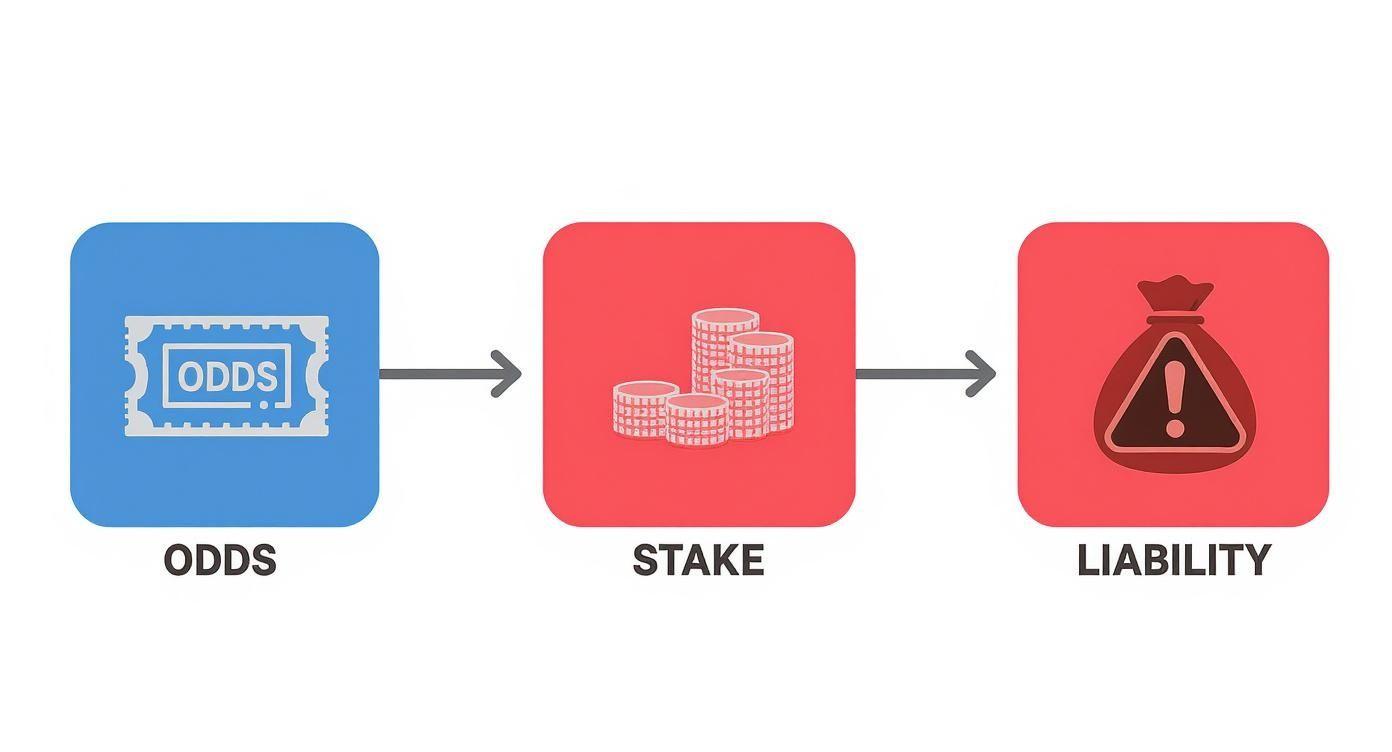
As you can see, the higher the odds, the more you have to risk to win the same backer's stake. This is why you always have to keep a close eye on your liability.
Step 4: Double-Check Your Liability and Confirm
Before you hit that final confirmation button, the bet slip will clearly show your potential profit (the £10 backer's stake) and your total liability. This is your last chance to make sure you are completely comfortable with the amount you stand to lose if you get it wrong and Liverpool wins.
Always pause at this step. Confirming a lay bet without fully understanding your liability is one of the most common and costly mistakes a newcomer can make.
Once you’ve given the numbers a final check and you’re happy with the risk, go ahead and confirm the bet.
Step 5: Understand Matched vs. Unmatched Bets
After you confirm, your bet doesn't instantly become "live." It has to be "matched" with a backer who is willing to take the other side of your wager.
- Fully Matched: Success! Your bet is on. Someone has accepted your offer.
- Unmatched: Your bet is just sitting in the market, waiting for someone to take it. This usually happens if the odds you offered aren't attractive enough or if there isn't enough liquidity (money) in that market yet.
- Partially Matched: Someone accepted part of your £10 offer, but the rest is still waiting to be matched.
This peer-to-peer process is what fuels betting exchanges across the globe. The scale of these operations is massive, with huge differences in market maturity. For instance, the Asia-Pacific region, including countries like China and Japan, represents the largest gambling market in the world. You can explore more global gambling statistics on Casino.org to get a sense of the scale. Finding active, liquid markets where your bets can get matched quickly is the key to successfully laying the odds.
Popular Strategies That Use Lay Betting
Getting the hang of laying the odds isn't just about learning a new bet type; it's like unlocking a whole new level of betting strategy. Once you can comfortably bet against an outcome, you open the door to much smarter ways of playing the market. For seasoned bettors, laying isn't just about opposing a team; it's a tool to engineer guaranteed profits or slash their risk.
These strategies shift your focus away from just trying to pick winners. Instead, you start hunting for value in market movements and inefficiencies. Let's walk through three of the most powerful and common approaches that have lay betting at their very core. Each serves a different purpose, but they all depend on the unique mechanics of a betting exchange.
Matched Betting for Guaranteed Profit
If you've heard of one lay betting strategy, it's probably Matched Betting. This is a mathematically sound method that cashes in on the free bets and promotions constantly offered by traditional bookmakers. The entire game is to set up a situation where you make a profit no matter what happens in the event.
The process is a simple two-step dance:
- The Back Bet: First, you place a qualifying bet with a bookmaker to trigger their free bet offer. For example, you back Team A to win.
- The Lay Bet: Then, you hop over to a betting exchange and lay the exact same outcome betting that Team A will not win.
By using a calculator to get your stakes right, you cover every possible result. This first pair of bets will result in a tiny, planned loss. But here's the magic: you’ve now unlocked a juicy free bet. You simply repeat the process with that free bet to lock in a guaranteed profit, often 80% or more of the free bet's value. It turns promotional offers from a gamble into a steady, reliable income stream.
Trading for In-Play Gains
Trading on a betting exchange works just like the stock market: buy low, sell high. In betting language, that translates to "back high, lay low." Your goal is to lock in a profit by taking advantage of odds movements before the event is even over.
Picture this: you back a tennis player to win at odds of 2.5. She plays brilliantly and wins the first set. Naturally, her odds of winning the match plummet, maybe down to 1.8. This is your moment. You can now lay the same player at these new, lower odds, creating a position that guarantees you a profit, regardless of who actually wins the match.
The whole point of trading isn't to be right about the final result. It's about being right about short-term odds movements and getting out with your profit before a last-minute comeback can ruin your day.
You can also do the reverse, known as "lay low, back high." If you think an outcome is overhyped and its odds are too short, you can lay it first. If the market agrees and the odds drift out to a higher price, you can back it at the bigger odds to secure your profit.
Laying a Weak Favorite
This is the most direct and intuitive way to use lay betting. It’s all about spotting a favorite that the market has overvalued. Maybe it’s a top football team playing away from home after a brutal midweek trip, or a star racehorse with a terrible record on muddy ground.
Instead of trying to figure out which of the dozen underdogs might pull off an upset, you can simply lay the weak favorite. This one bet effectively has you covered on every other outcome in the field. If anyone but the favorite wins, your bet is a winner. This strategy is all about finding vulnerability and exploiting it in the most efficient way possible. It takes sharp analysis, but it's an incredibly powerful tool for bettors who are good at spotting overhyped contenders.
How to Manage Your Risk and Protect Your Bankroll

When you step into the world of laying bets, you're taking on a completely different kind of financial responsibility. The potential for much higher liability means that disciplined risk management isn't just a good idea; it's absolutely essential if you want to have any long-term success on a betting exchange.
Without a rock-solid plan, it’s frighteningly easy to get carried away and expose your entire bankroll to unnecessary danger. One of the biggest traps for newcomers is the temptation to lay at crazy-high odds, which can create a dangerously large liability from what seems like a tiny stake.
The Danger of High-Odds Lays
Imagine you lay a longshot horse at odds of 50.0 for a backer's stake of just £10. The potential £10 profit might look tempting, but your liability would be a staggering £490. If that one bet goes wrong, it could wipe out a massive chunk of your funds in an instant.
This is exactly why a disciplined mindset is what separates successful exchange users from those who burn out in a week. You must have a clear framework for managing your funds before you even think about placing a bet.
The core principle of bankroll management is simple: never risk more than you can comfortably afford to lose. Your total liability on any single event should represent only a small, fixed percentage of your total bankroll.
Practical Tips for Risk Management
To protect your capital and actually stay in the game long enough to profit, you need to bake these non-negotiable rules into your strategy:
- Stick to a Staking Plan: Decide on a maximum percentage of your bankroll to risk on any single bet's liability, something like 1% or 2%, and never, ever exceed it.
- Start with Low Odds: When you're new to laying, stick to events with low odds. This is the best way to keep your liability manageable while you build confidence and get a feel for how it all works.
- Ensure Good Market Liquidity: Only place bets in popular markets where there's plenty of money being traded. This ensures you can get your bets matched and, crucially, exit a position if you need to. This is similar to the principles you'd apply when learning about hedging in sports betting, where market stability is key.
- Never Chase Your Losses: This is the golden rule. If a bet goes against you, accept it and move on. Trying to win it all back with bigger, riskier bets is the fastest way to an empty account.
Common Questions About Laying The Odds
Even after you get the hang of the basics, laying the odds can feel a bit counter-intuitive at first. It’s a total shift from the traditional betting mindset you’re used to, so it’s natural to have a few questions rattling around. Let's clear up some of the most common ones to help you get started with confidence.
Lots of bettors ask if they can lay a bet on pretty much any event. The answer is yes, as long as it's available on a betting exchange like Betfair. From the biggest football matches to niche political markets, if someone out there wants to back it, you can usually find an opportunity to lay it.
What Happens If No One Matches My Bet?
This is a big one. What happens when you offer a lay bet, but it just sits there, unmatched? If your odds aren't tempting enough for a backer, or if the market simply doesn't have much action (low liquidity), your bet will just remain an "unmatched" offer. The key thing to remember is that in this situation, your money isn't at risk. The bet just isn't active yet.
An unmatched bet is just an open offer waiting for a taker. Your liability is only ever locked in once another user on the exchange accepts your terms and the bet becomes "matched."
If your bet stays unmatched, you've got two simple options:
- Cancel it: You can pull your offer off the market at any time, no questions asked and no penalty.
- Adjust the odds: You can tweak your offer, making the price more attractive to coax a backer into matching it.
Is Laying Bets More Profitable?
Laying bets isn't automatically more profitable on its own, but it’s the key that unlocks a whole new world of smarter betting strategies. The real power comes from the sheer flexibility it gives you. It’s the engine behind powerful techniques like matched betting and in-play trading, which are designed to lock in profit by playing the market dynamics, rather than just trying to guess who will win.
By learning to lay the odds, you gain access to a far more tactical way of betting. It becomes less about pure luck and more about understanding value and managing risk which, at the end of the day, is the foundation of any long-term success on the exchanges.
At ValueBetFactory, we provide the tools and real-time alerts to help you spot these kinds of strategic opportunities. Our system finds odds discrepancies as they happen, giving you the edge you need to make more informed, value-driven decisions. Explore our plans and start betting smarter today.