
What Is a Betting Exchange Explained for Beginners
Unlock Profits with betting tips!
Think of the last bet you placed. You picked a team, went to a bookmaker, and took the odds they offered. It was a simple, one-way transaction: you against "the house." A betting exchange throws that entire model out the window.
Instead of a shop, imagine a bustling marketplace. A betting exchange is a peer-to-peer platform where you bet directly against other people, not a company trying to profit from your losses. It’s more like a stock market for sports, where you can either back an outcome you think will happen or lay one you believe won't.
A True Marketplace for Bettors
This small change in structure is a complete game-changer. When you bet against another person who holds the opposite opinion, the entire dynamic shifts. It’s no longer a static setup where a bookmaker dictates the prices. Instead, you're participating in a live market where the odds are shaped by the collective supply and demand of thousands of bettors.
This puts a huge amount of power back into your hands. You're not just a passive customer taking a price; you're an active participant in a marketplace.
How an Exchange Actually Works
At the heart of any betting exchange are two fundamental actions: backing and laying. Getting your head around these two concepts is the first real step to understanding this powerful way to bet.
Backing an Outcome: This is the bet you already know and understand. When you back a team, you're putting your money on them to win. It's the classic wager you'd place with any traditional bookmaker.
Laying an Outcome: This is where things get interesting. When you lay a team, you are betting that they will not win. This means your bet is a winner if that team loses or if the match ends in a draw. You are effectively playing the role of the bookmaker.
This peer-to-peer system creates an environment where odds are a genuine reflection of the market's opinion, not just a price set by a company with its profit margin baked in.
The Key Differences
The single biggest advantage of this model is the incredible value it offers. Since the exchange isn't betting against you, it doesn’t need to build a "house edge" into its odds. The exchange makes its money by taking a small commission, usually between 2% to 5%, only on a player's net winnings in a given market.
A betting exchange operates like a true marketplace. It connects people with opposing viewpoints on a sporting event and facilitates their wager, taking a small fee for providing the platform. This leads to fairer odds and gives bettors more strategic options.
This structure is precisely what makes platforms like Betfair so popular among serious bettors. The fair odds and strategic depth open the door to advanced strategies that are simply impossible with a standard bookie. You can learn more about this by exploring the unique benefits of why Betfair Exchange stands out as a critical tool for any sharp bettor.
Let's break down the core differences with a quick head-to-head comparison.
Betting Exchange vs Traditional Bookmaker at a Glance
This table gives you a quick snapshot of how these two models stack up against each other. It highlights the fundamental differences in how they operate and what that means for you as a bettor.
| Feature | Betting Exchange | Traditional Bookmaker |
|---|---|---|
| Who You Bet Against | Other bettors (peer-to-peer) | The bookmaker ("the house") |
| Odds | Set by market supply and demand | Set by the bookmaker, includes a profit margin |
| Betting Options | Back (betting an outcome will happen) and Lay (betting it won't) | Only Back (betting an outcome will happen) |
| How They Make Money | Small commission on net winnings (2%-5%) | Built-in profit margin ("overround") on all odds |
| Account Restrictions | Winners are welcome (they generate more commission) | Successful accounts are often limited or closed |
As you can see, the exchange model is built to be a neutral platform, while a traditional bookmaker has a direct financial interest in you losing your bet. This distinction is the foundation for finding better value and using more sophisticated strategies, which we'll dive into next.
The Core Mechanics: Backing and Laying Demystified
At the heart of any betting exchange are two simple but powerful actions that blow the doors off what a traditional sportsbook can offer: backing and laying. While one is familiar territory for any bettor, the other completely changes the game. Getting your head around both is the key to unlocking the true power of exchange betting.
This concept map breaks down the core relationship inside an exchange, showing how backers and layers create the two sides of every single bet.
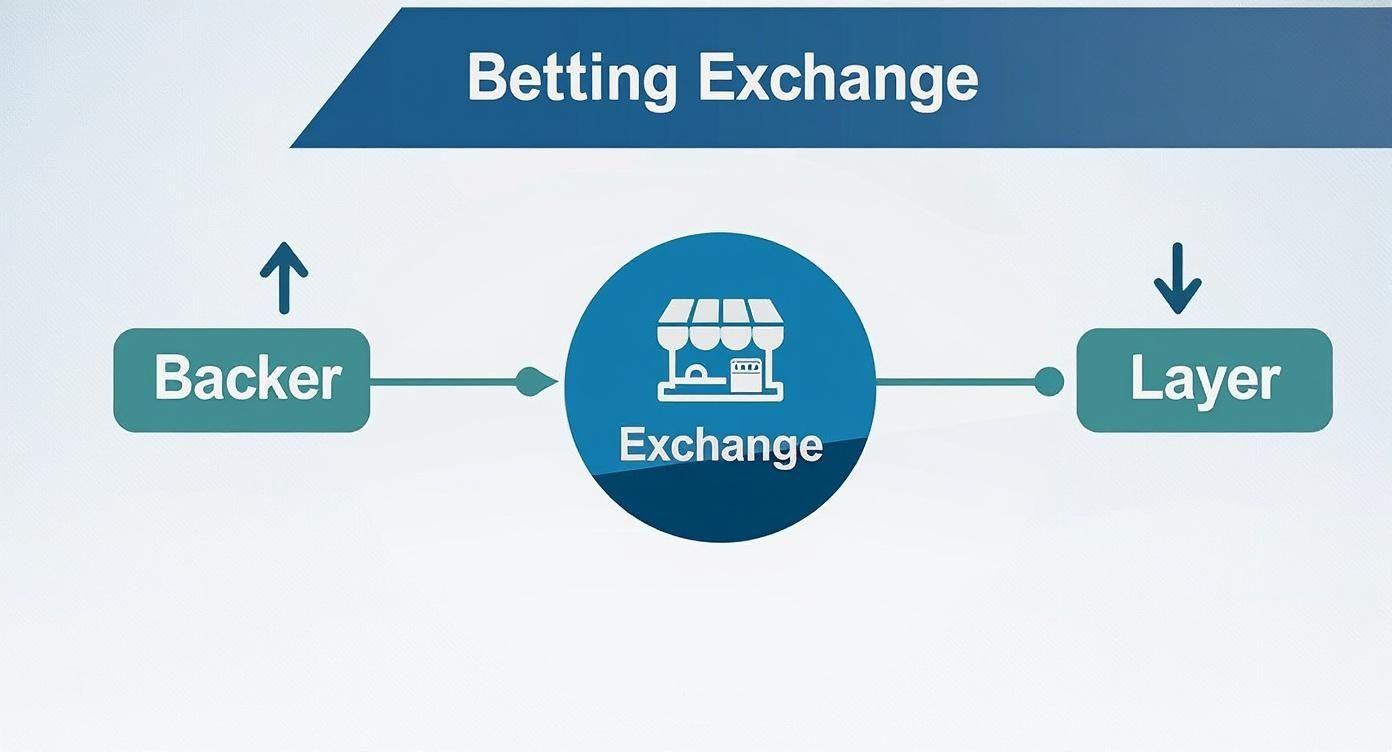
As you can see, the exchange is just the middleman. It’s a neutral platform connecting two opposing viewpoints, creating a dynamic and fair marketplace for everyone involved.
What Is Backing a Bet?
Backing a bet is the most straightforward concept in the world because you're already doing it. When you back an outcome, you are betting that it will happen. It’s the standard bet you place with any bookmaker, plain and simple.
For example, if you back Manchester City to win their match, your bet pays out only if they win. If they draw or lose, you lose your stake. It's a classic, direct wager on a positive result.
The Game Changer: Lay Betting
Now for the fun part. Laying a bet is the revolutionary feature of a betting exchange. When you lay an outcome, you are betting that it will not happen. You are stepping into the shoes of the bookmaker, taking the other side of someone else’s back bet.
This is where the power of an exchange truly shines. Let's stick with the Manchester City example:
- You lay Manchester City: You are betting they will not win the match.
- Your bet wins if: Manchester City loses OR the match ends in a draw.
- Your bet loses if: Manchester City wins the match.
This opens up a whole new world of strategic possibilities. Instead of needing to pinpoint a specific winner, you can profit from predicting an outcome you're confident won't occur. For a deeper dive into the numbers and strategy, check out our complete guide explaining back and lay odds in more detail.
By laying a bet, you are no longer limited to predicting winners. You can now profit from correctly identifying outcomes that are unlikely to happen, giving you a completely new angle to approach your betting strategy.
Understanding Your Liability
The freedom to lay bets comes with a critical concept you absolutely must understand: liability. When you back a bet, your risk is capped at your stake. If you bet $10, the most you can possibly lose is $10. Lay betting works differently.
Liability is the amount of money you could potentially lose if your lay bet goes wrong. It's the cash you'd have to pay out to the winning backer. The exchange calculates this for you before you ever confirm the bet, so you always know your exact exposure.
Let's say you lay a horse at odds of 4.0 for a $10 stake.
- Your potential profit is: $10 (the backer's stake).
- Your potential loss (liability) is: $30 ($10 stake x (4.0 odds - 1)).
Your $30 liability is held from your account balance to cover the potential payout if the horse wins. If the horse doesn't win, you collect the backer's $10 stake, and your $30 liability is returned to your balance.
Mastering the relationship between backing, laying, and liability is the first major step toward becoming a savvy exchange user.
Why Exchanges Offer Better Value Than Bookmakers
The real edge in betting comes to light when you pit a betting exchange against a traditional bookmaker. While they both let you place a bet, the way they work is fundamentally different, and that difference has a huge impact on your bottom line. Exchanges put more power, flexibility, and potential profit right back into your hands.
This isn't just some niche trend, either. The exchange betting market was valued at USD 17,033.8 million and is on track to nearly double to USD 34,742.5 million by 2030. That kind of growth tells you everything you need to know: serious bettors are moving toward the transparency and value of peer-to-peer platforms. You can dig into the data yourself and read the full research about exchange betting growth.
So where does all this extra value come from? It all boils down to three key areas: the odds, the business model, and the flexibility you get as a user.
Better Odds Through Fairer Pricing
The most obvious advantage of using an exchange is the quality of the odds. A traditional bookmaker is your opponent. They're betting against you, so they have to build a profit margin, known as the "overround" or "vig", directly into their prices to guarantee they win over the long run.
An exchange, on the other hand, is just a neutral marketplace. It's there to connect you with another bettor who wants to take the opposite side of your bet. Since the exchange has no financial stake in who wins or loses, it doesn't need to bake a profit margin into the odds. The prices you see are a true reflection of market supply and demand.
A betting exchange is like a stock market where prices are set by buyers and sellers. A bookmaker is like a currency exchange booth at an airport that builds its profit into the exchange rate. The former offers a fairer market price, while the latter guarantees itself a cut.
Because there's no built-in margin, the odds on an exchange are consistently better than what a bookmaker can offer, even after you account for the small commission paid by the winner. Over hundreds of bets, those small differences in price add up to a massive impact on your overall profit. To see the numbers behind this, you can learn more about how we calculate no-vig fair odds.
A Different Business Model
The way these platforms make their money tells you everything you need to know about their relationship with you. Their goals are worlds apart, and that directly impacts your experience.
Bookmaker's Goal: A bookmaker makes a profit when you lose. Their entire business is built on setting odds that ensure they take in more money than they pay out. As a result, they see consistently winning bettors as a liability and will often limit their stakes or even close their accounts.
Exchange's Goal: An exchange makes a profit when you win. They take a small commission (usually 2% to 5%) on a user's net winnings in a market. This means their interests are aligned with yours. They want active, successful traders on their platform because winning bettors generate commission.
This difference is absolutely critical. On an exchange, you are never punished for being good at what you do.
Unmatched Flexibility and Control
Beyond the better odds and fairer business model, exchanges give you a level of strategic flexibility that bookmakers just can't touch. You're no longer just a price-taker, forced to accept whatever odds are on the screen. You become an active participant in the market.
This control shows up in a few powerful ways:
- Lay Betting: The ability to bet against an outcome opens up a whole new world of strategies.
- Set Your Own Odds: You don't have to take the current price. You can request better odds and wait for another user to come along and match your offer.
- In-Play Trading: The peer-to-peer model is perfect for dynamic in-play trading. You can back a team at high odds before a match and then lay them at lower odds during the game to lock in a guaranteed profit, no matter who wins.
This potent combination of better odds, a pro-customer business model, and deep strategic flexibility is why so many serious bettors consider exchanges an essential part of their toolkit.
Understanding Market Liquidity and Why It Matters
Ever walked into a bustling farmers' market, buzzing with vendors and shoppers haggling over prices? Now, imagine another market on a quiet side street with just a couple of stalls. The first one is lively, making it easy to buy or sell whatever you want, right away, at a fair price.
That energy, that flurry of activity, is exactly what we call liquidity in the world of a betting exchange.
Simply put, liquidity is the amount of money waiting to be matched on a specific outcome. It's the total cash sitting there from all the unmatched back and lay bets, ready to trade. This pool of money is the absolute lifeblood of an exchange; without it, the whole system grinds to a halt.
The Impact of High vs. Low Liquidity
The amount of liquidity in a market has a direct and massive impact on your betting. When a market has high liquidity, it means there are tons of active bettors with plenty of money ready to go. This creates a stable, efficient environment where getting your bets matched is quick and painless.
On the flip side, a market with low liquidity is a ghost town. There are fewer people and less cash floating around. In these markets, you might really struggle to get a bet matched, especially if you're trying to place a larger stake. The odds can also be far more volatile, jumping around like crazy with every small bet that gets taken.
Liquidity is the essential ingredient that makes a betting exchange work smoothly. High liquidity ensures that you can get your bets, both large and small, accepted quickly and at stable, fair market odds. Without it, the exchange would feel like an empty store with nothing on the shelves.
To really see what this means, let's look at a couple of real-world scenarios.
High-Liquidity Example (World Cup Final): The final match of the FIFA World Cup will have millions of dollars available on the main outcomes. Thousands of people are backing and laying the result, creating deep pools of cash at very tight odds. You could easily place a $5,000 bet and have it swallowed up instantly without budging the price.
Low-Liquidity Example (Obscure Tennis Match): A low-level ITF tennis match might only have a few hundred dollars of available money across all outcomes. If you tried to place a $500 bet, you'd likely find there isn't enough money to match you at the current odds. You'd have to accept worse odds or just sit and wait, hoping someone else comes along.
How to Read Market Depth
One of the most powerful features of an exchange is its transparency, as it shows you exactly how much money is available. This information, often called market depth, is usually displayed right underneath the main back and lay odds for each outcome. It tells you the exact amounts of cash waiting to be matched at the next few price points.
By glancing at these figures, you can instantly tell if a market is healthy or not. If you see thousands of dollars available to back and lay at the top three odds, you know it's a liquid market. But if you only see tiny amounts like $15 or $50, you know the market is "thin," and you should be careful about placing larger stakes.
Learning to read market depth is a crucial skill. It empowers you to make smarter, more informed decisions before you ever risk a penny.
Powerful Strategies for Exchange Betting and Trading
Knowing how a betting exchange works is one thing, but putting that knowledge into practice is where the real magic happens. The peer-to-peer marketplace opens up powerful strategies that just aren't possible with a traditional bookmaker. These methods take advantage of the unique ability to both back and lay outcomes, turning simple wagers into a much more dynamic form of trading.
Unlike the old "bet and hope" model, exchange strategies often focus on locking in a profit no matter what the final score is. You start to see the odds not as a simple price but as a fluctuating market. This lets you buy low and sell high, just like a stock trader.
Let's break down some of the most effective approaches.
Master Sports Trading
Sports trading is the art of placing back and lay bets on the same outcome, but at different odds, to guarantee a profit before the event is even over. The goal is simple: back an outcome at a high price, then lay it at a lower price as the market moves in your favour.
Imagine you're watching a tennis match. A player starts with back odds of 2.5. You place a $100 back bet, giving you a potential return of $250 (for a $150 profit). After they storm through the first set, their odds of winning drop to 1.8.
This is your moment to trade out. You can now place a lay bet against them at these new, lower odds. This move creates what traders call a "green book," where you've locked in a profit regardless of who ultimately wins the match. It's a brilliant way to capitalise on those in-play momentum swings.
Unlock Matched Betting
Matched betting is a mathematically proven, low-risk strategy for turning the free bets and bonuses offered by traditional bookmakers into real cash. It works by using an exchange's lay function to cover every possible outcome of an event, effectively cancelling out any risk.
The process boils down to two simple steps:
- The Qualifying Bet: You place a back bet with a bookmaker to unlock their free bet offer. At the same time, you place a lay bet on the exact same outcome on a betting exchange. This cancels out your risk, usually for a tiny loss of just a few pennies.
- Using the Free Bet: Once the bookie gives you the free bet, you repeat the process. You back an outcome with the free stake and lay the same outcome on the exchange. Since you aren't risking your own cash on the back bet, the formula guarantees you a profit of around 80% of the free bet's value, no matter what happens.
Matched betting isn't really gambling. It's a calculated process that uses the mechanics of a betting exchange to convert bookmaker promotions into withdrawable money.
Find True Value Spotting
Value spotting is the purest form of strategic betting. It's all about finding odds on an exchange that are higher than the true, real-world probability of that outcome happening. While a bookie's odds always have a profit margin baked in, exchange odds are set by the market, and sometimes, the market gets it wrong.
For instance, after doing your homework on a football match, you determine a team has a 50% chance of winning, which translates to true odds of 2.0. But on the exchange, you find back odds of 2.2 available. That's a value bet.
Consistently placing wagers where the odds are tilted in your favour is the absolute cornerstone of long-term profitability. This requires a sharp analytical eye, but tools like ValueBetFactory are built to do the heavy lifting for you by scanning markets and comparing exchange odds to true probability, pinpointing these opportunities in real-time.
The rise of mobile-first platforms has made these strategies more accessible than ever. Betting exchanges have seen accelerated adoption thanks to platform innovation and sophisticated data analysis, which are central to the modern sports betting industry. The fastest-growing channels are mobile apps and online platforms, where live streaming and real-time betting fuel user engagement. You can explore more about the growth of the global sports betting industry to see how technology is shaping the market.
Key Risks and How to Bet Responsibly
The freedom a betting exchange gives you is incredible, but it also comes with a few unique responsibilities. Understanding the potential pitfalls is just as important as learning the winning strategies. A smart bettor faces the risks head-on to make sure they can navigate this world safely and for the long haul.
One of the first surprises for newcomers is the unmatched bet. You might try to place a wager in a market with low liquidity, only to find there's no one on the other side to take your action. Your bet just sits there, "unmatched," until someone agrees to your terms. If nobody does, the bet is simply cancelled, and your stake is returned.
The Critical Concept of Lay Liability
While an unmatched bet is just a minor hassle, the single biggest financial risk on an exchange comes from lay betting. When you lay an outcome, you're betting it won't happen. This means your potential loss, or liability, can be much, much larger than the small stake you're trying to win. If your lay bet loses, you're on the hook for paying out the backer's winnings.
This is a risk you absolutely must manage. For instance, laying a massive longshot at odds of 50.0 for just a $10 stake would make you liable for a staggering $490 payout if that underdog pulls off an upset. Always, always check your total liability before you confirm a lay bet.
The freedom to act as the bookmaker comes with the bookmaker's risk. Never lay a bet without fully understanding and accepting your total potential liability if the outcome goes against you.
Responsible Betting Principles
Staying in control is the bedrock of any long-term success. The global sports betting market is ballooning, with some projections suggesting it could hit around USD 261.34 billion by 2034. This explosive growth makes it more important than ever to participate responsibly. You can check out more details on these market trends on GlobeNewswire.
To bet responsibly on an exchange, stick to these core principles:
- Only Bet What You Can Afford: Your betting bankroll should be money you are completely prepared to lose without it affecting your life.
- Use Platform Tools: Good exchanges offer safety features like deposit limits, loss limits, and self-exclusion options. Use them. They're there to help you enforce your own rules.
- Understand Commission: Don't forget that a small percentage of every net win on a market is paid in commission. You have to factor this into your calculations to get a true picture of your profit and loss.
By respecting these risks and sticking to these principles, you can take full advantage of everything a betting exchange has to offer while keeping your activity safe, smart, and enjoyable.
Frequently Asked Questions About Betting Exchanges
Diving into a betting exchange for the first time always brings up a few questions. This section is all about giving you clear, straightforward answers to the things bettors wonder most when getting started. Our goal here is to knock down any last hurdles and get you betting with complete confidence.
We've already walked through the core ideas, from backing and laying to what market liquidity means. Now, let's get into the nitty-gritty questions that usually pop up right before you place that first wager.
Can You Lose More Than Your Stake on an Exchange?
Yes, you can, but only when you place a lay bet. Your potential loss on a lay bet is known as your liability. This is the total amount you’d have to pay out if the team or player you bet against actually wins. The good news is, this amount is always calculated and shown to you upfront before you ever confirm the bet.
When it comes to back bets, the risk is exactly the same as with a traditional bookmaker. The most you can possibly lose is the stake you put down.
How Is Commission Calculated on an Exchange?
Commission is simply the small fee an exchange charges for providing the platform that connects you with other bettors. It's how they make their money. The crucial thing to remember is that commission is almost always charged only on your net winnings for a specific market, not on your stake and never on losing bets.
For example, let's say you place a few bets on a single football match and walk away with $100 in net profit. With a 5% commission rate, the exchange would take $5, and you'd pocket the remaining $95. If you end up with a net loss on that same market, you don't pay a single cent in commission.
Are Betting Exchanges Legal and Safe to Use?
Absolutely, as long as they operate in a region where online betting is properly regulated. All the big, reputable exchanges are licensed and monitored by strict governing bodies, like the UK Gambling Commission. These licenses are your guarantee that the platform plays fair and that your funds are kept safe in protected, segregated accounts.
Before you sign up for any exchange, always do a quick check to make sure it holds a valid license in your country or state. It’s the single best way to ensure you're getting a safe and fair betting experience.
Ready to stop betting against unfair bookmaker margins and start finding true market value? ValueBetFactory uses powerful algorithms to scan exchanges and pinpoint odds that give you a statistical edge. Sign up today and let our real-time alerts guide you to smarter, data-driven wagers. Discover your next value bet at ValueBetFactory.