
The Kelly Criterion Your Ultimate Betting Guide
Unlock Profits with betting tips!
The Kelly Criterion is a game-changer for serious bettors. At its core, it's a mathematical formula that tells you the optimal percentage of your bankroll to wager on a single bet, all with the goal of maximizing long-term growth.
It answers the single most critical question every bettor faces: exactly how much should I stake? This isn't just about picking winners; it's about managing your money like a professional. The formula stops you from staking too little on a great opportunity or, even worse, betting too much and wiping out your bankroll on a risky play.
Why Smart Bettors Rely on The Kelly Criterion

Ever been stuck in that classic betting trap? You either bet too small and miss out on a massive payout, or you go too big and risk everything on one unlucky result. It's a dilemma that haunts nearly every bettor. Thankfully, there’s a mathematical solution that takes the guesswork out of the equation.
The Kelly Criterion is that solution. It's much more than a simple formula; it's a complete staking philosophy. Its entire purpose is to calculate the perfect bet size to grow your bankroll as efficiently as possible over the long haul. Think of it as a smart risk management system built right into your betting strategy.
The Unlikely Origin of Optimal Staking
Here’s a fun fact: the Kelly Criterion wasn't born in a casino or a sportsbook. It came out of a research lab.
Back in 1956, a brilliant scientist at Bell Labs named John Larry Kelly Jr. was working on a problem involving signal noise over long-distance telephone lines. He had a breakthrough insight. He realized that trying to find a clear signal through static was mathematically identical to a gambler trying to find their edge in a "noisy" betting market.
This connection led him to create a powerful formula for sizing bets to maximize long-term wealth. Its genius was quickly recognized, and its use expanded from gambling to the world of high-stakes investing, with legends like Warren Buffett reportedly using its core principles.
The central idea is both simple and profound: The size of your bet should be directly proportional to the size of your edge. A bigger advantage means you can justify a bigger—but still carefully calculated—risk.
This single principle is what separates disciplined, successful bettors from those who just go with their gut. It forces you to operate with pure logic and removes the emotion that so often leads to poor financial decisions.
A Framework for Long-Term Success
When you start using the Kelly Criterion, it fundamentally changes how you approach betting. This isn't some get-rich-quick scheme. It’s a blueprint for sustainable growth and protecting your capital.
By adopting this method, you gain several huge advantages:
- Smart Risk Management: It automatically tells you to bet less when your edge is small and more when your edge is large. No second-guessing.
- Built-In Bankroll Protection: The formula is designed to prevent you from going broke. It will never tell you to wager your entire bankroll on a single bet.
- Data-Driven Decisions: It makes you quantify your perceived advantage, forcing you to replace emotional hunches with objective numbers.
This formula links the fraction of your capital to wager (f*) directly to your probability of winning (p) and the odds you're getting (b). This mathematical relationship is the key to unlocking optimized, long-term bankroll growth.
Decoding The Kelly Criterion Formula
At first glance, the math behind the Kelly Criterion can look a bit intimidating. But once you pull back the curtain, you’ll find it’s a surprisingly simple and logical tool. It's designed to turn your betting insights into a precise, disciplined staking plan. Let's ditch the academic speak and break this down into something any serious bettor can use.
The most common version of the formula looks like this:
f = (bp - q) / b*
This little equation calculates f*, which is the ideal fraction of your bankroll you should wager on a particular bet. Let’s decode each piece so you can see exactly how it connects to your day-to-day betting decisions.
Translating Math Into Betting Logic
Every variable in the Kelly formula represents a core piece of information you already think about when placing a bet. This isn't just abstract mathematics; it's a way of asking, "Is this bet truly worth the risk, and if it is, how much should I put on the line?"
The image below shows how your estimated win probability and the bookmaker's odds work together to give you the final Kelly stake.
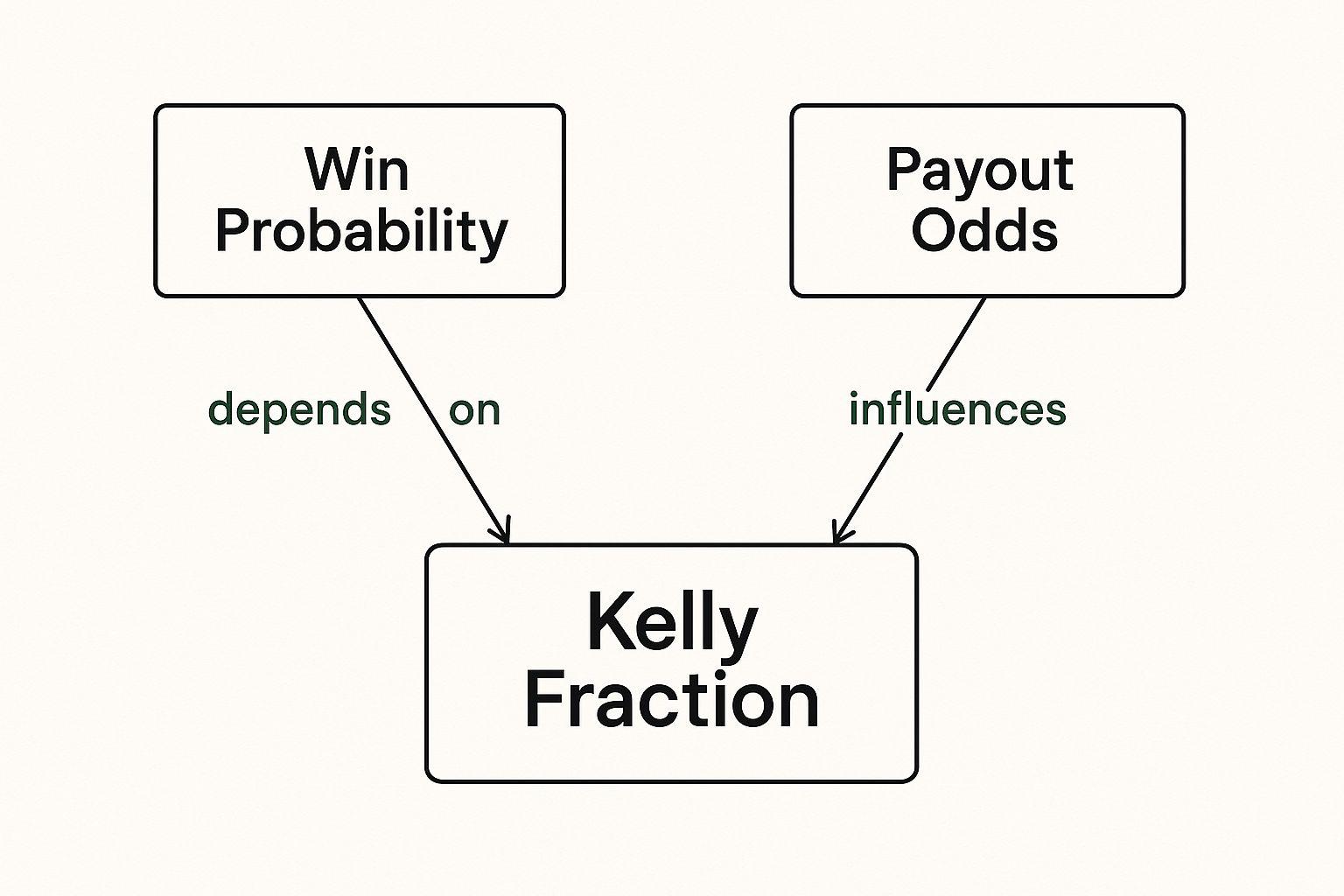
As you can see, the Kelly fraction is a direct result of the two most critical inputs you have: your own read on the game and the reward the market is offering.
To make this crystal clear, let's break down each variable in the formula.
Kelly Criterion Formula Components Explained
This table translates each mathematical symbol into a real-world betting concept.
| Variable | What It Represents | Example in Betting |
|---|---|---|
| f* | The optimal fraction of your bankroll to wager. | If f* = 0.05, you should bet 5% of your total bankroll. |
| b | The decimal odds offered by the bookmaker, minus 1. This is your potential profit. | If odds are 2.50, your profit on a $1 stake is $1.50. So, b = 1.50. |
| p | Your estimated probability of the bet winning. This is your personal assessment. | Your analysis suggests a team has a 60% chance to win, so p = 0.60. |
| q | Your estimated probability of the bet losing. It's always 1 minus p. | If your win probability (p) is 0.60, then q = 1 - 0.60 = 0.40. |
At its heart, the formula performs a powerful cost-benefit analysis for every single wager. It weighs your perceived edge against the potential payout. If you don't have an edge, the formula will tell you the smartest move is to not bet at all.
A Real-World Football Match Example
Let’s see how this works with a practical example. Imagine you're eyeing the "Over 2.5 Goals" market for an upcoming match between Manchester City and Arsenal.
The bookmaker is offering decimal odds of 2.00.
After doing your homework—digging into team form, recent offensive stats, and historical head-to-heads—you believe the true probability of the game having over 2.5 goals is 53%. You've found your edge. Now, let's plug these numbers into the formula.
Step 1: Define Your Variables
- p (Probability of Winning): Your analysis gives you 53%, so p = 0.53.
- q (Probability of Losing): This is simply 1 - 0.53, so q = 0.47.
- b (Decimal Odds minus 1): The odds are 2.00, so b = 2.00 - 1, which means b = 1.
Step 2: Calculate the Kelly Fraction (f*)
Now we just need to put the pieces together using the formula: f* = (bp - q) / b
- f* = (1 * 0.53 - 0.47) / 1
- f* = (0.53 - 0.47) / 1
- f* = 0.06 / 1
- f* = 0.06
The result is 0.06. This means the Kelly Criterion recommends you stake exactly 6% of your current bankroll on this bet. If you have a $1,000 bankroll, your stake should be $60. Just like that, you’ve turned your expert opinion and the market odds into an objective, data-driven bet size.
The Strategic Advantages Of A Kelly Staking Plan

So, why go through the trouble of using the Kelly Criterion? It’s about much more than just trying to squeeze out extra profit. It's about building a disciplined, intelligent framework for managing risk right into the heart of your betting strategy. Think of it as upgrading your approach from hopeful guessing to a systematic, professional operation.
Perhaps the biggest upside is how it strips destructive emotions like greed and fear out of the equation. When every stake is tied directly to your perceived edge—to the data—you're forced to make decisions based on cold, hard logic. That methodical approach is what separates the pros from the amateurs.
An Automatic Defense For Your Bankroll
One of the most elegant features of the Kelly Criterion is its built-in bankroll protection. It’s like having an automatic defense system that adjusts to your performance in real-time.
Hit a winning streak, and your bankroll grows. The Kelly formula naturally calculates larger stakes, allowing you to press your advantage and capitalize on the momentum. But, more importantly, when you hit an inevitable downswing, your bankroll shrinks. The formula responds by automatically reducing your stake sizes.
This dynamic scaling is your best friend during a losing streak. It keeps you from making the classic mistake of "chasing" your losses with bigger, emotionally-charged bets—a habit that can wipe out a bankroll in no time.
In essence, the Kelly Criterion makes it mathematically impossible to go completely broke on a single bet, ensuring you never risk too much after a loss. Preserving your capital during the tough stretches is the key to long-term survival and, ultimately, growth.
Superior Long-Term Growth Simulation
To see this in action, let's picture two bettors. Both start with a $1,000 bankroll and place the same 100 bets. Each bet has a 55% chance of winning at odds of 2.00.
- Bettor A (Flat Staking): This bettor wagers a fixed $50 (5% of their initial bankroll) on every single bet, no matter what.
- Bettor B (Kelly Staking): This bettor uses the Kelly formula, which calculates an optimal stake of 10%. They risk 10% of their current bankroll on each bet.
After 100 bets, a simulation of their results would likely show a dramatic difference.
A Hypothetical Outcome After 100 Bets
| Bettor | Staking Method | Potential Bankroll | Key Behavior |
|---|---|---|---|
| Bettor A | Fixed $50 Stake | ~$1,250 | Growth is slow and linear, vulnerable to bad runs. |
| Bettor B | Kelly Criterion | ~$1,800+ | Aggressive growth that compounds, with built-in protection. |
While Bettor A did make a profit, their growth is flat and doesn't compound efficiently. Bettor B, on the other hand, benefits from superior geometric growth. Their stakes got bigger as their bankroll grew and smaller when it dipped, leading to a much healthier balance in the end. This is a perfect example of how a Kelly staking plan doesn't just protect your money—it actively maximizes its growth over the long haul.
Understanding The Risks and Limitations
While the Kelly Criterion is a phenomenal tool for growing your bankroll over the long haul, it's certainly not a magic crystal ball. Think of it like a powerful piece of machinery—its effectiveness comes down to how well you operate it. Knowing the risks and limitations is just as important as knowing the formula itself.
The biggest pitfall is the classic "Garbage In, Garbage Out" problem. The Kelly formula hinges on one critical input that you have to provide: the true probability of winning (p). Get that number wrong, and the entire calculation is thrown off.
If you’re overconfident and consistently overestimate your chances, Kelly will suggest dangerously large stakes. This can chew through a bankroll in no time, turning a tool designed for capital preservation into one that speeds up your losses. The formula can't tell if your probability estimates are wishful thinking; it just crunches the numbers you give it.
The Aggressive Nature of Full Kelly
Even if your probability estimates are spot on, using the "full Kelly" fraction can be a rollercoaster. It’s mathematically proven to be the fastest way to grow your funds over time, but it comes with a heavy dose of volatility. You have to be ready for some truly gut-wrenching drawdowns.
Following a full Kelly strategy isn't for the faint of heart. A long losing streak—which is a statistical certainty for every single bettor—can cause massive, though temporary, hits to your bankroll. For most people, that kind of pressure is psychologically crushing.
This is precisely why very few professional bettors use the full Kelly fraction. The raw mathematical optimum is often too aggressive for the real world, where managing your own emotions is a huge part of long-term success.
This psychological battle is a key reason why so many experienced bettors opt for a more conservative path. It’s all about striking a balance between optimal growth and your personal tolerance for risk.
Fractional Kelly: The Professional's Choice
This is where Fractional Kelly enters the picture. It’s the pro’s answer to the volatility problem, and it’s beautifully simple: instead of betting the full percentage the formula suggests, you just bet a fraction of it.
Common Fractional Kelly strategies look like this:
- Half Kelly (50%): If the formula spits out a 10% stake, you bet 5%.
- Quarter Kelly (25%): For that same 10% suggestion, you’d bet just 2.5%.
This simple tweak dramatically smooths out the journey. Your bankroll will grow a bit more slowly than with a full Kelly approach, but you massively reduce the size of those scary drawdowns. This makes the whole process far less stressful and much more sustainable. You still get the core benefit of Kelly—sizing your bet based on your edge—but with a crucial safety net built in.
This concept is vital when applying what we teach in our guide on finding true value in betting, as it helps you protect your capital even when you know you have a solid edge.
Evolving the Formula for Real-World Use
The central challenge—getting that probability estimate right—has pushed people to refine the formula over the years. Modern variations have been developed to account for the uncertainty in both win probabilities and payout odds.
For instance, some research into sports wagering has introduced models where the betting fraction changes as you gather more data. Think of it like a Bayesian approach: as you place more bets and gain more evidence, your confidence in your edge grows, and your bet sizing slowly gets closer to the original Kelly recommendation. You can dive deeper into these dynamic betting fraction models in the academic papers.
At the end of the day, the Kelly Criterion is a framework, not a set of commandments. A smart bettor knows its output needs to be filtered through common sense, a conservative Fractional Kelly strategy, and an honest look at how good you really are at predicting outcomes.
How to Put the Kelly Criterion Into Practice Today

Alright, let's move from theory to action. Understanding the math is one thing, but actually weaving it into your daily betting routine is where the magic happens. This is your practical playbook for getting started with the Kelly Criterion and turning those abstract formulas into a concrete staking plan.
First things first, there's one absolute prerequisite: you must have a consistent way to find value bets. This simply means you need a reliable method for estimating your own win probabilities to compare against the bookmaker's odds. Without an accurate "p" (your probability of winning), the Kelly formula is just a shot in the dark.
Fortunately, you don't have to do all the heavy lifting yourself. Modern tools, like the odds comparison and value betting software from ValueBetFactory, can scan the market for you. They pinpoint those golden opportunities where your probability of winning is higher than what the odds imply, giving you the exact data you need to fuel your Kelly staking plan.
A Step-by-Step Implementation Guide
Let's walk through a real-world example from start to finish. We'll see how to spot a value bet, pull together the numbers, and plug them into a Kelly calculator to determine your ideal stake.
Scenario: You’re looking at an upcoming Premier League match.
1. Find the Value Bet and Grab the Data Your first job is to find an edge. Whether you use a software tool or your own detailed analysis, you've identified a bet with positive expected value (+EV).
- The Bet: "Both Teams to Score - Yes"
- Bookmaker's Odds: 2.10 (in decimal format)
- Your Probability Estimate (p): Your model tells you the true probability is 50%.
2. Calculate the Variables for the Formula Next, we need to convert this information into the inputs the Kelly formula understands.
- p (Win Probability): 50% becomes 0.50
- q (Loss Probability): This is just 1 - p, so 1 - 0.50 = 0.50
- b (Decimal Odds - 1): 2.10 - 1 = 1.10
3. Plug Everything into the Kelly Formula With all our variables ready, we can solve for f**, the recommended stake percentage.
- Formula: f* = (bp - q) / b
- Calculation: f* = (1.10 * 0.50 - 0.50) / 1.10
- Result: f* = (0.55 - 0.50) / 1.10 = 0.05 / 1.10 ≈ 0.0454
The formula suggests you should stake 4.54% of your entire bankroll on this single bet.
Choosing Your Kelly Fraction
That 4.54% stake is what's known as full Kelly. As we've touched on, this can be incredibly aggressive and lead to some wild swings in your bankroll. This brings us to the most critical decision you'll make as a serious bettor: choosing a Kelly fraction that you can stomach.
A full Kelly might be mathematically "optimal" for pure growth, but a Fractional Kelly is optimal for your sanity and long-term survival. Most pros settle on a fraction to smooth out the ride.
Let's see how that 4.54% stake changes with a couple of common fractions:
- Half Kelly (50%): 0.0454 * 0.50 = 2.27% of your bankroll
- Quarter Kelly (25%): 0.0454 * 0.25 = 1.14% of your bankroll
By using a Quarter Kelly, you still get the main benefit—a dynamic plan that bets more on better opportunities—but you dramatically cut down the risk of those gut-wrenching drawdowns. You can find more detail on this in our complete Kelly Criterion betting guide.
Bankroll Management Best Practices
Finally, a few words on good bankroll habits. How often should you update your bankroll total for these calculations? You could do it after every single bet, but honestly, that's a huge pain and not really necessary.
A much more practical approach is to recalculate your total bankroll at the start of each day or betting session. This keeps your stakes proportional to your current capital without driving you crazy with constant admin.
While the Kelly Criterion was born from the world of discrete wagers, its core ideas are remarkably versatile. One study of European stock markets found that Kelly-based portfolio management led to better long-term wealth growth than more traditional methods. This isn't just a betting tool; it's a powerful framework for managing risk and growth in any scenario involving probability and payoff.
By following these steps, you build a disciplined system that takes emotion out of the equation, manages risk intelligently, and sets your bankroll up for consistent, long-term growth.
Frequently Asked Questions About The Kelly Criterion
It’s only natural to have a few questions when you’re thinking about using a new strategy like the Kelly Criterion. It's a genuinely powerful tool, but let's be honest—getting it to work in the real world can be a bit tricky at first. This section is all about clearing up the common sticking points and myths so you can start using the formula with confidence.
We’ll dig into everything from whether it’s a good fit for a newcomer to why you almost never see a pro using the full, unadjusted version. The aim here is to give you clear, practical answers that help you weave this staking plan into your betting routine.
Is The Kelly Criterion Good For Beginners?
The short answer is: it depends. While the Kelly Criterion is incredibly powerful, it’s really best suited for bettors who have a reliable way to estimate their probability of winning. For someone just starting out, the biggest hurdle is getting that ‘p’ value right. If your probability estimates are off, the formula will give you bad advice, leading to poor staking decisions.
My advice for beginners is to first get really good at finding value. Once you're confident you can spot an edge consistently, then it's time to think about staking. A great way to start is with a conservative 'Fractional Kelly', like using just 25% of the suggested stake. This lets you introduce disciplined staking without exposing your bankroll to unnecessary risk.
The Kelly Criterion’s output is only as good as the data you put into it. Your first priority should always be the quality of your probability estimates.
What Is Fractional Kelly And Why Is It So Popular?
Fractional Kelly is simply a more cautious, modified version of the main formula. Instead of wagering the full percentage the formula spits out, you only bet a fraction of it—say, 50% for "Half Kelly" or 25% for "Quarter Kelly."
So, why is this the go-to for most sharp bettors? It all comes down to managing volatility. The full Kelly formula, while theoretically optimal for growing your bankroll, is brutally aggressive in practice. It can create wild swings in your bankroll that are mentally draining, even for the most seasoned professionals.
Adopting a Fractional Kelly approach gives you several huge advantages:
- It smooths out the ride, leading to more stable, predictable growth.
- It dramatically cuts down the size of your drawdowns during a losing run.
- It makes the entire strategy more sustainable and practical for long-term betting.
This simple tweak lets you keep the best part of the Kelly Criterion—sizing your bets based on your edge—while shielding yourself from its inherent aggression.
How Is The Kelly Criterion Better Than Fixed Staking?
Fixed staking, where you bet the same amount on every wager, is simple, but it's also inefficient. The Kelly Criterion is a dynamic staking model, and that's what gives it a massive leg up for long-term growth.
The key difference is that Kelly adjusts your stake to match the size of your edge. When you’ve identified a fantastic opportunity with a big advantage, you risk more. When the edge is slim, you risk less. This approach optimizes your bankroll to squeeze the most profit out of your best bets.
Fixed staking, on the other hand, treats every single bet as if it has the same value, which is almost never true. Over the long haul, a well-managed Kelly strategy will almost always crush a fixed staking plan because it compounds your winnings more effectively.
How Often Should I Recalculate My Bankroll For Kelly?
There’s no single right answer here, but a common-sense approach that works for most people is to recalculate your bankroll at the start of each day or each betting session. While you could update your bankroll after every single bet, it’s a lot of work for very little extra benefit.
The main goal is just to make sure your stake sizes are a reasonable reflection of your current capital. Updating daily or per session strikes a perfect balance between staying accurate and being practical.
Ready to stop guessing and start calculating your optimal stakes? ValueBetFactory provides the tools you need to find value bets and apply the Kelly Criterion like a pro.