
How to Win Football Bets With Data Driven Strategies
Unlock Profits with betting tips!
Wondering how to win football bets? The short answer is to stop treating it like a lottery and start treating it like an investment. It’s all about swapping gut instinct for data-driven analysis, hunting for undervalued odds, and managing your risk like a professional.
Moving Beyond Luck With Smart Football Betting
Most bettors throw money at football wagers based on a mix of fan loyalty and pure guesswork, just hoping for a lucky break. While that can be fun for a while, it's a terrible formula for making any real profit.
The path to consistently winning football bets starts with a fundamental shift in mindset: you have to stop gambling and start investing.
This means you’re no longer searching for "sure things" (they don't exist). Instead, your entire focus shifts to finding value. A value bet is any wager where you believe the real probability of something happening is higher than the odds the bookie is offering. Spotting these opportunities requires a disciplined, analytical approach-not an emotional one.
Adopting a Professional Mindset
Embracing this new perspective means committing to a few core principles. You have to be willing to do the analytical homework, honestly track your performance, and stay completely detached from short-term wins and losses.
- Data Over Drama: Your decisions need to come from statistical models, team performance metrics, and historical data-not from media hype or your personal biases.
- Risk Management is Key: You absolutely must implement a strict bankroll management strategy. This is what protects your capital during the inevitable losing streaks.
- Long-Term Focus: Success isn't measured over one weekend. It's measured over hundreds of bets. A pro knows that profitability is a marathon, not a sprint.
Here's a reality check: a 55% win rate over the long haul is the mark of an exceptionally skilled bettor, not the unrealistic 70-80% often promised by tipsters. That small edge, compounded over time, is what separates the professionals from the amateurs.
Before diving into specific strategies, it’s crucial to internalize the core ideas that underpin a winning approach. The table below breaks down the foundational principles that move you from casual punting to a more strategic, business-like operation.
Core Principles for Winning Bets
| Principle | Description | Why It Matters |
|---|---|---|
| Value Identification | Finding odds that are higher than the true probability of an outcome. | This is the only way to achieve long-term profitability. Everything else is just noise. |
| Bankroll Management | Using a structured staking plan to manage your betting capital. | It protects you from going broke and strips emotion out of your staking decisions. |
| Specialization | Focusing on specific leagues or markets to build deep expertise. | Deeper knowledge is your edge. It allows you to spot mispriced odds more effectively than a generalist. |
| Record Keeping | Tracking every single bet to analyze performance and find patterns. | This provides the hard data you need to refine your strategy and plug any leaks in your approach. |
Getting these four pillars right is non-negotiable. They form the bedrock of everything that follows and are the first real step in learning how to win football bets consistently.
Master the Art of Value Betting
If you want to make money from football betting long-term, there's one concept you absolutely must understand: value betting. It’s the entire foundation of a winning strategy, and it all starts with spotting odds that are out of line with the real probability of something happening.
At its core, value betting is about finding a price that’s better than it should be. The bookie might offer odds of 3.00 on a team to win, which translates to a 33.33% implied probability. But what if your analysis shows that team actually has a 38% chance of winning? That gap is where your profit lives. That's a value bet.
Figuring out that "real" probability is the tricky part, of course. It involves digging into stats, comparing performance metrics, and building a model that can see where the bookies might have missed something.
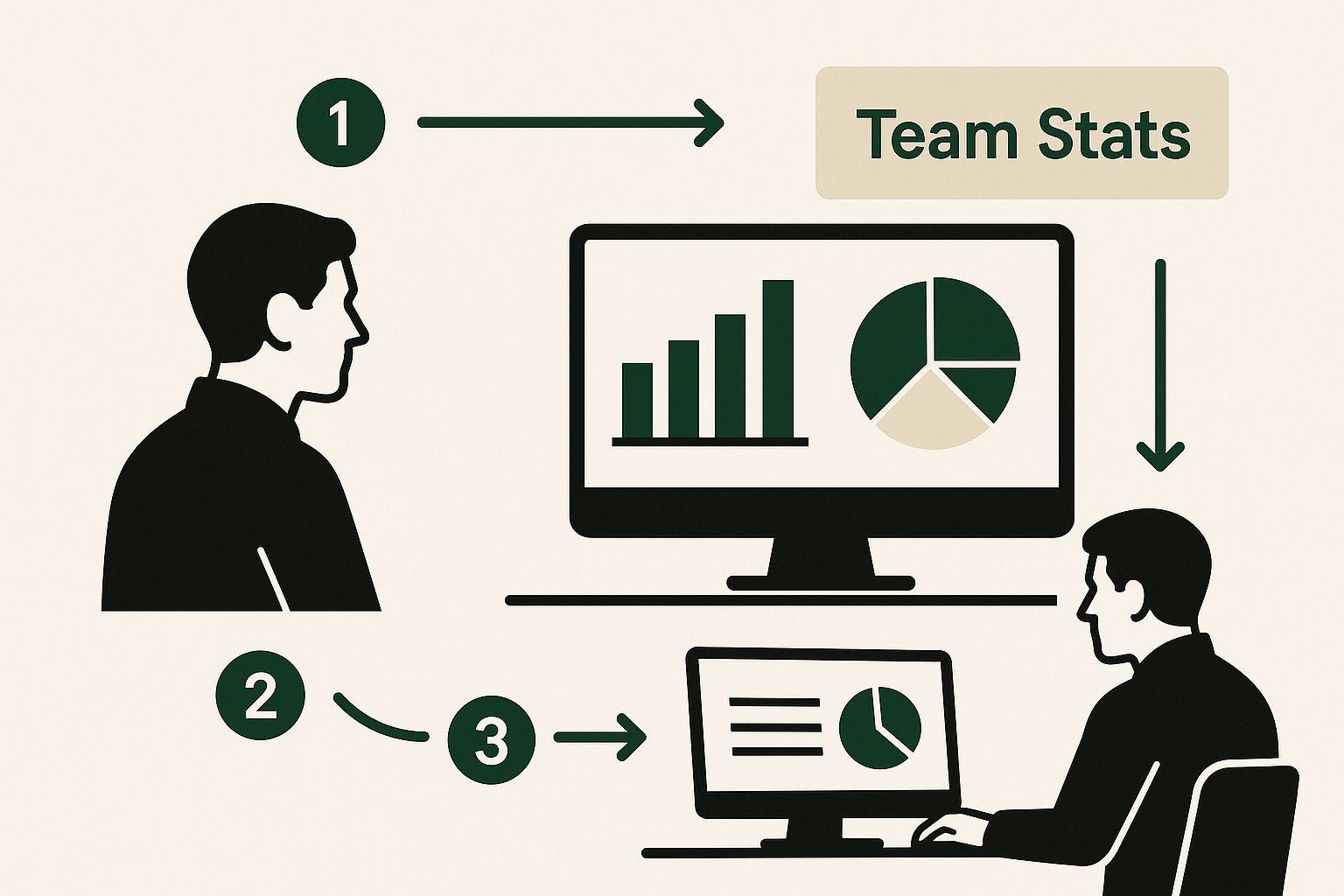
This might sound complex, but translating odds into actual value is a logical process. It's not magic; it’s just math. Let's break it down.
Converting Odds into Probabilities
First, you need to speak the bookie's language. A simple formula turns any decimal odds into the probability the bookmaker is implying:
- Implied Probability % = (1 / Decimal Odds) x 100
So, for odds of 2.50, the calculation is (1 / 2.50) x 100, which gives you 40%. This means the bookie's price suggests that outcome will happen 40 times out of 100. This quick conversion is your baseline for comparing against your own analysis.
Key Takeaway: Value exists whenever your own probability model gives an outcome a higher chance of happening than the bookmaker's implied percentage.
It's also crucial to understand the different odds formats out there, as getting them mixed up can lead to some costly mistakes.
- Decimal Odds (e.g., 2.20) show your total return for every unit you stake.
- Fractional Odds (e.g., 6/5) display your profit relative to your stake.
- American Odds (e.g., -110 or +130) show how much you need to bet to win 100, or how much you win for every 100 you bet.
Knowing how to read these is non-negotiable for accurate value calculations.
How to Spot High-Value Opportunities
Finding those golden opportunities is a repeatable process. Here's a simple framework:
- Estimate the "True" Chances: Use your own data-xG, current form, injuries, head-to-head records-to create your own probability for a team winning.
- Convert the Odds: Turn the bookmaker's available odds into an implied percentage using the formula above.
- Calculate the Value: Simply subtract the bookie's implied probability from your own estimated probability. The result is your Value %.
- Set a Threshold: To give yourself a margin of safety, only place bets where the Value is ≥ 5%. This ensures you're chasing a real, significant edge.
The accuracy you bring to this process is often what separates bettors who grind out a profit from those who are just chasing losses. And don't just stick to one market! Your data might give you a unique edge in less common markets like Asian handicaps or goal totals.
A Premier League Example
Let’s make this real. Imagine a match between Manchester City and Arsenal. A bookie is offering decimal odds of 2.20 for Man City to win.
First, we convert the odds: (1 / 2.20) x 100 = 45.45%. That's the bookie's implied chance.
But let's say your own model, after crunching all the numbers, puts Man City's true win probability at 52%. Now we find the value: 52% (your probability) - 45.45% (bookie's probability) = 6.55%.
That 6.55% is a solid edge and meets our 5% threshold. It’s a bet worth taking.
Now, imagine trying to do this level of detail for dozens of matches every weekend. It's not just tedious; it's a minefield for human error. One misplaced decimal or a mix-up between fractional (6/5) and American (+120) odds-which both equal 2.20 decimal-can completely wipe out your perceived edge.
Always double-check your calculations, especially when dealing with different odds formats. And remember to account for the bookmaker's commission, or "vig," which is typically around 5% built into the total odds.
The Pitfalls of Doing It All by Hand
Relying on manual calculations is tough. It's incredibly easy to make mistakes that slowly chip away at your profits. Common slip-ups include:
- Simple human error when converting odds formats.
- Forgetting key factors like the draw probability or home-field advantage.
- Overlooking last-minute team news, which can completely change a team's chances.
Trying to repeat these tasks perfectly across 20+ matches a day is a recipe for mistakes.
Why You Must Verify Your Probability Models
Even the best manual system is prone to bias. That's why you have to constantly test your models against real-world results to make sure they're not just getting lucky.
- Backtest your estimates against at least 100 historical matches.
- Use out-of-sample data (matches your model hasn't "seen" before) to check for biases.
- Monitor and recalibrate your model at least once every month to keep it sharp.
This regular review process ensures your value assessments stay reliable and profitable over the long run.
If you're looking to go even deeper into the mechanics of finding an edge, our guide on Value Betting Education is the perfect next step.
This is where automation becomes a game-changer. Tools like ValueBetFactory are built to do all the heavy lifting for you. They scan the markets, perform the calculations instantly, and send you an alert the second a value bet that meets your criteria pops up. You never miss an edge.
By building a systematic, data-driven method, you can start winning football bets with precision and turn a hobby into a source of consistent profit.
Build Your Analytical Edge With Data
If you’re serious about winning football bets, just glancing at league tables and recent scores won’t cut it. I’ve spent years diving into the deeper stats-those subtle figures that show how teams really perform, beyond one-off results. It’s through these details that you carve out a genuine edge.
Raw data can feel like drinking from a firehose, but you don’t need it all. Learn to zero in on a few critical metrics that professional bettors swear by. Those numbers will highlight teams punching above-or below-their weight before the market catches on.
Key Metrics That Truly Matter
Professional bettors steer clear of plain win/loss columns. Instead, they rely on performance indicators that reveal the process behind each result:
Expected Goals (xG): This stat gauges the quality of scoring opportunities. If a team consistently underperforms its xG, it’s often just a matter of time before the goals start flowing.
Defensive Solidity: Go beyond “goals conceded” and track shots conceded per game along with xG Against (xGA). Teams that limit dangerous chances prove far more reliable than those surviving on opponents’ poor finishing.
Home vs Away Performance: Some squads are powerhouses at home but unravel on the road. Splitting their data by venue uncovers hidden patterns that blanket form tables miss.
Player Injuries and Suspensions: Losing a key striker or a rock-solid defender can completely reshape a team’s outlook. Always adjust your probability estimates when a pivotal player is sidelined.
When you spot a squad with high xG but few goals, that’s your cue for positive regression-expect the goals to come soon.
Finding Value In Niche Data
Everyone’s chasing the big leagues, but real value often hides in under-the-radar competitions. I built a model focused on Finland’s Veikkausliiga and consistently outpaced bookies simply because they didn’t pour the same attention into those matches.
By specializing in less-covered markets you can:
- Craft more accurate models than the bookmakers.
- Exploit mispriced odds in low-liquidity events.
- Stay two steps ahead with local insights, live streams, and rapid data updates.
As of 2025, football represents nearly 80% of Europe’s sports betting market. That sheer volume delivers fairer odds and a broader array of markets-perfect for spotting overlooked opportunities. Discover more insights about the global betting landscape on outsfl.com.
Turning these analyses into a repeatable system is the next step. Start with a basic spreadsheet or explore software that automates key calculations. For a hands-on walkthrough, check out our guide on how to build a sports betting model. With a systematic approach in place, you’ll uncover profitable bets with confidence-no matter the league.
Manage Your Bankroll for Long-Term Success

Here's a hard truth: you can have the sharpest data model in the world, but poor money management will still sink your betting career. Winning football bets consistently is just as much about protecting your capital during cold streaks as it is about picking winners.
Think of your bankroll as your most critical tool. Without a disciplined staking plan, you risk going bust long before your edge has a chance to pay off.
This is exactly where so many aspiring bettors stumble. They hit a hot streak, get a little overconfident, and start increasing their stakes recklessly. A few unlucky losses later, and all their hard-earned gains are wiped out-and then some. A structured approach is what separates you from that emotional rollercoaster.
Choosing Your Staking Strategy
The foundation of solid bankroll management is a clear staking strategy. This isn’t about guesswork; it's a mathematical framework that dictates exactly how much you wager on each bet, shielding you from the inevitable ups and downs of sports betting.
Three common methods provide a great starting point, each with its own risk profile:
- Flat Betting: This is the simplest and safest way to go. You risk the exact same amount-typically 1% to 2% of your total bankroll-on every single bet. It doesn't matter what the odds are or how confident you feel.
- Percentage Staking: This is a slight evolution of flat betting. Your stake is a fixed percentage of your current bankroll. Your bet size naturally gets bigger as you win and smaller as you lose, which is a fantastic way to protect your capital during a downturn.
- The Kelly Criterion: This is a more advanced strategy that calculates the optimal stake size based on both the odds and your perceived value (your edge). While it can grow a bankroll faster, it's also much more aggressive and demands highly accurate probability estimates.
For a much deeper dive into these methods, our full guide on sports betting bankroll management breaks them down with detailed examples and calculators.
Weathering a Losing Streak
Let's run through a quick scenario. Imagine you have a $1,000 bankroll and hit an unavoidable five-bet losing streak. It happens to everyone. Here’s how a disciplined staking plan shields you.
Using a conservative 2% flat staking model, your first bet is $20. If it loses, your next bet is still $20. After five straight losses, your bankroll stands at $900. Yes, it's a setback, but you've only lost 10% of your capital and you are still very much in the game.
Now, picture an emotional bettor without a plan. They might have doubled their stake after each loss, chasing a win. That's a surefire path to a zero balance.
A disciplined strategy is your best defense against "tilt"-that dangerous emotional state where frustration leads to poor, impulsive decisions. Sticking to your plan prevents one bad day from turning into a catastrophic one.
Mastering these principles is non-negotiable for anyone learning how to win football bets for the long haul. Your ability to manage risk effectively will ultimately determine whether you succeed or fail.
Bet In-Play and On the Go
The days of placing a bet and just waiting for the final whistle are long gone. Modern football betting is dynamic, fast-paced, and full of opportunities that only pop up after kickoff. This is the world of in-play betting, where you can react to the flow of the game in real time.
Success here isn’t about making wild guesses; it’s about reading the momentum of a match. Picture this: a heavy favourite concedes an early, unexpected goal. Suddenly, their odds to win get much better. If your pre-match analysis tells you they’re still the dominant team, this temporary market panic creates a prime value opportunity that simply didn’t exist an hour ago.
Spotting Value When Odds Shift
In-play betting is all about identifying when a bookmaker’s algorithm has overreacted to an event. A red card, an injury to a key player, or a sudden tactical shift can all create immediate value for the bettor who’s paying attention.
The key is to have your pre-match homework done. That way, you can instantly assess how these events impact the game’s true probabilities instead of just guessing. This is a skill that blends sharp analysis with quick decisions. You have to stay emotionally detached, especially when odds are swinging wildly. Acting on a gut feeling after a goal is just gambling; acting on a calculated assessment of the new game state is strategic betting.
Pro Tip: Don't just watch the score. Pay attention to the underlying stats you can see in real-time feeds-shots on target, possession in dangerous areas, and corner counts. These metrics can signal a momentum shift long before the scoreboard ever reflects it.
The Rise of Mobile and Micro-Betting
Mobile technology has supercharged these opportunities, putting live odds and instant execution right in your pocket. This convenience is a major reason for the explosive growth we're seeing in the sports betting market.
The global sports betting market hit an estimated USD 90.8 billion in 2024 and is projected to keep growing at a compound annual rate of about 10.9%. A huge chunk of this is fueled by micro-betting-wagering on short-term events like the next team to win a corner or whether a penalty will be scored. You can learn more about the future of sports betting markets and their growth.
This is where a clean, fast interface like ValueBetFactory becomes essential. When you’re trying to make quick decisions, you need real-time data presented clearly, which is exactly what the platform is designed for.
Practical In-Play Betting Strategies
To really learn how to win football bets in live markets, you need a clear plan. Here are a few actionable tactics to get you started:
- Halftime Analysis: The 15-minute break is your golden window. Use this time to review first-half stats without the pressure of live play. Did one team dominate possession but fail to score? This could be a perfect setup for a second-half goals bet.
- Betting on the Underdog: If a strong favorite concedes an early goal, their live odds to win will improve significantly. If you believe the goal was against the run of play, this is an ideal moment to back them at a much better price than was available pre-match.
- Capitalizing on Fatigue: In the final 20 minutes of a match, watch for signs of tired legs, especially if one team has been under constant pressure. This is often a profitable time to bet on late goals, as defensive mistakes become more common.
Mastering in-play betting requires discipline and speed. By combining solid pre-game research with a sharp eye for live dynamics, you can unlock a whole new dimension of profitable football betting.
Football Betting FAQs
Let’s tackle some of the most common questions that come up when you’re trying to turn a profit on football betting.
This isn’t just about theory. It's about practical steps you can take, covering everything from picking the right leagues and managing your bookmaker accounts to avoiding the mental traps that derail even the sharpest bettors.
What Football Leagues Should Beginners Focus On?
When you're just starting out, it’s tempting to bet on everything. Don't. Stick to the major leagues with high liquidity, like the English Premier League or La Liga.
Why? Because these markets are flooded with data, the odds are tighter, and price movements are generally more predictable. You have a mountain of information at your fingertips.
- Premier League: Offers incredibly dense statistical coverage and some of the sharpest market odds on the planet.
- La Liga: Often shows consistent and exploitable trends in the Under/Over goals markets, with detailed team data to back it up.
For instance, you can find Premier League xG (Expected Goals) data that’s updated every 15 minutes during a match. That kind of real-time info lets you react instantly if you spot a team being over or undervalued.
In La Liga, you might notice a team shifting their playing style mid-season, creating betting angles that the broader market hasn't caught onto yet. That's where the real edges are found.
How Many Bookmaker Accounts Should I Maintain?
This is a classic question, and the sweet spot for most serious bettors is somewhere between three and five accounts.
Having too few accounts means you're leaving money on the table because you can't shop for the best lines. On the other hand, managing too many can be a nightmare and drain your focus.
Consistently comparing odds across just a few accounts can easily boost your ROI by double digits over the course of a season. It’s one of the simplest, most effective changes you can make.
Specialize in Key Markets
Trying to be an expert in everything is a recipe for disaster. Instead, focus on mastering just one or two markets. It's the fastest way to learn how to spot mispriced odds.
Many pros stick to Match Result (1X2) bets and Asian Handicaps because that's where value gaps frequently appear. The public often misunderstands these markets, leaving opportunities for sharp bettors to clean up.
- A simple but powerful habit is to keep a log of your bets, categorised by market type. This lets you see exactly where you're winning and where you're leaking money.
Avoid Emotional Betting
This is the big one. Your emotions are the single greatest threat to your bankroll. A big win can make you feel invincible, while a string of losses can lead to desperate, ill-advised "chasing."
Set firm stop-loss limits for your day or week. If you hit them, you walk away. No exceptions.
- If you catch yourself getting angry and trying to win back losses, stop immediately. Take a break and revisit your strategy when you're thinking clearly again.
- If you feel your discipline slipping, temporarily lower your stakes. It's a great way to get your head back in the game without risking your bankroll.
Discipline is the bridge between good analysis and consistent profits.
The legal sports betting market is exploding. As of 2025, it generated $7.62 billion across 30 states plus Washington D.C., and it's projected to nearly double to $14.44 billion by 2027.
This boom is fueling the creation of incredibly advanced odds-making tools and real-time data feeds-resources you can use to make much smarter wagers.
Review and Refine Your Bets
Winning bettors aren't just good at picking games; they're obsessed with reviewing their performance. You need to track your win rate and ROI on at least a monthly basis to find weaknesses in your approach.
You don’t need fancy software. A simple spreadsheet logging your odds, stake sizes, and outcomes is all it takes to get started.
- Regularly challenge your own assumptions. Is your model still accurately reflecting a team's current form?
- Always double-check for last-minute variables. A key injury or a sudden coaching change can completely flip the probabilities of a match overnight.
- Use midweek team news and press conferences to fine-tune your weekend forecasts.
These small, consistent adjustments might not feel like much at the time, but they compound over hundreds of bets and are crucial for long-term profitability.
By putting these simple, disciplined tactics into practice, you’ll sharpen your ability to spot value, manage risk like a professional, and keep your decision-making purely data-driven.
Ready to elevate your football betting with real-time value alerts? Give ValueBetFactory a try today: ValueBetFactory