
How to Read Betting Lines and Bet Smarter
Unlock Profits with betting tips!
Reading betting lines is really about decoding three core components: the moneyline (who wins), the point spread (by how much), and the total (combined score). The first thing to burn into your memory is that a negative number, like -150, always points to the favorite. A positive number, like +130, signals the underdog.
Getting that down is your first real step toward making smarter, more calculated wagers.
Your First Look at Sports Betting Lines
Jumping into sports betting for the first time can feel like you're trying to decipher a new language. You look at a screen packed with team names, numbers, and a bunch of plus and minus signs, and it's easy to get overwhelmed.
But once you break it down, every betting line is just telling a story about the game. Think of it as the sportsbook’s prediction of how a matchup will play out, presented as a set of odds you can either agree or disagree with. We'll start by decoding the three most common bet types you'll see for a classic NFL game.
The Three Pillars of a Betting Line
Nearly every major sporting event you look at will feature these three core betting options. They are the absolute foundation for everything else you'll ever encounter in sports betting.
- Moneyline: This is the simplest bet of them all. You’re just picking which team will win the game, straight up. The final score doesn't matter one bit-only who comes out on top.
- Point Spread: This is the great equalizer. The spread levels the playing field by making the favorite win by a certain number of points. At the same time, it gives the underdog a "head start" they can lose by and still win the bet.
- Totals (Over/Under): Here, you’re not picking a winner at all. Instead, you're betting on the total combined score of both teams. Will it be higher (Over) or lower (Under) than the number the sportsbook sets?
To really see how these work together, let's break down a fictional line for a game between the Kansas City Chiefs and the Denver Broncos.
Key Takeaway: Every betting line is carefully designed to create a balanced market, attracting as close to equal betting action as possible on both sides. Those numbers aren't just pulled out of thin air; they're calculated to reflect team strengths, weaknesses, and public perception.
Anatomy of a Betting Line
This quick-reference table breaks down what you're looking at in a typical NFL betting line. It shows how the three core bet types are presented for a single game.
| Bet Type | Example | What It Means |
|---|---|---|
| Point Spread | Chiefs -7.5 | The Chiefs are the favorite and must win by at least 8 points. The Broncos (+7.5) can lose by up to 7 points and still cover the spread. |
| Moneyline | Chiefs -350 | The Chiefs are the heavy favorite. You would need to bet $350 to win $100 in profit. The Broncos (+280) are the underdog; a $100 bet would win $280 in profit. |
| Totals | O/U 48.5 | This is the Over/Under line. You bet on whether the total combined points scored by both teams will be Over or Under 48.5. |
As you can see, the negative numbers (-7.5, -350) immediately tell you the Kansas City Chiefs are the favorite. The positive numbers (+7.5, +280) just as quickly identify the Denver Broncos as the underdog. This fundamental structure is the key to how to read sports betting odds.
Getting comfortable with these formats is crucial because they're the language sportsbooks use to communicate risk, reward, and their expected outcomes. The different bet types evolved to give bettors clear propositions, from the simple win/loss moneyline bets of early American sports gambling to the more nuanced point spreads we see today.
Finding Value by Converting Odds to Probability
Those numbers next to a team's name are much more than just payout figures. Think of them as the sportsbook's opinion, translated into the language of odds. Every set of odds carries an implied probability-the bookmaker's estimated chance of that outcome actually happening.
Learning to convert these odds into a simple percentage is one of the most powerful skills you can build. It forces a massive shift in your perspective. You'll stop asking, "Who's going to win?" and start asking the much smarter questions: "What are the chances?" and "Is this bet priced correctly?" This is the foundation of reading betting lines for genuine value.
The Simple Math Behind American Odds
The good news is you don't need a math degree to crack this code. The formulas for converting American odds into implied probability are surprisingly simple. There's just one for favorites (negative odds) and another for underdogs (positive odds).
Let's walk through a couple of common examples to see how it works.
For Favorites (Negative Odds): The formula is Risk / (Risk + Win) x 100. With odds of -150, you're risking $150 to win $100. So, the math is 150 / (150 + 100) x 100, which works out to 60%. The sportsbook is telling you they believe the favorite has a 60% chance of winning.
For Underdogs (Positive Odds): The formula is 100 / (Odds + 100) x 100. For odds of +200, a $100 bet wins you $200. The math here is 100 / (200 + 100) x 100, which equals 33.3%. The book thinks the underdog has a 33.3% chance to pull off the upset.
If you'd rather skip the manual number-crunching, a good odds to percentage calculator can do the work in a split second, letting you focus on the analysis.
By converting odds to a percentage, you're translating the sportsbook's language into a clear, universal metric. This simple act is the first step in moving from casual betting to strategic analysis.
Why Implied Probability Is Your Key to Value
So, why does any of this matter? Because this simple conversion is what lets you compare the sportsbook's opinion to your own. True value in sports betting is found when you believe a team's actual chance of winning is higher than the probability implied by the odds.
Imagine the New York Jets are listed at +150 against the Buffalo Bills. The implied probability for those odds is 40%. But after you’ve done your own research-looking at recent form, key matchups, and injury reports-you think the Jets actually have a 45% chance to win.
That 5% gap between your assessment and the book's price is where the value is. That's your edge.
Understanding the Vig or Juice
Here's something you'll notice pretty quickly. When you convert the odds for both sides of a game and add them up, the total will always be more than 100%.
Let's take a look at a typical moneyline:
- Favorite at -150 = 60% implied probability
- Underdog at +130 = 43.5% implied probability
- Total Probability: 60% + 43.5% = 103.5%
That extra 3.5% is the sportsbook's built-in commission, what we call the vig or juice. It's the fee they charge for taking your bet, and it's how they guarantee a long-term profit. Knowing the vig exists helps you see the true cost of every wager and reinforces just how crucial it is to hunt for value to overcome this built-in disadvantage.
Mastering Point Spreads and Totals
Sure, the moneyline is all about picking a winner, but the real craft of sports betting often lives in the point spread and totals markets. These bets force you to think beyond who wins and start analyzing how the game will play out. This is where a sharper understanding of team styles, key matchups, and even simple math can give you a massive leg up.
Once you learn to read betting lines like a pro, you start seeing the story the numbers are telling. A point spread isn't just some random handicap; it’s a meticulously calculated figure designed to split the betting action right down the middle, often landing right on the most common margins of victory for a sport.
The Power of Key Numbers
In a sport like football, some numbers are just more important than others. Thanks to the scoring system-3 points for a field goal, 7 for a converted touchdown-certain victory margins show up over and over again. Bettors call these key numbers.
The most sacred numbers in the NFL are 3 and 7. A staggering percentage of games end with one of these two margins. This statistical reality makes even a half-point swing in a spread incredibly valuable.
- A spread of -2.5 means your team just needs to win by a field goal to cover. Easy enough.
- But a spread of -3.5 means they have to win by four or more, which is a much bigger ask.
- On the flip side, grabbing an underdog at +7.5 feels a lot safer than taking them at +6.5.
This is why you'll often see the "juice" or odds shift around these critical numbers. A bookmaker might move a -3 spread from the standard -110 to -120 instead of jumping the line to -3.5. They're charging you a premium to bet on that all-important number.
Getting the best of the number is a fundamental principle of successful spread betting. The difference between cashing a ticket and tearing it up often comes down to grabbing a line at -2.5 before it moves to -3.
Should You Buy Points?
Some sportsbooks will give you the option to "buy points," letting you shift the spread in your favor in exchange for worse odds. For example, you could pay extra juice to move a line from -3 down to -2.5.
It sounds tempting, but buying points is rarely a profitable long-term strategy. The extra price you pay almost always outweighs the statistical benefit you gain. A much better approach is to simply shop around at different sportsbooks to find the line you want at the standard -110 price.
Analyzing Totals Beyond the Score
Betting on totals, or the over/under, requires a completely different mindset. You're not picking a side; you're forecasting the entire pace and flow of the game. Smart bettors look way beyond basic offensive and defensive stats.
Here are a few factors that can swing a total:
- Pace of Play: Are you looking at two teams that play fast, creating more possessions and scoring opportunities? Or are they methodical, clock-chewing teams that grind games out?
- Offensive vs. Defensive Matchups: Does one team's offense have a specific strength that perfectly exploits the other's defensive weakness?
- Weather Conditions: This is a huge one for outdoor sports. In football, heavy wind or rain can cripple passing and kicking games, almost always pushing the score lower. The average NFL game total in the 2022 season was 44.0 points, but that number can plummet in bad weather.
- Injuries: Losing a star quarterback or a lockdown defensive player can completely reshape a game's scoring potential.
Thinking through these elements is what it’s all about. It helps you decide whether you’re in for a high-scoring shootout or a defensive slugfest, giving you the real context you need to master these bets.
Reading the Tea Leaves: How to Interpret Line Movements
Betting lines aren't set in stone. Think of them as living, breathing numbers that react to new information and, more importantly, to the flow of cold, hard cash. Learning to read why a line moves from its opening number gives you a massive advantage, turning you from a passive bettor into someone who can read the market.
A shift in the odds or spread tells a story about how both the public and the sharp, professional bettors are sizing up a game. This skill is critical because not all movement is created equal. A line might lurch because a star quarterback is suddenly ruled out-a totally legitimate, fundamental reason. But it can also drift simply because a tidal wave of public money is crashing down on one side, often driven by media hype rather than smart analysis.
Spotting Public vs. Sharp Money
The real trick is learning to tell the difference between the two main drivers of line movement. Public money-the cash from casual bettors-usually floods in closer to game time and almost always favors popular teams, big favorites, and the "over" on totals. Sportsbooks see this one-sided action and will adjust the line to limit their own risk.
This is where opportunities pop up. If the public hammers the Kansas City Chiefs from -6.5 to -7.5, the real value might suddenly be on the underdog. The original -6.5 line was likely sharp, but the new number has been inflated by popular opinion, not professional insight.
A line moving from heavy public action is the market reacting to volume. A line moving because of sharp money is the market reacting to respected, intelligent opinions. Knowing the difference is a game-changer.
The Ultimate Tell: Reverse Line Movement
The clearest signal of sharp action is reverse line movement. This is when the betting line moves in the opposite direction of where the public is betting. Let's say 75% of all bets placed are on the New England Patriots, but the line actually moves in favor of their opponent.
What does that scream? It means a smaller number of bets-but with much larger sums of money (the sharp money)-are being placed on the other side. Sportsbooks respect a few huge bets from winning professionals far more than thousands of small bets from the public, so they adjust the line accordingly.
For anyone serious about tracking market dynamics, these subtle shifts are pure gold. You can learn more about spotting these specific situations in our complete guide on dropping odds.
The good news is that comprehensive historical sports odds data has become more accessible than ever. Various platforms now offer incredibly detailed snapshots of odds history, letting you track and analyze these market moves with precision. Some services even provide data at 5-minute intervals across dozens of sportsbooks, painting a vivid picture of how and when lines really move. You can get more info on how historical odds data is tracked and provided.
Building Your Game Analysis Routine
This is where the rubber meets the road. All the theory we’ve covered comes together into a repeatable process that you can use for every single bet. A solid routine is what separates a reactive bettor-someone who just glances at the odds-from a proactive analyst who forms an opinion before seeing what the market thinks.
Getting into a structured workflow is the key to consistently spotting value. It’s about building a habit of checking opening lines, tracking their movement, and comparing all that market data against your own research on the game itself. This is how you make truly data-driven wagers, not just gut-feel guesses.
Start with the Opening Line
The very first number a sportsbook puts out for a game is the opening line. Think of this as the bookmaker's purest take on a matchup, created before public money has had a chance to muddy the waters. Your analysis should always start here.
Knowing where a line started gives you critical context for where it is now. If a spread opens at -4 and moves to -6, you immediately know something significant-whether it’s a flood of money or breaking news-pushed it that way. Your job is to figure out why.
This is the typical lifecycle of a betting line, from its initial release to how public betting action forces adjustments.
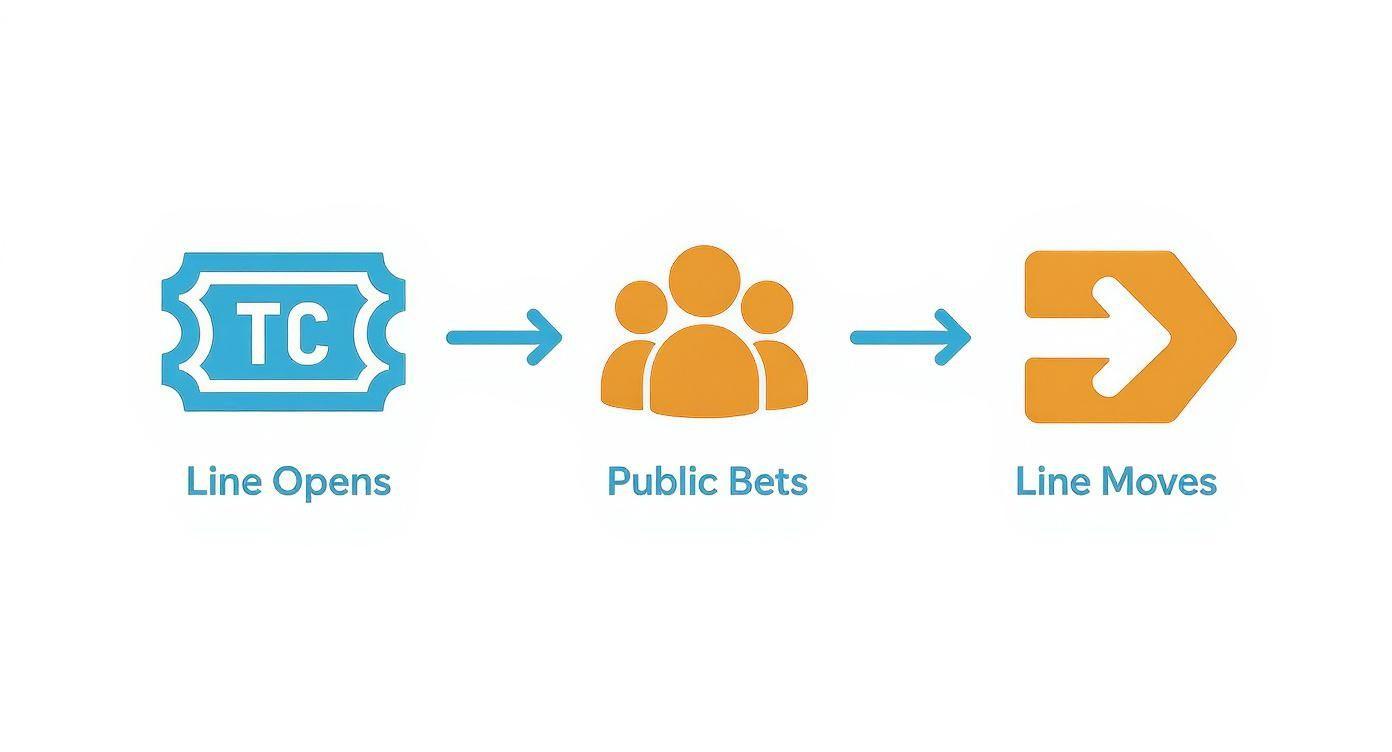
This flow shows how an initial number gets shaped by betting volume, forcing sportsbooks to shift the line to balance their risk. Grasping this progression is fundamental to reading the market and finding opportunities.
Incorporate Historical Odds and Data
One of the most powerful tools in your arsenal is historical data. Looking at how a team has performed in similar spots in the past provides a statistical backbone for your bets. For instance, how does a team do against the spread when they are a home underdog of 3 points or less?
By comparing current betting lines to past performance in similar scenarios, you can uncover patterns and trends that the general public often overlooks. This is where data-driven betting truly separates itself from casual gambling.
The numbers don't lie. Analyzing historical betting data can seriously improve your results. Some studies show that bettors who use this kind of analysis can boost their chances of profiting to around 40%, a massive leap from the roughly 2% profit rate for those who don't. This edge comes from spotting market inefficiencies and undervalued odds based on past trends. You can find more insights on the benefits of historical odds analysis on BettorEdge.com.
To put it all together into a repeatable checklist, here’s a simple framework you can follow for every bet you consider. This process ensures you're covering all your bases before putting any money down.
Your Betting Line Analysis Checklist
| Step | Action Item | Key Question to Ask |
|---|---|---|
| 1. Find the Opening Line | Check where the line first opened at multiple sportsbooks. | What was the oddsmaker's initial, "pure" assessment of this game? |
| 2. Track Line Movement | Monitor how the line has moved since it opened. | Has the line moved for or against a team? Why might this be happening? |
| 3. Analyze Historical Data | Look up how both teams perform in similar betting situations. | What are the ATS/O/U trends when this team is a home favorite, road underdog, etc.? |
| 4. Calculate Implied Odds | Convert the current odds into an implied probability percentage. | What chance of winning does the current market price imply? |
| 5. Form Your Own Opinion | Do your own research (injuries, form, matchups) to estimate a "true" probability. | What do I think the actual chances are, independent of the market odds? |
| 6. Compare and Identify Value | Compare your estimated probability against the market's implied probability. | Is there a significant gap between my assessment and the odds? Is this a value bet? |
Finally, you bring everything together. Compare the market's implied probability with your own analysis of team form, injuries, and matchups. If your assessment shows a higher probability of an outcome than the odds suggest, you’ve found a potential value bet. This systematic approach is what builds a profitable betting career over the long haul.
Got Questions? Let's Clear a Few Things Up
Even once you get the hang of the basics, some of the jargon and weird situations you see on the odds board can throw you for a loop. Think of this as your quick-reference guide for those last few nagging questions.
Getting these common points of confusion sorted is the final piece of the puzzle. It’s what helps you move from just reading the lines to truly understanding what they mean.
You’ve probably noticed that the odds for the exact same matchup can be different from one sportsbook to another. This isn’t a mistake-it’s actually a key feature of the betting world.
Why Do Odds Differ Between Sportsbooks?
Sportsbooks don't just post a line and walk away. Each one is actively managing its own risk based on the bets coming in.
If one book gets slammed with money on the Kansas City Chiefs, they'll adjust their line to make the other side more attractive. This is how they balance their books. A competitor who has more even action on that game won't need to make the same adjustment, creating a different price.
This is a massive opportunity for anyone serious about betting. It's exactly why "line shopping"-checking odds across multiple sportsbooks before you place a bet-is one of the most vital habits for making a long-term profit.
Finding the best price is just as important as picking the right team. Grabbing a moneyline at +150 instead of +140, or a spread at -2.5 instead of -3, might not feel like a big deal. But those little edges are exactly what separates winning from losing over hundreds of bets.
What Does PK or Pick'em Mean?
When you see "PK" or "Pick'em" on a betting line, it means the sportsbook sees the two teams as perfectly matched, so there's no point spread. The playing field is considered dead even.
In a pick'em game, you just have to pick the team that will win the game, straight up.
For a pick'em:
- There's no favorite or underdog.
- Your only job is to pick the outright winner.
- The odds for both sides will usually be right around -110.
Basically, it's a moneyline bet where the bookmaker has officially declared the game a true toss-up.
How Does a Push Work?
A push is just another word for a tie. It happens when the final score lands exactly on the point spread or total. When that occurs, there's no winner or loser.
For example, if you bet on a team at -7 and they win by exactly seven points, your bet is a push. Same thing if you bet the Over on a total of 48 and the final score is 28-20.
When a bet pushes, the sportsbook just refunds your original stake. It's like the bet never even happened. This is also why you see so many half-points (like -7.5) in betting lines-they make a push impossible.
Ready to stop guessing and start finding real value in the odds? At ValueBetFactory, we use advanced tools to scan the market for you, identifying mispriced lines and sending you real-time alerts on the best betting opportunities. Turn your knowledge into a data-driven strategy. Explore our tools and start your free trial today.