
How to Earn money Betting on Sports: A Proven Guide
Unlock Profits with betting tips!
If you want to earn real money from sports betting, the first thing you have to do is completely change how you think about it. Forget about gut feelings, favorite teams, and hunches. That’s the path of a casual fan, and it’s a fast track to an empty wallet.
Profitable betting is a disciplined, analytical process. It's about shifting your identity from a fan who enjoys a punt to a strategic investor hunting for mispriced assets.
Moving from Casual Punter to Strategic Bettor

Let's get one thing straight: knowing how to make money from betting has almost nothing to do with predicting who will win a game. This is the biggest mistake nearly every amateur makes. They think they can outsmart the bookies by simply picking the team they believe is going to win.
The real secret is a fundamental mindset shift. You have to stop thinking like a sports fan and start acting like a data-driven investor. This transition is the absolute cornerstone of long-term profit and it’s what separates the tiny percentage of winners from the masses who consistently lose.
The Foundation of Profit: Value Betting
The core principle you need to master is value betting. A value bet exists when you believe the true probability of an outcome is higher than the odds offered by the bookmaker suggest. You aren't just betting on who will win; you're betting on odds that are incorrectly priced.
Think of it like this: a coin toss has a true 50% chance of landing on heads. If a bookmaker offered you odds that implied only a 40% chance, you'd have a massive value opportunity. You would bet on heads every single time, knowing that over the long run, the math guarantees you’ll come out ahead. That's the essence of strategic sports betting.
The goal isn't to be right about every game. The goal is to consistently place bets where the mathematical edge is on your side. Over hundreds of bets, this edge will overcome short-term luck and generate profit.
The global sports betting market is a massive and growing industry. Valued at around USD 100.9 billion, it’s projected to hit nearly USD 187.39 billion by 2030. You can explore more insights on this growth from Grand View Research. This immense scale creates endless opportunities, but it also means you’re competing in a sophisticated marketplace where a casual approach just won't cut it.
Key Differences Between Casual and Professional Bettors
The jump from betting for fun to betting for profit is all about process. This table breaks down the crucial mindset and behavioral shifts that separate the hobbyists from the pros.
| Attribute | Hobbyist Bettor | Professional Bettor |
|---|---|---|
| Motivation | Entertainment, emotional thrill, "the buzz" | Long-term profit, consistent financial growth |
| Decision-Making | Gut feelings, team loyalty, media hype | Data analysis, statistical models, finding value |
| View of Losses | Frustration, chasing losses with bigger bets | Acknowledges variance, sticks to the strategy |
| Bankroll Approach | No defined plan, bets random amounts | Strict bankroll management, calculated staking |
| Primary Goal | To pick the winner of a single game | To find odds that are mathematically incorrect |
Making these changes isn't just a suggestion; it’s a requirement. This is the blueprint for turning a costly hobby into a profitable venture.
Debunking Common Betting Myths
To succeed, you have to ditch the destructive habits that keep most bettors in the red. These myths are gospel to the recreational crowd, and they're precisely why the bookmakers always win.
Myth 1: Betting with Your Gut: Emotional bets, like backing your favorite team just because you love them, are financial poison. Every decision has to be rooted in objective analysis and data, not loyalty or intuition.
Myth 2: Chasing Losses: After a losing bet, the urge to place a bigger, unplanned wager to "win it all back" is powerful. This is called chasing, and it's the single fastest way to destroy your bankroll. Discipline is non-negotiable.
Myth 3: Believing in "Hot Streaks": Luck comes and goes. A winning streak doesn't mean you've suddenly become invincible or developed a magic touch. Sticking to your pre-defined strategy and staking plan is crucial, no matter what happened yesterday.
Making the switch from a casual punter to a strategic bettor means embracing a structured, analytical process. It becomes less about the adrenaline of the game and more about the quiet satisfaction of executing a well-reasoned financial plan.
How to Find and Exploit Value Bets
The entire game of profitable sports betting boils down to one core skill: spotting and placing value bets. This isn’t about gut feelings or some secret insider knowledge. It's a repeatable, analytical process that pros use to get a mathematical edge over the house.
Forget complex algorithms for a minute. The big idea is actually pretty simple. You find value when a bookmaker’s odds are juicier than the true probability of something happening. That little gap is your profit margin. Learning to find those gaps consistently is how you stop gambling and start investing.
Creating Your Own Probability Estimate
Before you can spot value, you need to figure out your own odds for a game, completely separate from what the bookies are telling you. This means rolling up your sleeves and doing a bit of homework to estimate the real probability of an outcome.
Let's walk through a real-world scenario. Say the Los Angeles Lakers are playing the Boston Celtics. Instead of just glancing at the odds, you’d dig into the factors that actually matter:
- Team Form: How have both squads looked in their last 5-10 games? Is one team on a hot streak while the other is in a slump?
- Player Injuries: Is a key player like LeBron James or Jayson Tatum sidelined? The absence of a star can completely change a team's chances.
- Head-to-Head Stats: What happens when these two teams meet? Some teams just seem to have another's number due to style matchups.
- Situational Factors: Think about the schedule. Is one team playing the second night of a back-to-back, while the other is rested and playing at home?
After weighing all of this, you land on your own number. Let's say your research convinces you the Lakers have a 55% shot at winning this game. That percentage is now your personal "true probability."
Converting Probability into True Odds
Now, you have to translate that 55% into betting odds. This quick calculation is what lets you compare your assessment to what the sportsbooks are offering.
The formula is dead simple:
True Odds = 100 / Probability Percentage
Using our Lakers example:
True Odds = 100 / 55 = 1.82
This number is your benchmark. Based on your homework, any odds offered above 1.82 represent a value bet. This is your personal "true odds" for the game.
The infographic below lays out the basic workflow for betting strategically, from setting your budget to placing wagers based on solid analysis.
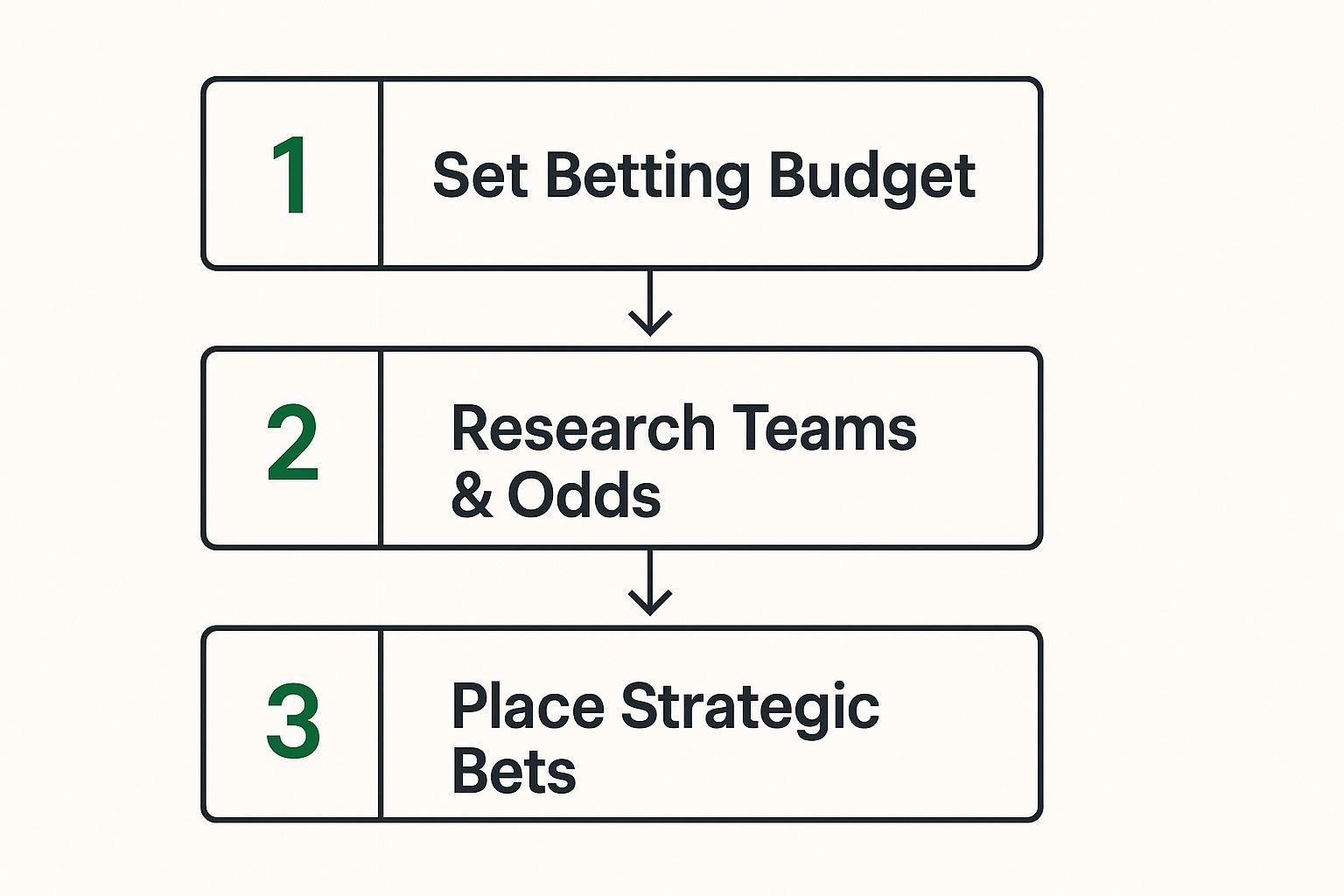
As you can see, solid research and odds analysis are the bridge between managing your money and actually making smart bets.
Comparing Your Odds to the Bookmaker
This is the moment of truth. You log into your sportsbook and see they’re offering odds of 1.95 for the Lakers to win. Time for a quick comparison:
- Your Calculated "True Odds": 1.82
- Bookmaker's Offered Odds: 1.95
Bingo. The bookie's odds (1.95) are higher than your true odds (1.82), which means you've officially found a value bet. The space between those two numbers is your mathematical edge. Placing this bet is a sound move because you believe the payout is too high for the actual risk involved.
A value bet doesn't guarantee you'll win that specific wager. It means that if you made 100 similar bets with the same edge, the laws of probability dictate you would come out profitable in the long run.
This repeatable system is the engine that drives a profitable betting strategy. The cycle of researching, calculating your own odds, and then hunting for better prices in the market is the fundamental skill you have to master.
For a deeper dive into the mechanics, you can learn more about value betting in our comprehensive guide. It’s all about discipline and process, not luck.
Implementing Smart Bankroll Management

Finding value bets is the engine of a profitable strategy, but bankroll management is the unbreakable chassis that holds it all together. Without it, even the most brilliant betting mind will eventually crash and burn.
This is your financial defense system, the set of rules that protects you from yourself and the inevitable randomness of sports. Smart bankroll management strips the emotion out of your financial decisions. It forces discipline when you’re on a hot streak and prevents panic when you’re losing, allowing you to survive the unavoidable downturns and stay in the game long enough for your mathematical edge to pay off.
The Golden Rule: Separate Your Funds
Before you ever place a single bet, the first and most critical step is to set aside a dedicated betting bankroll. This is money allocated only for betting, completely separate from your personal finances for bills, savings, and daily life. This separation is non-negotiable. Think of it as a vital psychological firewall.
This betting fund should be an amount you are 100% prepared to lose. Thinking of it this way removes the desperation that leads to disastrous decisions. Once it's gone, it’s gone, you don’t dip into your personal accounts to chase losses. Period.
Choosing Your Staking Plan
With your bankroll established, you need a staking plan, a rigid rule that dictates the size of every single bet. This is how you standardize your wagers and stop emotional swings from influencing your financial risk.
Let's look at the two most common approaches.
Flat Staking: A Beginner's Best Friend
The simplest and most effective method for most people is flat staking. You just decide on a fixed percentage of your total bankroll, usually between 1% and 3%, and that becomes your standard bet size, or "unit."
- Example: You have a $1,000 bankroll and choose a 1.5% flat staking plan.
- Your unit size: $1,000 x 0.015 = $15
- Result: Every single value bet you place will be for $15.
It doesn't matter if you just won five bets in a row or lost seven. The amount stays the same. This protects you from overconfidence when you're winning and fear when you're losing. This method's power is its beautiful simplicity. It enforces discipline and is the most reliable way to ride out variance.
The Kelly Criterion: An Advanced Approach
For more experienced bettors, the Kelly Criterion is a dynamic staking method that calculates the optimal bet size based on the perceived value of the wager. In short, you bet more on opportunities with a bigger edge and less on those with a smaller one.
While it's powerful in theory, it's extremely volatile and risky in practice. It demands that you be highly accurate in your probability assessments. Even a small error in estimating your edge can lead the formula to suggest dangerously large bets, wiping out your bankroll in a heartbeat. For this reason, most pros use a modified or "fractional" Kelly, risking only a portion of the suggested amount.
For the vast majority of bettors, flat staking is the superior choice. It offers robust protection against variance and emotional decision-making, which are the biggest threats to long-term profitability.
The Psychology of Discipline
Your staking plan is only as good as your ability to actually follow it. The real challenge comes during the inevitable losing runs. After a string of losses, it’s human nature to want to increase your bet size to win your money back faster.
This is called chasing losses, and it's the number one killer of sports betting bankrolls.
Conversely, after a big win, you might feel invincible and be tempted to bet bigger. This is just as dangerous. True discipline means sticking to your pre-defined staking plan no matter what. Your plan is your anchor in the emotional storm of wins and losses.
For a more detailed breakdown, check out our complete guide to sports betting bankroll management.
Using Technology to Gain an Analytical Edge
While learning to spot value bets by hand is a crucial skill, let's be honest: it’s a serious grind. The process is a blur of constant research, crunching numbers, and flipping between dozens of bookie sites hoping to catch the right odds.
This is where technology stops being a luxury and becomes your most powerful ally. It’s what transforms a slow, manual chore into a sharp, efficient, and scalable operation. For anyone serious about making money from sports betting, modern tools completely change the game, shifting your focus from the grunt work to pure execution and smart bankroll management.
The Power of Automation in Betting
Imagine trying to find the best price on a new TV by physically driving to every electronics store in the city. That’s what manual value betting feels like. Automation, on the other hand, is like firing up a price comparison site that shows you the best deal in seconds.
That's exactly what dedicated value betting software does. Platforms like ValueBetFactory are built to do all that heavy lifting for you, working tirelessly in the background.
- Real-Time Odds Scanning: These systems monitor thousands of odds across a huge number of bookmakers at once. It’s a feat no human could ever hope to replicate.
- Instant Value Identification: Smart algorithms compare bookmaker odds against a calculated 'true odds' benchmark, instantly flagging any gap that represents a value bet.
- A Centralized Dashboard: All the good opportunities are pulled into one clean interface. No more drowning in a sea of browser tabs.
This level of automation frees up hours of your time. It lets you move from the tedious job of finding bets to the strategic work of placing them.
The real advantage here isn't just speed; it's scale. Automation allows you to scan more markets and find far more opportunities than you ever could manually, which is key to increasing your turnover and growing your bankroll.
If you're interested in the nitty-gritty, our guide on how to automate data analysis for sports betting breaks down how to sharpen your edge. In a market this competitive, it’s an approach that's becoming essential.
A Look at a Value Betting Platform
Seeing one of these platforms in action makes its benefits crystal clear. The screenshot below shows a typical dashboard where all the identified value bets are laid out for the user.
The interface neatly organizes all the crucial info: the event, the specific bet, the size of the identified value, and which bookmaker is offering the good odds. This clarity lets you make quick decisions and place your bets efficiently.
The growth in sports betting is undeniable. Projections show the global user base could hit nearly 232 million by 2029, with an average revenue per user around $390. This market is filled with serious players, and it's technologies like AI and machine learning that give sharp bettors their edge. You can discover more insights about these global market trends to get a sense of the scale of the opportunity.
From Data Overload to Actionable Insights
Ultimately, technology acts as a filter. It cuts through the overwhelming noise of endless data points, player stats, and shifting odds to hand you exactly what you need: actionable value opportunities.
Without these tools, you're competing against a market that is faster, bigger, and better informed than you can ever be on your own. By adopting the right software, you level the playing field and start operating with the efficiency of a professional. You're finally able to make the kind of data-driven decisions that are the bedrock of long-term profitability.
Finding More Opportunities in Global Betting Markets
To really make money from sports betting, you have to think bigger than your own backyard. Sticking only to the bookies you know locally is like fishing in a small pond when there’s a massive, opportunity-rich ocean right next door.
The global betting market is a vast ecosystem, and for those willing to explore it, it’s absolutely teeming with value.
Expanding your scope internationally isn't just about having more games to bet on; it's about exploiting the natural inefficiencies between different markets. A bookmaker in Europe might set different odds for an NBA game than one in Asia, even though it’s the exact same event. These little gaps caused by regional betting patterns, local biases, or different risk models create prime value and arbitrage opportunities for a sharp bettor.
By going global, you dramatically increase the pool of available bets. This means more chances to find mispriced odds around the clock, turning your betting into a 24/7 operation instead of one tied to local business hours.
Why Global Markets Create More Value
A huge reason for these opportunities comes down to market diversity. Different regions have different betting cultures and levels of sophistication, and that has a direct impact on the odds.
For instance, Asian betting markets are famous for their high liquidity on soccer, which often leads to sharper, more efficient lines. On the flip side, a smaller European bookmaker might be slower to adjust its odds on a less popular league, leaving a window of value open for much longer.
Tapping into the global market means you are no longer limited by the opinions or pricing of a single region. You can shop for the absolute best price on any given bet, a fundamental practice for any serious investor.
This is exactly why having accounts with multiple bookmakers across different regions is standard practice for professionals. It’s the only way to ensure you’re always getting the best possible return on your investment.
Navigating International Betting
Venturing into global markets does require a bit of adaptation, but it’s nothing you can’t handle. You'll run into different odds formats and need a plan for currency exchange, but these are minor hurdles with simple solutions.
Understanding Odds Formats: You might be used to American odds (-110), but you'll need to get comfortable with Decimal (1.91) and Fractional (10/11) formats. Thankfully, most online sportsbooks let you switch between formats with a single click, and conversion calculators are everywhere online.
Managing Currencies: Betting in different currencies like Euros (€) or British Pounds (£) is common. Using an e-wallet service can simplify transactions and help minimize conversion fees, letting you move your bankroll between bookmakers efficiently and cheaply.
The learning curve is small, but the payoff is enormous. The ability to scan markets in Europe, Asia, and the Americas simultaneously gives you an incredible advantage.
Regional trends really highlight just how much opportunity exists beyond your home turf. The Asia-Pacific (APAC) region, for example, is a powerhouse in the sports wagering world, accounting for a staggering 47% of all global bets placed. This massive market, fueled by a population of over 4 billion and growing digital access, is projected to expand at a rate of nearly 12.9% annually. You can read the full research on global sports betting markets to truly grasp the scale here.
By ignoring these massive international markets, you're leaving a significant amount of potential profit on the table. Learning to navigate them is a critical step in elevating your strategy from a local hobby to a global, profit-oriented operation.
A Few Final Questions on Profitable Sports Betting
Even when you've got a solid game plan, a few questions always pop up. It's a natural part of the process. Let's tackle some of the most common hurdles and queries that new bettors run into.
Think of this as a final check-in to make sure you're heading into this with a clear, realistic mindset about how to actually make money betting on sports.
Is It Realistically Possible to Make a Living from Sports Betting?
Yes, it is, but let's be brutally honest. It's incredibly difficult and requires the discipline and hours of a full-time job. Only a tiny, tiny fraction of bettors ever reach that level. It demands serious analytical skills, unbreakable bankroll management, and the emotional steel to ride out long, painful losing streaks.
This is not a get-rich-quick scheme. A much more achievable and realistic goal for most people is to generate a steady side income by diligently applying the value betting principles we've covered.
How Much Money Do I Need to Start Value Betting?
There’s no magic number here. The most important rule is to start with an amount you are 100% prepared to lose. For most people, a starting bankroll somewhere between $500 and $2,000 is a good range.
But what truly matters isn't the starting amount; it's how you manage it.
Let's say you start with a $1,000 bankroll and use a conservative 1% staking plan. Your standard bet size would be just $10. This simple approach allows you to place 100 bets, giving you a large enough sample size to weather the inevitable ups and downs and let your mathematical edge shine through. You can survive a bad run without blowing up your entire capital.
The size of your first deposit is far less important than the discipline you apply to managing it. A small, well-managed bankroll will always outperform a large, recklessly managed one.
What Are the Most Common Mistakes New Bettors Make?
The costliest mistakes are almost always psychological, not strategic. Getting a handle on your emotions is just as critical as getting the numbers right.
Here are the top three bankroll killers:
- Chasing losses by placing bigger, unplanned bets to try and win back money after a tough loss.
- Emotional betting, like blindly backing your favorite team regardless of the odds or value.
- Poor bankroll management, such as staking way too high a percentage of your funds on a single bet.
Mastering your strategy means nothing if you can't first master your own discipline.
How Long Does It Take to See Profits from Value Betting?
Profitability is a long-term game. We're talking hundreds, if not thousands, of bets. Because of natural variance (what most people call luck), you can easily have losing weeks or even losing months, even if you execute your strategy perfectly. It is absolutely crucial to separate your process from the short-term results.
Instead of sweating the daily wins and losses, focus on flawless execution. It often takes 6-12 months of consistent betting to build up a big enough sample size of wagers. Only then can you confidently see a stable, positive trend emerge from the noise of random chance.
Patience isn't just a virtue in this game; it's a requirement for survival and success.
Ready to stop guessing and start finding a real mathematical edge? ValueBetFactory uses powerful technology to scan thousands of odds in real-time, delivering verified value bets directly to you. Take the next step in your betting journey and see how our tools can give you the advantage you need. Explore ValueBetFactory today.