
Your Guide to Arbitrage in Betting
Unlock Profits with betting tips!
Arbitrage betting is less about gambling and more about financial strategy. It’s a calculated approach that guarantees a profit by placing bets on all possible outcomes of an event across different bookmakers. You're not trying to predict who wins; you're just exploiting price differences in the market to lock in a return, no matter the final score. It turns the uncertainty of betting into a sure thing.
What Arbitrage in Betting Really Means

Think of it like being a savvy shopper. If you see a brand-new TV for sale at Store A for $500, and you know Store B is selling the exact same model for $600, you could theoretically buy it from Store A and immediately sell it to someone heading to Store B. You’ve just made a risk-free $100.
Arbitrage betting, or "arbing" for short, applies this same idea to the sports betting world. Instead of TVs, you’re shopping for odds.
Bookmakers are all competing for your business, and they each set their own odds to manage their financial exposure. This constant competition and independent adjustment means they often have slightly different prices (odds) for the very same game.
When those price differences become big enough, an arbitrage opportunity often called a "surebet" is created. By placing precisely calculated stakes on every possible outcome (like Team A to win and Team B to win), you can guarantee that the amount you win will be more than the total amount you wagered.
The Core Principle of a Surebet
The entire goal is to find a set of odds from different bookies where the combined implied probabilities add up to less than 100%. Normally, a single bookmaker’s odds always add up to more than 100% that built-in extra is their profit margin, or "vig."
An arb flips this on its head, shifting the mathematical advantage over to you. You’re covering all your bases and locking in a small but guaranteed profit.
This strategy has really taken off with the explosion of online betting. For example, before 2008, finding an arb in an English Premier League match was almost unheard of. Fast forward to 2015, and one study found 81 arbitrage situations across 21.3% of matches, with an impressive average return of around 21.78%. You can check out the full Yale research to see just how these opportunities have evolved.
Why Do These Opportunities Exist?
So, why don't bookies just offer the same odds? Arbs pop up for a few key reasons that are baked into the very nature of the betting industry:
- Intense Competition: With hundreds of online bookies all fighting for customers, you're bound to see variations in pricing as they try to stand out.
- Differing Opinions: Bookmakers don't always agree. They might use different algorithms or have oddsmakers with different opinions, leading them to set different opening lines.
- Risk Management: A bookie’s main job is to balance their books. If a flood of money comes in on one team, they’ll lower the odds for that outcome and raise the odds for the opponent to encourage betting on the other side. This adjustment can create an arb when compared to another bookie who hasn't seen the same lopsided action.
Getting a handle on these fundamentals is the first step. To go even deeper, check out our complete guide on arbitrage betting for more in-depth examples and strategies.
The Math Behind a Guaranteed Profit
Arbitrage betting isn't really about gambling; it’s about turning the tables on the bookies by turning a bet into a pure financial calculation. It completely ignores gut feelings, team loyalty, and expert predictions. Instead, it’s all about the numbers.
At the heart of it all is a concept called implied probability. Every set of odds you see is just the bookmaker's way of showing you the percentage chance of something happening. For example, decimal odds of 2.00 imply a 50% chance (1 / 2.00 = 0.50). Here’s the catch: if you add up the implied probabilities for all outcomes on a single bookmaker, the total will always be more than 100%. That extra bit is their built-in profit margin, or "juice."
An arbitrage opportunity often called a "surebet" pops up when you find odds from different bookmakers that, when combined, create a total implied probability of less than 100%. This is the mathematical loophole we’re looking for. When the total is under 100%, it means the bookies are paying out more than they’re taking in, and you can lock in a slice of that guaranteed profit.
Calculating an Arbitrage Opportunity
Let's make this real. Imagine a tennis match is coming up, Player A vs. Player B. You’ve scanned the market and found two different bookmakers offering juicy odds on opposite outcomes.
- Bookmaker 1 has Player A to win at odds of 2.05.
- Bookmaker 2 has Player B to win at odds of 2.05.
To see if we have a surebet, we first need to convert these odds back into their implied probabilities. The formula is simple: (1 / Decimal Odds) * 100.
- Probability of Player A winning: (1 / 2.05) * 100 = 48.78%
- Probability of Player B winning: (1 / 2.05) * 100 = 48.78%
Now, we add them together: 48.78% + 48.78% = 97.56%. Bingo. Because the total is less than 100%, we've officially found a profitable arbitrage opportunity. That gap between 100% and our total (100% - 97.56% = 2.44%) is our guaranteed profit margin on this bet.
This simple, repeatable process is the key to capitalizing on these opportunities over and over again.
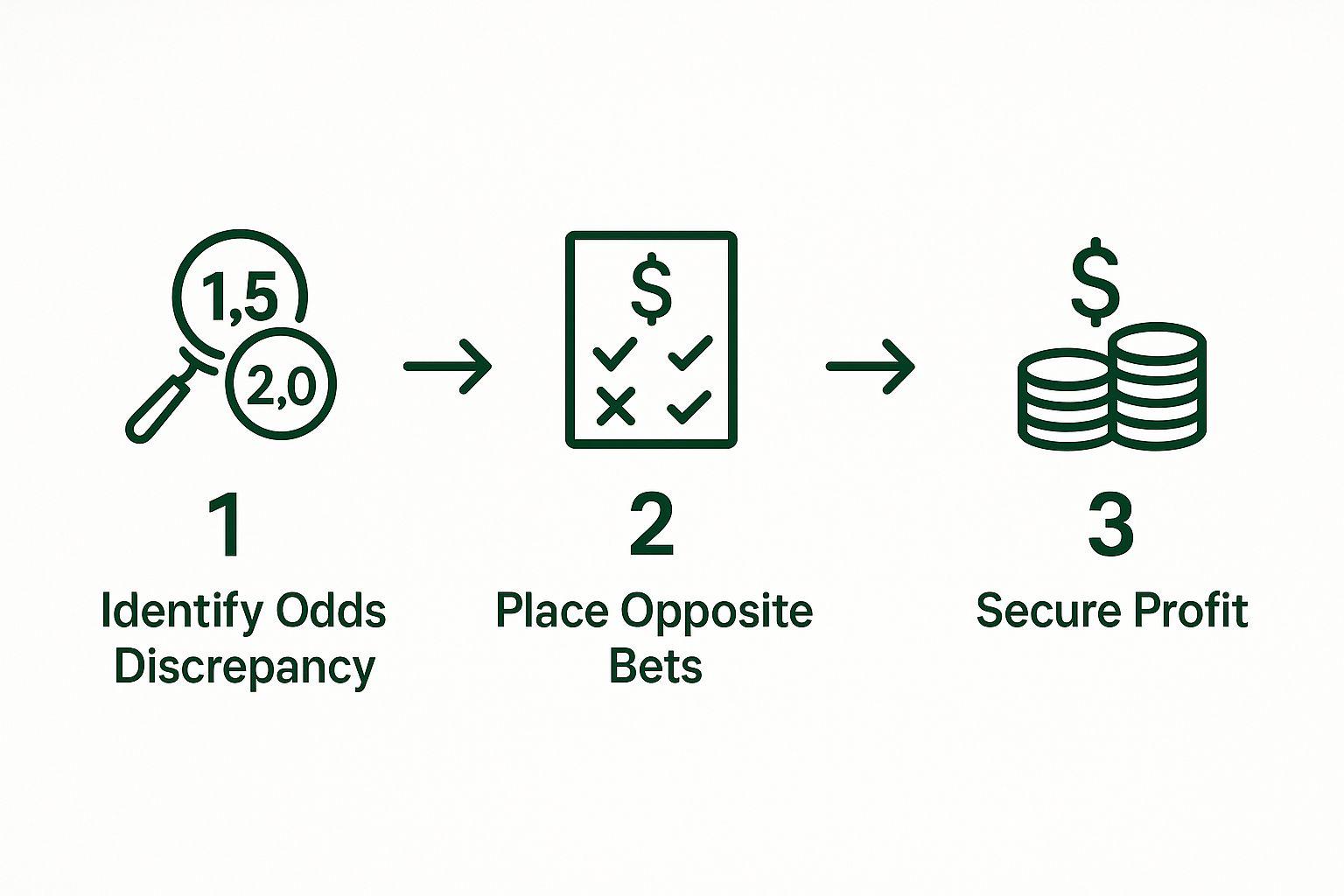
As you can see, finding that price discrepancy is the critical first step. Once you've found it, the rest of the risk-free strategy falls right into place.
Calculating Your Stakes and Profit
Spotting the opportunity is only half the battle. Now you need to figure out exactly how much to bet on each outcome to lock in your profit, no matter who wins. Let's say we're working with a total stake of $100.
To get the individual stake for each player, you'll use this formula:
(Individual Implied Probability / Total Implied Probability) * Total Stake
- Stake on Player A: (48.78% / 97.56%) * $100 = $50.00
- Stake on Player B: (48.78% / 97.56%) * $100 = $50.00
With these stakes, you're investing a total of $100. Let’s see what happens when the match is over.
The whole point of calculating stakes this way is to make sure your payout is identical regardless of the outcome. This balanced approach is what takes the risk out of the equation and locks in your profit.
This table breaks down the entire process, from the odds we found to the guaranteed cash we'll make.
Example Tennis Match Arbitrage Calculation
| Outcome | Bookmaker | Decimal Odds | Calculated Stake | Potential Payout | Guaranteed Profit |
|---|---|---|---|---|---|
| Player A Wins | Bookmaker 1 | 2.05 | $50.00 | $102.50 | $2.50 |
| Player B Wins | Bookmaker 2 | 2.05 | $50.00 | $102.50 | $2.50 |
See how that works? If Player A wins, your $50 bet at 2.05 odds returns $102.50. After subtracting your total $100 investment ($50 on A, $50 on B), you’ve made a profit of $2.50.
And if Player B wins, the exact same thing happens. Your $50 bet on Player B returns $102.50, and after your $100 total stake is accounted for, you're left with that same $2.50 profit. The actual winner of the match is completely irrelevant to your bottom line. You've just successfully executed a perfect arbitrage bet.
Why Arbitrage Opportunities Are More Common Today

Arbitrage betting hasn't always been this accessible. In fact, if you go back just a couple of decades, the betting world was a completely different beast. It was a much smaller pond, with only a handful of major bookmakers running the show.
This lack of competition was great for them, but not so much for bettors. Bookies could operate with huge built-in profit margins what we call the "juice" or "vig." With fewer places to take your money, you had no choice but to accept their less-than-generous odds. As you can imagine, this made the price differences needed for a surebet almost nonexistent.
The Explosion of Online Bookmakers
Then the internet happened, and everything changed. Suddenly, hundreds of new online bookmakers flooded the market, all fighting tooth and nail for the same customers. This explosion in competition is the single biggest reason arbitrage betting is what it is today.
To get an edge, bookies had to start offering more attractive odds, which meant slashing their profit margins. That once-comfortable buffer they enjoyed became a razor-thin line, creating the perfect storm for arbitrage opportunities to pop up everywhere.
The core principle is simple market economics. More competitors lead to price wars. In sports betting, the "price" is the odds, and a price war between bookmakers is an arbitrage bettor's best friend.
Think of it like gas stations on a busy intersection. If there's only one, it can charge whatever it wants. But when three more open up across the street, they immediately start undercutting each other to win your business. That's exactly what bookmakers are doing with their odds every single day.
Shrinking Margins and Rising Opportunities
This isn't just a theory; you can see it in the data. Back in the late 1990s, finding arbs was like panning for gold. Fast forward to the 2011/12 season, and the sheer number of online bookies had completely reshaped the landscape by forcing margins down and creating price gaps all over the place.
This shift meant the potential profit from arbitrage betting effectively doubled in a relatively short time. Big names like Interwetten and Ladbrokes saw their average profit margins on certain markets plummet from over 12% down to a much tighter 6-8%. Every percentage point they lost is a potential gain for an arber. You can dig into the numbers yourself in these findings on betting market efficiency.
So, what causes these constant price differences? It comes down to a few key factors:
- The Speed of Information: News travels fast. A key player gets injured in warm-ups, and some bookies will adjust their odds instantly while others lag behind. That temporary gap is your window of opportunity.
- Managing Their Own Books: Every bookmaker has to manage its own financial risk. If one bookie gets a flood of money on Team A, they'll slash those odds to limit their exposure. This independent risk management constantly creates misalignments across the market.
- Different Opinions and Models: At the end of the day, bookmakers use their own unique data, algorithms, and human oddsmakers to set their lines. These differences in methodology and opinion naturally lead to different prices.
Today's betting market is a chaotic, fast-moving ecosystem where odds are in constant flux. This chaos, driven by intense competition, is precisely why arbitrage opportunities are no longer a rare glitch in the system but a consistent, predictable feature of modern sports betting.
How to Find and Act on Surebet Opportunities
Knowing the math behind arbitrage in betting is a great start, but theory doesn't pay the bills. The real challenge is finding and jumping on these opportunities in a live market where odds can change in the blink of an eye. In this game, your success comes down to one thing: how quickly and accurately you can spot an arb.
You really have two paths you can take here. The first is the old-school, manual approach. The second, and far more effective, is using specialized software built for this exact purpose. Each one comes with its own set of pros and cons that make a huge difference in your results.
The Manual Search Method
The manual approach is exactly what it sounds like. You'd have a bunch of browser tabs open, each one showing a different bookmaker, and you'd start hunting for odds discrepancies on your own. It involves a ton of clicking back and forth, comparing numbers for the same event, and hoping you stumble upon a mathematical inconsistency that signals a surebet.
Sure, this method is free, so there’s no upfront cost. But its practicality is incredibly limited. Arbitrage opportunities are often gone in a matter of minutes. By the time you’ve manually checked the odds, done the math in your head, and figured out your stakes, that window has almost certainly slammed shut. It’s a bit like trying to catch falling coins with your bare hands you might get lucky and snag one here and there, but you’re going to miss almost all of them.
Leveraging Specialized Arbitrage Software
For anyone who's serious about making money with arbitrage, using specialized software isn't just a nice-to-have; it's a flat-out necessity. These tools are what turn the theory of surebetting into a consistent, profitable practice. They're like your own team of digital scouts, constantly scanning hundreds of bookmakers at once.
The moment an opportunity pops up, the software flags it and lays out all the critical info you need on a single, clean dashboard. You get the event, the bookmakers involved, the specific odds to take, and the guaranteed profit percentage. This instant alert system is what separates successful arbers from everyone else who's always a step behind.
This screenshot shows how software like ValueBetFactory presents these opportunities, making it easy to act fast.
The entire interface is built for speed, giving you the key data points needed to make a decision before the odds shift and the opportunity disappears.
But perhaps the most powerful feature is the integrated calculator.
Once an arb is identified, the software automatically calculates the precise stakes you need to place on each outcome to guarantee your profit. This removes the risk of human error and saves precious seconds when every moment counts.
Let's put the two methods side-by-side to really highlight the massive differences.
Manual Search vs. Arbitrage Software Comparison
When you're deciding how to approach surebetting, it helps to see a direct comparison of the tools at your disposal. The table below breaks down how manual searching stacks up against dedicated arbitrage software across the most critical features for success.
| Feature | Manual Searching | Arbitrage Software |
|---|---|---|
| Speed | Very slow, often minutes per event | Instant, scans hundreds of bookies in seconds |
| Accuracy | Prone to human calculation errors | Automated calculations are precise |
| Coverage | Limited to a few bookmakers at a time | Comprehensive, covering a vast market |
| Efficiency | Extremely low; opportunities are missed | High; maximizes the number of arbs found |
| Stake Calculation | Manual and time-consuming | Instant and automatic |
Ultimately, while trying the manual method can be a decent learning exercise, it’s just not a sustainable strategy for making consistent profit. The modern betting market moves way too fast for a human to keep up.
If you want to dig deeper into the practical side of this, you can learn more about how to find arbitrage bets in our complete guide. Choosing the right software and getting to know its features is the single most important step you can take toward building a successful arbitrage betting operation.
Unlocking More Opportunities with Betting Exchanges
While hunting for price differences between bookmakers is a solid strategy, it's really just scratching the surface. To really open the floodgates on potential profits, you have to venture into a more dynamic corner of the market: betting exchanges. They operate on a completely different model, blowing the doors wide open for arbitrage in betting.
Think of a traditional bookmaker as a shop where you bet against the house. A betting exchange, on the other hand, is a peer-to-peer marketplace, much like a stock exchange for sports. You’re not betting against a company; you’re placing wagers against other people who hold an opposite opinion.
This setup introduces a game-changing move that you simply can't make at a normal bookie. Sure, you can place a back bet the standard wager on an outcome to happen just like anywhere else. But the real power lies in the ability to place a lay bet, which is a bet against an outcome.
The Power of Lay Betting
Laying a bet is the key that unlocks a whole new world of arbitrage scenarios. When you lay an outcome, you’re essentially stepping into the shoes of the bookmaker. You're saying, "I don't think this will happen," and you're taking on someone else's back bet.
For instance, if you lay Manchester United to win, your bet wins if they either lose or draw the match. You only lose your stake if Manchester United actually wins. This simple ability to bet against a specific result is an incredibly powerful tool for creating arbitrage positions.
By pairing a traditional back bet at a bookmaker with an opposing lay bet on an exchange like Betfair, you can lock in what’s known as an inter-market arbitrage. This single technique dramatically increases the number of profitable opportunities you'll find.
The real advantage of using exchanges is that you are no longer limited to waiting for two bookmakers to disagree. You can actively create your own arbitrage by finding a discrepancy between a bookmaker's price and an exchange's price.
This changes everything. Instead of passively waiting for that rare moment when two bookies are out of sync, you can now proactively look for a single high back odd and combine it with a low lay odd on an exchange. The number of potential combinations just skyrockets.
How Exchanges Boost Arbitrage Frequency
This isn't just theory; the data backs it up in a big way. Sticking to opportunities found only between traditional bookmakers can be a slow, frustrating grind with long waits between surebets.
Research that analyzed nearly 12,000 soccer matches confirmed this. The study found just 102 arbitrage opportunities when looking only at bookmaker-to-bookmaker odds. But when they combined bookmaker odds with those on the Betfair exchange, the researchers uncovered a staggering 2,287 inter-market arbitrages. That means an opportunity popped up in more than one out of every six matches. You can dig into the full analysis of inter-market arbitrage findings to see the numbers for yourself.
While these exchange-based arbitrages often have a slightly smaller average return around 1.4% their sheer frequency makes them an essential part of any consistent arbitrage strategy. Mastering the interplay between backing at a bookmaker and laying on an exchange is non-negotiable for anyone serious about making a steady profit.
Navigating the Real-World Risks of Arbitrage Betting
While the math behind arbitrage in betting is perfectly sound, the real world of placing bets is messy. A strategy that looks risk-free on paper can quickly turn into a loss if you aren't ready for the practical hurdles that pop up. The journey from spotting a surebet to locking in your profit demands speed, precision, and a healthy respect for the challenges ahead.
Successfully managing these risks is what separates seasoned arbers from beginners who get burned. It’s not just about the numbers; it’s about flawless execution when the pressure is on.
Sudden Odds Changes
The most common snag you'll hit is the odds shifting after you've placed one side of the bet. Arbitrage opportunities are incredibly fleeting, often lasting just a few minutes. Imagine you bet on Team A at Bookmaker 1, but before you can place the second bet on Team B at Bookmaker 2, the odds drop. Just like that, your guaranteed profit evaporates, leaving you with an exposed, risky wager.
This is a high-stress moment where you're left with a few less-than-ideal options:
- Place the second bet anyway: This will likely lock in a small, guaranteed loss, but it closes your position and prevents a much bigger one.
- Wait for the odds to improve: This is a pure gamble. The odds might shift back in your favor, but they could just as easily get worse.
- Find another bookmaker: You can scramble to find another bookie with favorable odds to complete the arb, but time is everything.
Stake Limitations and Bet Cancellation
Another huge hurdle is running into bookmaker-imposed limits. You might find a perfect 2% arb, only to discover that one of the bookmakers will only let you stake a tiny amount, making the whole effort pointless. These limits are often slapped on accounts that the bookie suspects of sharp betting.
Even more frustrating is the risk of a "palpable error," or "palp." This is when a bookmaker cancels your bet after you've placed it, claiming the odds were an obvious mistake on their part.
A palpable error clause in a bookmaker's terms and conditions gives them the right to void bets made on clearly incorrect odds. If one leg of your arb is canceled for this reason, you are left fully exposed on the other side.
This can be a massive blow. You might not even realize the bet was canceled until it's too late to do anything about it, leaving you stuck with a large, one-sided bet you never wanted.
The Biggest Threat: Account Restrictions
Ultimately, the number one threat to any serious arbitrage bettor is having your accounts limited or shut down completely. Bookmakers are private businesses, and even though arbitrage isn't illegal, they actively fight against it because it costs them money. For a deeper dive, you can learn more about the legality of arbitrage betting and how bookies see it.
Bookmakers use sophisticated software to flag accounts that show arbing patterns. Once you're flagged, they will either slash your maximum stakes to pennies or just close your account for good. To keep your valuable accounts alive for as long as possible, you have to fly under the radar. This means avoiding behavior that screams "arber," such as:
- Betting obscure amounts: Staking $127.34 is a dead giveaway. Always round your stakes to a normal-looking number (e.g., $125 or $130).
- Only betting on arbs: Throw in some occasional "mug bets" on popular games to make your activity look more like a regular punter's.
- Maximizing stakes: Constantly hitting the maximum allowed bet is a huge red flag that you're a professional, not a casual player.
By blending in with the crowd, you can keep your accounts open longer and continue to capitalize on these profitable opportunities.
Got Questions About Arbitrage Betting? We've Got Answers
Jumping into the world of arbitrage in betting always kicks up a few questions. That’s perfectly normal. Getting straight answers from the get-go is the best way to start off on the right foot and dodge those classic rookie mistakes. Let’s clear up the most common things new arbers ask.
Is Arbitrage Betting Legal?
Absolutely. Arbitrage betting is 100% legal. You're not breaking any laws. All you're doing is placing bets with different, legally operating sportsbooks to take advantage of the different prices they're offering to the public. It’s no different from finding a product cheaper in one store than another and buying it there.
However, just because it's legal doesn't mean the bookies have to like it. They are private businesses, and since arbing is a guaranteed loss for them, their terms of service almost always give them the right to limit or shut down accounts they suspect of doing it. So, the real game isn't about staying legal it's about flying under the radar.
How Much Money Do I Need to Start?
There’s no official "buy-in," but to make this work efficiently, you need a decent starting bankroll. Most seasoned arbers would tell you to start with at least $500 to $1,000.
That money isn't for one big bet. You need to spread it across several different bookmaker accounts. When a surebet pops up and they disappear fast you have to be ready to act instantly. If your bankroll is too small, your cash gets tied up waiting for bets to settle, and you'll miss out on the next opportunity that comes along.
Think of it this way: the bigger your bankroll, the more tables you can play at simultaneously. It gives you the flexibility to jump on more opportunities and place larger stakes, which is crucial for making those low-margin arbs actually worth your time.
What Are the Biggest Beginner Mistakes?
Newcomers almost always trip over the same few hurdles. Knowing what they are is half the battle. Watch out for these:
- Moving too slow: Odds can change in the blink of an eye. If you place one side of the arb and hesitate on the other, the odds can shift, wiping out your profit and leaving you with a standard, risky bet. Speed is everything.
- Betting weird amounts: Staking an exact, calculated amount like $87.41 screams "arbitrage." It's a massive red flag for any bookie. Always round your stakes to a normal-looking number, like $85 or $90, to blend in with regular bettors.
- Skipping the final check: Rushing leads to stupid mistakes. Before you hit that "place bet" button, always take one final second to confirm you've got the right odds, the right teams, and the right stakes. A simple typo can be a costly error.
Why Are Bookmaker Odds Different?
The very existence of arbitrage hinges on a simple fact: bookmakers don't all offer the same odds. This happens for a couple of key reasons.
First, the online betting world is insanely competitive. Bookies will sometimes offer slightly better odds just to attract your business. But the main reason is risk management. If a ton of money suddenly pours in on one team, a bookmaker has to protect themselves. They'll lower the odds on that team and raise the odds on the opponent to encourage bets on the other side. Their goal is to balance their books so they make a profit no matter who wins. Since this balancing act happens independently at every single bookmaker, it creates temporary gaps in the market and that's exactly where an arber steps in to lock in a profit.
Ready to stop searching for opportunities and start profiting from them? ValueBetFactory uses advanced algorithms to scan hundreds of bookmakers in real-time, delivering actionable arbitrage alerts directly to you. Sign up today and turn market inefficiencies into your advantage.