
Is Sports Arbitrage Legal? Find Out the Truth & Risks
Unlock Profits with betting tips!
So, let's cut right to the chase: Is sports arbitrage legal?

The short answer is yes. In most places where sports betting is legal, the act of placing arbitrage bets won't get you in trouble with the law. You're not going to see police lights in your rearview mirror for locking in a guaranteed profit.
But here’s the catch, and it’s a big one. The real fight isn't with the government; it's with the bookmakers themselves. They absolutely hate arbing, and their terms of service give them all the power they need to shut you down.
Legal vs. Allowed: The Critical Difference

To really get your head around sports arbitrage, you have to see the line between what’s against the law and what’s against a private company's rules. The government doesn’t care if you outsmart a bookie. The bookie, on the other hand, sees you as a direct threat to their bottom line and will act accordingly.
Think of it this way. Imagine a grocery store has a pricing error on an item—a $50 bottle of wine is listed for $5. Grabbing one bottle is just a lucky find. But if you fill ten carts and try to clear out their entire stock, the store manager has every right to stop you and refuse the sale.
Arbitrage betting lives in that same gray area. You aren't breaking any laws, but you're definitely breaking the unwritten (and often written) rules of the game. You're exploiting a loophole, and the house always reserves the right to show you the door.
Where the Real Risk Lies
So, while the practice of arbing isn't illegal in markets like the UK, parts of Europe, or certain US states where betting is regulated, its permissibility is a different story. Your ability to place these bets is entirely dependent on staying on the good side of the sportsbooks. You can dive deeper into the legal nuances of arbing across different regions to see how it aligns with local regulations.
This creates a fundamental split between what the law says and what a bookmaker's internal policies enforce. The consequences you face aren't fines or jail time; they're account restrictions and closures.
Key Takeaway: The primary risk in sports arbitrage isn't legal trouble. The real danger is getting your betting accounts limited (a practice known as "gubbing") or shut down for good by bookmakers who flag your activity.
To make this distinction crystal clear, let's break down the two perspectives side-by-side.
Legality vs Bookmaker Policy on Arbitrage Betting
The table below contrasts the legal standing of sports arbitrage with how bookmakers actually treat it. It's a classic case of "You can, but you may not."
| Aspect | Legal Status | Bookmaker Policy |
|---|---|---|
| Action | Placing mathematically guaranteed bets across multiple platforms. | Exploiting odds discrepancies to guarantee profit against the bookmaker. |
| Governing Body | National or state law enforcement and gambling commissions. | Individual sportsbook's security and risk management departments. |
| Consequence | Generally no legal action; not a criminal offense. | Stake limitations, voided bets, or permanent account closure. |
| Your Standing | You are a citizen abiding by the law. | You are a customer violating the platform's terms of service. |
As you can see, your focus as an arber shouldn't be on the law books. It should be on mastering the art of flying under the radar. Your long-term success hinges entirely on your ability to look like a regular bettor, not someone who's systematically taking money from the bookies.
What Is Sports Arbitrage Betting, Anyway?
Let's cut through the jargon. At its heart, sports arbitrage is a lot like spotting a pricing mistake between two different shops. Imagine finding a brand-new TV for sale at a deep discount online, while knowing another store will buy that exact same model for more than you paid. You’d simply buy it from the first and sell it to the second, locking in a guaranteed profit. It's a strategy that relies on market smarts, not luck.
In sports betting, this same principle applies to the odds offered by different bookmakers. You're hunting for discrepancies on the same game. When you find one, it creates a mathematical window of opportunity. By placing carefully calculated bets on every possible outcome of that event across different sites, you guarantee a profit, no matter which team or player actually wins.
The Math Behind the Magic
Let’s look at a simple tennis match to see how this works. Say Rafael Nadal is playing Novak Djokovic. Bookmakers are always tweaking their odds to balance their books and attract action, and sometimes, they just don't line up.
You might stumble upon a scenario like this:
- Bookmaker A: Offers odds of 2.10 for Nadal to win.
- Bookmaker B: Offers odds of 2.05 for Djokovic to win.
Bingo. That’s an arbitrage opportunity, or an "arb" for short. By betting a precise amount on both outcomes, you ensure your total winnings are higher than your total stake. For example, if you bet a total of $100, you might put $48.81 on Nadal and $51.19 on Djokovic. It doesn't matter who wins the match; your payout will be about $102.50, giving you a guaranteed profit of $2.50. This is why the question "is sports arbitrage legal?" is so often tied to understanding its mechanics—it’s a math-based strategy, not a gamble.
The core idea of arbitrage isn't about picking winners. It's about turning the chaos of sports into a predictable financial result by taking advantage of market inefficiencies. You're investing in math, not in chance.
This approach demands precision and, crucially, accounts with several different bookmakers. While the return from a single arb might look small, those little wins add up fast if you're consistent. To dive deeper into the nuts and bolts, check out our complete guide to arbitrage betting.
Staying Compliant and Under the Radar
Even though the strategy itself is legal in most places, you still need to play by the rules. The best way to stay out of trouble is to follow a simple three-step process to make sure you’re operating correctly.
This chart lays out the essential checks every aspiring arber should follow.
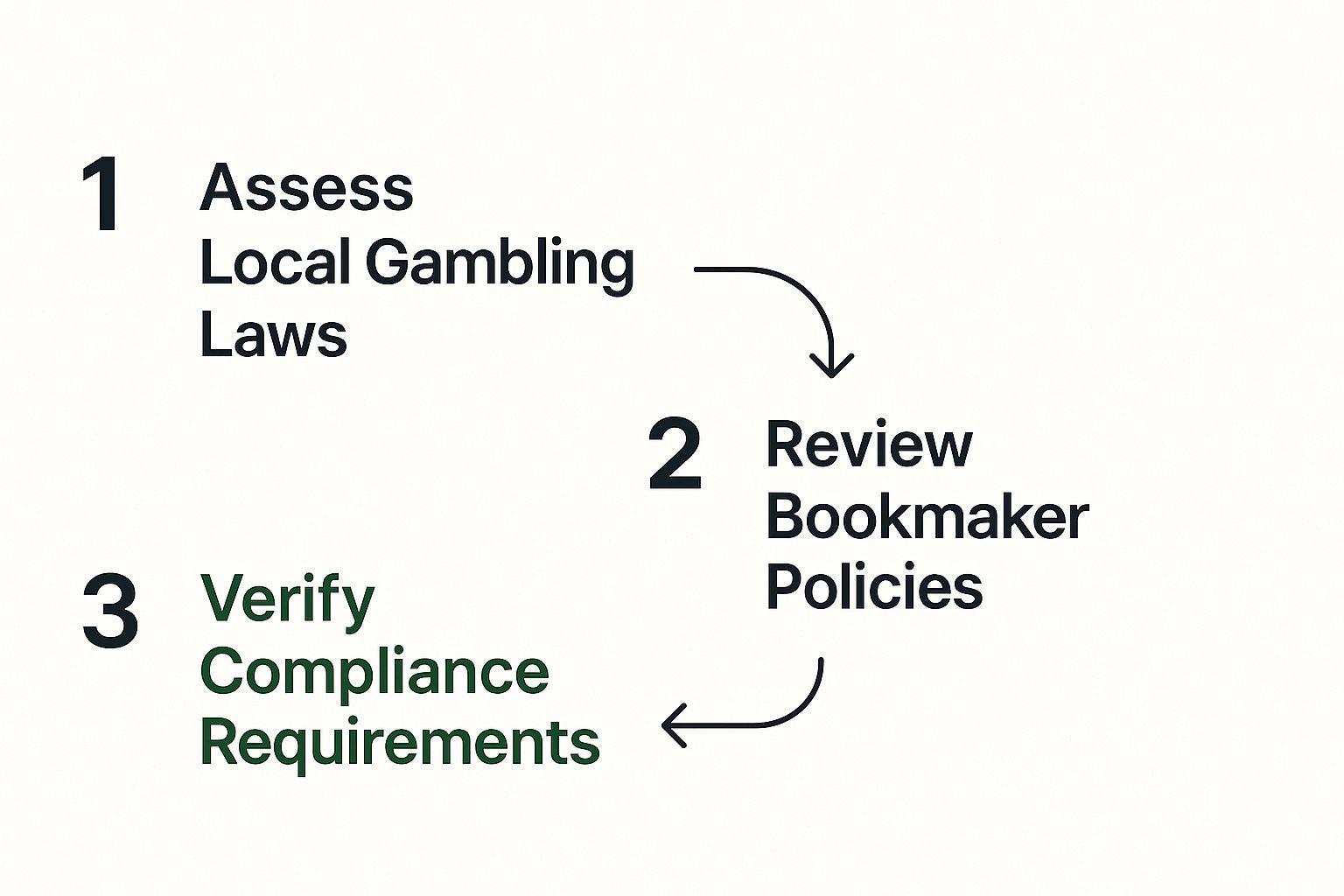
The flowchart makes one thing crystal clear: your first move should always be to check your local laws. Only after confirming you're in the clear should you worry about bookmaker rules and other compliance details. Following this sequence is key to practicing arbitrage responsibly and for the long haul, helping you avoid headaches with both the law and the betting sites.
Understanding the Global Sports Betting Legal Landscape
So, the big question: is sports arbitrage legal? The honest answer is... it's complicated. There's no single "yes" or "no" that applies everywhere. The legality of arbitrage is tied directly to a country's general stance on sports betting. If a nation gives the green light to online sports betting, then arbitrage isn't typically against the law—but it's almost always against the bookmaker's rules.
Think of it like this: the basic rules of driving are pretty universal, but speed limits and specific traffic laws can change dramatically the moment you cross a state or country line. The world of online betting is just like that—a patchwork of different regulatory environments. Before you even think about placing a bet, your first job is to get a handle on the specific laws right where you live.
A Tale of Two Continents: Europe vs. The USA
When you look at established betting markets, Europe and the United States tell two very different stories. Europe has been in the game for a long time, leading to more structured regulations and a predictable environment for bettors. The U.S., on the other hand, is the new kid on the block, with a fragmented market that creates a complex web of state-by-state rules.
- Europe's Regulated Markets: Many European countries have had legal frameworks for online gambling for years. While this gives you clarity, it also means the regulators and bookmakers are very good at spotting unusual betting patterns.
- The American Frontier: After a landmark 2018 Supreme Court decision, individual states got the authority to legalize sports betting. This kicked off a rapid, but very inconsistent, rollout. The rules in one state can be completely different from its next-door neighbor.
Getting a grip on these regional differences is absolutely critical. A betting strategy that's perfectly fine in one country might get your account flagged and closed just across the border.
Spotlight on European Betting Hubs
Europe is a great place to see how mature, regulated markets work. Italy, for instance, legalized online sports betting way back in 2006 and still has a relatively open system. France is another giant, with market revenues hitting $4.6 billion in 2021. The French government uses a regulatory body, ANJ (formerly ARJEL), to license and monitor sportsbooks. Then there's the United Kingdom, overseen by the UK Gambling Commission, which boasts one of the most developed online betting markets in the world. For a deeper dive, you can explore this detailed overview of global betting markets.
This map paints a clear picture of how sports betting legality differs across the globe.

The different colors immediately show you how drastically the rules can change from one region to another, making it obvious why a one-size-fits-all approach to arbing just won't work.
Crucial Insight: Your journey into sports arbitrage doesn't start with finding the perfect odds. It starts with a thorough check of your local, state, and national gambling laws. You have to be sure you're operating on solid legal ground first.
Other Key Regions to Consider
Outside of Europe and the U.S., the legal situation is all over the place. Latin America is a great example of an emerging market with a mix of everything—regulated countries, unregulated ones, and others where betting is restricted. Brazil is currently working to regulate its huge market, while countries like Colombia have already set up a licensed system.
In sharp contrast, many nations in Asia and the Middle East have strict bans on all forms of gambling. Trying to do any kind of sports betting there, including arbitrage, is illegal and comes with serious legal risks that go way beyond just having your account shut down.
At the end of the day, staying compliant is on you. The legality of what you're doing hinges entirely on your physical location when you place your bets. Always, always verify the laws of the country—and state or province, if it applies—before you get started.
Why Bookmakers Consider Arbing a Threat
To get why bookmakers really can't stand arbitrage bettors, you first have to understand their business. It’s not about predicting who will win a game. Not at all. Their entire model is built on setting odds that guarantee them a slice of the action, no matter the outcome.
This built-in profit is what the industry calls the "vigorish" or "juice."
Think of a simple coin toss. The real odds are 50/50, a perfectly even split. A bookie, however, will never offer you even money. Instead, they’ll set the odds at something like -110 for both heads and tails. That means you have to risk $110 just to win $100. That tiny difference is their lifeblood—their guaranteed cut.
Arbitrage betting throws a wrench directly into that machine. By snapping up mismatched odds across different sportsbooks, you effectively erase their built-in margin. You're not just beating them; you're using their own math against them to create a guaranteed loss for at least one of them. And they take that very personally.
How Bookmakers Identify Arbers
Bookmakers aren't flying blind here. They've poured a ton of resources into developing sophisticated systems designed to sniff out arbitrage activity. Their whole game is to flag and neutralize accounts before they can do any real damage to the bottom line.
These systems are trained to spot specific red flags that scream "arber" instead of "recreational bettor." The patterns might seem subtle to you, but to their risk management software, they stick out like a sore thumb.
Here are some of the biggest tells they look for:
- Unusual Stake Sizes: Normal people bet in round numbers like $10, $50, or $100. When a bet for $73.41 or $128.92 comes through, alarm bells start ringing. It's the clearest sign that you're using a calculator, not your gut.
- Betting on Obscure Markets: Are you consistently placing big bets on Ukrainian second-division volleyball or under-19 table tennis? Unless you have a very specific passion, it’s obvious you’re hunting for odds, not entertainment.
- Ignoring Bonuses and Promotions: This one feels backward, but it’s a huge giveaway. Casual players love freebies. Arbers, on the other hand, often avoid bonuses because the rollover requirements mess with their ability to quickly move money and lock in an arb.
- Winning Consistently with Small Margins: A betting history packed with lots of small, steady wins and almost no big losses doesn't look like luck. It looks like a system.
Once your account gets flagged, it's not a question of if the bookie will act, but when. And when they do, they move fast to protect their profits.
"Bookmakers often react ambiguously. Some actually welcome arbing as it helps them sharpen their odds and enhance their modeling. But the majority see arbers as unwanted customers and enact penalties against them."
This quote nails it. While a tiny minority of sharp books might see arbers as a source of market intelligence, the vast majority just see you as a problem to be solved.
The Consequences of Being Caught
Once a bookmaker has you pegged as an arber, they have a whole playbook of actions they can take to shut you down. All of these measures are perfectly legal because you agreed to them in the fine print of their terms and conditions when you signed up. The question isn't whether sports arbitrage is legal, but whether the bookmaker will allow it.
The penalties almost always start small and ramp up from there.
Common Bookmaker Penalties:
- Stake Limiting (Gubbing): This is the classic first move. The bookie will slash your maximum bet size, often down to just a few dollars. It's called "gubbing," and it makes it impossible to make any real money.
- Bet Cancellation: Sometimes, a bookmaker will just cancel a bet they think is part of an arb. This happens most often with "palpable errors"—obvious mistakes in their odds. They'll refund your stake, but your arb is instantly ruined.
- Account Closure: This is the end of the line. If the warnings don't work, they’ll simply close your account for good. They’ll usually refund your balance, but some policies allow them to confiscate it in certain situations.
At the end of the day, the real cat-and-mouse game in arbitrage isn't with the law. It's with the bookmakers themselves and their ever-watchful security systems.
How to Reduce Your Risk and Avoid Detection

While we've established that sports arbitrage is perfectly legal, staying on the right side of the law is only half the battle. The real trick is staying under the radar of the bookmakers, who are constantly on the lookout for arbers. Your goal is to blend in, making your betting activity look as recreational and unassuming as possible.
Think of yourself as an undercover agent. Your mission is to secure profits without blowing your cover and getting your accounts restricted. To pull this off, you have to act like a regular, casual player and ditch the precise, calculated patterns that arbitrage betting naturally produces.
Round Your Stakes and Act Human
The quickest way to get flagged by a bookie’s algorithm is to place bets with weirdly specific amounts. A casual punter might bet $25 or $50. An arber, following their calculator down to the last cent, might bet $47.83. That’s a massive red flag.
To avoid this, always round your stakes. Get it to the nearest whole number, or better yet, to a multiple of five. So, instead of that $47.83 bet, place a $48 or even $50 wager. This simple change makes your activity look far more natural. Yes, it might slightly chip away at your guaranteed profit for that one arb, but that tiny hit is a small price to pay for keeping your account healthy and active.
Place Occasional “Mug Bets”
Another dead giveaway is an account history filled only with small, consistent wins on obscure markets. To counteract this, you need to build a more believable betting profile by placing what we call “mug bets.” These are just ordinary, everyday bets that have no arbitrage value.
- Throw a small wager on a huge event, like a Premier League match or a championship fight.
- Bet on your favorite team, even if the odds are nothing special.
- Every now and then, try a small accumulator or parlay.
These bets are designed to lose a tiny bit of money over the long run, but their real job is strategic. They create a "normal" betting history that camouflages your profitable arbitrage activity. While it’s vital to find good arbs, knowing how to play defense is just as important. For those still learning the ropes, our guide on how to find arbitrage bets is a great starting point for spotting these opportunities.
Diversify Your Bookmaker Portfolio
Funneling all your action through just a couple of bookmakers is asking for trouble. It concentrates your activity, making it ridiculously easy for their systems to spot your patterns. The solution? Spread your bets across a wide array of different bookmaker accounts.
Key Strategy: By spreading your activity, you reduce the number of arbitrage bets placed with any single bookmaker. This makes it significantly harder for them to build a complete picture of your strategy and flag you as a professional.
Think of it this way: placing one suspicious bet at ten different shops is far less likely to raise alarms than placing ten suspicious bets at the same shop. Diversification is your best friend in this game.
Best Practices for Staying Under the Radar
- Limit Withdrawal Frequency: Constantly cashing out, especially after a string of small wins, signals that you're treating the bookie like a personal ATM. Let your balance grow and make larger, less frequent withdrawals. It just looks more natural.
- Use Different Bet Types: Don't just stick to the simple win/lose markets. Mix it up with bets on totals (over/under), handicaps, and other exotic bets to create a varied and less predictable profile.
- Avoid Chasing Palpable Errors: Sometimes a bookie makes an obvious, massive mistake with their odds. These "palps" can offer huge arbitrage margins, but betting on them is the fastest ticket to getting your account limited or shut down. It’s just not worth the risk.
At the end of the day, longevity is the name of the game. By adopting these strategies, you can operate more discreetly and ensure you’re able to keep capitalizing on arbitrage opportunities for a long, long time.
Quick Answers to Your Burning Arbitrage Questions
Alright, we've covered the what and the how of arbitrage betting, but it's completely normal to still have some questions buzzing around. This is where things can get a little confusing, especially when you're trying to figure out where the legal lines are drawn versus the rules a betting site makes up for itself.
Let's cut through the noise. This section is all about tackling those common "what if" scenarios head-on with straight, simple answers. Think of it as a final check to make sure you're crystal clear on the important stuff before moving forward.
Can I Go to Jail for Arbitrage Betting?
This is usually the first question on everyone's mind, so let's get it out of the way. The answer is a hard no.
In places where you can legally bet on sports—think the UK, Australia, most of Europe, and a growing number of US states—arbitrage betting itself isn't a crime. You aren't breaking any laws by betting on every possible outcome of a game across different sportsbooks.
The key thing to remember is the difference between what's illegal and what a bookie simply doesn't allow. You won't face any legal heat. The pushback comes directly from the sportsbooks who will limit or close your account if they catch on. Their rules are based on their private terms and conditions, not the law of the land.
Is Arbing the Same as Match-Fixing?
Not even close. It's crucial to understand that these two things are worlds apart.
Match-fixing is a serious crime. It's about illegally rigging a game's outcome, usually for a massive betting payoff, and it completely destroys the integrity of the sport.
Arbitrage betting, on the other hand, has zero impact on what happens on the field. It’s a pure numbers game—a trading strategy that capitalizes on mismatched odds. Arbers honestly don't care who wins or loses; the whole point is to make a small profit no matter the result. It's an investment, not cheating.
What Is the Difference Between Arbitrage and Value Betting?
This is a great question. While both are smart betting strategies, they work on fundamentally different principles. They're cousins, not twins.
- Arbitrage Betting: This is your risk-free play. The entire goal is to lock in a guaranteed, small profit by covering all outcomes of an event. Your profit is locked in before the game even starts. The returns are usually small, around 1-5%.
- Value Betting: This is about finding an edge. You’re placing a bet because you believe the odds offered are better than the actual probability of that outcome happening. You've found "value," but there's no guarantee—your bet could still lose. It's a calculated risk, not a sure thing.
Many arbers eventually get into value betting. Once you understand how to spot market inefficiencies for arbs, you start to see them everywhere. For a deeper dive into the math behind it, learning about expected value and its meaning is the perfect next step.
The Bottom Line: Arbitrage is a risk-free guarantee. Value betting is a calculated risk you take because you believe the odds are in your favor.
How Much Money Can You Realistically Make?
Let's set some realistic expectations here. Arbitrage betting isn't your ticket to overnight millions. It's a grind. Since profits on any single arb are tiny—again, usually 1% to 5% of your total stake—your overall earnings really depend on a few things:
- Your Bankroll: The more money you have to bet with, the larger your stakes can be, and the more that 1-5% profit is actually worth.
- Your Accounts: More bookie accounts mean more chances to find odds discrepancies. Simple as that.
- Your Time: This isn't passive. You have to be ready to act fast. The more time you put in, the more arbs you'll catch.
- Staying Under the Radar: This is the big one. How long you can keep your accounts open and unrestricted is the single biggest factor in your long-term success.
A dedicated arber with a healthy bankroll can certainly build a nice, consistent monthly income. But it’s a game of stacking small, steady wins day after day.
To make things even simpler, here are the most frequent questions I get, all in one place.
Quick Answers to Your Arbitrage Questions
| Question | Answer |
|---|---|
| Is arbing illegal? | No, it's perfectly legal in any country or state where online sports betting is legal. |
| Will I face criminal charges? | Absolutely not. Any consequences, like account closures, come from the bookmakers, not the police. |
| Does it affect the game's outcome? | Nope. It's a math-based strategy that has nothing to do with the players or the final score. |
| Can you get rich quickly? | Not a chance. It’s a method for earning small, consistent profits over time, not a get-rich-quick scheme. |
This table sums up the most critical points we've covered. The takeaway is that while arbing is legal, it operates in a gray area defined by bookmaker rules, not laws.
Why Do Bookmakers Offer Different Odds Anyway?
The very existence of arbitrage comes down to two simple things: competition and human (or algorithmic) error.
Every sportsbook is an independent company fighting for your business. They set their own odds using their own data, risk models, and desired profit margin (known as the "vig" or "juice").
Sometimes their opinions just don't line up. One bookie might be slow to react to an injury report. Another might deliberately post attractive odds on one team to balance out the money they've taken on the other. These brief moments of disagreement are what create the arbitrage window. It's a completely natural side effect of a competitive market.
Ready to stop gambling and start investing in sports? At ValueBetFactory, we provide the tools and education you need to make smarter, data-driven betting decisions. Our platform identifies profitable opportunities in real-time, helping you turn market inefficiencies into consistent returns. Discover a smarter way to bet at ValueBetFactory.