
How Do Betting Shops Make Money? Discover Key Strategies
Unlock Profits with betting tips!
Ever wondered how betting shops really make their money? It’s a common misconception that their profit comes from simply winning when your bet loses. While that’s part of the story, the real secret is far more methodical and, for them, much safer. They aren't gambling against you; they're acting as a market maker, guaranteeing themselves a profit no matter who wins or loses.
It’s a business model built on a small, consistent mathematical edge that ensures they get a slice of almost every single bet placed.
The Secret Behind the Bookmaker's Edge

The engine driving a bookie’s revenue is something called the bookmaker's margin. You might also hear it called the "overround" or the "vig." This is their built-in advantage, and it's baked into every market they offer.
Instead of presenting true odds that perfectly mirror the real-world probability of an event, a bookmaker will slightly shorten them in their favor. This creates a clever situation where the implied probabilities of all possible outcomes add up to more than 100%. That little bit extra is their guaranteed profit. You can dive deeper into the fundamentals in our detailed guide on what is a bookmaker.
A Simple Coin Toss Analogy
Let's make this concrete with a simple coin toss. Everyone knows the true probability is exactly 50% for heads and 50% for tails. If a bookie offered fair odds on this, they'd break even over the long run not a great business model.
So, they don't. A real bookmaker might offer odds that imply, say, a 52% chance for heads and a 52% chance for tails. When you add those up (52% + 52%), you get 104%. That extra 4% is the overround, their guaranteed cut, no matter which side the coin lands on.
To see this in action, here's a quick breakdown of how this margin works on a 50/50 event.
Bookmaker Margin on a Simple Coin Toss
This table shows how a bookmaker applies a margin to a simple coin toss to ensure they make a profit, regardless of the outcome.
| Outcome | True Odds (Probability) | Bookmaker Odds (Implied Probability) | Profit Margin |
|---|---|---|---|
| Heads | 2.00 (50%) | 1.92 (52%) | 4% (Overround) |
| Tails | 2.00 (50%) | 1.92 (52%) | |
| Total | 100% | 104% |
As you can see, the total implied probability exceeds 100%, and that extra percentage is where the bookmaker's profit is locked in.
This concept is often called the 'house edge.' It is the fundamental difference between the true odds of an event and the odds offered to bettors, ensuring the bookmaker retains a percentage of all wagers over the long term.
This margin is the bread and butter of betting shops. For most fixed-odds sports betting, this built-in profit margin typically sits somewhere between 5% to 10%. In simple terms, for every $100 wagered across a market, the bookmaker expects to keep around $5 to $10 as their gross profit.
Calculating the Overround and Profit Margin
Knowing that a bookie’s profit comes from the overround is one thing, but being able to calculate it yourself is a genuinely powerful skill. It lets you peel back the curtain and see the exact size of the house edge on any market you’re looking at. The process is surprisingly straightforward and just involves turning betting odds into their implied probabilities.
Let's use a real-world example: a football match with three possible outcomes Team A wins, Team B wins, or it’s a draw. The first step is to convert the decimal odds for each of those outcomes into a simple percentage.
The formula to calculate implied probability from decimal odds is super simple: (1 / Decimal Odds) * 100
You just run that quick calculation for every possible result. This shows you the percentage chance the bookmaker is giving each outcome based on the odds they’re offering.
A Football Match Example
Imagine the odds for a match are laid out like this:
- Team A to Win: 2.50
- Draw: 3.40
- Team B to Win: 2.80
Applying the formula, we can figure out the implied probability for each one. For Team A to win, it’s (1 / 2.50) * 100 = 40%. For the draw, it's (1 / 3.40) * 100 = 29.41%. And finally, for Team B to win, it's (1 / 2.80) * 100 = 35.71%.
This infographic breaks down exactly how to find the overround by converting those odds into percentages and just adding them all up.
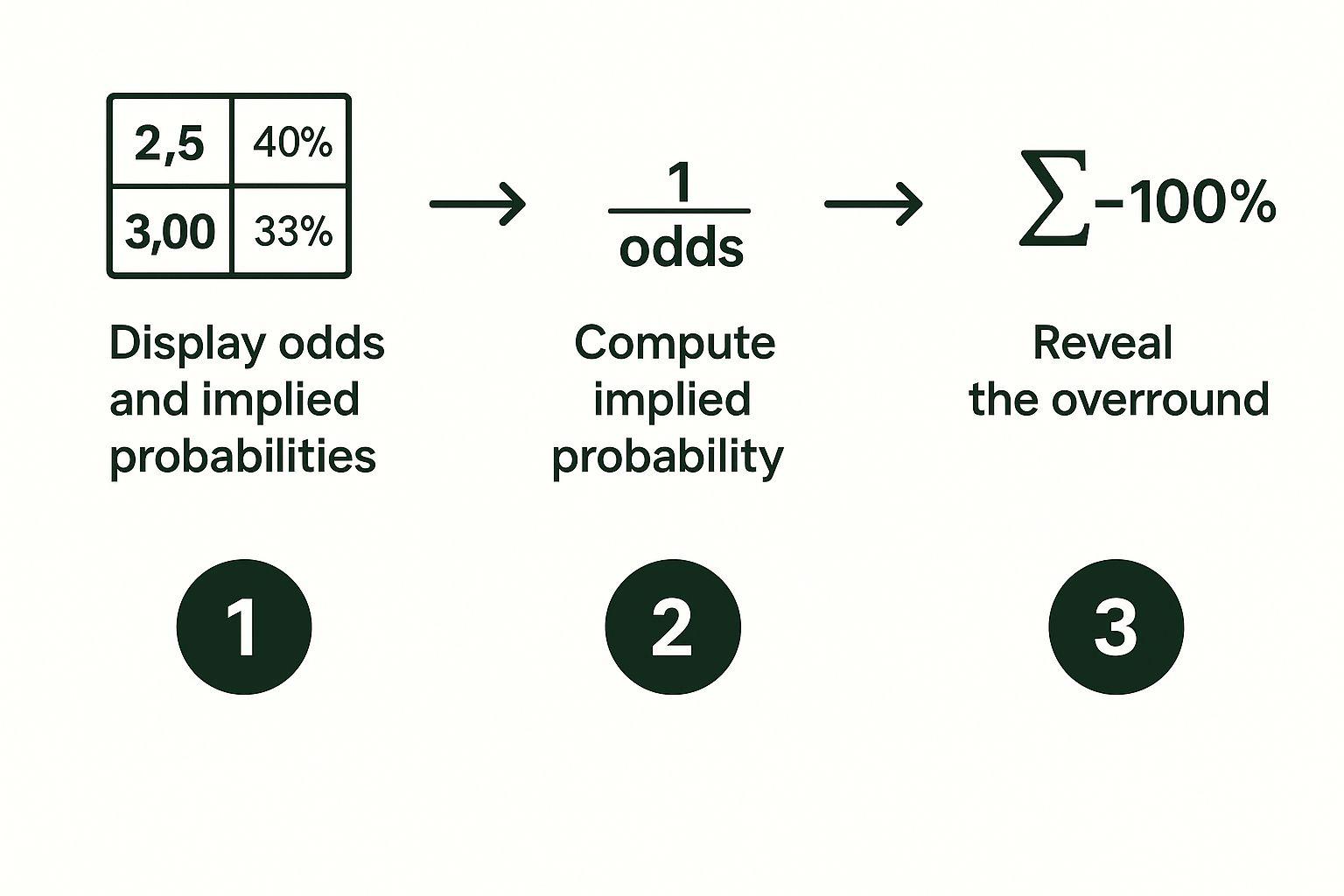
As the visual shows, once you have the individual probabilities, you just sum them together to expose the bookmaker's built-in margin.
When we add these percentages up (40% + 29.41% + 35.71%), we get a grand total of 105.12%. Since a perfectly fair market would add up to exactly 100%, that extra 5.12% is the overround. That number is the bookmaker’s guaranteed profit margin on this specific market, assuming they take balanced action.
If you want to get a feel for this, you can mess around with a betting margin calculator to instantly find the overround on any set of odds.
A higher overround means a bigger built-in profit for the betting shop. By learning how to spot it, you get a much clearer picture of how betting shops make money on every single event they post.
How Bookmakers Balance Their Books to Guarantee Profit

When they get this right, it guarantees that no matter who wins, the total they pay out is less than the total they took in. Think of it like a grocer who needs to sell all their produce. If everyone is only buying apples, they might put the oranges on sale to encourage sales and avoid getting stuck with a pile of rotting fruit.
Bookmakers do the exact same thing, but instead of adjusting prices, they adjust the odds in real-time based on the flow of money from bettors like you and me.
Responding to Betting Patterns
When a huge wave of cash floods in on one particular outcome, it creates a massive liability for the sportsbook. Let's say a popular football team attracts 90% of all the bets for an upcoming match. If that team wins, the bookmaker is looking at a catastrophic payout and a potential loss on that single event.
To stop this from happening, they'll immediately shorten the odds on the popular team, making it a much less attractive bet. At the same time, they'll lengthen the odds on the underdog, making that side of the bet far more appealing to anyone hunting for better value.
This strategic shift in odds is designed to attract wagers on the less popular side, effectively "balancing" the money wagered across all outcomes and minimizing the bookmaker's financial risk.
By constantly tweaking the odds, they aim to secure their profit margin regardless of the final score. It's a dynamic dance where public opinion and betting volume directly shape the market you see. For a deeper look into how they manage risk at a more advanced level, you can explore more about hedging in sports betting.
The money generated through this careful balancing act is known as gross gaming revenue (GGR). In the United States, the scale of this is staggering; revenue from online sports betting alone was forecasted to hit $7.62 billion in 2025 and is expected to rocket past $14.44 billion by 2027. You can dig into more sports betting statistics and learn about market growth projections.
Advanced Strategies That Boost Bookmaker Revenue
While the built-in margin is the bread and butter of how bookmakers make money, it's just the starting point. Modern bookies have a whole arsenal of clever strategies designed to multiply their revenue, moving far beyond simple single bets.
These methods are incredibly powerful because they tap into technology and bettor psychology. Two of the most profitable by far are accumulator bets and the explosion of in-play betting.
The Power of Compounded Margins in Accumulators
You've probably heard them called accumulators, or "accas," and in the US, they're known as parlays. This is where a bettor combines multiple different selections into one single wager. For the bet to pay out, every single pick has to win. No exceptions.
So, why are these so ridiculously lucrative for the bookie? It all comes down to compounded margins.
Let's say a bettor builds a four-fold accumulator, and each individual selection has a 5% margin baked into the odds. The bookmaker's total margin on that bet isn't just 5% it's far, far higher because the margin on each leg compounds on the others. This makes accumulators a classic high-reward, low-risk product for the house.
An accumulator bet dramatically decreases the bettor's probability of winning while simultaneously increasing the bookmaker's effective profit margin. This combination makes them one of the most profitable products a betting shop can offer.
The Non-Stop Action of In-Play Betting
The other absolute game-changer has been the rise of in-play or live betting. Instead of just placing a wager before a match kicks off, people can now bet in real-time as the action unfolds on the screen.
This has completely transformed the betting landscape. A single 90-minute football match is no longer one betting event; it's dozens of them. Markets for the next goalscorer, the next team to get a corner, or the total number of cards are constantly opening and closing.
This keeps bettors glued to the action, encouraging more frequent, smaller wagers. Every time the odds shift during the game, it creates a fresh opportunity for the bookmaker's margin to do its work, turning a single event into a continuous revenue stream.
Revenue Model Comparison Traditional vs Modern Betting
The shift from the old-school betting shop to the modern online platform has dramatically changed where the money comes from. The table below breaks down the key differences in their primary revenue models.
| Revenue Model | Traditional Betting Shop | Modern Online Platform |
|---|---|---|
| Core Product | Pre-match single and accumulator bets. | A vast menu of pre-match, in-play, and prop bets. |
| Primary Margin Source | Standard overround on a limited number of events. | Compounded margins from accumulators and continuous in-play markets. |
| Customer Engagement | Limited to shop opening hours and major events. | 24/7 engagement through mobile apps and live streaming. |
| Key Profit Driver | High-margin accumulator bets on popular sports. | Massive volume from thousands of in-play betting markets running concurrently. |
This evolution shows how technology has allowed bookmakers to move beyond the simple margin model into a dynamic, high-volume operation that generates revenue around the clock.
The move to digital platforms has poured gasoline on this fire. The global online gambling market, valued at around USD 105.5 billion in 2025, is expected to explode to USD 286.4 billion by 2035, with live betting being a massive part of that growth. You can explore more data on the growth of the online gambling market.
What was once a simple shopfront operation has become a sophisticated, 24/7 revenue-generating machine.
Essential Risk Management for Betting Shops
Even with a guaranteed margin baked into the odds, a bookie’s worst nightmare is a large, one-sided bet. The ideal scenario is a perfectly "balanced book," where money is spread evenly across all outcomes, but real life is rarely that neat. This is where defensive strategies become absolutely critical for protecting profits.
When a tidal wave of cash comes in on one particular outcome, it creates a massive liability. A surprise win for an underdog that everyone piled on could easily wipe out the profits from thousands of smaller, balanced bets. To stop that from happening, betting shops have to actively manage their financial exposure.
This risk management can take a few different forms, from tweaking the odds in real-time to taking more direct, hands-on action. The goal is always the same: avoid a catastrophic loss that could cripple the entire operation.
Protecting Profits from Major Losses
One of the most common and controversial tactics is hitting consistently successful gamblers with account restrictions and stake limitations. These skilled bettors, often called 'sharps,' find their maximum bet amounts slashed to pennies or get banned from promotions altogether.
This move ensures that even if a sharp bettor wins, the financial damage is controlled and minimal. It's a blunt but effective way for bookmakers to shield themselves from customers who can regularly spot value in their odds.
Another crucial strategy is hedging. Just think of this as the bookmaker buying insurance on a risky bet.
If a betting shop faces an enormous potential payout on one outcome, they might place a large bet on that same outcome with a rival bookmaker. This move offsets their own liability, ensuring they don't face a devastating loss.
For example, imagine a bookie is on the hook for a £1 million payout if a specific horse wins a big race. To protect themselves, they might place their own £500,000 bet on that same horse with another company.
Now, if the horse wins, the winnings from their hedge bet cover a huge portion of what they have to pay out to their customers. It's a clever move that turns a potential disaster into a much more manageable loss.
A Few Final Questions About How Bookmakers Operate
Even after you get your head around the core ideas of overrounds and balanced books, a few common questions always seem to surface. Tackling these helps paint the complete picture of how a bookie’s day-to-day operation really works.
Let’s run through a few of the most frequent ones.
Can Betting Shops Actually Lose Money on an Event?
Absolutely. It’s entirely possible for a betting shop to take a hit on a single event. If the betting is incredibly one-sided on a winning result and they just can't balance their book in time, they can face a massive payout that’s far bigger than the total stakes they took in.
But here’s the key: that’s just a short-term loss. Their entire business is built for long-term profit. Across thousands of events, that guaranteed margin ensures the wins will always, always outweigh these occasional losses.
Are the Odds the Same at All Betting Shops?
Not at all. The odds are rarely identical from one bookie to the next. While you'll see very similar odds on major events like the World Cup final, you'll almost always find small differences.
These little variations pop up for a few key reasons:
- Different Profit Margins: Every bookmaker sets their own overround. A bookie aiming for a higher margin will naturally offer slightly shorter odds.
- Current Liability: Imagine one shop has taken a flood of money on Manchester United. They’ll shorten those odds to discourage more bets, while a competitor without that lopsided action might keep their odds the same.
- Promotional Strategy: Sometimes, a bookie will deliberately offer better-than-market odds on a big match. It’s a simple marketing trick to pull in new customers.
This variation in odds is exactly why sharp bettors "shop around" at different bookmakers, hunting for the best possible value on their wager. It’s a fundamental part of trying to maximize your potential returns.
How Do Free Bets and Promotions Make Money for Bookmakers?
Handing out free bets and juicy sign-up bonuses might look like they're just giving away money, but it's one of the sharpest customer acquisition tools they have. The initial cost of a free bet is tiny compared to the long-term value a new, active customer brings in.
These offers are designed to get you in the door, knowing you'll likely stick around and place bets with your own cash long after the promo is gone. On top of that, these "free" bets often come with strings attached, like wagering requirements, which give the bookmaker a great chance to win that promotional money right back.
At ValueBetFactory, our entire goal is to give you the tools to understand these odds and make more informed decisions. By automatically spotting these discrepancies in the market, our platform gives you the insights needed to find potential value. Discover how our system can work for you by visiting ValueBetFactory.