
7 Advanced Football Betting Strategies Sharp Bettors Use to Win in 2026
Unlock Profits with betting tips!
Winning in football betting isn't just about picking the winner; it's about playing a numbers game where strategy trumps guesswork. While casual fans might rely on gut feelings, professional bettors use disciplined, data-driven approaches to secure long-term profits. They understand that identifying value, managing risk, and exploiting market inefficiencies are the cornerstones of success. This guide moves beyond simple tips like 'don't bet on your own team.' We're diving deep into seven advanced football betting strategies that form the foundation of professional play.

Each method offers a unique angle for finding an edge over the bookmakers. You will learn how to implement proven techniques that treat betting as a calculated investment rather than a gamble. We will cover:
- Value Betting: Finding odds that are better than the real probability of an outcome.
- Arbitrage Betting: Guaranteeing a profit by covering all outcomes across different bookmakers.
- Asian Handicap: Eliminating the draw option to create more balanced odds.
- Kelly Criterion: A mathematical formula for optimal stake sizing.
- In-Play Betting: Capitalizing on shifting momentum and live-game dynamics.
- Statistical Modeling: Building your own models to predict outcomes.
- Matched Betting: Using free bets and promotions to secure risk-free profits.
This article breaks down the what, why, and how of each strategy with actionable steps and real-world examples, empowering you to make more informed and potentially profitable decisions.
1. Value Betting
Value betting is the cornerstone of all successful football betting strategies and is championed by professional gamblers and betting syndicates worldwide. At its core, the concept is simple: you place a bet only when you believe the odds offered by a bookmaker are higher than the true probability of an outcome. In essence, you are looking for pricing errors in the market that give you an edge over the long term.

Unlike betting on favorites or following hunches, value betting is a purely mathematical approach. It requires you to calculate your own probability for a match outcome and then compare it to the implied probability of the bookmaker’s odds. When your assessed probability is greater than the bookmaker's, you've found a "value bet."
How to Find and Calculate Value
To identify a value bet, you must first convert the bookmaker's decimal odds into an implied probability. The formula is straightforward: Implied Probability (%) = (1 / Decimal Odds) * 100.
For example, if a team has odds of 2.50 to win, their implied probability is (1 / 2.50) * 100 = 40%. The critical step is then to conduct your own research. Using statistical models, team news, historical data, and performance metrics like Expected Goals (xG), you might determine the team's actual chance of winning is closer to 45%. Since your assessed probability (45%) is higher than the implied probability (40%), this represents a value bet.
Actionable Tips for Implementation
- Focus on Niche Markets: Bookmakers are less likely to make pricing errors on major leagues like the Premier League. Look for value in lower leagues or less popular markets (e.g., corners, cards) where their knowledge may be limited.
- Build a Statistical Model: While it takes time, creating your own simple model in a spreadsheet using data like goals scored/conceded, xG, and recent form will help you generate more accurate probabilities than relying on gut feelings.
- Maintain Meticulous Records: Track every bet you place, including the odds, stake, your calculated probability, and the outcome. This data is vital for refining your strategy and confirming you have a genuine edge.
2. Arbitrage Betting (Sure Bets)
Arbitrage betting, often called "sure betting," is one of the few football betting strategies that can guarantee a profit regardless of the match outcome. The strategy involves exploiting the slight differences in odds offered by various bookmakers for the same event. By placing precisely calculated bets on all possible outcomes across different betting sites, you can lock in a small but guaranteed return.

This mathematical approach is not about predicting a winner but about capitalizing on market inefficiencies. Bookmakers constantly adjust odds to balance their books, and when their opinions differ, an arbitrage opportunity, or "arb," is created. These opportunities are fleeting, but for disciplined bettors, they represent a risk-free way to build a bankroll.
How to Find and Calculate an Arb
Finding an arbitrage opportunity requires comparing odds across multiple bookmakers. The goal is to find a set of odds where the combined implied probabilities are less than 100%. The formula to check for an arb in a two-way market (e.g., Over/Under 2.5 goals) is: Arb % = [(1 / Odds A) + (1 / Odds B)] * 100. If the result is less than 100, you have a sure bet.
For example, imagine a match where Bookmaker 1 offers odds of 2.10 for Over 2.5 goals, and Bookmaker 2 offers odds of 2.05 for Under 2.5 goals. The calculation would be: [(1 / 2.10) + (1 / 2.05)] * 100 = (0.476 + 0.488) * 100 = 96.4%. This 3.6% difference (100% - 96.4%) is your guaranteed profit margin. Your stakes would be calculated to ensure the same profit no matter which outcome occurs.
Actionable Tips for Implementation
- Use Arbitrage Software: Manually searching for arbs is nearly impossible as they appear and disappear in minutes. Use specialized arbitrage detection software that scans hundreds of bookmakers in real-time to alert you to opportunities.
- Act Quickly and Decisively: When an arb is identified, you must place your bets on all outcomes as fast as possible. Hesitation can lead to one of the odds changing, which eliminates the profit and leaves you with an exposed bet.
- Maintain Multiple, Funded Accounts: To execute this strategy effectively, you need accounts with numerous bookmakers that are pre-funded and ready to go. This allows you to jump on any opportunity without delay. If you want to dive deeper, you can learn more about how to find arbitrage bets on valuebetfactory.com.
3. Asian Handicap Betting
Asian Handicap betting is one of the most sophisticated football betting strategies, designed to eliminate the draw outcome and balance the odds between two mismatched teams. This market, originating in Asia and now popular globally, gives one team a virtual "handicap" (a goal deficit or surplus) before the match begins, creating a more competitive betting environment with roughly 50/50 outcomes.
This approach is highly favored by professional bettors as it reduces betting variance and often provides better value than traditional 1X2 markets. By removing the draw, bookmaker margins are typically lower, and bettors can focus purely on assessing which team will outperform its expected handicap, rather than predicting one of three distinct results.
How to Understand and Use Handicaps
Asian Handicaps are expressed in goal lines, such as -0.5, -1.0, -1.5, +0.25, or +0.75. A negative handicap is given to the favorite, who must win by more goals than the handicap to cover the bet. A positive handicap is given to the underdog, who can win, draw, or lose by less than the handicap for the bet to be successful.
For example, betting on Manchester City with a -1.5 handicap means they must win by two or more goals (e.g., 2-0, 3-1). Conversely, if you bet on an underdog with a +0.5 handicap, your bet wins if they win or draw the match. Quarter-ball handicaps (like +0.25 or -0.75) split your stake between two handicaps, offering partial wins or losses.
Actionable Tips for Implementation
- Analyze Team Motivation and Style: This strategy is perfect when a top team needs a decisive win or when a defensive underdog is likely to keep a game tight. Consider factors like squad rotation in cup games or end-of-season motivation.
- Focus on Quarter-Ball Handicaps for Security: Lines like +0.25 or +0.75 are excellent for cautious underdog betting. A +0.25 bet on an underdog means you win if they win and get half your stake back if they draw, providing a valuable safety net.
- Identify Mismatched Teams: Look for games where one team is heavily favored but the standard win odds are too low to be valuable. The Asian Handicap market provides a much more attractive way to bet on the favorite's dominance.
4. Kelly Criterion Staking
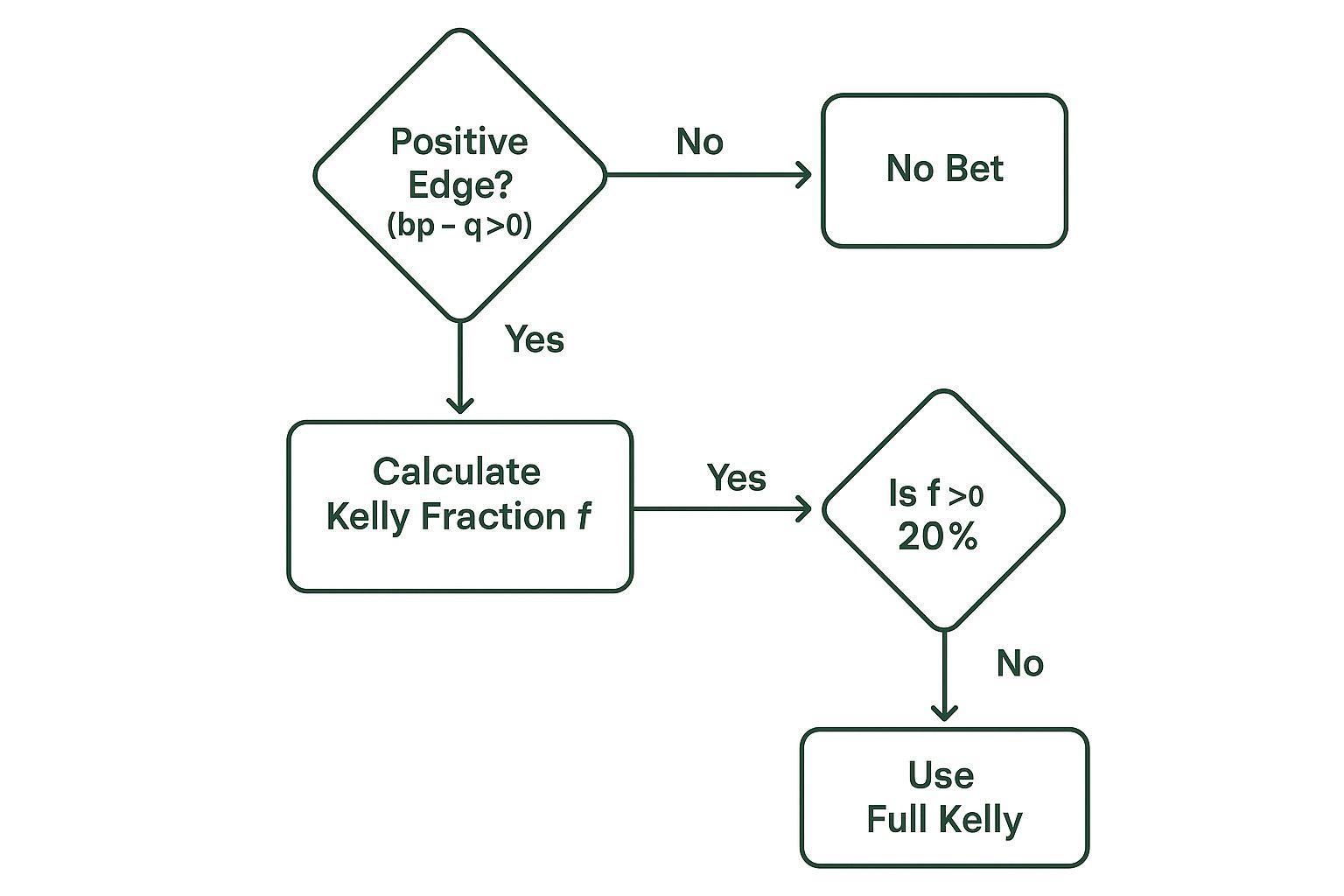
Once you've mastered finding value, the next logical step in advanced football betting strategies is determining how much to wager. The Kelly Criterion is a renowned mathematical formula designed to calculate the optimal stake size for a bet, balancing aggressive bankroll growth with risk management. It essentially tells you what percentage of your capital to risk on a value bet to maximize long-term returns.
Popularized by professional gamblers and hedge fund managers, this method prevents you from over-staking and wiping out your bankroll, while ensuring you capitalize effectively on the edges you find. It is a dynamic staking plan that adjusts your bet size based on the perceived value and the odds.
How to Calculate Your Stake
The Kelly Criterion formula calculates the fraction (f) of your bankroll to bet: f = (bp - q) / b. In this formula, b is the decimal odds minus 1, p is your assessed probability of winning, and q is the probability of losing (1 - p). The result, f, is the recommended percentage of your bankroll to stake.
For example, you find a bet at decimal odds of 2.00 (so b = 1). Through your analysis, you estimate the true win probability is 60% (p = 0.60), meaning the loss probability is 40% (q = 0.40). The calculation would be: f = ((1 * 0.60) - 0.40) / 1 = 0.20. The formula suggests staking 20% of your bankroll, a very aggressive amount that highlights the confidence in your perceived edge.
Actionable Tips for Implementation
- Use Fractional Kelly: Full Kelly can be highly volatile. Most professionals use a "fractional Kelly," staking only a portion (e.g., 25% or 50%) of the recommended amount to reduce variance and protect their bankroll from inevitable downswings.
- Only Use on Proven Edges: The formula is only as good as your probability estimates. Only apply it when you have a statistically validated edge confirmed through meticulous record-keeping. Using it on hunches is a recipe for disaster.
- Reassess Probabilities Constantly: Team news, injuries, and form changes can alter true probabilities. Your inputs for the Kelly formula must be based on the most current and accurate data available before placing a bet. To dive deeper into the mathematics and practical applications, you can learn more about the Kelly Criterion.
5. In-Play (Live) Betting
In-play, or live betting, has revolutionized modern sports wagering by allowing you to place bets after a football match has already kicked off. This dynamic strategy relies on interpreting real-time events and momentum shifts to find value in odds that constantly fluctuate. It transforms the bettor from a pre-match analyst into a live tactician, reacting to game-changing moments like goals, red cards, or key injuries.

Unlike pre-match betting, which is based entirely on historical data and predictive analysis, live betting incorporates the "eye test" and your ability to read the flow of the game. A team might be the pre-match favorite, but if they start sluggishly and concede early, their live odds to win will lengthen significantly. This is where sharp in-play bettors find opportunities that were unavailable before the match started.
How to Capitalize on Live Game Events
Success in live betting is about anticipating how an event will impact the odds and acting before the market fully adjusts. The key is to react to on-field events that pre-match models couldn't account for. This is a core component of many advanced football betting strategies.
For example, imagine a top team is dominating possession and creating chances against a weaker opponent, but the score remains 0-0 after 60 minutes. The pre-match odds for "Over 1.5 Goals" will have drifted to a much more attractive price. By identifying the dominant team's persistent attacking pressure, you can place a live bet on that outcome with favorable odds, predicting that their pressure will eventually convert into goals.
Actionable Tips for Implementation
- Watch the Match Live: Do not rely solely on statistics or a bookmaker’s match tracker. Watching the game allows you to gauge a team's body language, tactical shifts, and momentum, which raw numbers cannot convey.
- Have Pre-Planned Scenarios: Before the match, identify potential scenarios and your corresponding betting actions. For instance, "If the underdog scores first but the favorite is still creating chances, I will back the favorite on the live handicap." This prevents impulsive, emotional decisions.
- Focus on Specific Markets: Become an expert in a few in-play markets, such as "Next Team to Score," "Over/Under Total Goals," or corner betting. Understanding the specific triggers for these markets will give you an edge over casual bettors.
6. Statistical Model Betting
At the most advanced end of football betting strategies lies statistical model betting. This approach moves beyond intuition and basic stats, using mathematical models built with historical data, player metrics, and team performance indicators to forecast match outcomes. These models, which can range from relatively simple rating systems to complex machine learning algorithms, aim to identify market inefficiencies and predict results more accurately than the bookmakers.
Popularized by sports analytics firms and professional betting syndicates, this quantitative strategy treats football betting as a data science problem. The goal is to create a system that can process vast amounts of information-like Expected Goals (xG), possession stats, shot locations, and player form-to generate its own probabilities for a game. When the model's probability differs significantly from the odds on offer, a betting opportunity arises.
How to Build and Use a Model
The core of this strategy is creating a system that can assess team strength and predict performance. A common starting point is an Elo rating system, which adjusts a team's score based on match results, opponent strength, and the margin of victory. More advanced models might use Poisson distribution to forecast the likely number of goals each team will score.
For example, a model might analyze the last 20 home games for Team A and the last 20 away games for Team B, incorporating xG for and against. Based on this data, it might predict a 2-1 victory for Team A, translating to a 55% win probability. If the bookmaker's odds only imply a 48% chance, the model has identified a potential value bet on a Team A victory. If you're looking to get started, you can learn more about how to build a sports betting model.
Actionable Tips for Implementation
- Start with Simple Frameworks: Begin with a basic model, such as one based on goal difference or a simple Elo rating system, using spreadsheet software. This helps you understand the core principles before adding complexity.
- Backtest Your Model Rigorously: Before risking real money, test your model against historical data it hasn't "seen" before. This process, known as out-of-sample testing, validates whether your model has genuine predictive power.
- Continuously Refine and Update: Football is dynamic; teams change, and leagues evolve. Your model must be regularly updated with the latest match data and refined to adapt to new trends and maintain its edge.
7. Matched Betting
Matched betting is one of the few football betting strategies that can mathematically guarantee a profit, regardless of the match outcome. It works by exploiting the free bets and promotional offers provided by bookmakers. The core principle involves placing a "back" bet on a specific outcome with one bookmaker (using their free bet) and a "lay" bet against the same outcome on a betting exchange like Betfair. This dual-bet approach covers all possibilities, ensuring you lock in a profit.
This strategy is not traditional gambling; it is a calculated, risk-free method (when executed correctly) for turning promotional bonuses into real cash. It leverages the competitive nature of the betting industry, where bookmakers constantly offer incentives to attract and retain customers. The goal is to convert these offers, such as a "Bet £10, Get £30 in Free Bets" promotion, into a withdrawable profit, typically around 80% of the free bet's value.
How to Guarantee a Profit
To execute a matched bet, you must complete a two-step process: the qualifying bet and the free bet. First, you place a qualifying back bet (e.g., Manchester United to win) with your own money at a bookmaker and simultaneously place an opposing lay bet on a betting exchange. This initial step usually results in a very small, calculated loss. Once this bet settles, the bookmaker credits your account with the free bet.
You then repeat the process with the free bet, finding another football match with close odds between the bookmaker and the exchange. By backing an outcome with the free stake and laying it on the exchange, you guarantee a profit because you are not risking your own money on the back bet. For example, a £20 free bet can be consistently converted into £16-£18 of pure profit.
Actionable Tips for Implementation
- Use Matched Betting Calculators: These essential tools do all the complex maths for you. They calculate the exact lay stake required at the exchange to guarantee a profit, eliminating the risk of human error.
- Maintain Normal Betting Patterns: To avoid having your accounts restricted, place occasional "mug bets" (regular bets without an offer) on high-profile football matches. This helps your activity appear natural to bookmakers.
- Start with Welcome Offers: Welcome bonuses are the most lucrative and straightforward. Focus on these first to build your bankroll and gain confidence before moving on to more complex reload offers and accumulator insurance promotions.
- Keep Meticulous Records: Track every qualifying bet, free bet, profit, and loss in a detailed spreadsheet. This is crucial for managing your bankroll and monitoring your overall profitability.
7 Football Betting Strategies Comparison
| Strategy | Implementation Complexity 🔄 | Resource Requirements 💡 | Expected Outcomes 📊 | Ideal Use Cases 💡 | Key Advantages ⭐⚡ |
|---|---|---|---|---|---|
| Value Betting | High - Requires strong math & statistical skills | High - Extensive research & multiple bookmaker accounts | Long-term consistent profits ⭐ | Skilled bettors with statistical knowledge | Mathematically sound, disciplined betting, long-term edge ⭐ |
| Arbitrage Betting | Medium - Must manage multiple accounts & fast execution | Medium - Multiple bookmaker accounts & software | Small, risk-free consistent profits ⚡📊 | Risk-averse bettors seeking guaranteed return | Risk-free profit, no sports knowledge needed, can be automated ⭐ |
| Asian Handicap Betting | Medium - Understanding handicaps and team strengths | Medium - Strong sport knowledge required | Better odds with reduced variance ⭐ | Football bettors wanting strategic bets | Eliminates draw, better odds, lower margins ⭐ |
| Kelly Criterion Staking | Medium - Requires accurate probability estimation | Medium - Detailed probability data & bankroll records | Optimized bankroll growth over time ⭐ | Bettors confident in their edge and sizing | Maximizes growth, manages risk, adapts bet size automatically ⭐ |
| In-Play (Live) Betting | High - Demands quick decision-making and attention | High - Constant monitoring, fast reactions | Variable, can leverage momentum ⚡ | Experienced bettors able to read games live | Capitalizes on live game shifts, many markets, cash-out options ⭐ |
| Statistical Model Betting | Very High - Technical skills to build and maintain models | High - Data, computing power, expertise | Potentially high edge with model updates ⭐ | Data-driven bettors with technical background | Removes bias, processes large datasets, improves over time ⭐ |
| Matched Betting | Low - Process driven exploiting promotions | Medium - Multiple accounts & tracking of offers | Risk-free, predictable short-term profits ⚡ | Beginners targeting bookmaker offers | Risk-free, no sports knowledge required, predictable returns ⭐ |
Integrating Strategies for Smarter Betting
Navigating the world of football betting without a plan is like a team taking the field without a game plan; occasional wins might happen, but long-term success remains elusive. Throughout this guide, we've dissected several powerful football betting strategies, moving beyond simple predictions and into the realm of calculated, analytical decision-making. The journey from a recreational bettor to a strategic one is defined by this very shift in mindset.
The core principle that unites these methods is the pursuit of a demonstrable edge. Whether it's the pure mathematical logic of Value Betting, the risk-free approach of Arbitrage Betting, or the nuanced risk management of Asian Handicaps, each strategy is designed to find and exploit market inefficiencies. They empower you to stop being a passive price-taker and start becoming an active value-hunter.
From Theory to Profitable Practice
The most effective bettors rarely stick to a single, rigid strategy. Instead, they build a versatile toolkit, understanding that different scenarios call for different approaches. The true art lies in integrating these concepts into a cohesive, personalized system.
- Synergistic Application: Imagine using a Statistical Model to identify a potential value bet. You can then apply the Kelly Criterion to calculate the optimal stake size, ensuring you're managing your bankroll effectively. If the match begins, In-Play Betting markets might offer an opportunity to hedge your initial position or double down if your analysis proves correct.
- Discipline as a Cornerstone: The common thread through all successful football betting strategies is discipline. This means meticulously tracking every bet, analyzing your performance, and resisting the emotional impulse to chase losses or bet on your favorite team without objective justification.
- Continuous Learning: The betting market is dynamic. Bookmakers adjust, models evolve, and new data becomes available. Committing to continuous learning and refining your approach is not just recommended; it's essential for staying ahead of the curve.
Ultimately, the goal is to transform your betting from a game of chance into a structured investment. By mastering the strategies outlined in this article, you are equipping yourself with the analytical framework needed to consistently make smarter, data-driven decisions. Start by focusing on one or two methods that resonate with you, practice them with small stakes, and build your confidence and expertise over time. This disciplined, strategic path is your most reliable route to achieving sustainable profitability in football betting.
Ready to put these advanced concepts into action without spending countless hours on manual analysis? ValueBetFactory uses sophisticated algorithms to scan millions of odds across global bookmakers, instantly identifying profitable value betting opportunities for you. Start making data-driven decisions today by visiting ValueBetFactory and let our technology find your edge.