
Double Chance Meaning in Betting A Complete Explainer Guide
Unlock Profits with betting tips!
If you've ever felt the sting of a last-minute equaliser wrecking your bet, the double chance market might be your new best friend. It’s a popular option that lets you wager on two of a match's three possible outcomes at the same time. Instead of making a single, high-risk prediction, you get a built-in safety net, which can seriously boost your win rate though, as you'd expect, the odds are a bit lower in return.
Understanding the Double Chance Meaning in Betting

Think about any standard football match. It can only end in one of three ways: the home team wins, the away team wins, or it's a draw. A classic bet forces you to pick just one of those outcomes. Get it right, you win. Get it wrong, you lose. Simple as that.
Double chance betting completely changes the game by letting you combine two of those possibilities into a single wager. It’s like being told you can open two doors out of three to find the prize. Your probability of success instantly jumps from 33.3% to around 66.7%. This fundamental shift is the core of the double chance meaning in betting.
The Three Core Double Chance Bets
Every double chance market is built from three straightforward combinations. Getting a handle on these is the key to using this bet type like a pro. The options are based on the traditional "1X2" market, where "1" is the home team, "X" is the draw, and "2" is the away team.
The table below breaks down the three fundamental choices you'll find at any bookmaker.
The Three Types of Double Chance Bets Explained
| Double Chance Bet | Meaning | Winning Scenarios |
|---|---|---|
| 1X | Home Win or Draw | Your bet wins if the home team wins OR the match is a draw. |
| X2 | Away Win or Draw | Your bet wins if the away team wins OR the match is a draw. |
| 12 | Home Win or Away Win | Your bet wins as long as the match does not end in a draw. |
As you can see, each option covers two of the three possible results, giving you a much wider path to a winning betslip. It’s a simple but powerful way to manage your risk.
A double chance bet fundamentally reduces your risk. By covering two of the three potential results in a match, you create a buffer against upsets or unexpected draws, making it a valuable tool for more conservative betting strategies.
This type of wager is just one of many specialized options out there. To get a better feel for the lingo and see where double chance fits into the wider world of betting, it's worth exploring a good glossary of common sports betting terms. Building that context will help you make smarter, more informed decisions across all markets.
How Double Chance Bets Work With Real Examples
Theory is one thing, but to really get a feel for the power of a double chance bet, you need to see it in action. Let's walk through a real-world scenario. Imagine a Premier League clash where Manchester City, the clear home favourite, is facing off against a tough but underdog Aston Villa side.
If you were looking at the standard 1X2 market, the odds might look something like this:
- Manchester City to Win (1): 1.50
- Draw (X): 4.50
- Aston Villa to Win (2): 6.50
A simple £10 bet on a Man City win gets you back £15 a nice £5 profit. But here’s the catch: if the match ends in a draw or Villa somehow pulls off an upset, your entire stake vanishes. That’s the classic high-risk, higher-reward nature of a standard match-winner bet.
Comparing Odds and Payouts
Now, let's see how the double chance market completely changes the game. Because you're covering two of the three possible outcomes, the odds are naturally going to be lower to reflect your massively reduced risk.
For that same Man City vs. Aston Villa match, the double chance odds would look more like this:
- Manchester City to Win or Draw (1X): 1.14
- Aston Villa to Win or Draw (X2): 2.62
- Man City or Aston Villa to Win (12): 1.22
Let’s say you put that same £10 on the 1X option (Man City to Win or Draw). Your bet now wins if City gets the victory or if the game ends in a tie. The only way you lose is if Aston Villa wins the match outright. Your return would be £11.40, for a £1.40 profit. It's a smaller payout, for sure, but your probability of walking away a winner is substantially higher.
The core trade-off is simple: you sacrifice higher potential profit for a much greater probability of winning. Understanding the double chance meaning in betting is about recognizing this balance between risk and reward.
Why the Odds Reflect a Safer Bet
This pricing isn’t just pulled out of thin air; it’s all based on probability. Think of a standard 1X2 bet as having three doors to choose from. Picking one gives you a theoretical 33.3% chance of being right.
A double chance bet, on the other hand, lets you open two of those three doors. Instantly, your implied probability of winning skyrockets to roughly 66.7%.
Bookmakers price their odds to account for this huge statistical advantage you’ve just gained. You are essentially paying for a safety net with your lower returns. That’s why a bet on a heavy favourite to simply avoid defeat (like the 1.14 odds for Man City) offers such a modest payout it’s an outcome that is statistically very, very likely to happen.
Double Chance vs Other Popular Betting Markets
To really get the strategic value of any betting market, you have to see how it stacks up against the alternatives. The double chance bet doesn't exist in a vacuum; it’s part of a family of markets that includes the classic 1X2 bet and the more cautious Draw No Bet (DNB). Picking the right one comes down to your risk appetite and how you read a specific match.
The traditional 1X2 bet is the most straightforward but also the most unforgiving. You pick one of three outcomes: home win, draw, or away win. It offers higher odds because it demands you to be exactly right, leaving no room for error. If you're wrong, your stake is gone. For a deeper look at this wager, check out our guide on betting on the money line, which runs on a similar all-or-nothing principle.
A Spectrum of Risk
On the complete other end of the risk spectrum is the double chance bet, which is built for safety. By covering two of the three possible results, you seriously boost your chances of winning, even though the returns will naturally be lower. This makes it a go-to choice in sports like soccer, where a draw is a very common result.
Statistically, draws happen in about 20-30% of soccer matches, which makes any market that properly accounts for them strategically vital. A double chance wager lets you capitalize on this by bundling a win with a draw, creating a solid safety net for your bet.
The key difference is how each market treats a draw. A 1X2 bet sees it as a distinct losing outcome (unless you bet on it), Draw No Bet neutralizes it, and Double Chance embraces it as a potential win.
This brings us to Draw No Bet, which sits perfectly in the middle of this risk spectrum.
The Middle Ground: Draw No Bet
Draw No Bet is the ideal compromise between the high-risk 1X2 bet and the high-security double chance. With DNB, you simply bet on a team to win. If your team wins, you win. If they lose, you lose. But if the match ends in a draw, the bet is voided, and you get your original stake back in full. It’s like the match never even happened.
To make the distinctions crystal clear, here’s a direct comparison of how each market functions. This table should help you quickly see the trade-offs between risk and reward for each one.
Double Chance vs Draw No Bet vs 1X2
| Feature | Double Chance | Draw No Bet (DNB) | 1X2 (Three-Way Moneyline) |
|---|---|---|---|
| Outcomes Covered | Two (e.g., Win or Draw) | One (Win, with a draw refund) | One (Win, Draw, or Loss) |
| Risk Level | Low | Medium | High |
| Potential Payout | Low | Medium | High |
| Result on a Draw | Can be a win (if included) | Stake is refunded | A loss (unless you bet on it) |
As you can see, each market offers a different tool for a different job. Double Chance is your defensive play, DNB is your balanced approach, and 1X2 is your all-out attack. Understanding when to use each is a huge step toward becoming a more versatile and strategic bettor.
When to Use a Double Chance Betting Strategy
Knowing what a double chance bet is is one thing. Knowing exactly when to pull the trigger on one is where the real skill comes in. This market is far more than just a "safe" option; it's a sharp risk management tool that's perfect for specific scenarios where a straight win-lose bet feels too much like a coin flip.
Think of it as a calculated move, not just a casual guess.
One of the best times to use a double chance bet is when you're backing a major underdog, but you have a strong feeling they can at least grind out a draw. Instead of betting on them to pull off a miracle win at massive odds, you can simply back them to either win or draw (X2). This gives you a massive safety net, turning a potential upset into a much more probable winning ticket.
It works just as well when a top team has a tricky away game. Even the best clubs can struggle on the road against a well-drilled, defensive opponent. Betting on the favorite to win outright can be a nail-biter, but backing them to win or draw (1X or X2) protects your stake against that hard-fought tie.
Aligning Strategy with Your Risk Appetite
Your own betting style and how much risk you're comfortable with play a huge role here. Are you a conservative bettor who prefers racking up smaller, more consistent wins? Or do you chase the bigger payouts that come with higher-risk wagers? It's a fundamental question every bettor needs to answer for themselves.
This graphic gives you a simple way to see where the double chance strategy fits into different risk profiles.
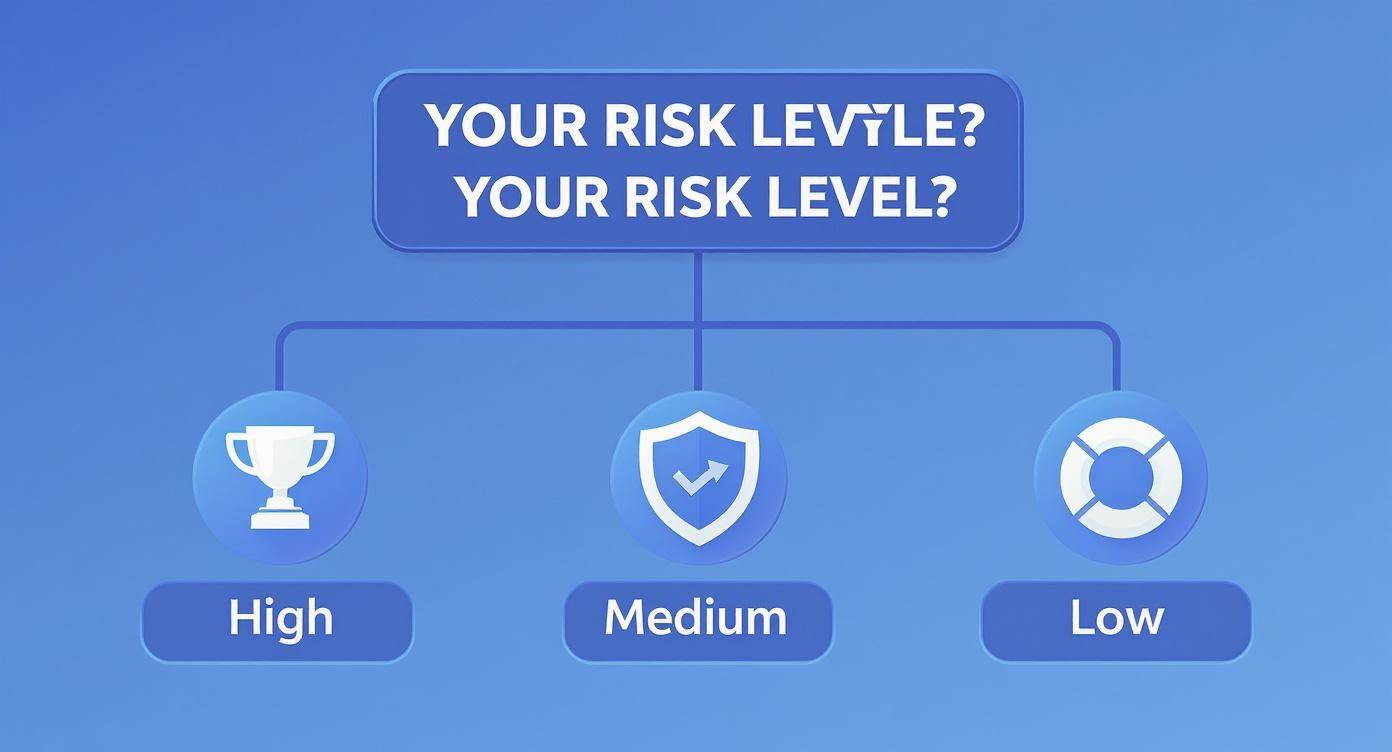
As you can see, double chance betting is the ideal choice for low-risk bettors. It's like a lifebuoy that helps keep your wagers afloat.
While a standard 1X2 bet gives you a theoretical 33.33% chance of winning, a double chance bet instantly boosts that to 66.66% by covering two of the three outcomes. Bookmakers balance this out with lower odds, of course. For instance, a bet on 'Team A or Draw' might be priced around -200, highlighting the classic trade-off between higher probability and smaller returns. You can dig deeper into how sportsbooks price these markets in this guide to double chance betting explained on wagertalk.com.
Securing Accumulator Bets
Another fantastic use for the double chance market is when you're building accumulator bets (or parlays). Accumulators are hugely popular for their massive potential payouts, but they're incredibly fragile one wrong leg, and the whole ticket is toast.
By using a double chance bet for a particularly unpredictable leg of your accumulator, you effectively add a layer of insurance. It will lower the overall odds slightly, but it dramatically increases the chance that your multi-bet ticket survives to see the final whistle.
This strategic move can be the difference between a frustrating near-miss and a great payout. It’s a smart way to manage risk on an inherently high-risk bet, giving you a much better shot at long-term success with your accas.
Finding Value in Double Chance Markets

This is where we move past the basics. Using Double Chance as a simple safety net is one thing, but turning it into a genuine profit-making tool means shifting your mindset from just playing it safe to actively hunting for value.
Value exists when your analysis tells you an outcome is more likely to happen than the bookmaker's odds suggest. For Double Chance, this often means finding spots where a draw is a much more probable result than the market is giving it credit for. A bit of homework can transform a defensive bet into an offensive weapon.
Key Factors for Analysis
To find that edge, you need to dig deeper than just the league table. Spotting underpriced opportunities requires you to look at specific performance stats. Your bets should be driven by data, not just a gut feeling.
Focus your research on these key areas:
- Defensive Records: Is a team known for keeping clean sheets, especially at home? A rock-solid defense can grind out a draw against a much stronger opponent, making that 1X or X2 bet look very appealing.
- Team Form: Look beyond the simple win/loss streak. A team drawing a lot of games might be tough to beat, but they also struggle to land the killer blow. This pattern is often a goldmine for Double Chance value.
- Head-to-Head Stats: Some matchups just have a history of ending in draws. Finding these "bogey teams" can uncover patterns the bookies may have overlooked in their pricing.
Calculating Implied Probability and Expected Value
Once you think you've found a good spot, it's time to check if the numbers back you up. The first step is to calculate the implied probability from the bookie's decimal odds. The formula is simple: (1 / Decimal Odds) * 100.
For example, if a 1X bet is priced at odds of 1.40, the implied probability is 71.4%.
Now, if your own research suggests the actual chance of a home win or draw is closer to 75%, you've likely found a bet with positive expected value (+EV). This concept is the absolute cornerstone of any serious betting strategy.
Finding value is all about exploiting the gap between a bookmaker's odds and the real-world probability. In Double Chance markets, that gap is often hidden in an undervalued draw.
Mastering the principles of value betting is what separates casual punters from those who build long-term profit.
Finally, a simple but powerful habit: always shop around for the best odds. The prices for the same Double Chance bet can vary between sportsbooks, and even a small difference can have a massive impact on your bottom line over time. Getting the best price is a crucial part of maximizing your edge.
A Few Final Questions on Double Chance
To wrap things up, let's tackle some of the most common questions that pop up when bettors first start digging into the double chance market. Getting these details straight will help you use this bet type with total confidence.
Does Double Chance Work for Other Sports?
While it’s an absolute superstar in soccer betting because draws are so common, you can find double chance markets in any sport with three possible outcomes. This includes sports like hockey (for regulation time) and even boxing, where a draw, though rare, is still on the table.
That said, its real strategic power is in sports where a draw is a frequent and predictable result. This makes soccer its natural home. The sheer frequency of draws gives the market a consistent reason to exist and offer value.
Is Double Chance the Same as Laying the Draw?
They can achieve the same result in one specific scenario, but they are fundamentally different beasts. A "12" double chance bet (home or away win) cashes if the match doesn't end in a draw, which is the exact same winning condition as successfully "laying the draw" on a betting exchange.
The key difference is the mechanics. A double chance is a straightforward wager placed with a traditional bookmaker. A lay bet, on the other hand, is a peer-to-peer transaction on a betting exchange where you are betting against an outcome. So, while the outcome for a "12" bet is identical, how you get there is completely different.
The primary drawback of double chance betting is the significantly lower odds and smaller payouts compared to a standard 1X2 bet. Because you're covering two outcomes, the bookmaker adjusts the price to reflect your lower risk.
How Are Payouts Calculated?
Calculating a double chance payout is as simple as it gets it works just like any other single bet you'd place. You just multiply your stake by the decimal odds offered for your chosen outcome.
For example, if you place a $10 bet on a "Home Win or Draw" (1X) at odds of 1.50, your total return would be $15. That includes getting your original $10 stake back, plus $5 in pure profit. No complex math or hidden rules to worry about.
Ready to stop guessing and start finding statistically profitable betting opportunities? ValueBetFactory uses powerful algorithms to scan the markets for you, delivering real-time alerts on value bets across various sports. Start your free trial and bet smarter today at valuebetfactory.com.