
Your Guide to Betting on Money Line
Unlock Profits with betting tips!
If you've ever bet a friend five bucks on who's going to win the big game, you already understand the basics of money line betting. It’s the purest and most straightforward way to get in on the action.
What Is Money Line Betting
At its core, a money line bet is a wager on which team or player will win a contest, straight up. That's it. No point spreads to cover, no complex conditions, just pick the outright winner.
The only real twist is that a sportsbook sets the odds, which is just their way of pricing each team's chances. These odds determine your potential payout, and they're based on how likely each side is to win. The concept is ancient, with roots stretching all the way back to 17th-century England, where oddsmakers first started standardizing wagers on horse races.
The real beauty of the money line is its simplicity. You don't need to worry about the margin of victory. A last-second field goal to win by one point cashes just the same as a 30-point blowout, making it a go-to bet for countless sports fans.
To give you a quick snapshot, here's a simple breakdown of the core ideas.
Money Line Betting At A Glance
| Bet Component | What It Means | Example |
|---|---|---|
| The Favorite | The team the sportsbook expects to win the game. | New York Yankees listed at -150 odds. |
| The Underdog | The team the sportsbook expects to lose the game. | Boston Red Sox listed at +130 odds. |
| The Bet | A simple wager on which side will win outright. | A $100 bet on the Red Sox to win the game. |
| The Outcome | The bet pays out if your chosen team wins, regardless of the score. | If the Red Sox win, the $100 bet pays $130 in profit. |
This table covers the fundamentals. Keep these simple definitions in mind, as they're the engine that makes the whole concept work.
Favorites and Underdogs: The Core Concept
Every single money line bet revolves around a simple dynamic: a favorite and an underdog. The sportsbook flags one team as the more likely winner (the favorite) and the other as the less likely winner (the underdog).
- The Favorite: This is the team expected to win. Betting on them offers a smaller payout because the risk is lower.
- The Underdog: This is the team expected to lose. It's a riskier bet, but it comes with a much sweeter reward if they pull off the upset.
The entire game of money line betting is a constant balancing act between risk and reward. Backing a heavy favorite might feel like a safe bet, but the returns will be modest. The real thrill, and often the real value, comes from spotting an underdog that has a legitimate shot to defy the odds.
This dynamic is what keeps things interesting. Your job is to decide if the favorite is a lock or if the underdog has what it takes to cash a bigger ticket. In some sports like soccer, things get a bit more complex with the possibility of a draw. To learn more, check out our guide that explains what a three-way moneyline is and how it works.
How to Read Money Line Odds
The first time you look at a betting line, the numbers can seem a little cryptic. These are called American odds, and they're the native language of money line betting. They might look strange, but they follow a simple logic that revolves around the number $100.

Think of it this way: every money line has either a minus (-) or a plus (+) sign in front of the number. These little symbols are your first clue, instantly telling you who the sportsbook thinks will win (the favorite) and who is expected to lose (the underdog). Getting comfortable with these signs is the key to reading any line.
Decoding the Favorite (Minus Sign)
When you see a minus sign (-), you're looking at the favorite. The number that follows tells you how much you need to risk to win a $100 profit.
It's a straightforward rule: minus means you risk more to win less.
Let's say the Los Angeles Lakers are listed at -180. This means:
- You have to bet $180 on the Lakers to win $100.
- If they win, your total payout is $280 (your $180 stake comes back, plus your $100 profit).
The smaller payout is the bookmaker's way of telling you this team has a higher chance of winning. Because the bet is seen as less risky, the reward is smaller.
Understanding the Underdog (Plus Sign)
On the flip side, a plus sign (+) always points to the underdog. The number here shows you the profit you'll make for every $100 you bet.
The rule for underdogs is just as simple: plus means you risk less to win more.
If the Boston Celtics are the underdog at +150, it means:
- A $100 bet on the Celtics would win you $150 in profit.
- If they pull off the upset, your total payout is $250 (your $100 stake plus the $150 profit).
Betting on the underdog offers a bigger reward because you're taking on more risk. The sportsbook has to entice you with a better payout to bet on the team that's more likely to lose.
These odds are more than just payout indicators; they represent the sportsbook's calculated chance of a team winning. A key skill for any bettor is to see beyond the numbers and assess if the implied probability aligns with reality.
At the end of the day, these numbers are just a different way of expressing probability. Once you learn to see the implied chances behind the odds, you can start hunting for real value in the market.
To take the next step, you need to be able to translate these numbers into percentages. Our guide on how to convert odds to probability will show you exactly how to do that. Mastering this skill is what transforms you from someone who just places bets into someone who makes calculated investments.
Calculating Payouts and Finding Value
Reading the odds is one thing. Putting them to work is a whole different ballgame. While the standard $100 example is great for getting your head around the basics, you need to know how to calculate your potential winnings for any amount you want to wager.
More importantly, this is where we get into a concept that separates casual bettors from the pros: implied probability.

Implied probability is simply the win chance that a sportsbook's odds are suggesting. For instance, odds of +100 (even money) imply a 50% chance of winning. By converting the odds into a simple percentage, you can compare the sportsbook's assessment to your own. This is the absolute key to spotting a valuable bet.
From Odds to Probability
Finding real value is all about identifying when you believe a team's actual chances of winning are higher than what the odds imply. If your research tells you a team has a 40% shot to win, but the sportsbook’s odds only give them a 30% implied probability, you’ve just found a potential value bet.
Here’s a quick-reference table to help you translate common American odds into their implied probabilities.
Odds To Implied Probability Conversion
This table is a handy shortcut for converting some of the most common money line odds you'll encounter into the percentage chance of winning that they represent.
| Money Line Odds | Implied Probability |
|---|---|
| +300 | 25.0% |
| +200 | 33.3% |
| +150 | 40.0% |
| +100 | 50.0% |
| -110 | 52.4% |
| -150 | 60.0% |
| -200 | 66.7% |
| -300 | 75.0% |
Mastering this simple conversion is a fundamental skill. It shifts your entire mindset from just trying to pick winners to hunting for mispriced odds where the value is in your favor.
Finding True Betting Value
Once you can flip odds into percentages, the next leap is to calculate the expected value (EV) of a bet. A positive expected value (+EV) means that, on average, the bet is profitable over the long run. It's the mathematical proof that you've found a genuine edge over the bookie.
Finding a bet with positive expected value is the primary goal of any serious sports bettor. It means you are placing a wager where the potential reward outweighs the statistical risk, giving you a long-term advantage over the sportsbook.
This might sound a bit complex, but you don't have to do it all by hand. For a deeper dive into this crucial metric, you can use a powerful expected value calculator to do the heavy lifting.
Just plug in the odds and your own estimated win probability to see if a bet truly offers value. It’s an essential tool for making data-driven decisions instead of just guessing. By consistently finding and placing +EV bets, you move beyond simple fandom and start treating sports betting like a strategic investment.
A Walkthrough of Placing Your First Money Line Bet
Reading odds and crunching numbers is one thing, but the best way to really get it is to just walk through the process. Let's place a hypothetical first bet together, from start to finish, so you can see exactly what it feels like without any of the guesswork.
We'll use a classic NBA rivalry for our example: the Los Angeles Lakers versus the Boston Celtics. You've opened your favorite sportsbook app and are looking at the day's games.
Finding and Analyzing the Odds
You scroll down and find the game. The money line odds are right there next to each team's name, plain as day.
- Los Angeles Lakers: -140 (Favorite)
- Boston Celtics: +120 (Underdog)
Just from these numbers, you instantly know who the sportsbook thinks is going to win. A $140 bet on the heavily favored Lakers would net you $100 in profit. On the flip side, a $100 bet on the underdog Celtics would bring back a cool $120 if they manage to pull off the upset.
This next image breaks down that core thought process you'll use for every money line bet.
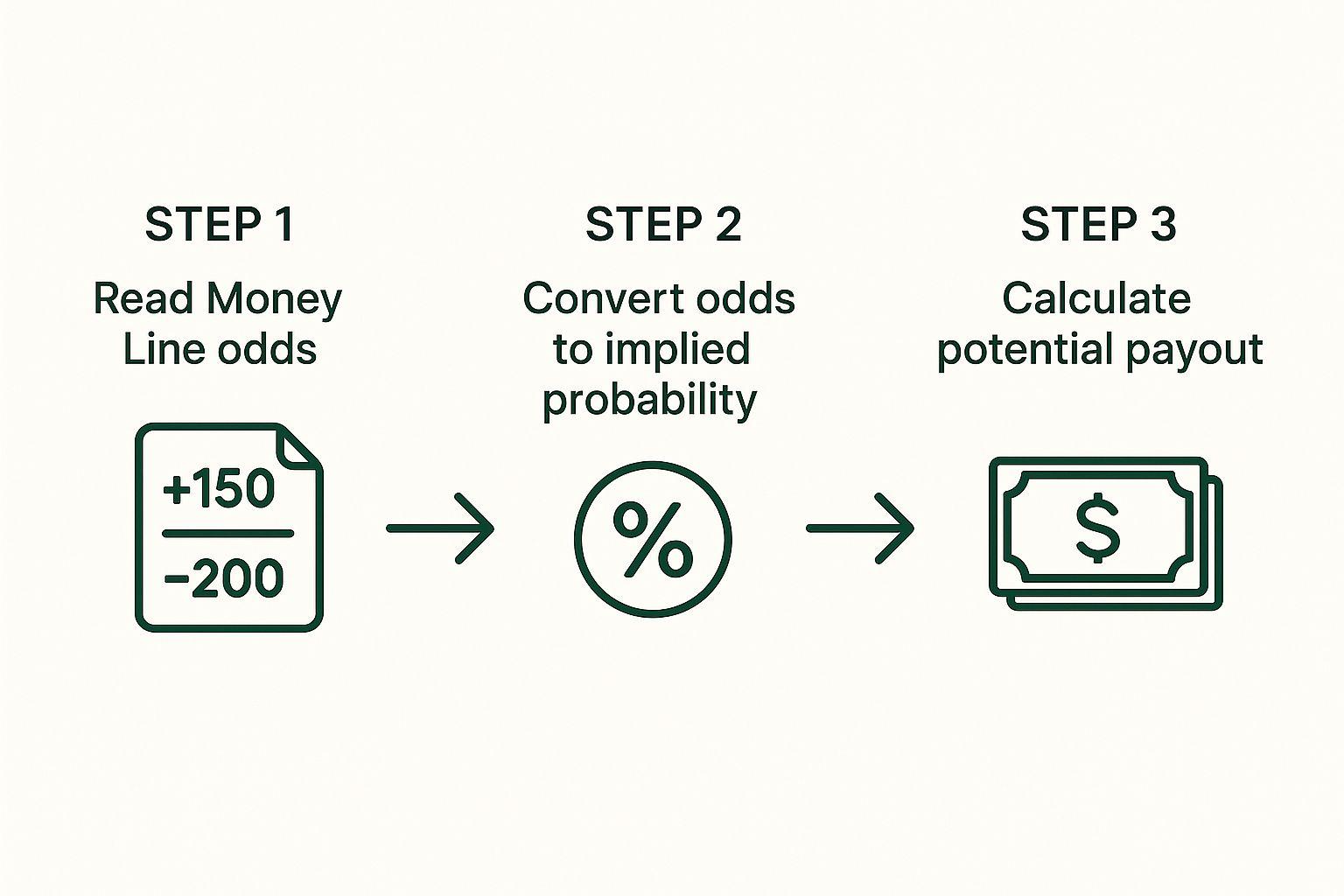
It perfectly visualizes the three key stages: reading the odds, figuring out the implied probability, and then calculating what you stand to win.
After thinking about the matchup, you decide the Celtics at +120 look like a great value play. You believe their actual chance of winning is better than the 45.5% the odds suggest.
Placing the Wager and Confirming the Bet
Once you've made your decision, the rest is easy. This part of the process is designed to be quick and only takes a few seconds.
- Select Your Bet: You tap on the Boston Celtics +120 odds. This instantly adds the pick to your bet slip, which usually pops up on the side or bottom of the screen.
- Enter Your Stake: The bet slip has a little box where you type in how much you want to risk. For this example, let's say you go with $50.
- Review the Payout: The second you enter $50, the bet slip does the math for you. It will clearly show that your $50 wager at +120 odds will win $60 in profit, for a total return of $110 ($50 stake + $60 profit).
- Confirm Your Bet: You give everything one last look, team, odds, and stake are all correct. When you're good to go, you hit the "Place Bet" or "Confirm" button.
And that's it. Your first money line bet is officially in the system. The whole process is incredibly intuitive, taking you from analysis to action in just a few taps. Now all that's left is to watch the game and root for your underdog to come through.
Developing a Winning Money Line Strategy
Once you’ve got the mechanics down, the real art of betting on money lines is all about building a consistent, disciplined approach. A winning strategy has very little to do with luck. It’s about doing the right homework to find an edge, which means digging a lot deeper than just a team's win-loss record.
Successful bettors don't just pick winners. They're masters at analyzing matchups from multiple angles, spotting the little things that the average fan completely overlooks. That’s exactly where you find your advantage.
Doing the Homework That Matters
Before you even think about putting your money down, you need a solid pre-game analysis routine. Just backing the team with the better record is a classic beginner's mistake and a surefire recipe for a dwindling bankroll. Instead, your research should zero in on a few key areas.
- Recent Performance and Form: How has the team been playing in the last handful of games? A team riding a three-game winning streak often has a ton more momentum than one that’s been struggling, no matter what their season-long record says.
- Key Player Injuries: Is a star quarterback, ace pitcher, or top scorer out of the lineup? The absence of a single critical player can completely flip the script on a game, creating huge value on the other side.
- Head-to-Head History: Some teams just have another's number. It's a real thing. Look at recent matchups between the two squads to spot tactical advantages or psychological edges that you won't find on a standard stat sheet.
- Travel and Schedule: Is a team playing its third road game in five nights? Travel fatigue is a very real factor that leads to upsets, especially when a well-rested home team is sitting there as the underdog.
By digging into these factors, you start to build a much more accurate picture of a team's true chances, completely separate from the odds the sportsbook is offering.
The goal isn't just to predict who will win. It's to find games where the odds don't accurately reflect the true probability of an outcome, giving you a valuable opportunity to capitalize on a mispriced line.
Identifying Value in Underdogs
While betting on a heavy favorite can feel like a safe bet, the tiny returns often don't justify the risk involved. The most profitable long-term strategies are usually built on finding value in underdogs, teams that the sportsbooks may have seriously underestimated.
Think about it this way. An underdog priced at +200 only needs to win about 34% of the time for you to break even. If your homework suggests their actual chances of winning are closer to 40%, you’ve just found a bet with a significant mathematical edge.
This kind of strategic thinking is at the heart of betting markets all over the world. Money line betting is the cornerstone of wagering on sports like soccer, basketball, and baseball. In North America, it's the most common wager for NFL games, making up a massive slice of the total betting handle. You can discover more insights about sports betting markets on Wikipedia.
The Golden Rule of Bankroll Management
Even the sharpest strategy in the world is doomed to fail without proper bankroll management. This is, without a doubt, the most crucial, and most often ignored, part of successful betting. The golden rule is incredibly simple: never risk a large chunk of your betting funds on a single game.
A good rule of thumb is to only wager 1-3% of your total bankroll on any individual bet. This simple discipline ensures that one unexpected loss won't wipe you out. It allows you to survive the inevitable losing streaks and stay in the game long enough for your edge to ultimately pay off. At the end of the day, responsible betting is sustainable betting.
Common Money Line Betting Mistakes to Avoid
Even the sharpest bettors make mistakes. The real key to long-term success isn't hitting every bet, but consistently dodging the simple, unforced errors that sink most bankrolls. These common pitfalls are incredibly easy to fall into, especially when you're just starting out.
Think of this as your pre-flight checklist. Learning to spot and sidestep these traps is the first real step toward building smarter, more disciplined betting habits. It’s what separates a casual gambler from someone with a genuine strategy.
Overvaluing Heavy Favorites
One of the classic rookie moves is blindly backing a heavy favorite. You see a team listed at -400, and it feels like a lock. Free money, right? But the tiny returns almost never justify the massive risk. To win just $100, you have to put $400 on the line. One unlucky upset, and you've wiped out the profits from several previous wins.
This is just a terrible risk-to-reward proposition. A much smarter approach is to hunt for value in slight favorites or underdogs where the potential payout actually makes sense for the risk you're taking.
The name of the game isn't just picking winners. It's finding bets where the odds properly compensate you for the risk. A heavy favorite might win 80% of the time, but if the odds demand an 85% win rate just to break even, it's a fundamentally bad bet.
Letting Emotions Cloud Your Judgment
Betting with your heart instead of your head is the fastest way to drain your account. We all have our favorite teams, but letting that loyalty dictate your wagers is a fatal flaw. This is what we call emotional betting, and it means you're willfully ignoring critical data like injuries, recent form, or a terrible matchup.
To beat this, you have to treat every single game like an objective puzzle to be solved.
- Bet on the matchup, not the jersey. Break down the game like a neutral analyst.
- Avoid betting on your favorite team altogether. If you can't separate your fandom from your analysis, the smartest move is to just sit those games out.
- Focus on the numbers. Let your research and the value in the odds guide your decisions, not a gut feeling.
Chasing Your Losses After a Bad Beat
Everyone takes a tough loss. It’s just part of the deal. The real mistake happens in the minutes that follow, when you immediately try to win it all back with a bigger, more desperate bet on the next game you see. This is called chasing losses, and it almost never ends well.
This kind of impulsive betting leads to poorly researched wagers and digs a much deeper financial hole. A disciplined bettor accepts the loss, sticks to their strategy, and places their standard wager on the next bet. A single loss should never be allowed to derail your entire process.
Money Line Betting FAQs
Even after you've got the basics down, a few nagging questions always seem to pop up when you're starting with money lines. Let's tackle some of the most common ones head-on.
Think of this as tying up the loose ends. Getting these final pieces of the puzzle sorted will clear up any lingering confusion and help you place your bets with a lot more confidence.
What Happens in a Tie or Push?
This is easily one of the most frequent questions: what if the game ends in a dead heat? In most sports where a tie is a real possibility, think NFL regular season or hockey, a money line bet simply results in a push.
A push just means the bet is canceled out. Your original stake gets returned to your account in full. No win, no loss. It's like the bet never happened. The one big exception here is the "three-way money line" common in soccer, which specifically includes the tie as a third betting option.
Money Line vs. Point Spread Betting
The biggest difference comes down to simplicity versus the margin of victory. A money line bet is straightforward: you just need to pick the outright winner, no matter how they get it done. A point spread, on the other hand, is a bet on how much a team will win or lose by.
A money line is a bet on who wins. A point spread is a bet on how they win. Money lines are often a better vehicle for betting on underdogs, since you just need them to pull off the upset, not cover a spread.
For example, say the Patriots are favored by 7.5 points. If you bet on their point spread, they have to win by 8 points or more for you to cash your ticket. With a money line bet, a last-second field goal to win by one point is all you need.
Can You Parlay Money Line Bets?
Yes, you absolutely can. A parlay is just a single wager that strings two or more money line bets together. The catch? To win the parlay, every single one of your picks (often called "legs") has to win. If even one team lets you down, the entire ticket is a loser.
The big appeal of a parlay is the massive potential payout, as the odds from each leg get multiplied together. But that reward comes with a much, much higher risk. While the dream of turning a small stake into a huge win is tempting, the statistical probability of hitting a multi-leg parlay is incredibly low.
Ready to stop guessing and start making data-driven bets? The tools at ValueBetFactory are designed to help you spot market inefficiencies and find valuable betting opportunities. Explore our betting calculators and tutorials to gain your edge.