
A Winning Guide to betting on the rugby
Unlock Profits with betting tips!
Betting on rugby is about more than just picking a winner. It's a game of finding real value by digging into matchups, understanding the different ways you can bet, and sticking to a solid strategy. The most successful bettors learn to look past the obvious favorites to spot those golden opportunities where the odds don't quite tell the whole story.

Understanding the World of Rugby Betting
Welcome to the thrilling, and sometimes chaotic, world of rugby betting. If you think this is just about guessing who'll win, you're in for a surprise. Making money here is built on strategy, sharp analysis, and a genuine feel for the game itself. Rugby’s brutal mix of raw power and intricate tactics creates a seriously rich landscape for anyone willing to look a little deeper.
Unlike sports with more predictable scoring, a rugby match can flip on its head in a heartbeat. A single penalty, a breakaway try against the run of play, or a heroic defensive stand can change everything. That unpredictability is exactly what makes it so exciting to bet on.
Why Rugby Offers Unique Betting Angles
What really sets rugby apart are the countless factors that can shape a game's outcome. It’s not just about which team has the biggest lads on the pitch; it's about strategy, discipline, and who can execute under immense pressure.
Here are a few core ideas that open up some diverse betting opportunities:
- Tactical Depth: A team's game plan is everything. Are they a forward-dominated side built to grind teams down at the scrum, or a fast-paced backline that loves to run the ball wide? The answer directly impacts scoring patterns and the entire flow of the match.
- Physicality and Attrition: The sheer brutality of the sport means injuries and fatigue are huge factors, especially in long tournaments. A team with a deep bench often has a massive advantage in the final 20 minutes.
- Set-Piece Dominance: If a team can't control its own scrum and lineout, they're in big trouble. Dominance here dictates territory and possession, essentially starving the other team of any chance to score.
This constant tug-of-war between power and tactics means a sharp bettor can find an edge. A team might be a clear underdog on paper, but if they have a scrum that can bully the opposition, they could easily neutralize a favorite's flashy attack.
The Global Scale of Rugby Wagering
The passion for rugby has fueled a massive global betting market. The big international tournaments are the pinnacle, pulling in eyeballs and wagers from every corner of the globe. This isn't some niche market; we're talking about a multi-million dollar industry where major events drive colossal betting volumes.
For example, a staggering $250 million was wagered on matches during the 2019 Rugby World Cup alone. That figure tells you everything you need to know about the sport's appeal. While the UK and Ireland are still the heartlands, betting is booming in France, Australia, New Zealand, and South Africa. Even emerging rugby nations like Japan and the United States are getting in on the action. You can get more great insights on how international tournaments impact betting markets at nxtbets.com.
The global reach of rugby ensures deep liquidity in betting markets, especially for major events like the Six Nations or The Rugby Championship. This means more competitive odds and a wider variety of betting options are available for those who know where to look.
Ultimately, getting started with rugby betting is all about building a solid foundation. Once you understand what makes the sport tick, you can move beyond simple win/loss predictions and start making informed, strategic wagers. This guide is here to walk you through the essentials, from navigating the key betting markets to managing your money like a pro.
Navigating Popular Rugby Betting Markets
Once you've got the basics down, it's time to get familiar with the tools of the trade: the betting markets themselves. Don't think of these as just simple guesses. Instead, see them as different lenses you can use to analyze a match, each offering a unique way to act on your insights.
The most straightforward starting point is the Match Result market, sometimes called 1X2. You’re simply betting on one of three outcomes: a home team win (1), a draw (X), or an away team win (2). It’s the purest prediction you can make.
But a quick word of warning on draws in rugby. They're far rarer than in sports like football, happening in less than 5% of professional matches. This means the odds for a draw can look juicy, but you're backing a statistically unlikely outcome. Most of the time, your focus will be on picking the outright winner.
The Power of the Handicap Bet
Now, let's get into a market that adds a brilliant layer of strategy: the Handicap or Spread. This is your go-to when you're looking at a lopsided matchup where the Match Result odds on the favourite are just too short to offer any real value.
The handicap effectively levels the playing field by giving the underdog a virtual head start in points.
Let's say it's a Six Nations clash with Ireland as heavy favourites to beat Italy in Dublin. A bookie might set the handicap at Ireland -24.5.
- If you back Ireland -24.5, they need to win by 25 points or more for your bet to come in.
- If you bet on Italy +24.5, you'll win if Italy wins, draws, or loses by 24 points or fewer.
This market forces you to think beyond just who will win and start considering by how much. It demands a much deeper look at a team's attacking flair versus their opponent's defensive grit.
A handicap bet is often a truer test of your analytical skill. It’s not just about identifying the better team; it's about accurately predicting their performance margin against a specific opponent on a specific day.
This simple decision tree can help you pick a path when you're just starting out with betting on the rugby.
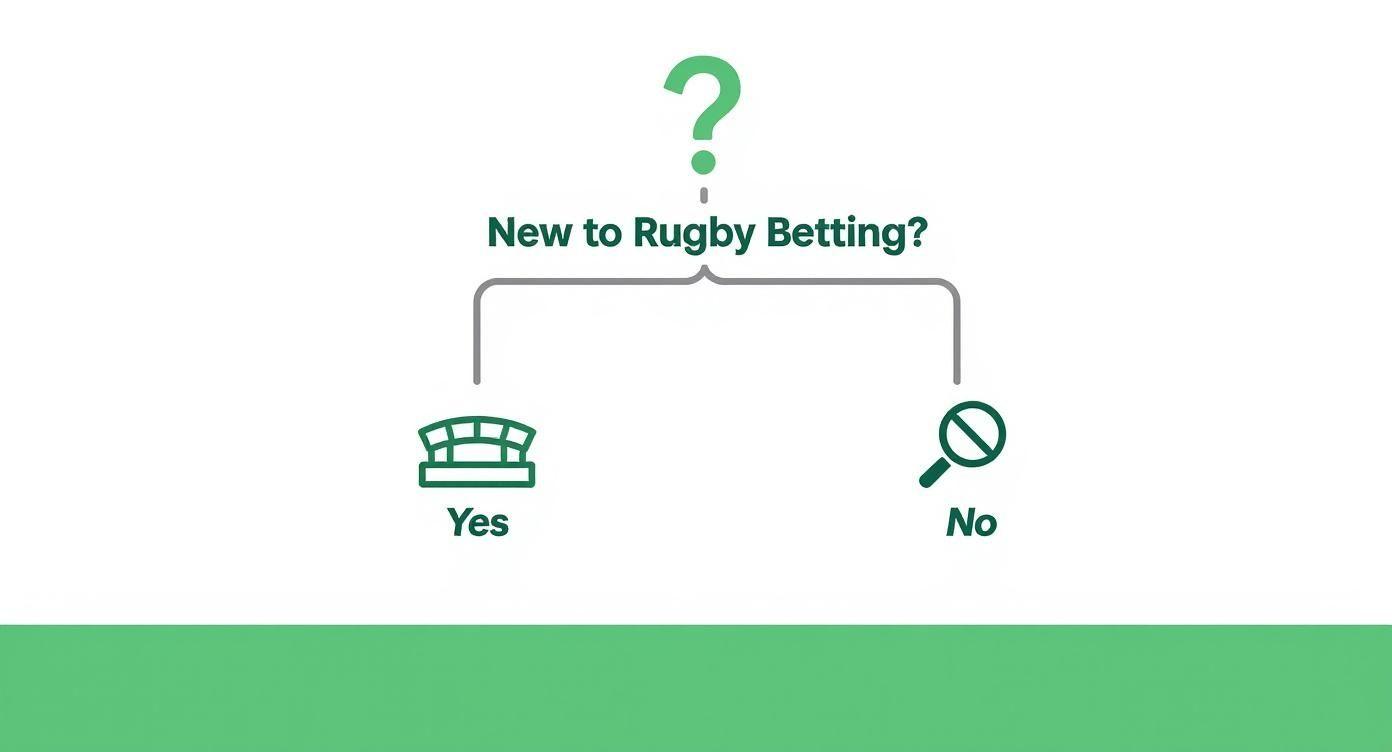
As you can see, you can stick with familiar markets to build confidence or dive into more strategic options if you feel ready.
Betting on Total Points Markets
Another incredibly popular market is Over/Under, also known as Total Points. The bookmaker sets a line for the total combined points they expect both teams to score. Your job is to predict whether the final tally will be over or under that number.
What's great about this market is that you don't need to pick a winner at all. Your entire focus shifts to the style and flow of the game itself.
Think about a match between two high-scoring, attack-minded teams like France and New Zealand. The points line might be set at 52.5. If you're expecting an open, free-flowing game with plenty of tries, you'd bet the "Over."
On the flip side, if two defensive giants like South Africa and England are set to clash, especially in wet, muddy conditions that favour a tight kicking game, the line might be much lower, maybe 42.5. Here, a bet on the "Under" could be the smart play, as you're predicting a gritty, low-scoring battle dominated by the forwards.
Before we move on, let's put these core markets into a quick-reference table. It’s a handy way to see how they stack up at a glance.
Common Rugby Bet Types Explained
| Bet Type | What It Means | Best Used When |
|---|---|---|
| Match Result (1X2) | You're betting on the final outcome: Home Win (1), Draw (X), or Away Win (2). | You have a strong opinion on who will win the match, and the odds offer decent value. |
| Handicap (Spread) | The favorite is given a points deficit (-), or the underdog a head start (+), to level the odds. | One team is a heavy favorite, and you want to bet on the margin of victory, not just the win itself. |
| Total Points (Over/Under) | You bet on whether the total combined points scored by both teams will be over or under a line set by the bookie. | You have a good read on the game's likely style (high-scoring vs. defensive), regardless of the winner. |
Getting a solid handle on these markets is the foundation of smart rugby betting. Each one gives you a different angle to attack a game, letting you tailor your bets to your specific analysis of the matchup, team styles, and even outside factors like the weather. Mastering them is your first big step toward making more informed and, hopefully, more profitable decisions.
How to Analyze Teams and Predict Outcomes

This is where you make the leap from a casual punter to a sharp analyst. Nailing your rugby bets isn't about blind luck or just backing your favourite team. It's about building a repeatable process to break down a match and make genuinely informed predictions.
It means looking past a simple win-loss record to understand the why behind a team's performance. Developing this skill is what turns pure guesswork into a calculated, long-term strategy.
Looking Beyond the Standings at Team Form
A team’s current form is one of the most powerful signals of what they’re capable of right now. A solid winning streak builds confidence and momentum, while a string of losses can breed doubt. But "form" is so much more than just a list of recent results. You have to dig a little deeper.
Start asking yourself some critical questions about their last few games:
- Who were they playing? A 20-point win against a team at the bottom of the table is a lot less impressive than a narrow loss to the reigning champions.
- How did they actually look? Did they dominate possession and territory but just couldn't convert, or did they scrape by with a few lucky breaks?
- What's their style? Are they scoring tries for fun, or are they grinding out gritty wins with a suffocating defence and a world-class goal-kicker?
This kind of nuanced view gives you a much clearer picture than the league table ever could. For example, a team on a "losing streak" might have just played the top three clubs back-to-back and looked pretty good doing it. That suggests they’re battle-hardened and probably undervalued heading into a match against an easier opponent.
The Decisive Impact of Player Availability
Rugby is a brutal sport, which means player availability is a huge variable that can completely flip a team's chances on their head. The absence of just one star player, especially in a key position like fly-half or scrum-half, can unravel an entire game plan.
Team stats and player availability are deeply connected. In a recent Rugby Championship, for instance, South Africa and New Zealand were offensive powerhouses, scoring 188 and 175 points, respectively. Meanwhile, Argentina's defence was leaking points, conceding a massive 195. These numbers tell a story about attacking and defensive quality. Take a world-class player out of one of those lineups, and you'll see those stats, and the betting markets, shift instantly. You can usually find detailed team stats over at SportyTrader.com.
When a team's primary goal-kicker is ruled out, it’s not just a loss of points from the tee. It often forces a change in strategy, making the team more likely to kick for touch and set up a lineout rather than take a shot at goal, which can impact total points markets.
This is exactly why paying close attention to team news and injury reports in the days before a match is non-negotiable for serious bettors. A late withdrawal can create a massive value opportunity if you're quick enough to act before the odds fully adjust. If you want to take a more systematic approach, check out our guide on how to build a sports betting model for a deeper dive.
Understanding Crucial Contextual Factors
Beyond the team sheets and recent results, a bunch of external factors play a huge role in a rugby match. These elements provide crucial context that can often be the deciding factor in a really tight contest.
Here are a few of the most important ones to always keep in mind:
Home-Field Advantage: This is a very real thing in rugby. The roar of a home crowd can lift a team and rattle opponents, sometimes even influencing referees. Teams almost always have a significantly better win percentage at home.
Travel Fatigue: Long-haul travel, especially across several time zones, takes a serious physical toll. A team flying from South Africa to New Zealand for a single match is at a clear disadvantage compared to the home side who got to sleep in their own beds.
Historic Rivalries: Some matchups just carry more weight. Think England vs. Scotland for the Calcutta Cup or New Zealand vs. Australia for the Bledisloe Cup. In these derby games, form can go right out the window as passion and history take over, often leading to tighter, more physical contests than the odds might suggest.
Weather Conditions: A wet, windy day typically favours a forward-heavy, defensive-minded team that excels at kicking for territory. On the flip side, a dry, sunny day is perfect for teams with a fast backline who want to run the ball and play an expansive, high-scoring game.
By systematically working through these elements for every match, you move away from just making simple predictions and start making well-rounded, data-backed analytical judgments. This disciplined approach is the cornerstone of any successful long-term rugby betting strategy.
Finding Value Bets with Advanced Analytics
Once you've got a handle on team analysis, it's time to level up. Making real money from rugby betting isn't about just picking winners; it’s about finding value. This is the professional approach, and it means spotting moments when a bookie's odds don't line up with an outcome's true statistical probability.
Let's break it down. If you believe a team has a genuine 50% shot at winning, fair odds would be 2.00. But if a bookmaker offers you 2.20 on that same team? You've just found a value bet. You're getting a better price than the real probability suggests, which gives you a mathematical edge over the long haul.
The trick is catching these mispriced odds before the rest of the market does.
The Rise of Data-Driven Betting
In the old days, finding value was all about gut feel and hours of manual research. Now, modern platforms do the heavy lifting with machine learning and massive historical databases, uncovering opportunities the human eye would almost certainly miss. These tools are built to find an analytical edge.
They crunch thousands of data points for every single match, looking at things like:
- A team's recent travel schedule and potential fatigue levels.
- Historical performance in specific one-on-one player matchups.
- Weather forecasts and how they could dictate the style of play.
- A referee’s track record and their tendencies for certain calls.
This kind of detail goes way beyond a simple form guide. It helps build a far more precise probability model for any given game, turning what used to be a guess into a calculated investment. This is how the pros do it.
The core idea behind value betting is simple: only put your money down when the odds are stacked in your favor. This demands discipline and patience. You'll end up passing on a lot of matches that don't meet your value threshold, even if you feel pretty confident about who will win.
Using Algorithms to Spot Opportunities
The explosion of advanced analytics has totally changed the game for rugby betting. Data platforms now exist that can process information on a scale that was once unthinkable. Some systems, for example, tap into databases containing every international rugby match played since 1871, running algorithms that weigh team rankings, historical scoring patterns, rest periods, and home-field advantage. The entire goal is to generate an expected score and pinpoint mispriced odds with cold, hard data.
A great example is how, during the Six Nations, home teams historically win over 60% of their matches, a stat that dramatically influences both pre-match and in-play betting lines. You can see a fantastic example of how these rugby analytics platforms work at Sports4Cast.
For the average bettor, this means you now have access to insights that were once the exclusive domain of professional betting syndicates. You can see how an algorithm rates a team's chances compared to the available odds. Learning how these systems tick is a huge step forward, and you can dig deeper into the mechanics behind them in our guide to sports betting algorithms.
The key takeaway here is the direct comparison between a model's predicted outcome and the bookmaker's odds. It shines a spotlight on where the potential value is hiding. This is the data-driven approach that allows you to make informed decisions backed by statistics, not just intuition. By embracing these tools, you can systematically hunt for bets where your analysis reveals a clear statistical advantage.
Smart Bankroll Management for Long-Term Success

This might just be the most important lesson you'll ever learn about betting on rugby. Sure, digging into team stats and sniffing out value bets is the exciting part, but without disciplined bankroll management, even the sharpest bettors eventually go broke. This is the stuff that separates the hobbyists from the pros who grind out a profit year after year.
Your betting bankroll is a pot of money you set aside purely for wagering. It's not your rent, it's not the grocery budget, and it's definitely not your emergency fund. This separation is non-negotiable. It protects your personal finances and, just as importantly, takes the emotion out of your betting decisions.
Think of it as your business capital. The goal isn't to hit one massive jackpot; it's to grow that capital steadily over time.
Choosing Your Staking Strategy
Once you've set aside your bankroll, you need a crystal-clear staking plan. These are the rules of engagement that dictate how much you risk on any single bet. A solid plan keeps you consistent and protects you from the devastating losses that can happen during an inevitable cold streak.
The two most common and effective methods are flat staking and percentage-based staking. Both are designed to install discipline and preserve your capital through the natural ups and downs of sports betting.
A well-defined strategy is your best defence against chasing losses or getting overconfident after a few wins, two of the fastest ways to empty your account.
Flat Staking: A Model of Consistency
The simplest and often most effective method is flat staking. You just decide on a fixed amount, or "unit," to bet on every single selection, no matter your confidence level or the odds. This unit should typically be between 1% to 2% of your starting bankroll.
Let's say you start with a $1,000 bankroll. If you choose a 1% unit, your stake is $10. Every bet you place, whether it’s a short-odds favorite or a longshot handicap, will be for that same $10.
This approach has a massive psychological benefit. It smooths out the profit and loss curve, preventing the emotional rollercoaster that comes with chopping and changing your stakes. It forces discipline and ensures one or two bad results won't cripple your entire operation.
Percentage-Based Staking: A Dynamic Approach
A slightly more advanced method is percentage-based staking. Instead of a fixed dollar amount, you bet a consistent percentage of your current bankroll. Again, this is usually between 1% and 2%.
Using that same $1,000 bankroll, your first bet at 1% would be $10.
- If you win and your bankroll grows to $1,020, your next 1% bet is $10.20.
- If you lose and your bankroll drops to $990, your next 1% bet becomes $9.90.
This strategy has a brilliant built-in safety mechanism. Your stakes automatically shrink during a losing run, preserving your capital. On the flip side, your stakes increase as your bankroll grows, helping to compound your winnings. It naturally adapts to your performance.
The ultimate goal of any staking plan is survival. Profitability is impossible if you don't stay in the game long enough for your analytical edge to pay off. Disciplined bankroll management is your insurance policy against bad luck.
The key to long-term success is treating your betting like a serious investment. That means setting rules and sticking to them religiously. For a more detailed breakdown, you can learn much more about sports betting bankroll management and figure out which strategy best fits your style. Adopting these professional habits is what will carry you through losing runs and position you for steady, sustainable growth.
Your Common Rugby Betting Questions Answered
As you get deeper into the world of rugby betting, you’re going to have questions. It’s only natural. This last section is all about tackling those common queries head-on, giving you quick, practical answers to reinforce everything we’ve covered.
Think of this as your go-to reference for those tricky "what if" moments. From the fast-paced world of live betting to keeping your cool when a massive upset torches your bet slip, these insights will help build your confidence.
What Is Live Betting and Is It Worth It?
Live betting, or in-play betting, is exactly what it sounds like: placing wagers on a match after it’s already kicked off. The odds are constantly shifting in real-time based on what’s happening on the pitch, creating a super dynamic and exciting way to bet.
For example, say the pre-match underdog scores an early try. Their odds to win will shorten in a flash, while the favorite's odds will suddenly look much more appealing. This is where the opportunity lies. If you still believe the favorite has what it takes to mount a comeback, you can get much better odds on them than you ever could have before the first whistle.
So, is it worth it? Absolutely, but only if you're prepared. Live betting is a fantastic way to capitalize on momentum swings you spot while watching, but it demands quick thinking and a solid feel for the game's flow.
Should I Cash Out My Bet Early?
The "cash out" feature is a tool that lets you settle a bet before the final whistle. You can use it to either lock in a guaranteed profit or to cut your losses on a bet that looks like it’s heading south. The amount you're offered is based entirely on the live odds at that moment.
Imagine you backed a team with a +10.5 handicap, and they're cruising with a 15-point lead and only 10 minutes left on the clock. The bookie might dangle a cash-out offer that's just shy of your full potential winnings. Taking it means you walk away with a guaranteed profit, even if the other team stages a dramatic late comeback.
Cashing out is a strategic tool, not an emotional panic button. It's best used when you genuinely believe the game's momentum is turning against your bet and the risk of losing it all outweighs the potential for a slightly bigger payout.
Figuring out when to cash out is a skill in itself. If you get into the habit of cashing out winning bets too early, you'll slowly chip away at your long-term profits. Use it sparingly and always with a clear, logical reason.
How Do I Handle a Major Upset?
Major upsets are part of what makes sports betting so thrilling and, let's be honest, so painful at times. The first rule when one of your bets goes down in flames is simple: do not panic. Don't immediately try to win your money back on the next game. That behavior, known as "chasing losses," is the single fastest way to destroy your bankroll.
A shocking result doesn't automatically mean your analysis was flawed. Sometimes, a team just has a terrible day at the office, or the underdog plays the game of their lives.
Here's a simple process for dealing with an unexpected loss:
- Accept It: Don't let one bad beat derail your entire strategy. Even the sharpest bettors have losing weeks. It’s part of the game.
- Review Your Analysis: Was there something you missed? Maybe you underestimated an injury or didn't account for a key tactical switch? A quick review can be a great learning experience.
- Stick to Your Staking Plan: This is absolutely crucial. Your very next bet should be your standard unit size, exactly as your bankroll management rules dictate. No exceptions.
Remember, a disciplined approach is built for the long haul. It's designed to absorb the occasional shock result without blowing up your bankroll. Success in rugby betting is measured over months and seasons, not a single weekend.
Ready to stop guessing and start finding statistically-backed wagers? ValueBetFactory uses powerful algorithms to scan the markets and alert you to potential value bets in real-time. Start making smarter, data-driven decisions today. Discover your edge at ValueBetFactory.