
Decision Making Under Uncertainty: The Complete Guide
Unlock Profits with betting tips!
Why Your Brain Struggles With Uncertain Choices
Let’s be honest: making a decision with an unknown outcome is stressful. There's a deep-seated, evolutionary reason your brain tenses up in these moments. Our minds are pattern-matching machines, constantly searching for predictability to keep us safe. When information is missing or contradictory, this system can feel like it's short-circuiting, leading to anxiety and a sense of being out of control.
This feeling isn't just a simple dislike of the unknown; it's a profound psychological preference for risk over ambiguity. We are far more comfortable dealing with a known probability (risk) than a situation where the probabilities themselves are a complete mystery (ambiguity). While academic frameworks like Subjective Expected Utility (SEU) theory suggest people make rational choices to maximize their own value, our real-world actions often tell a different story. The famous Ellsberg paradox is a perfect example, showing how we instinctively shy away from unknown odds, even when the potential reward is the same. A revealing study on market choices found that about 70% of participants behaved in ways that contradicted SEU principles, showing the gap between theory and how we actually handle decision making under uncertainty. Explore the full study on decision-making behavior
To see this aversion to ambiguity in action, look at the classic setup of the Ellsberg paradox:
The image shows two urns. Urn 1 has 50 red and 50 black balls—a clear 50% chance. Urn 2 also contains 100 balls, but the mix of red and black is a total mystery. When offered a bet on drawing a specific color, the vast majority of people choose to bet on a ball from Urn 1. This decision exposes our built-in bias: we prefer known odds over unknown ones, even when the objective chance of winning is technically the same for both.
Key Biases That Cloud Judgment
This preference for the familiar is just one of many mental traps. To handle the constant stream of information in our lives, the brain creates shortcuts, or heuristics, that can either be a great help or a major hindrance. In high-pressure situations, these shortcuts often appear as cognitive biases.
- Loss Aversion: The emotional sting of a loss feels roughly twice as intense as the pleasure from an equivalent gain. For a bettor, this means the fear of losing $100 can easily stop you from placing a smart wager that has a positive expected value.
- Status Quo Bias: We have a powerful emotional preference for keeping things as they are. This can trap you into sticking with a losing betting strategy simply because changing it requires an active and uncomfortable decision.
- Confirmation Bias: This is our tendency to hunt for information that validates what we already believe. If you have a gut feeling a team will win, you'll naturally gravitate toward stats and articles that support your opinion while dismissing any evidence to the contrary.
These psychological forces are always working in the background, nudging you toward choices that feel emotionally comfortable rather than ones that are logically sound. The most successful people in competitive fields like sports betting don't suppress these tendencies; they learn to recognize them as they happen. Understanding that your brain would rather have bad news than no news at all is the first major step toward building the mental discipline needed for smarter choices when the stakes are high.
What Decision Making Under Uncertainty Really Means
The anxiety we feel when facing the unknown often comes from a simple mix-up. We tend to treat all unpredictable situations as the same, but decision making under uncertainty is a unique challenge, fundamentally different from just taking a risk. This isn't just wordplay; it's a critical distinction that changes how you should approach your strategy.
Let’s use an analogy. Risk is like playing a game of roulette. You know for a fact there are 37 pockets on the wheel. You know the precise odds of the ball landing on red (48.6% on a European table), and you know exactly what the payout will be. While you don't know the outcome of a single spin, the probabilities are perfectly clear.
Uncertainty, on the other hand, is like trying to guess the opening weekend box office for a movie made by a first-time director with an unproven script. You know the range of outcomes—it could be a flop, a modest earner, or a blockbuster—but you have no reliable data to assign a specific probability to each. This is the world of sports betting, where a last-minute injury or a sudden drop in team morale can make historical stats almost useless.
The Spectrum of Choice
To make this clearer, decision theorists put choices on a spectrum based on how much information we have.
This table shows the progression from certainty (knowing the outcome), to risk (knowing the odds), and finally to pure uncertainty (knowing the possible outcomes but not their likelihoods). The best decision-makers don't try to pretend uncertainty is just a complicated risk. They accept the ambiguity and pull out a different set of tools.
Structuring the Unknown
Accepting ambiguity doesn't mean you should make wild guesses. It means you need to bring structure to an unstructured problem. Even when a perfect mathematical model is impossible, some foundational methods can guide you. One of the most effective approaches is Bayes' Decision Rule. This framework helps you pick the option with the highest expected payoff by systematically thinking through the consequences of each choice and your estimated probability for each one.
It forces you to define your options, their potential results, and what those results are worth to you. For instance, in marketing, using Bayesian methods to forecast customer behavior can boost campaign engagement by up to 20% simply by enabling better targeting. Discover more about this powerful decision rule.
This gets to the core idea: the goal isn't to get rid of the unknown, but to manage it with intelligence. People who succeed in ambiguous fields aren't fortune-tellers; they're skilled at seeing patterns and figuring out when incomplete information is good enough to act. Instead of waiting for a guarantee that will never come, they ask, "What's the minimum I need to know to make a directionally correct decision?" This change in mindset—from chasing certainty to managing ambiguity—is where all good decision-making begins.
Battle-Tested Frameworks That Actually Work
Knowing that uncertainty is part of the game is one thing, but having a plan to deal with it is what separates amateurs from sharps. Instead of relying on gut feelings, successful bettors use structured frameworks to bring order to the chaos. These aren’t rigid formulas, but rather mental models that help you organize information, pinpoint key variables, and map out what could happen next.
Structuring Your Choices with Decision Trees
One of the most straightforward tools for any bettor is the decision tree. Think of it as a flowchart for a single, specific decision. It starts with one choice and then branches out into every potential outcome, with each branch showing a different path your decision could take.
This visual map forces you to put a number on both the probability and the value of each potential result. It’s an effective way to demystify a complex problem by breaking it down into a series of smaller, more digestible pieces.
Preparing for Multiple Futures with Scenario Planning
While a decision tree is perfect for a specific fork in the road, scenario planning helps you look at the entire map. This framework isn't about predicting a single "correct" future. Instead, it’s about imagining several plausible futures and building a strategy that can hold up no matter which one unfolds.
For instance, a bettor looking at a championship match might create a few different stories:
- Scenario A: The underdog’s star player delivers a career-defining performance, turning the game into a high-scoring nail-biter.
- Scenario B: The favorite’s defense puts on a clinic, shutting down the opposition and leading to a low-scoring, one-sided game.
By preparing your betting strategy for both scenarios, you're ready for whatever the game throws at you. This kind of proactive thinking is a cornerstone of strong decision making under uncertainty.
To help you choose the right approach, here's a comparison of the frameworks we've discussed and a few more advanced ones.
| Framework | Best Use Case | Complexity Level | Time Required | Key Advantage |
|---|---|---|---|---|
| Decision Tree | Specific, quantifiable choices (e.g., "Should I bet on this team?") | Low to Medium | Short to Medium | Provides a clear, visual map of a single decision. |
| Scenario Planning | Long-term or strategic bets with major unknown factors | Medium | Medium to Long | Builds resilience by preparing for multiple potential futures. |
| Real Options Analysis | Decisions that can be staged or delayed to gather more info | High | Medium | Promotes flexibility, treating bets as opportunities, not final acts. |
| Monte Carlo Simulation | Complex problems with many interacting random variables | High (requires software) | Varies (fast with computers) | Shows a full probability distribution of outcomes, not just one guess. |
Each framework offers a different lens through which to view uncertainty. The best one depends entirely on the complexity and nature of the decision you're facing.
Embracing Flexibility and Advanced Tools
For even more complicated situations, you can borrow some powerful tools from other fields. Real Options Analysis, a concept from the world of finance, treats your decisions not as final commitments but as opportunities. It gives you the right—but not the obligation—to make follow-up choices later, encouraging you to make small, information-gathering bets before going all-in.
When you're juggling countless variables at once, Monte Carlo simulations can be a game-changer. These computer-driven models run a scenario thousands of times, each with slightly different random inputs, to generate a full spectrum of possible outcomes. This moves beyond a single "best guess" to show you the true range of possibilities. To learn more about the models that power modern wagering, you can explore our guide on sports betting algorithms.
However, it's worth noting that even with these powerful tools, simple rules of thumb can sometimes perform better in highly unpredictable environments. The key is matching the right framework to the problem at hand.
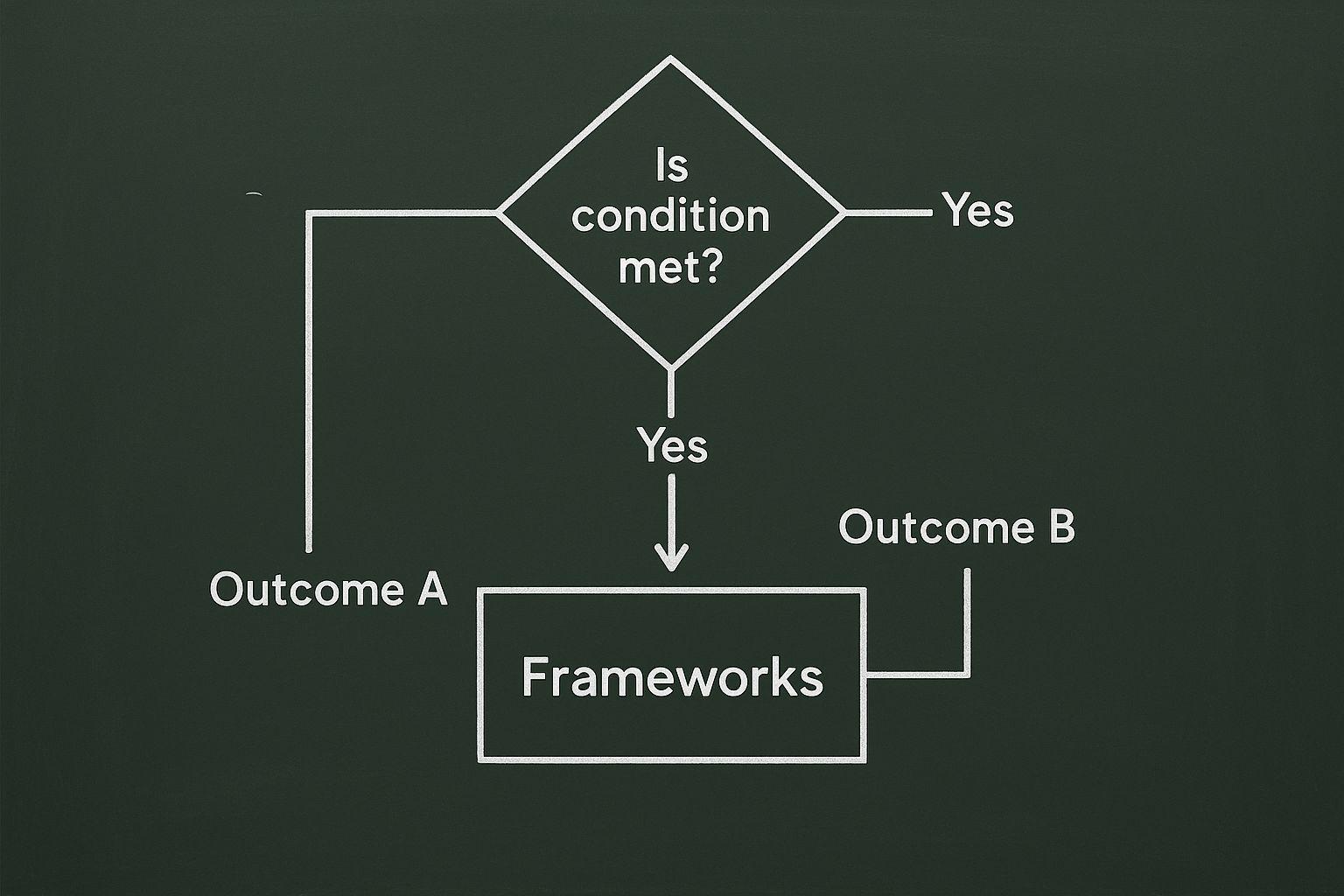
Ultimately, applying a structured framework helps turn a tangled web of possibilities into a clear set of manageable pathways, giving you a real edge.
Making Numbers Your Ally, Not Your Master
Frameworks give your decisions structure, but numbers give them power. While you can't erase uncertainty with math, you can use quantitative analysis like a floodlight to illuminate the landscape of possibilities. The objective isn't to find one perfect number that magically predicts the future; it's to map out the ambiguity, understand the range of potential outcomes, and ultimately, make smarter choices. This is how you transform numbers from something to fear into your greatest decision-making ally.
The Power of Simulation: Peeking into Thousands of Futures
One of the most powerful quantitative tools for this is the Monte Carlo method. Think of it this way: imagine you could simulate a single football match 10,000 times. In each simulation, you could slightly alter key variables—a star player’s form, a sudden change in weather, or even the tendencies of the referee. A Monte Carlo simulation does just that, running thousands of randomized scenarios to build a complete picture of what might happen.
Instead of getting a single, rigid prediction, you receive a full probability distribution of potential scores. This visual from Wikipedia shows how the method is used to estimate the value of Pi.
By randomly dropping dots into a square and seeing how many fall inside the inscribed circle, the simulation produces a remarkably accurate approximation. This same principle allows bettors to move beyond simple hunches, modeling complex game dynamics to see which results are most probable and which are rare outliers. It’s a game-changer for handling the many moving parts involved in decision making under uncertainty.
Understanding What Risk Metrics Really Tell You
Simulations generate a cloud of possible futures; risk metrics are the instruments you use to navigate that cloud. These aren't crystal balls, but rather yardsticks for measuring the exact amount of uncertainty you are accepting. They distill complex probability models into single, actionable numbers that can guide your strategy, highlighting everything from the average return you can expect to the chances of a catastrophic loss.
To help you get a grip on these tools, the table below breaks down some of the most common risk metrics used in sports betting and other fields involving uncertain choices.
Risk Metrics and Their Applications Overview of common risk metrics used in uncertain decision-making, their calculation methods, and practical applications
| Risk Metric | What It Measures | Calculation Method | Best Used For | Limitations |
|---|---|---|---|---|
| Expected Value (EV) | The average profit or loss of a bet if it were made many times. | (Probability of Winning × Amount Won per Bet) − (Probability of Losing × Amount Lost per Bet) | Identifying bets that are profitable over the long term. | Doesn't account for short-term variance or the size of your bankroll. A high EV bet could still wipe you out. |
| Standard Deviation | The volatility or "swinginess" of returns around the expected value. | A statistical measure of the dispersion of a set of outcomes from their average. | Assessing the risk level and consistency of a betting strategy. | A high standard deviation isn't inherently bad, it just signifies higher risk and bigger bankroll swings. |
| Kelly Criterion | The optimal fraction of your bankroll to wager on a positive EV bet. | Kelly % = (Decimal Odds × Win Probability - 1) / (Decimal Odds - 1) | Advanced bankroll management to maximize long-term growth. | Extremely sensitive to the accuracy of your probability estimates. An incorrect estimate can lead to oversized, risky bets. |
As you can see, no single metric tells the whole story. They are most powerful when used together to form a complete risk profile for a potential bet.
One of the most fundamental metrics to master is Expected Value (EV). It answers one critical question: "If I made this exact bet hundreds of times, what would be my average profit or loss per wager?" A positive EV indicates a bet is profitable in the long run, even if you lose in the short term. To get comfortable with the concept, it helps to work through scenarios yourself. You can learn how to use an expected value calculator with our dedicated guide.
Ultimately, even the most advanced model is useless if followed blindly. These quantitative tools are meant to inform your judgment, not replace it. The real skill is knowing when to trust the numbers and when to lean on your own expertise. This process, often called sensitivity analysis, means actively testing your assumptions. Ask yourself: "How does my conclusion change if this key player is less fit than I thought?" Numbers don't remove the difficulty of making a choice, but they provide the clarity to make your decision making under uncertainty more disciplined, confident, and successful over time.
Learning From Masters of Uncertain Decisions
Theories and models give us a blueprint, but the real craft of decision making under uncertainty comes to life in the field. To see these ideas in action, we can look to leaders who have faced down impossible choices with patchy information. By studying high-stakes scenarios from business, medicine, and crisis management, we can learn from both their triumphs and their telling mistakes. This is where we uncover the habits that separate a smart process from a simple stroke of luck.
Patterns of Success in High-Stakes Environments
Picture a CEO betting the company's future on an untested market. Or a pharmaceutical firm investing $1 billion in a new drug, fully aware it has over a 90% chance of failing clinical trials. These situations share a common DNA with crisis managers making split-second calls during a market crash, where data is unreliable and incomplete. The context changes, but the core challenge remains: how do you commit to a path when you can’t see the destination?
To really draw lessons from these events, we need a consistent way to break them down, similar to how a business school might approach a case study.
This structured method helps untangle the quality of the decision-making process from the randomness of the outcome. It gives us a clearer view of what truly led to success or failure.
Key Lessons From the Front Lines
If there's one golden rule to take from these masters, it's the discipline to judge a decision by its process, not its outcome. A brilliant choice based on all available information can still blow up due to bad luck. Likewise, a terrible guess can be saved by sheer good fortune. The most successful people focus relentlessly on building and refining a solid process, because they know it's the only thing they can actually control.
Another powerful pattern is the constant hunt for asymmetric bets. Venture capitalists and tech startups are experts at this. They place many small bets where the most they can lose is their initial investment, but the potential upside is astronomical. This mindset isn't about avoiding failure; it's about actively finding opportunities with massive growth potential, a vital principle in any uncertain field.
Great decision-makers also realize that not every choice is final. They actively look for decisions that are reversible or can be implemented in stages. This builds flexibility, allowing them to gather more information and change direction as the situation becomes clearer. Often, this involves taking specific steps to limit potential downsides. This is a core idea we explore in our guide on hedging bets to protect your position, a key strategy for managing risk in an unpredictable world.
Finally, these leaders master the art of acting with sufficient information instead of waiting for a certainty that will never come. They recognize that in competitive environments, hesitation is often a far greater risk than making a well-considered, but imperfect, choice.
Ultimately, people who master uncertainty don't have a crystal ball. They have a playbook built on a robust process, an appetite for asymmetric opportunities, and a deep understanding of how to structure their thinking when ambiguity is the only thing that's certain.
How Technology Changes The Uncertainty Game
Technology isn’t a crystal ball that shows us the future, but it does act as a powerful partner, helping us make smarter choices when the path forward is unclear. Instead of eliminating unknowns, artificial intelligence and machine learning give us a better way to manage them. These tools can sift through enormous amounts of data at speeds no human ever could, sharpening our judgment for decision making under uncertainty.
At the core of this change are Decision Support Systems (DSS), which combine data, models, and user input to guide choices in complex situations. A simple diagram shows how they work.
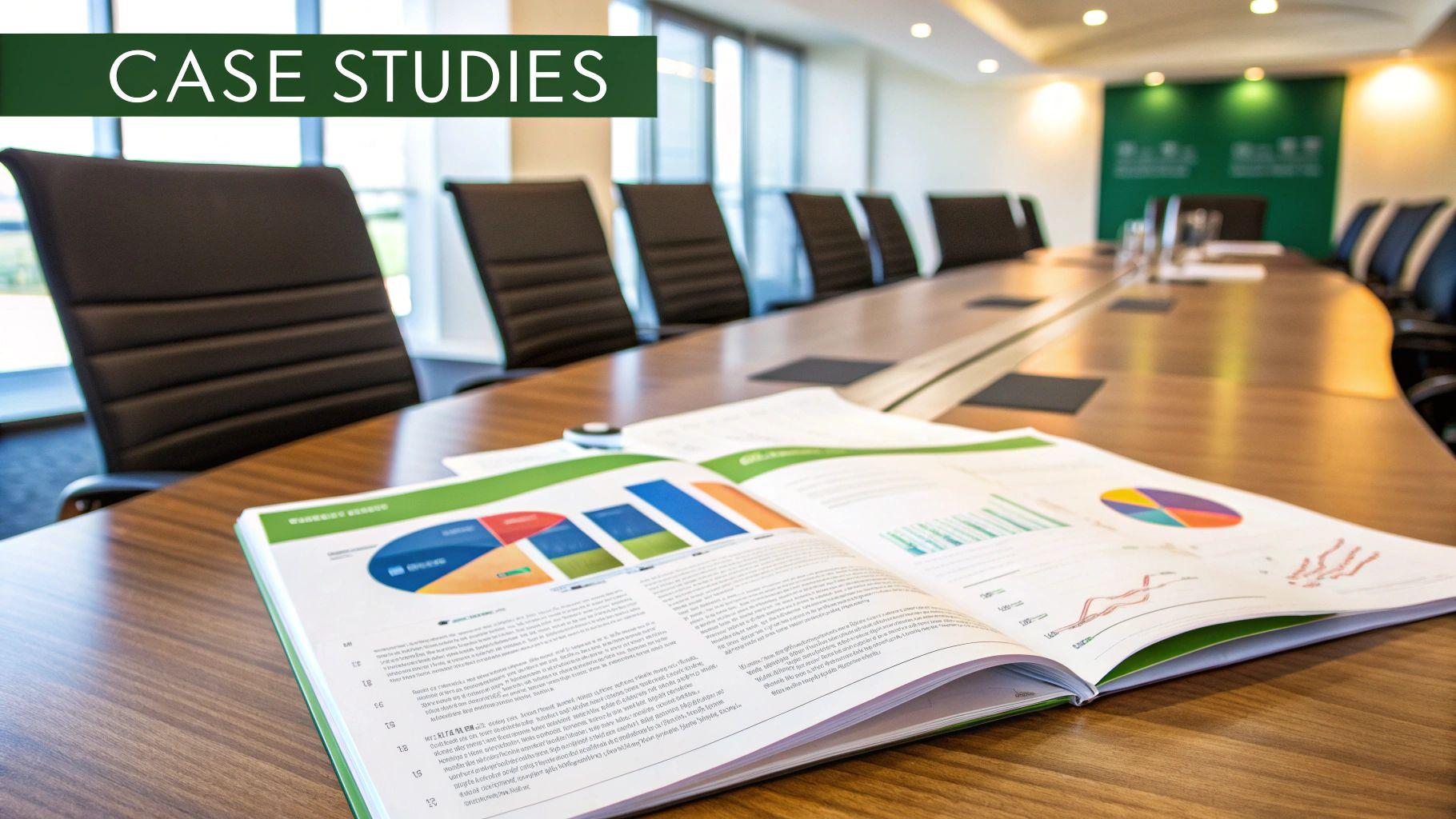
As you can see, a DSS takes raw information, runs it through analytical models, and presents the results through a clear interface. The key thing to notice is that the system supports the user; it doesn't replace them. The final decision still rests with a person.
The Human-Algorithm Partnership
The real advantage here is collaboration, not total automation. Think of a predictive model less like a fortune-teller and more like an incredibly experienced scout. It can analyze decades of data—far more than a person could review in a lifetime—to spot subtle patterns and map out potential outcomes. For a sports bettor, this could mean simulating a single match thousands of times to find an edge, revealing that an underdog actually has a 15% higher chance of winning than the odds imply.
However, this partnership requires caution. An algorithm is only as reliable as the data it’s fed. If the initial information is flawed or incomplete, you can run into algorithmic bias. Another issue is the “black box” problem, where a model’s internal logic is so complex that even its designers can't fully explain how it reached a conclusion. This is why human oversight is essential. An algorithm might flag a high-risk trade in the stock market, but it takes a human trader to weigh factors like market sentiment or breaking news—things a machine can't feel.
To bring technology into your own decision-making process effectively, stick to these guiding principles:
- Start Small: Test decision support tools on smaller, low-stakes problems first. This helps you get a feel for their strengths and weaknesses without significant risk.
- Question Everything: Always examine where the data comes from. Look for hidden biases and challenge the model’s basic assumptions before trusting its output.
- Maintain Oversight: Treat an algorithm’s recommendation as a powerful suggestion, not an order. You are still responsible for the final call and its consequences.
- Focus on Synergy: Let the technology do the heavy lifting—processing data and running simulations. This frees up your mental energy for big-picture strategy and intuition.
In the end, technology doesn't provide an escape from uncertainty. What it does offer is a better toolkit for dealing with it. Our choices become grounded in solid evidence, while still being guided by essential human wisdom and context.
Building Your Personal Decision-Making System
While technology provides powerful data, the best tool you have is your own mind. In the end, you’re the one making the call. Successful bettors don’t just consume data; they weave it into a personal system for making choices. This is how you combine smart frameworks, sharp analysis, and self-awareness into a process you can rely on. Mastering your own approach to decision making under uncertainty is the greatest advantage you can build.
Honestly Assess Your Decision-Making Style
Before you can build a reliable system, you need to know what you’re working with. Think of it as a blueprint of your own mind. Under pressure, everyone defaults to certain mental habits and has a unique tolerance for risk. Look back at your past decisions, especially the ones that went wrong. Were you trying to avoid another loss (loss aversion), or did you get stuck in a comfortable strategy that was no longer working (status quo bias)?
To get a clear picture, ask yourself a few tough questions:
- Do I naturally prefer small, frequent risks or big, infrequent ones?
- When I see information that contradicts my opinion, do I investigate it or ignore it?
- Am I calm and collected or tense and anxious when the stakes are high?
Answering these honestly allows you to build guardrails into your process that protect you from your own worst tendencies.
Create a Simple, Repeatable Process
With this self-awareness as your foundation, you can design a practical workflow. The goal isn’t a rigid, soul-crushing checklist. It's a simple, flexible guide that ensures you hit the important points before making a choice, especially when things feel chaotic and uncertain. This brings discipline to your actions and makes your decisions deliberate.
A solid baseline process should always include these steps:
- Frame the Decision: Be crystal clear about the specific choice you're making and what a successful outcome would look like.
- Gather Sufficient Information: The aim is clarity, not certainty. Identify the 1-3 key variables that will have the biggest impact and put your energy there to avoid analysis paralysis.
- Explore Plausible Futures: Take a moment to imagine two or three different ways the event could play out. How does your potential decision perform in each scenario?
- Commit and Execute: Once you've done the work, make your choice with confidence. Most importantly, write down your reasoning before you know the result.
Build a Feedback Loop for Continuous Improvement
Experience doesn't automatically lead to expertise. You only get better if you actively learn from your results. The most effective way to do this is by keeping a decision journal. This is more than just a log of wins and losses; it's a tool for dissecting your thought process to find what’s working and what isn’t. By explaining your logic before the outcome is known, you can judge the quality of your thinking, separate from the influence of good or bad luck.
This journal becomes the engine of your improvement. It helps you identify recurring biases and slowly build true intuition, which is really just your brain getting better at recognizing patterns. A simple entry is all you need to capture the data for later review.
| Component | Description |
|---|---|
| The Bet | Team A to win at +150 odds. |
| My Rationale | Key player for Team B was questionable. Team A showed strong recent form. |
| Uncertainty Factor | Weather was unpredictable; could impact Team A’s passing game. |
| Outcome | Lost. Team B's key player played and had a great game. |
| Lesson Learned | Overestimated the impact of the injury report. Need a better process for evaluating player status. |
Manage Pressure and Maintain Confidence
High-stakes decisions are stressful, and stress can sabotage even the most carefully crafted plans. Learning to manage this pressure is a skill in itself. One powerful technique is the pre-mortem: before you commit, imagine the decision has already failed spectacularly. Then, work backward to figure out all the reasons why it might have failed. This process shines a light on hidden weaknesses in your plan.
This kind of preparation, combined with a consistent process, builds genuine confidence. It’s not the flimsy confidence of just hoping you’re right, but the resilient confidence of knowing you made the best possible choice with the information you had. This is what allows you to stay disciplined when the results are out of your hands.
Building this personal system takes work, but it’s what separates bettors who rely on luck from those who create their own. When you combine your disciplined process with powerful data, you create an edge that’s hard to beat.
Ready to feed your system with high-quality insights? ValueBetFactory uses advanced tools to find market value, delivering real-time alerts that fuel your decision-making process. Let us handle the data-crunching so you can focus on making the winning call. Start your free trial at ValueBetFactory.com today.