
What Is the Vig in Betting Explained for Profit
Unlock Profits with betting tips!
You’ve heard the term before, probably thrown around by seasoned bettors or mentioned in a broadcast. But what exactly is the vig, and why should you care? Simply put, the vig (short for vigorish) is the built-in commission that a sportsbook charges on every single wager.
Think of it as a hidden service fee. It's the reason why a bet on a perfectly even matchup doesn't quite double your money when you win. It's the sportsbook's guaranteed cut, ensuring they stay in business no matter who wins or loses.
Understanding The Hidden Cost In Every Bet
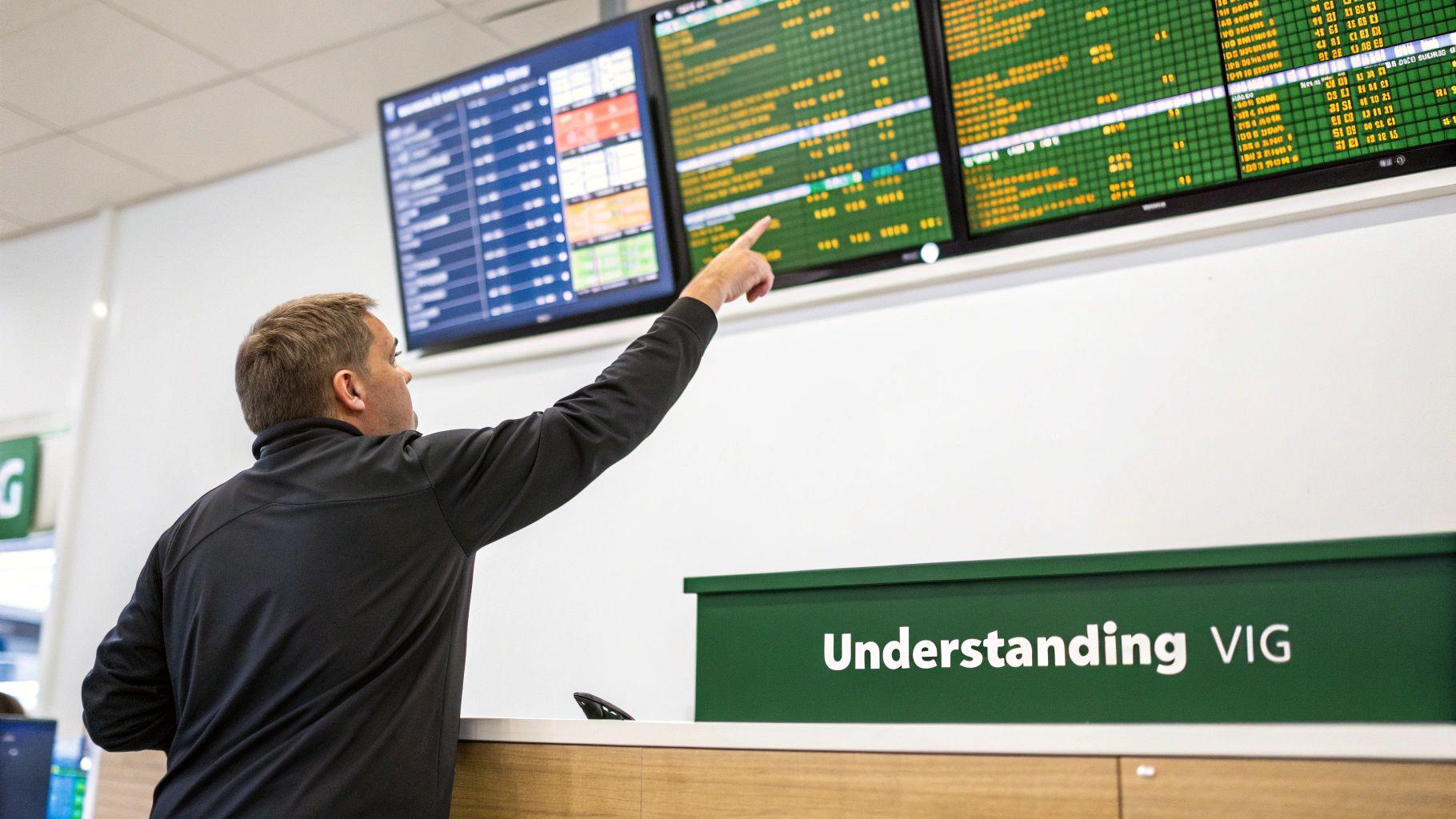
When you pull up the odds for a game, you're not looking at a pure, unfiltered reflection of probability. What you're actually seeing are prices that the sportsbook has intentionally shaded in its own favor. That subtle adjustment is the vig, and it’s the fundamental engine of their business model.
Let's strip it down with a simple analogy. Imagine two friends betting $10 on a coin toss-one takes heads, the other takes tails. The winner walks away with the entire $20 pot. That's a "no-vig" bet, a true 50/50 shot with a perfectly fair payout.
Now, picture a third person acting as the house. They take both $10 bets but announce that the winner will only get back $19. That $1 they pocket is the vig. Sportsbooks do the exact same thing, just in a more sophisticated way by baking that fee directly into the odds themselves.
Why The Vig Exists
At its core, the vig is all about guaranteeing the house a profit. By building this small margin into their lines, sportsbooks create a system where they can make money without having to be better than their customers at picking winners.
Their ideal scenario is to attract balanced action-roughly the same amount of money wagered on both sides of an event. When they pull this off, they can simply pay the winners with the money from the losers and keep the leftover vig as their profit. It's a clever, sustainable business model that removes most of their own risk.
The vigorish represents the commission that bookmakers build into their odds to guarantee profitability. Bookmakers can achieve this by securing just 52.4% of bets on the correct side of their lines, using skewed odds to attract balanced action while maintaining a mathematical edge. Discover more insights about how betting markets operate from the University of Chicago.
This built-in commission is also commonly known as betting juice, a term that perfectly captures the idea of the bookmaker "squeezing" a small percentage out of the total money wagered. You can dive deeper into the concept in our article about understanding betting juice.
To get a clearer picture of these core ideas, this quick table breaks down the essentials.
The Vig at a Glance Key Concepts Explained
| Concept | Simple Explanation |
|---|---|
| What is it? | A commission or "service fee" that sportsbooks build directly into their betting odds. |
| Why do they use it? | To guarantee themselves a profit regardless of which side of a bet wins. It’s their business model. |
| How does it affect me? | It slightly reduces your potential payout on winning bets, making it harder to be profitable long-term. |
| Where can I find it? | It’s not listed separately. It's the reason a 50/50 outcome is priced at -110 instead of +100. |
Keeping these simple definitions in mind is the first step. Understanding that every line you see has this small cost baked in is crucial before you can learn how to spot it, measure it, and ultimately, find bets that are good enough to beat it.
How to Calculate the Vig with Real Examples

Figuring out the vig isn't nearly as complicated as it might seem. You don't need to be a math genius-just a little grade-school arithmetic will do the trick. With a simple two-step process, you can peel back the curtain and see the exact fee the sportsbook has baked into any wager.
The whole game is about translating odds into what they really mean: implied probability. Once you do that, you just add up the probabilities for every possible outcome. Anything over 100% is the bookie's cut.
Step 1: Turn the Odds into a Probability
First things first, we need to convert the odds into a simple percentage. This is the key to seeing what the sportsbook thinks the chances of an outcome are. American odds use a minus (-) for the favorite and a plus (+) for the underdog, and the math is just slightly different for each.
- For negative odds (the favorite): Probability = |Odds| / (|Odds| + 100)
- For positive odds (the underdog): Probability = 100 / (Odds + 100)
These little formulas are your decoder ring. They turn the sportsbook's pricing into a clear percentage, laying the groundwork for spotting that built-in house edge.
Step 2: Add It All Up to Find the Vig
Once you have the implied probability for each side of the bet, just add them together. In a perfect, fair world with zero house edge, the total would be exactly 100%. But this is the real world, and sportsbooks are businesses, so the total will always be higher.
The formula to nail down the vig is dead simple:
Vig = (Total Implied Probability - 100%)
This quick calculation shows you the precise percentage the book expects to pocket, assuming they get balanced money on both sides.
Let's run through a couple of real-world examples to see how this plays out.
Example 1: The Standard -110 Point Spread Bet
The most common line in all of sports betting is -110, slapped on both sides of a point spread or totals bet. It's the industry standard. This means you have to bet $110 to win $100. Let's find the vig.
Calculate probability for Side A (-110):
- Formula: 110 / (110 + 100) = 0.5238
- Probability: 52.38%
Calculate probability for Side B (-110):
- Formula: 110 / (110 + 100) = 0.5238
- Probability: 52.38%
Add them together:
- 52.38% + 52.38% = 104.76%
Find the vig:
- 104.76% - 100% = 4.76%
So, the vig on a standard -110 line is 4.76%. Put another way, for every $220 wagered ($110 on each side), the bookmaker takes in $220 but only pays back $210 to the winner. That leftover $10 is their commission.
Example 2: A Moneyline Bet with Different Odds
Moneyline bets almost never have identical odds. Let's take a look at a typical matchup where the favorite is priced at -150 and the underdog is at +130.
Calculate probability for the favorite (-150):
- Formula: 150 / (150 + 100) = 0.60
- Probability: 60.0%
Calculate probability for the underdog (+130):
- Formula: 100 / (130 + 100) = 0.4348
- Probability: 43.48%
Add them together:
- 60.0% + 43.48% = 103.48%
Find the vig:
- 103.48% - 100% = 3.48%
In this case, the vig is 3.48%. You'll often see that the vig is a bit lower on competitive moneyline markets compared to standard spreads. Doing this math yourself is a great skill to have, but when you need a quick answer, you can always use a tool like a free online devig calculator to strip out the vig and see the true odds instantly.
Why Ignoring the Vig Erodes Your Bankroll
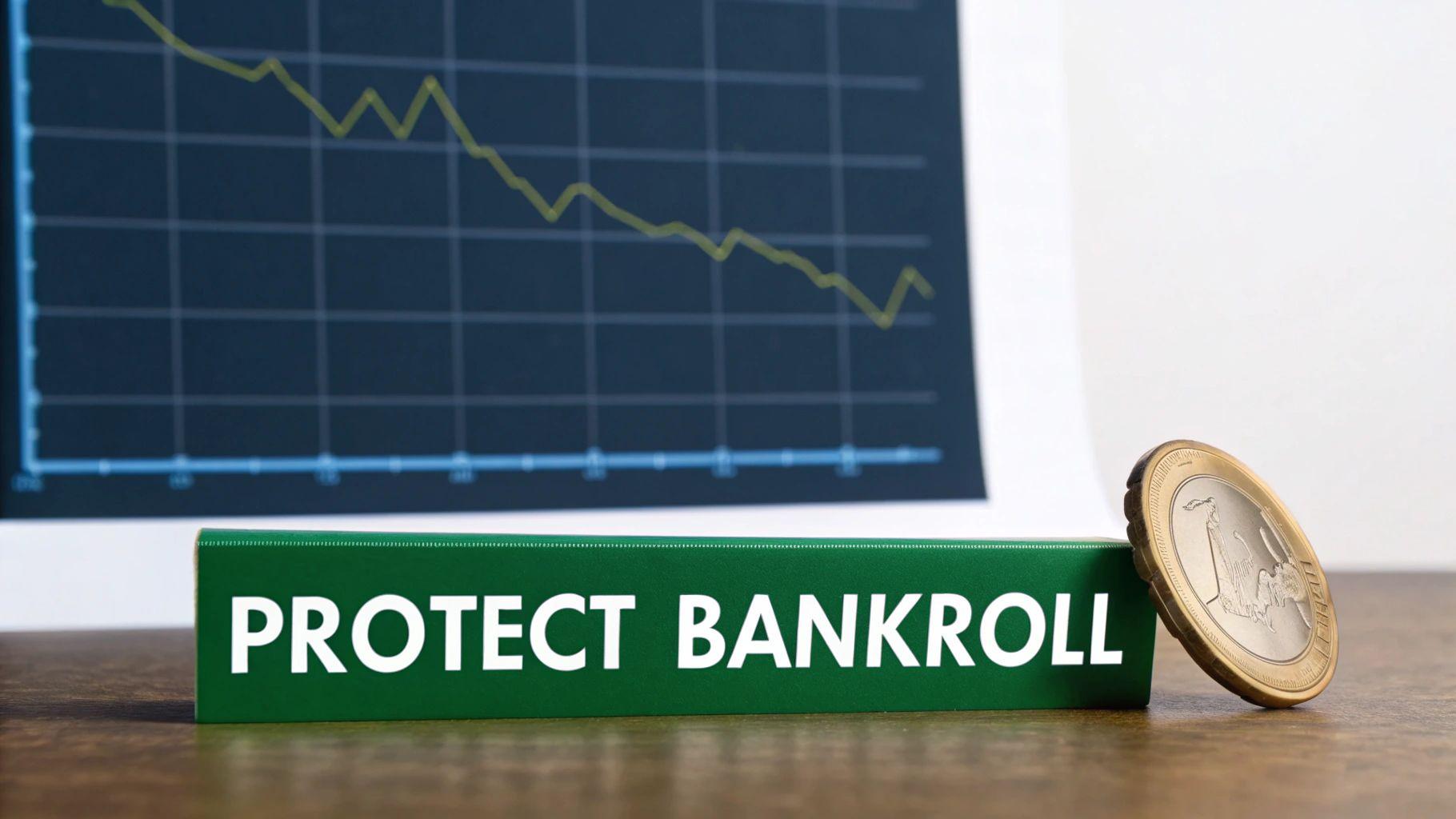
Knowing what the vig is and how to calculate it are the first steps. But the real lightbulb moment comes when you grasp its relentless, corrosive effect on your long-term profits.
Think of the vig as a slight headwind you face on every single wager. It might feel like nothing on one bet, but over hundreds or thousands, it can completely blow you off course.
Ignoring this built-in house edge is one of the fastest ways to drain your funds. It quietly stacks the odds against you, making sure that even a decent run of picking winners might not be enough to keep you in the black. This is where so many casual bettors get tripped up, focusing only on their win-loss record without seeing the hidden tax working against them.
The -110 Coin Toss Dilemma
To see the vig's true power, let's look at the simplest scenario imaginable: a fair coin toss. We know the actual, real-world probability of heads or tails is a perfect 50%. If there were no vig, a winning $100 bet would pay $100 in profit. You'd only need to win half your bets to break even.
But sportsbooks don't offer fair coin tosses. They offer them at -110 odds.
This is where the math becomes unforgiving. As we calculated earlier, those -110 odds have an implied probability of 52.38%. In other words, the bookmaker has priced the bet as if you need the coin to land on your side nearly 52.4% of the time just to come out ahead.
The vig forces you to be better than average just to survive. On a true 50/50 event priced at -110, you're starting from a mathematical hole. Your goal is no longer just to win 50% of your bets; it's to win enough to overcome the house's built-in commission.
This one concept changes everything. Successful sports betting isn't just about picking winners. It's about finding wagers where the odds are better than the true probability of that event happening-by a margin big enough to beat the vig. You're constantly hunting for value that can overcome the sportsbook's inherent advantage.
Long-Term Bankroll Decay
Over time, this constant disadvantage acts like a slow leak in your bankroll. A bettor who wins exactly 50% of their -110 wagers will watch their funds steadily shrink.
Let's say they make 100 bets of $110 each. They'll win 50 of them for a $5,000 profit. But they'll also lose the other 50, costing them $5,500. The end result is a net loss of $500, despite having a perfectly average 50% win rate.
This slow erosion is exactly why sound sports betting bankroll management is non-negotiable for anyone serious about this. Without a plan that accounts for the vig, even skilled bettors can see their capital get whittled away. The challenge is crystal clear: you have to consistently win at a rate higher than the break-even point set by the vig to see any real growth.
Actionable Strategies to Beat the Bookmakers Edge

Understanding the vig is your first major milestone as a serious bettor, but it's only half the battle. The next, and most crucial, step is figuring out how to consistently climb over that wall. This is where smart strategy separates the profitable bettors from the crowd.
Instead of just accepting the first odds you see, you need to actively hunt for better prices. This simple but powerful habit is the foundation of a winning approach, transforming you from a passive bet-taker into someone who actively works the market.
Shop for the Best Lines
Think about shopping for a new TV. You wouldn't just walk into the first electronics store and pay whatever price is on the sticker. You'd check online, compare prices at different retailers, and find the best possible deal. Line shopping in sports betting is the exact same concept.
Not all sportsbooks offer identical odds on the same game. One book might have the Chiefs at -110, while another, trying to balance its own action, offers them at -105. By simply placing your bet at the book offering -105, you are instantly reducing the vig you have to pay and boosting your potential profit.
Successful betting isn't always about picking the winner. Often, it's about finding the best price on the winner you've picked. Line shopping is the most fundamental way to ensure you're not leaving money on the table.
This practice obviously requires having accounts at multiple sportsbooks, which gives you the flexibility to quickly compare odds and pounce on the most favorable line. Over hundreds of bets, those seemingly small price differences can add up to thousands of dollars in your pocket.
Master the Art of Value Betting
Line shopping helps you pay less vig, but value betting is how you truly beat it. This is the art of finding wagers where you believe the true probability of an outcome is higher than the odds offered by the sportsbook suggest. You are essentially finding spots where the bookmaker has mispriced the market.
For example, imagine you analyze a matchup and determine a team has a 60% chance of winning. A sportsbook, however, is offering odds of -120, which only implies a 54.5% probability. That gap between your assessment (60%) and the book's price (54.5%) is your edge. That is a value bet.
These are the opportunities that generate long-term profit. They are bets with a positive expected value (+EV), meaning that if you could make that same wager under the same conditions an infinite number of times, you would be guaranteed to come out ahead.
Automate Your Edge with Modern Tools
Manually line shopping and calculating value for every game across dozens of sportsbooks is an exhausting, time-consuming grind. The modern solution is to use platforms specifically designed to do the heavy lifting for you.
Tools like ValueBetFactory use powerful algorithms to constantly scan odds from sportsbooks around the globe. They instantly compare these lines against a calculated "true" odd, flagging any profitable discrepancies in real time. This automated approach turns what used to be a manual slog into an efficient hunt for +EV opportunities.
The vig is a constant drag on your profitability, but data-driven platforms have proven that a systematic approach to finding mispriced odds can overcome it. Research on historical odds shows that users on analytics platforms had a 40% chance of turning a profit, compared to just 2% at traditional sportsbooks. In other words, a data-first approach makes you about 20 times more likely to profit. You can learn more about these historical odds findings and see the data for yourself.
To put these strategies into perspective, here’s how the manual and automated approaches stack up.
Comparing Approaches to Mitigating the Vig
| Strategy | Process | Efficiency | Potential for Profit |
|---|---|---|---|
| Manual Line Shopping & Value Hunting | Requires opening dozens of browser tabs, manually comparing odds, and performing your own calculations to spot value. | Very low. Extremely time-consuming and prone to missing fleeting opportunities. | Moderate. Profitable if done with extreme discipline, but the time investment is huge. |
| Automated Value Betting (e.g., ValueBetFactory) | Software scans all major bookmakers in real-time, instantly flagging +EV bets based on proprietary algorithms. | Very high. Eliminates the manual work, allowing you to focus purely on placing the bets. | High. Maximizes the number of +EV opportunities you can find and act on. |
As the table shows, while the core principles are the same, automation provides a massive efficiency boost that is almost impossible to replicate by hand.
By combining the discipline of line shopping with the precision of value betting-and turbocharging it all with automation-you build a robust strategy capable of consistently beating the bookmaker’s built-in edge.
Right, so we've covered the theory. We know what the vig is, why it exists, and how it quietly eats away at your returns. But theory only gets you so far. The real trick is putting that knowledge to work in a market that moves at lightning speed.
This is where the game really begins. Instead of spending hours flipping between a dozen different sportsbook tabs, manually punching numbers into a calculator, you need a way to turn all that abstract knowledge into quick, actionable decisions. The goal is to spend less time hunting and more time capitalizing on real opportunities.
How Real-Time Alerts Flip the Script on the Vig
The entire game of beating the vig boils down to one thing: finding odds that are out of sync with an outcome's true probability. That's exactly what ValueBetFactory is built to do. Our platform is constantly scanning the market, comparing odds from countless sportsbooks against our own sharp, data-driven line.
When we spot a major difference-a bet with positive expected value (+EV)-we flag it instantly. You get an alert showing you the team, the sportsbook offering the juicy odds, and exactly how big your edge is over the house.
Here’s what that looks like on the ValueBetFactory dashboard:
In this example, the system has sniffed out a bet with a +4.2% edge. What does that mean in plain English? For every $100 you wager on opportunities like this, your expected return is $104.20 over the long haul. You’re not just overcoming the vig; you’re effectively turning it back on the sportsbook and putting the advantage in your corner.
Size Up Any Bet in a Matter of Seconds
Automated alerts are fantastic, but what about those times you spot a line on your own and get that gut feeling? Our integrated betting calculators are made for exactly that moment. You can plug in the odds from any moneyline or spread, and the tool will immediately show you the implied probability and, crucially, the sportsbook's vig.
This lets you instantly size up the "cost" of placing a bet. Are you looking at a standard 4.5% juice, or has the bookmaker sneakily inflated it to 7%? Knowing that number in a heartbeat helps you decide whether to pull the trigger or shop around for a better price.
This is where it all comes together. Using real-time alerts to find value and calculators to vet the lines you find-this is the active, strategic approach that directly confronts and beats the sportsbook’s built-in advantage.
Think of this as the most efficient path forward. Instead of drowning in manual calculations, you're using specialized tools to make smarter, faster decisions. For any bettor who's serious about grinding out a long-term profit, this is the logical next step to consistently beat the vig.
A Few Common Questions About the Vig
Once you get the hang of the basics, a few more specific questions usually start to bubble up. It's one thing to know what the vig is, but it's another to understand how it behaves out in the wild.
Let's clear up some of the most common queries bettors have. Think of this as tying up the loose ends so you're fully prepared to spot the vig's influence on any bet you're considering.
Is the Vig the Same for All Sports?
Not even close. The amount of vig a bookmaker charges can swing pretty wildly depending on how popular a sport or league is. It all comes down to competition and risk.
For the big players like the NFL or the NBA, sportsbooks are fighting tooth and nail for your business. That intense competition forces them to tighten their lines, often resulting in a lower vig-typically in the 4% to 5% range. But for less common sports or niche markets, there's less competition. That gives the bookie more breathing room to charge a higher vig, sometimes creeping up to 6% or more, because they're taking on more uncertainty.
Do All Types of Bets Have a Vig?
Yep, pretty much. If a traditional sportsbook is offering a bet, you can be sure there's a vig baked into the odds. It doesn't matter if it's a point spread, moneyline, total, future, or prop bet-the house has to get its cut somehow.
That said, the amount of juice can change dramatically from one bet type to another.
Parlays are the classic example of where the vig really flexes its muscles. Each bet you add to a parlay has its own vig, and those commissions compound on each other. A simple single bet might have a 4.5% edge for the house, but on a five-leg parlay, that compounded vig can slash your potential payout by over 20%.
Are There Bets with No Vig?
Finding a bet with absolutely zero vig at a regular sportsbook is like spotting a unicorn. It's incredibly rare, but not totally impossible. Sometimes, a book will run a "no juice" or "reduced juice" promotion on a big game just to get people in the door, but these are just marketing gimmicks, not standard practice.
The most reliable place to find no-vig action is on a peer-to-peer betting exchange. On platforms like these, you aren't betting against the house; you're placing a wager directly against another person. The exchange just acts as the middleman, taking a tiny commission on your net winnings, which is almost always a better deal than a standard sportsbook vig.
What Is a Fair Vig Percentage?
"Fair" is always a bit subjective, but in today's competitive online market, the industry standard for a point spread or total is about 4.5%. That's the house edge you're looking at with the classic -110 odds on both sides. Anything you find that's lower than that is a solid price for you.
Moneyline bets are a little more variable, but a vig somewhere between 3% and 5% is generally considered competitive. If you're consistently calculating the vig on bets and seeing numbers pushing 6% or higher, that’s your cue to start shopping around. Sticking to that discipline is one of the easiest ways to protect your bankroll from getting slowly eaten away.
Ready to stop fighting the vig and start beating it? ValueBetFactory uses powerful algorithms to scan the market for you, instantly alerting you to profitable betting opportunities where the odds are in your favor. Start your free trial today and turn the tables on the sportsbooks.