
Boost Your Sports Betting ROI
Unlock Profits with betting tips!
When you get serious about sports betting, there's one metric that stands above all others: your Return on Investment (ROI). Forget your win-loss record for a moment. ROI is the true measure of your long-term success, telling you exactly how much profit you're generating relative to the total cash you've put on the line.
It's the clearest way to separate genuine skill from a lucky streak.
Why ROI Is the Ultimate Metric in Sports Betting

It’s completely natural to get caught up in the emotional rollercoaster of big wins and frustrating losses. But those feelings don't paint the full picture of your performance. Think about it: a bettor bragging about a 70% win rate could easily be losing money if all their bets are on heavy favorites with rock-bottom odds.
On the flip side, someone who only wins 40% of their bets might be incredibly profitable. How? By consistently identifying and betting on undervalued underdogs. This is where your sports betting ROI cuts through all that noise. It’s a cold, hard number that only cares about one thing: your profitability.
Key Takeaway: Focusing on ROI forces a critical mindset shift. You stop being a casual fan who chases wins and start thinking like a strategic investor who hunts for value. This approach is the bedrock of sustainable, long-term profit.
This analytical mindset is more important than ever. The global sports betting market is ballooning, projected to hit USD 124.39 billion in 2025. This explosion, driven by wider access and a packed sports calendar, shows just how much money is in play. If you want a piece of that, you need a sharp, data-driven strategy. For a deeper dive into these industry trends, you can explore the complete sports betting market report on ResearchAndMarkets.com.
Understanding the ROI Formula
So, how do you calculate this critical metric? The formula itself is surprisingly simple, but don't let that fool you. Its power is in boiling down all your betting activity—every win, loss, and push—into a single, telling number.
Here's the formula: ROI = (Net Profit / Total Amount Wagered) x 100
Let’s quickly break that down:
- Net Profit: This is your total winnings minus your total stakes. A positive number means you're in the black; a negative number means you're in the red.
- Total Amount Wagered (Turnover): This is the sum of every single dollar you've staked on all your bets over a given period, win or lose.
A positive ROI means you're making money. A negative one means you're losing it. It really is that straightforward. For context, even a small but consistent ROI of 3-5% is considered excellent in the sports betting world. It’s definitive proof that you have a real edge over the sportsbooks.
Putting It All Together With a Simple Example
Formulas can feel a bit abstract, so let's walk through a real-world scenario to make it stick.
Let's say over the course of a month, you place 100 bets, each with a $10 stake.
- Your Total Amount Wagered is simple: 100 bets × $10 per bet = $1,000.
- After all the games are over, you count up your winnings and find your total return is $1,070.
- To get your Net Profit, you subtract your initial stakes from your returns: $1,070 - $1,000 = $70.
Now, we just plug those numbers into our formula: ROI = ($70 / $1,000) x 100 = 7%
That 7% ROI gives you a powerful piece of information. It means for every single dollar you wagered, you earned, on average, seven cents in profit. It's an objective, undeniable measure of your betting skill.
To make this even easier to remember, here's a quick summary of how the calculation works.
Quick Guide to Calculating Your Sports Betting ROI
This table breaks down the components of the ROI formula with the example we just used.
| Component | Description | Example |
|---|---|---|
| Total Amount Wagered | The sum of all money staked on bets. | $1,000 |
| Net Profit | Total Payouts minus Total Amount Wagered. | $70 |
| ROI Formula | (Net Profit / Total Amount Wagered) x 100 | ($70 / $1,000) x 100 |
| Your Sports Betting ROI | The resulting percentage. | 7% |
Keep this calculation handy. Tracking it consistently is the first and most important step toward becoming a smarter, more profitable bettor.
How to Accurately Track and Calculate Your Betting ROI
Knowing the ROI formula is easy. The real discipline comes from actually using it, and that starts with meticulous, honest record-keeping. If you're not tracking every single wager, you're essentially just guessing about your own performance.
Think of it this way: every bet you place is a data point. Over time, these points build a rich database of your own betting habits. This isn't just about celebrating wins or lamenting losses; it's about uncovering the patterns that lead to long-term profit.
The Non-Negotiables of Bet Tracking
To get a true picture of your performance, you need to log more than just "win" or "loss." A few key details are essential for turning raw data into meaningful insights.
At an absolute minimum, every entry in your tracking log must include:
- Date: When you placed the wager.
- Sport & Event: Be specific, like "NFL - Chiefs vs. Ravens."
- Bet Type: Was it a Moneyline, Spread, Total, Prop, or Parlay?
- Stake: The exact amount of money you risked.
- Odds: The price you got when you placed the bet.
- Result: A simple Win, Loss, or Push.
- Payout: The total amount returned on a winning bet (your initial stake plus the profit).
This level of detail is what separates the pros from the amateurs. It lets you slice and dice your history to find what's really working. Maybe you discover you're crushing NBA totals but bleeding money on NFL moneylines. That’s a game-changing insight you can only get from detailed tracking.
The infographic below breaks down how this all flows together.
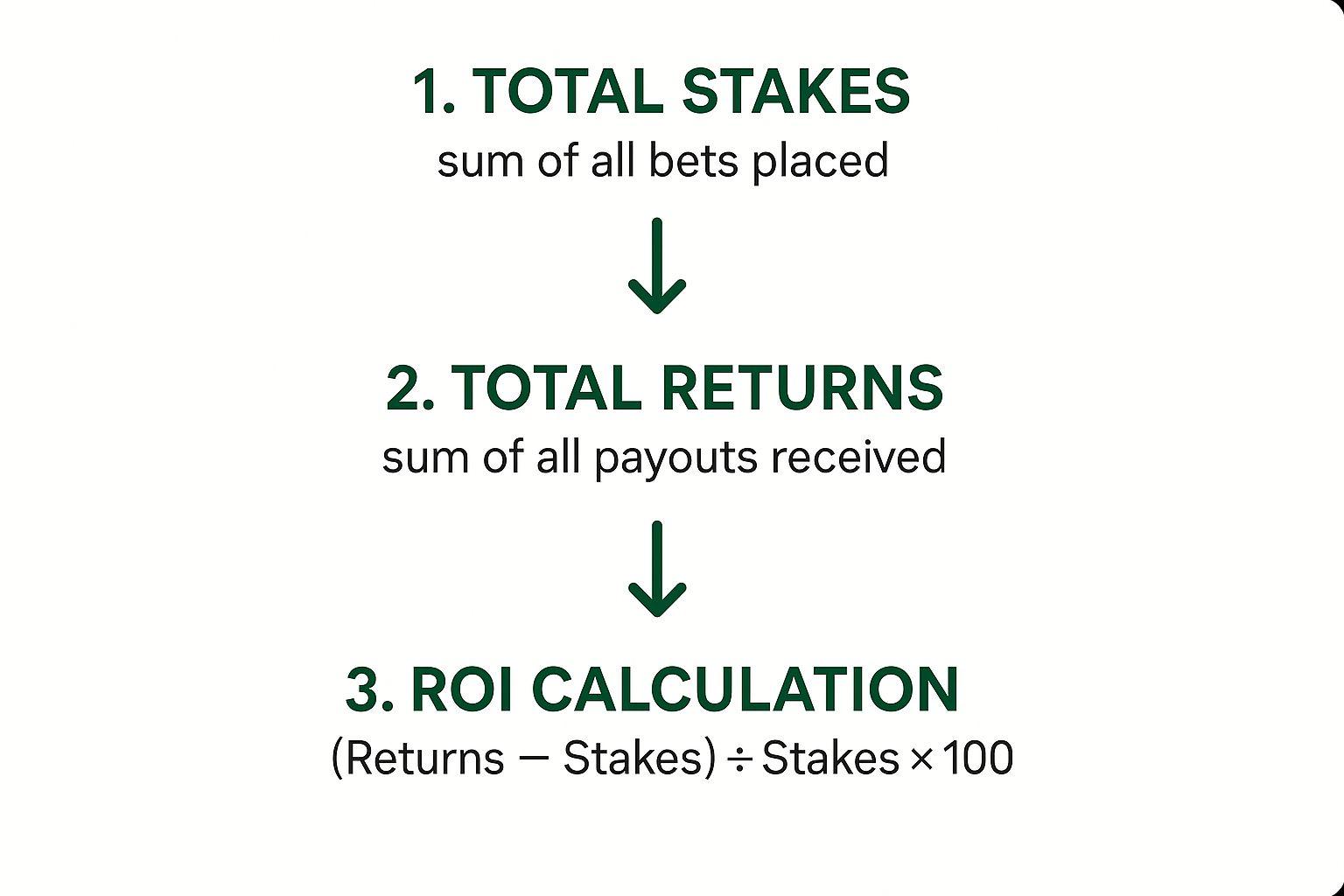
As you can see, your total stakes and total returns are the two simple inputs you need. From there, you can calculate the ROI percentage that truly defines your profitability.
A Practical Scenario: One Month of NFL Betting
Let's walk through a real-world example. Say you commit to tracking every single NFL bet you make for one month. No exceptions.
After a few weeks of action, your log might start looking like this:
| Date | Event | Bet Type | Stake | Odds | Result | Payout | Net Profit/Loss |
|---|---|---|---|---|---|---|---|
| Oct 1 | BAL @ KC | BAL +3.5 | $25 | -110 | Win | $47.73 | +$22.73 |
| Oct 1 | JAX @ HOU | Over 48.5 | $20 | -110 | Loss | $0.00 | -$20.00 |
| Oct 8 | DAL vs NYG | DAL ML | $50 | -200 | Win | $75.00 | +$25.00 |
| Oct 8 | LV @ DEN | Parlay | $10 | +250 | Loss | $0.00 | -$10.00 |
At the end of the month, you'll have a complete history. To figure out your sports betting ROI, you just need to tally up two key numbers from your log:
- Total Stake (Turnover): The sum of every dollar you risked.
- Total Net Profit/Loss: The sum of the profit or loss from every bet.
Let's imagine after the full month, you risked a total of $1,250 and ended up with $87.50 in net profit.
Now for the moment of truth. You plug those numbers into the formula: ROI = (Net Profit / Total Stake) x 100 ROI = ($87.50 / $1,250) x 100 = 7%
A 7% ROI over a decent sample size is fantastic. It’s concrete proof that your strategy is working and gives you a real benchmark to protect or improve upon. That hard number, backed by your own data, is infinitely more powerful than just having a "good feeling" about your bets.
Tools for Painless Tracking
Manually logging every bet might sound like a chore, but the right tools make it a simple habit to form. You don't need fancy software to get started.
Many successful bettors begin with a basic spreadsheet. A tool like Google Sheets or Microsoft Excel is free, incredibly flexible, and powerful enough to calculate your ROI and let you filter by sport, bet type, or anything else you track.
If you prefer a more automated route, plenty of bet tracking apps exist. Many of these can sync directly with your sportsbook accounts, importing your wagers automatically and serving up advanced charts and analytics. Some might carry a subscription fee, but for a serious bettor, the time saved and depth of insight can be a worthwhile investment.
The most important thing is to pick a method you'll actually stick with. Consistency is what turns raw data into a higher sports betting ROI.
What a Realistic Sports Betting ROI Actually Looks Like

So, you've been tracking your bets and you've finally calculated your ROI. The big question is: what does that number really mean? It’s easy to get a skewed idea of success when social media is full of people flashing massive, unbelievable winning tickets.
Let's cut through the noise and get real about what a good sports betting ROI actually is for the long run.
The truth is, the most respected professional bettors in the world—the ones who do this for a living—operate on surprisingly thin margins. They aren't boasting about a 50% or 100% ROI every month. Returns like that almost always come from short-term luck, a tiny sample size of bets, or just plain dishonesty. They aren't the result of a sustainable, skill-based strategy.
For a serious bettor, a consistent, long-term ROI in the 3-5% range is considered very solid. If you can push that into the 5-10% range, you're in truly elite territory. Those percentages are proof that you have a genuine, measurable edge over the sportsbooks.
A professional bettor once said something that stuck with me: "The bookmaker's built-in edge is about 4.5%. My job is to be just a little bit better than that, consistently." That’s the game. It's about grinding out a small, repeatable advantage, not hitting a lottery ticket.
The Gold Standard: A Sustainable 5% ROI
Why is a modest 5% ROI seen as the gold standard? Because holding onto that edge over thousands of bets is incredibly difficult. Sportsbooks have teams of oddsmakers and statisticians whose entire job is to set the sharpest lines possible. To consistently find small mistakes in their numbers and beat them requires immense discipline and a ton of work.
Think of it like an investment fund. A fund manager who consistently beats the S&P 500 index by 2-3% every year is celebrated as a superstar. The same idea applies here. The sportsbook's line is your "index," and your ROI shows how much you're "beating the market."
A sky-high ROI of 30% or more from just a handful of bets isn't skill; it's variance. It’s what happens when you get lucky on a few longshots. While it’s certainly fun while it lasts, it tells you nothing about your future prospects. In fact, any experienced bettor would see a 30% ROI over 100 bets as a statistical fluke that's bound to come back down to earth.
Volume and Variance: The Great Equalizers
The connection between your betting volume and your ROI is absolutely critical. A high volume of bets is your best tool for smoothing out the wild swings of luck, or variance, which gives you a much clearer picture of your actual skill.
- Low Volume (e.g., 50 bets): Your ROI will be all over the place. A couple of lucky underdog wins might shoot your ROI up to 25%, while a few bad beats could drop it to -15%. The sample size is just too small to mean anything.
- High Volume (e.g., 1,000+ bets): This is where your ROI starts to settle and reflect your true edge. The impact of a single lucky or unlucky result fades, and your real advantage starts to show. This is precisely why pros focus on placing a high volume of bets that they've identified as having value.
This is a fundamental truth of betting. A bettor with a 4% ROI over 2,000 bets is far more impressive—and much more likely to be profitable in the long term—than someone with a 15% ROI over 50 bets. The first person has proven they have an edge. The second has just been on a hot streak.
How ROI Changes Across Different Sports and Bets
Finally, it’s important to know that a realistic ROI isn't the same for every market. Different sports and bet types come with their own unique characteristics.
For example, major markets like NFL point spreads are incredibly efficient. The lines are razor-sharp because of the massive betting volume and intense public scrutiny. Finding an edge here is tough, so a sustainable ROI of 2-3% is a fantastic achievement.
On the other hand, in more niche markets—think lower-league soccer, college basketball totals, or specific player props—there’s less data available and less action from the general public. This creates more opportunities for a knowledgeable bettor to find soft lines and achieve a higher sports betting ROI, maybe even in the 5-8% range. The key is to specialize and attack markets where you have an information advantage.
Proven Strategies to Improve Your Betting ROI
So, you're tracking your sports betting ROI. That's the first step, and a big one. But now for the fun part: making that number climb. This means shifting your mindset from just tracking results to actively hunting for better opportunities. It's not about luck or just picking teams you like; it's about consistently finding spots where the odds are tilted in your favor.
The great news is that there are tested, practical methods you can put to work right away. These aren't wild get-rich-quick promises. They're the disciplined, analytical approaches that professional bettors use to build their profits over the long haul.
Let's dig into three of the most effective strategies you can use to start boosting your ROI.
Find True Value by Beating the Closing Line
If you want the single biggest indicator of a sharp, winning bettor, this is it: consistently beating the closing line. The "closing line" is simply the final odds a sportsbook offers right before a game begins. It's considered the most accurate reflection of reality because it's been hammered into shape by all the market's money, data, and collective wisdom.
When you consistently place bets at odds that are better than where the line closes, you're practicing what's known as value betting.
Here’s a real-world example. Say you bet on the Kansas City Chiefs at -110 odds early in the week. By the time kickoff rolls around, a ton of money and news has pushed the line, and now the Chiefs are sitting at -125. You successfully beat the closing line. This is a powerful signal that your analysis was ahead of the curve and you found genuine value.
Over thousands of bets, there's an undeniable correlation between beating the closing line and having a positive ROI. Your goal should be to get your money down before the rest of the market catches on and corrects the price.
Specialize in Niche Markets
The major sports leagues—think the NFL, NBA, or English Premier League—are incredibly popular and draw massive betting action. This means the odds are razor-sharp. The sportsbooks have armies of analysts and sophisticated models, making it tough to find a real edge. It’s not impossible, but the ROI ceiling is often lower because the lines are so efficient.
This is where specialization becomes your superpower. By diving deep into smaller, less-covered markets, you can develop a real informational advantage.
Think about markets like these:
- Lower-Division Soccer: Leagues in smaller European nations or even second-tier competitions often fly under the radar.
- College Sports Player Props: Oddsmakers can't be experts on every single player in college football or basketball, leaving soft spots in the lines.
- Specialized Sports: The lines for darts, snooker, or volleyball just don't get the same level of scrutiny from the public or the books.
By becoming a true expert in one or two of these areas, you can genuinely know more than the oddsmakers. You'll spot trends, hear about injuries before the market moves, and understand team dynamics that algorithms miss. This informational edge is what translates directly into a higher sports betting ROI.
Implement Smart Bankroll Management
Even the most brilliant betting strategy on the planet is doomed to fail without proper money management. A smart bankroll plan is what keeps you in the game during the inevitable losing streaks and what allows your profits to compound when you're on a hot run. It's the engine that powers your entire betting operation.
For a comprehensive breakdown, check out our guide to building a bulletproof sports betting strategy.
Let’s look at two of the most common staking plans.
| Staking Plan | Description | Best For |
|---|---|---|
| Flat Betting | Risking the same fixed amount, or "unit," on every bet. This is typically 1% of your bankroll. Your stake doesn't change based on confidence or odds. | Beginners. It's fantastic for controlling emotion and protecting your capital from devastating losses. It’s simple and effective. |
| Kelly Criterion | An advanced method where your bet size is a percentage of your bankroll, calculated based on your perceived edge. The bigger your advantage, the more you risk. | Experienced bettors who can accurately estimate their edge. It's built for maximum bankroll growth but is very risky if you miscalculate your advantage. |
For almost everyone starting out, a flat-betting approach of 1-2% of your bankroll per wager is the smartest way to go. It takes the emotion out of sizing your bets and ensures that a few bad beats won’t send you to the sidelines.
This kind of disciplined approach is more important than ever. The global sports betting market is projected to grow by an astounding USD 221.1 billion between 2025 and 2029, driven by new technology and the use of AI in betting platforms. This explosive growth means more opportunities for sharp, data-driven bettors, but it also demands a more sophisticated approach to stay ahead. You can read the full Technavio research on these market trends to see just how much technology is changing the game.
Using Modern Tools and Data to Sharpen Your Edge

The best bettors I know don't just rely on gut feelings. They've evolved. Today, success is all about gaining an analytical advantage, and that means embracing technology. Improving your sports betting ROI comes down to finding every possible edge, and these days, modern tools are your most powerful allies.
This is a data game now. Whether it's locking in the best price or dissecting your own performance, data is what turns a small, perceived advantage into tangible profit.
The entire industry is reflecting this shift. The sports betting market is now overwhelmingly online, and it's not just the biggest piece of the pie—it's also the fastest-growing. In 2024, the global market was valued at an estimated USD 100,910.9 million, and it's projected to climb to USD 187,392.2 million by 2030. That explosion is driven by technology, making a data-first approach non-negotiable for anyone serious about winning. You can read more about these global market trends at GrandViewResearch.com.
Never Settle for Bad Odds Again
If you want an instant way to boost your potential ROI, stop accepting subpar odds. It's the lowest-hanging fruit. Placing a bet at -110 when another sportsbook has the same line at -105 is like setting money on fire. It might not feel like much on a single wager, but over hundreds of bets, those tiny differences compound into a massive drain on your profits.
This is exactly why odds comparison software is essential. Think of it as your personal shopping assistant. These tools scan dozens of sportsbooks in real-time, instantly flagging which one is offering the best line for your bet. What used to be a tedious manual task is now an immediate, data-backed decision.
Key Takeaway: Making line shopping a non-negotiable part of your betting process is a simple habit that pays huge dividends. It's one of the few "free lunches" in sports betting, directly adding percentage points to your potential returns without requiring any extra handicapping skill.
Online vs Offline Betting ROI Factors
The dominance of the online market has fundamentally changed how we find an edge. The factors that influence your ROI look very different online compared to walking into a brick-and-mortar book.
| Factor | Online Betting | Offline Betting |
|---|---|---|
| Odds Availability | Instant access to dozens of global sportsbooks for price shopping. | Limited to the odds offered by a single physical location. |
| Betting Speed | Near-instantaneous, crucial for live betting. | Slower process of waiting in line, filling out slips. |
| Data Analysis | Easy integration with tracking software and analytics tools. | Requires manual data entry and tracking, often with pen and paper. |
| Market Access | Wide variety of niche sports and exotic prop bets available. | Generally restricted to major sports and standard bet types. |
| Promotions | Frequent deposit bonuses, odds boosts, and free bets. | Promotions are less common and typically smaller in scale. |
Ultimately, the online environment provides far more opportunities to actively manage and improve your ROI through data, speed, and market diversity.
Explore Betting Exchanges for Unique Opportunities
If you're looking for an alternative to traditional sportsbooks, you need to check out betting exchanges. They operate on a completely different model. Instead of betting against the house, you're betting against other people.
Because you’re in a peer-to-peer marketplace, the odds are often better. The exchange just takes a small commission—a fraction of the "vig" baked into a normal sportsbook's lines. Exchanges also let you "lay" a bet, which means you can bet against an outcome happening. This opens up entirely new strategic avenues that can have a profound impact on your overall sports betting ROI.
Turn Your Betting History into Actionable Intelligence
Your own betting history is a goldmine of data. Meticulously tracking your wagers is the first step, but the real magic happens when you analyze that data to find patterns. A simple spreadsheet or a dedicated bet-tracking app can reveal powerful, and sometimes surprising, insights.
Start by asking the right questions and letting your data provide the honest answers:
- Where do I win most? Is my ROI for NBA bets blowing my MLB performance out of the water?
- Which bet types are my bread and butter? Am I crushing totals but consistently losing on moneylines?
- Do I have a bias? Does my data show I perform better on favorites or underdogs, regardless of what I think?
Pinpointing your strengths allows you to focus your bankroll where you have a proven edge. Just as importantly, identifying your weaknesses tells you where you either need to sharpen your analysis or maybe just stay away from certain markets. This is the core of refining your strategy: a continuous loop of betting, tracking, analyzing, and adjusting. This entire process is built on finding positive expected value, and you can learn more by exploring our detailed guide on the principles of value betting.
Common Questions About Sports Betting ROI
Even after you get the hang of the basics, some parts of sports betting ROI can still seem a little fuzzy. It's totally normal. Let's tackle the questions I hear most often from bettors trying to get a real handle on their performance.
Think of this as tying up the loose ends. Getting these concepts straight will give you a much firmer foundation for tracking, analyzing, and actually improving your returns.
What Is Variance and How Does It Affect My ROI?
In sports betting, variance is just a technical term for luck—both good and bad. It's the natural up-and-down rhythm of the game. It’s the reason you can be on a brilliant strategy and still hit a soul-crushing losing streak. It’s also why you might go on a heater that feels like you can’t possibly lose.
No matter how skilled you are, you simply can't escape short-term variance.
This is exactly why a small batch of bets tells you next to nothing about your real ROI. A couple of lucky underdog wins could temporarily spike your ROI to an unbelievable 25%. On the flip side, a string of bad beats could make it seem like your strategy is a complete failure, even when it's fundamentally sound.
The key is trusting that over a long enough timeline, luck tends to even out. Your real job is to manage your bankroll so you can stay in the game long enough for your skill to overcome the noise of variance.
So, don't get spooked by a downswing or overconfident during a hot streak. Stick to your process and let the law of large numbers do its thing.
How Many Bets Do I Need for a Reliable ROI?
This is the big one, isn't it? The honest answer is probably more than you think. While there's no single magic number, most experienced bettors will tell you that a pretty significant sample size is needed before your ROI figure starts to mean something concrete.
Here’s a rough guide from my experience:
- Under 200 Bets: Your ROI is still mostly noise. It’s good for basic tracking, but don't read too much into it. Luck is the dominant factor here.
- 200-500 Bets: Things are starting to take shape. You can begin to spot genuine trends and get a feeling for your actual edge over the bookmakers.
- 1,000+ Bets: Now we're talking. Once you cross this threshold, your ROI becomes a much more reliable indicator of your long-term skill and profitability.
The journey to becoming a data-driven, profitable bettor is a marathon, not a sprint. If you want to dive deeper into the discipline required, our guide on professional sports betting is a great place to start.
Can My ROI Be Too High?
Absolutely. In fact, an unusually high ROI is often a warning sign. If you’ve placed 100 bets and you're staring at a 40% ROI, I can almost guarantee you it's the result of a lucky streak, not a sustainable strategy. It feels fantastic, but it's not a realistic long-term expectation.
Think about it: the pros who do this for a living are grinding out consistent profits in the 3-8% ROI range. A figure way above that usually just means you’ve hit a few longshots and that a market correction—what we call regression—is likely on its way.
By all means, celebrate the big wins! But don't make the mistake of changing your strategy or your unit size based on a performance that's a statistical outlier. Real success in this game is built on consistency and discipline, not a single spectacular month.
Ready to stop guessing and start making data-driven decisions? ValueBetFactory uses advanced algorithms to find and alert you to value opportunities across the sports betting market. Let our technology do the heavy lifting so you can focus on making smarter, more profitable bets. Discover your edge with ValueBetFactory today.