
8 Key Risk Assessment Methods for Smarter Betting in 2025
Unlock Profits with betting tips!
The world of sports betting is often perceived as a game of chance, where luck reigns supreme. However, the most successful bettors understand a critical truth: long-term profitability is not about guesswork, it is about systematic analysis and managing risk. While industries like aerospace and finance have long relied on structured risk assessment methods to prevent catastrophic failures, these powerful techniques can be adapted to give you a significant edge in sports betting.

By understanding and applying these frameworks, you can move beyond simple odds comparison and begin to evaluate your bets with the precision of a professional analyst. This guide will break down eight sophisticated risk assessment methods, translating them from their industrial origins into practical strategies for identifying value, protecting your bankroll, and making consistently smarter wagers.
We will explore how to analyze the 'failure modes' of a bet using approaches like FMEA, quantify uncertainty with tools such as Monte Carlo simulations, and build layers of protection into your betting strategy. The goal is to transform your approach from a hobby into a calculated endeavor, giving you a clear, repeatable process for evaluating wagering opportunities. Let's dive into the methods that can provide that analytical advantage.
1. Failure Mode and Effects Analysis (FMEA)
Failure Mode and Effects Analysis (FMEA) is a systematic, forward-looking technique used to identify potential failures within a system, process, or product. Originally developed by the U.S. military and famously adopted by NASA and the automotive industry, this method meticulously examines how and why a process might fail. For a sports bettor, the "process" is your betting strategy, from research to execution. FMEA helps you proactively pinpoint weaknesses before they lead to significant losses.
The core of FMEA involves analyzing potential failure modes, their causes, and their effects. You then score each potential failure on three criteria: its Severity, its likelihood of Occurrence, and the ease of its Detection. Multiplying these scores creates a Risk Priority Number (RPN), which helps you prioritize which risks to address first. This structured approach is one of the most effective risk assessment methods for building a resilient and consistent betting system.
How to Apply FMEA to Sports Betting
Imagine your betting process includes researching team stats, analyzing recent performance, and placing a bet on a specific platform. A potential failure mode could be "misinterpreting key player injury news."
- Severity: High (10/10). A bet based on a star player who is actually injured is likely to lose.
- Occurrence: Moderate (5/10). This might happen occasionally if you don't use reliable, up-to-the-minute sources.
- Detection: Difficult (8/10). Once the bet is placed, you can't undo it, and you might not realize the error until the game starts.
The RPN would be 10 x 5 x 8 = 400. This high score signals an urgent need to create a control, such as a pre-bet checklist that includes cross-referencing two independent, reputable sports news outlets for injury reports. By systematically identifying and mitigating such risks, you fortify your entire betting strategy against common pitfalls.
2. Fault Tree Analysis (FTA)
Fault Tree Analysis (FTA) is a top-down, deductive risk assessment method that starts with a specific undesirable outcome, known as the "top event," and works backward to identify all the potential causes. Developed by Bell Laboratories and widely adopted in high-stakes industries like aerospace and nuclear power, FTA uses Boolean logic to map out the chain of events that could lead to a catastrophic failure. For a sports bettor, the top event is a major, bankroll-crippling loss, and FTA helps you visualize every possible path to that disaster.
This technique constructs a logic diagram, or "fault tree," to illustrate how various lower-level faults and component failures combine to cause the top event. Unlike FMEA, which looks at individual failures and their effects, FTA focuses on a single, specific undesired outcome and traces its roots. This makes it one of the most powerful risk assessment methods for understanding the complex interplay of factors that can lead to a significant betting mistake.

How to Apply FTA to Sports Betting
Let's define our top event as "Losing an entire week's betting stake in one weekend." Using FTA, we would identify the immediate contributing events, such as "Making multiple bad bets" and "Poor bankroll management."
- Make Multiple Bad Bets: This could be caused by "Chasing losses after an initial bad beat" OR "Betting on unfamiliar sports out of desperation."
- Poor Bankroll Management: This might stem from "Wagering more than 2% of bankroll on a single bet" AND "Failing to stop after hitting a pre-defined loss limit."
The logical "AND" and "OR" gates are crucial. Chasing losses OR betting on unfamiliar sports could lead to multiple bad bets. However, it might require wagering too much AND ignoring your stop-loss to wipe out the stake. By mapping this out, you can identify the critical control points, such as implementing a strict "no chase betting" rule or setting automated deposit limits on your betting accounts to prevent catastrophic failure.
3. HAZOP (Hazard and Operability Study)
A Hazard and Operability Study (HAZOP) is a structured and systematic examination technique used to identify potential hazards and operational problems. Originally developed by Imperial Chemical Industries (ICI) for chemical process plants, its core strength lies in its creative, open-ended approach. For a sports bettor, HAZOP helps you challenge the "normal operation" of your betting system by brainstorming what could go wrong when specific parameters deviate from your plan.
The HAZOP process uses a series of guide words (e.g., "No," "More," "Less," "As Well As") applied to key parameters of your process (like bankroll allocation, research time, or odds thresholds). By systematically exploring these deviations, you uncover hidden risks that other methods might miss. This makes it one of the most thorough risk assessment methods for stress-testing a betting strategy against unexpected scenarios.
How to Apply HAZOP to Sports Betting
Imagine a key parameter in your betting process is "research time," with your design intent being "60 minutes of analysis per bet." Using HAZOP guide words, you can explore deviations.
Deviation (Less): What happens if you have less research time?
- Cause: A last-minute betting opportunity arises; you are busy with other commitments.
- Consequence: Rushed analysis, overlooked factors (like late lineup changes), emotional decision-making, and a lower-quality bet.
- Action: Implement a rule to "pass" on any bet where you cannot complete a minimum research checklist (e.g., 30 minutes), regardless of how good the opportunity seems.
Deviation (More): What happens if you spend more research time?
- Cause: Getting lost in data ("analysis paralysis").
- Consequence: Missed betting windows due to line movements, wasted time that could be spent on other opportunities, and potential overthinking of a simple value proposition.
- Action: Set a hard time cap for research. If a decision isn't clear within that window, the value is likely not strong enough to warrant a bet.
4. Quantitative Risk Assessment (QRA)
Quantitative Risk Assessment (QRA) is a data-driven method that assigns numerical values to the probability and impact of potential risks. Unlike qualitative methods that use descriptive scales like "high" or "low," QRA uses hard numbers, statistical models, and historical data to provide a precise, objective measure of risk. This approach is heavily used in high-stakes industries like nuclear power and chemical engineering, where understanding the exact financial or safety impact of a failure is critical.
For a sports bettor, QRA transforms abstract feelings about a game into concrete probabilities and expected values. The goal is to move beyond intuition and build a mathematical foundation for your decisions. By quantifying the likelihood of an outcome and its potential financial consequence (the win or loss), you can make decisions based on calculated, positive expected value (+EV). This is one of the most powerful risk assessment methods for bettors who want to treat their activity like a serious investment portfolio.
How to Apply QRA to Sports Betting
Imagine you're considering a moneyline bet on an underdog team priced at +200 (3.00 decimal odds). Your historical data and statistical model suggest this underdog has a 40% chance of winning, a higher probability than the odds imply (33.3%).
- Probability of Occurrence: Your model calculates a 40% (0.4) chance of winning. The probability of losing is therefore 60% (0.6).
- Consequence (Impact): A $100 bet wins $200 (the consequence of a win) or loses $100 (the consequence of a loss).
- Calculate Expected Value (EV): The formula is (Probability of Winning x Amount Won) - (Probability of Losing x Amount Wagered).
The calculation would be (0.40 x $200) - (0.60 x $100) = $80 - $60 = +$20. This positive EV of $20 indicates that for every $100 you bet on similar opportunities, you can expect to make an average profit of $20 over the long term. QRA provides the numerical proof needed to confirm that, despite the risk of losing any single bet, this is a profitable wager to make repeatedly.
5. Bow-Tie Analysis
Bow-Tie Analysis is a visual risk assessment method that effectively illustrates the pathways from risk causes to their consequences. It gets its name from the diagram's shape, which resembles a bow-tie. Popularized in high-hazard industries like oil and gas by companies such as Royal Dutch Shell, this technique provides a clear, one-page summary of a major risk scenario, making it one of the most intuitive risk assessment methods available. It combines a fault tree (the causes on the left) with an event tree (the consequences on the right), connected by a central "top event."
For a sports bettor, the top event is the critical moment where control is lost, such as "placing an emotionally-driven, impulsive bet." The left side of the bow-tie identifies the threats that could cause this event (e.g., chasing losses, betting under the influence). The right side outlines the potential consequences (e.g., significant bankroll damage, loss of confidence). The analysis focuses on implementing "barriers" to prevent the event and mitigate its effects, offering a complete picture of a specific risk.
This infographic visualizes the core structure of a Bow-Tie Analysis, showing how threats lead to a top event and how that event can escalate into various consequences, with barriers placed at key stages.
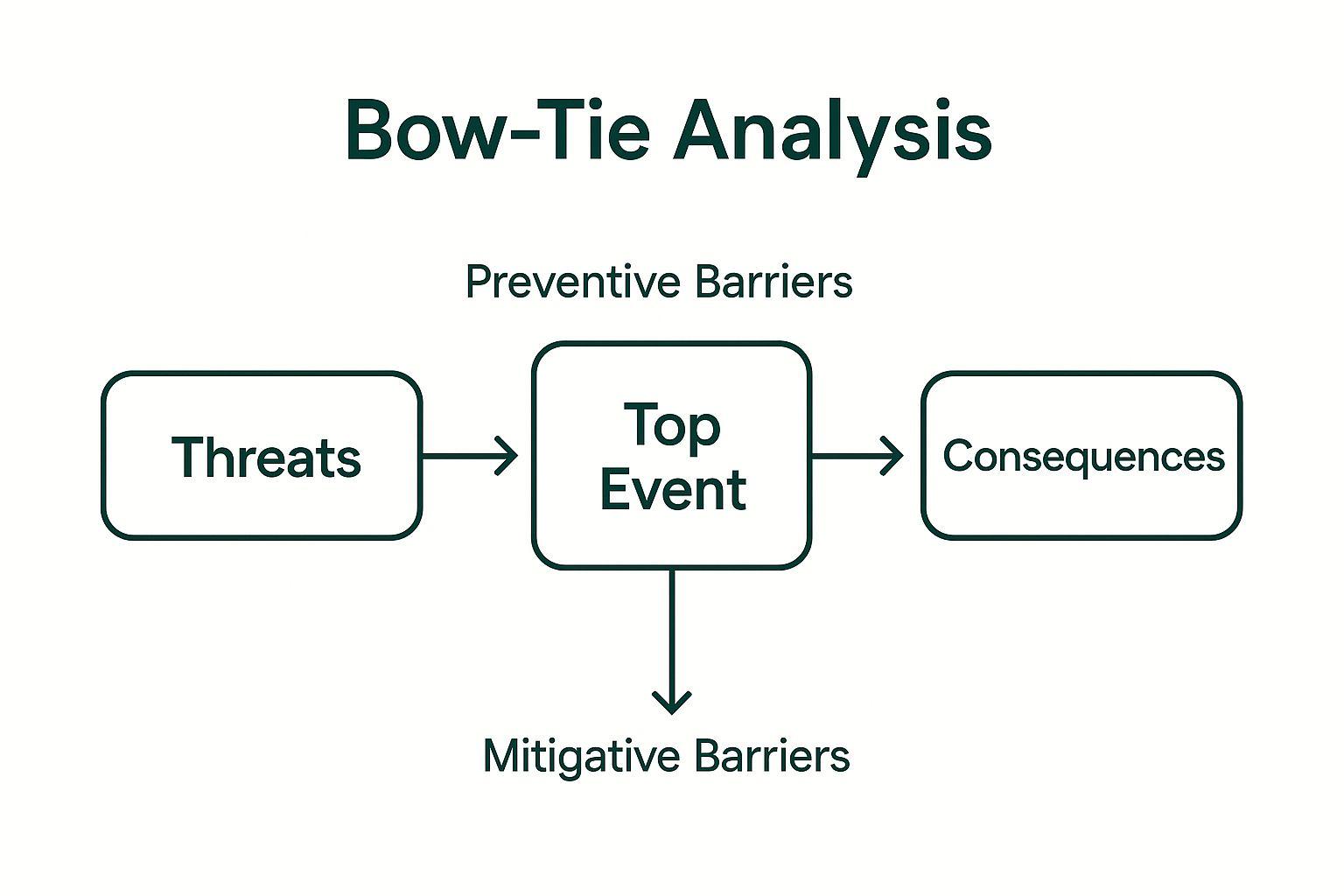
The diagram clearly separates preventive barriers, which stop threats from causing the top event, from mitigative barriers, which reduce the impact after the event occurs.
How to Apply Bow-Tie Analysis to Sports Betting
Let's use the top event: "Deviating from a validated betting model." This is the knot in your bow-tie.
- Threats (Causes): What could cause you to abandon your model?
- A long losing streak creating doubt (Preventive Barrier: Set a "cool-off" period after five consecutive losses).
- A "hot tip" from an unreliable source (Preventive Barrier: A rule to only bet on wagers that meet your model's criteria, no exceptions).
- Overconfidence after a big win (Preventive Barrier: Sticking to a fixed staking plan regardless of recent results).
- Consequences (Effects): What happens if you abandon your model?
- Loss of expected value (EV) (Mitigative Barrier: Immediately review the bet against your model's prediction to understand the mistake).
- Damage to long-term bankroll growth (Mitigative Barrier: Implement a stop-loss limit for the week to cap the damage).
- Erosion of discipline (Mitigative Barrier: Conduct a weekly review of all bets to identify and correct deviations).
By mapping out these pathways, Bow-Tie Analysis helps you build specific, robust controls to protect your betting process from both internal and external pressures.
6. Monte Carlo Simulation
Monte Carlo Simulation is a powerful computational method that uses random sampling to model the probability of thousands of different outcomes in a complex system. Popularized by figures like Stanislaw Ulam during the Manhattan Project and now widely used in finance and engineering, this technique is perfect for sports betting, where multiple uncertain variables (player performance, weather, coaching decisions) influence the final result. It allows bettors to move beyond single-point estimates and understand the full range of potential outcomes.
At its core, a Monte Carlo simulation runs a model repeatedly, each time with a new set of random values drawn from predefined probability distributions. By aggregating the results of these many "trials," you can build a comprehensive picture of what is most likely to happen, what is possible, and what is a long shot. This makes it one of the most advanced risk assessment methods for quantifying uncertainty in your betting predictions.

How to Apply Monte Carlo Simulation to Sports Betting
Let's say you're modeling a basketball game. Instead of predicting a single final score, you can assign probability distributions to key variables like each team's field goal percentage, number of three-point attempts, and free throw accuracy based on historical data. The simulation then "plays" the game thousands of times with random values from these distributions.
- Define Variables: Identify key performance metrics (e.g., Team A's 3P% is a normal distribution with a mean of 38% and a standard deviation of 4%).
- Run Simulations: A computer model simulates the game 10,000 times. In one simulation, Team A might shoot 42%; in another, 35%.
- Analyze Results: After all simulations, you might find that Team A wins by more than 5.5 points in 6,500 of the 10,000 runs (65%).
This result gives you a quantified probability (65%) that Team A will cover the spread, which you can then compare to the sportsbook's implied probability to find value. This data-driven approach allows you to assess the risk of a bet not just on gut feeling, but on a statistical foundation built from thousands of possible futures.
7. What-If Analysis
What-If Analysis is a creative, brainstorming-based technique used to identify risks by asking a series of probing "what if...?" questions. Popularized in the chemical process industry for its straightforward approach to hazard identification, this method encourages you to explore potential deviations from your expected betting process. For a sports bettor, it’s a powerful way to challenge your assumptions and uncover hidden vulnerabilities that more rigid systems might miss.
This technique’s strength lies in its simplicity and reliance on experience and intuition. By systematically questioning every step of your betting strategy, from research to bankroll management, you can identify potential scenarios that could lead to negative outcomes. This qualitative exploration of risk is one of the most accessible risk assessment methods, allowing you to build a more resilient betting framework by anticipating and preparing for unexpected events.
How to Apply What-If Analysis to Sports Betting
Imagine you have a well-defined strategy for betting on NBA games. A What-If Analysis session would involve asking targeted questions to stress-test this strategy.
- Question: What if my primary source for player statistics goes offline right before a big game?
- Consequence: Inability to perform final checks, potentially leading to a poorly informed bet or missing a valuable opportunity.
- Mitigation: Identify and bookmark two reliable backup data sources. Create a rule to not place a bet if you cannot verify critical stats from at least one source.
Another scenario could be:
- Question: What if a team known for its strong defense unexpectedly changes its tactical approach to a more offensive style mid-season?
- Consequence: Your model, which heavily weighs past defensive performance, becomes inaccurate and starts recommending poor-value bets.
- Mitigation: Implement a trigger to re-evaluate a team’s profile if their game statistics deviate from their historical average by more than a set percentage over three consecutive games. This ensures your analysis remains current and adaptive.
8. Layer of Protection Analysis (LOPA)
Layer of Protection Analysis (LOPA) is a simplified, semi-quantitative risk assessment method traditionally used in the chemical and process industries. It analyzes whether you have enough independent safeguards, or "protection layers," to prevent a catastrophic event. For a sports bettor, this means evaluating the series of checks, rules, and strategies that stand between you and a major bankroll-crippling loss. LOPA asks a simple question: are your defenses strong enough to withstand foreseeable risks?
The core of LOPA involves identifying an undesirable outcome, such as losing 10% of your bankroll in a single weekend. You then identify the initiating causes, like chasing losses or betting on unfamiliar sports. Finally, you list all your Independent Protection Layers (IPLs), which are the safeguards you have in place. Each layer must be truly independent to be effective. This method provides a clear, structured view of your risk management defenses, making it one of the most practical risk assessment methods for serious bettors.
How to Apply LOPA to Sports Betting
Imagine the undesirable outcome is "placing a large, emotionally-driven bet after a string of losses." An initiating cause would be the emotional state of frustration combined with easy access to your betting app.
Your protection layers might include:
- Layer 1: A strict daily or weekly deposit limit on your betting account.
- Layer 2: A personal rule to take a mandatory 24-hour break after three consecutive losing bets.
- Layer 3: A separate bank account for betting funds, requiring a manual transfer that creates a "cooling off" period.
- Layer 4: A betting log where you must document the reason for every bet, forcing you to rationalize the decision beyond pure emotion.
LOPA forces you to analyze if these layers are sufficient and, critically, independent. For instance, if you can easily override your deposit limit, it's not a strong layer. By evaluating your defenses this way, you can identify weak points and add more robust, independent safeguards to protect your capital from your own worst impulses.
Risk Assessment Methods Comparison Matrix
| Method | Implementation Complexity 🔄 | Resource Requirements 🔄 | Expected Outcomes 📊 | Ideal Use Cases 💡 | Key Advantages ⭐⚡ |
|---|---|---|---|---|---|
| Failure Mode and Effects Analysis (FMEA) | Moderate to High (team-based, detailed scoring) | High (time-intensive, experienced facilitators) | Structured risk prioritization, failure prevention | Product/process design, quality control | Prevents problems early, regulatory documentation, collaborative, cost-effective |
| Fault Tree Analysis (FTA) | High (complex logic diagrams) | High (detailed system knowledge, software tools) | Visual failure path mapping, quantitative risk | Safety-critical systems, complex system analysis | Clear visual fault paths, quantitative risk, identifies single points of failure |
| HAZOP (Hazard and Operability Study) | High (systematic, node-by-node guide word use) | High (skilled facilitators, multidisciplinary team) | Comprehensive hazard and operability identification | Process industries, chemical, pharmaceutical | Systematic coverage, team expertise leveraged, regulatory compliance |
| Quantitative Risk Assessment (QRA) | Very High (data-heavy, complex modeling) | Very High (extensive data, computational power) | Numerical risk estimates, scenario comparison | Risk-informed decision making, regulatory | Objective numerical risk, cost-benefit analysis, sensitivity and uncertainty |
| Bow-Tie Analysis | Moderate (diagram creation, integration) | Moderate (skilled analysts, software tools) | Visual risk scenarios combining causes & consequences | Process safety management, hazard communication | Clear communication, integrates prevention and protection, performance monitoring |
| Monte Carlo Simulation | High (statistical modeling, sampling) | High (computationally intensive resources) | Probability distributions and uncertainty estimates | Complex systems with uncertainties | Handles multiple uncertainties, sensitivity analysis, broad applicability |
| What-If Analysis | Low to Moderate (brainstorming approach) | Low (minimal resources, relies on team experience) | Initial hazard identification, rapid screening | Preliminary hazard identification, training | Flexible, quick, creative, low cost |
| Layer of Protection Analysis (LOPA) | Moderate (semi-quantitative, scenario-based) | Moderate (data-dependent, semi-quantitative) | Evaluation of protection layer sufficiency | Process safety decision making, gap analysis | Faster than full QRA, objective basis for decisions, bridges qualitative & quantitative |
Putting Theory into Practice: Your Next Move
Navigating the world of sports betting without a structured approach is like setting sail without a compass. You might get lucky, but the odds are stacked against you. This article has guided you through a suite of powerful risk assessment methods, from the proactive FMEA and the forensic FTA to the comprehensive Bow-Tie Analysis and the predictive power of Monte Carlo simulations. Each method offers a unique lens through which to view and deconstruct the inherent risks in any wager.
The core takeaway is this: successful betting isn't about eliminating risk, which is impossible. It's about understanding, quantifying, and managing it more effectively than the market. While you may not construct a formal HAZOP study for a weekend football match, the principles are what matter. The structured thinking behind these industrial-grade tools can be directly adapted to build a more resilient and profitable betting portfolio.
Synthesizing Strategy from Method
The true power of these concepts emerges when you combine their underlying philosophies. Think of it as building a multi-layered defense against poor decision-making and unforeseen events.
- Proactive Thinking (FMEA & What-If): Before placing a bet, actively brainstorm potential failure modes. What could go wrong with your analysis? This simple 'What-If' questioning, inspired by FMEA, forces you to consider variables beyond the obvious stats, such as team morale, surprise tactical changes, or referee bias.
- Quantifying Uncertainty (QRA & Monte Carlo): Don't just guess, estimate. Assigning probabilities, even rough ones, to different outcomes is a fundamental step. A Monte Carlo simulation, even a basic version in a spreadsheet, can help you visualize the range of potential returns on a betting strategy, moving you from a single-bet mindset to a portfolio perspective.
- Building Defensive Barriers (LOPA & Bow-Tie): Your most crucial barrier is finding value. A value bet is, in essence, your primary "layer of protection" against the bookmaker's margin. Other layers include strict bankroll management, diversification across different bets or sports, and setting hard stop-loss limits.
Your Actionable First Steps
Mastering these advanced risk assessment methods is a journey, not a destination. To move from theory to application, start with manageable actions that build analytical muscle over time.
- Select One Method to Trial: Choose the 'What-If Analysis' for its simplicity. For your next three to five bets, formally write down at least three "what-if" scenarios and how they would impact your wager.
- Define Your "Layers of Protection": Document your personal betting rules. What is your maximum stake per bet (as a percentage of your bankroll)? What conditions must be met before you even consider a wager? This is your personal LOPA.
- Focus on Value: Shift your goal from "picking winners" to "identifying value." This critical change in perspective is the foundation of all long-term, data-driven betting strategies. It is the single most important risk mitigation tool you possess.
By integrating these frameworks, you elevate your process from simple prediction to sophisticated risk management. You learn to protect your capital, identify sustainable opportunities, and build a betting strategy that is robust, repeatable, and designed for long-term success.
Ready to put professional-grade risk analysis to work for you instantly? The algorithms at ValueBetFactory perform a sophisticated form of quantitative risk assessment in real-time, scanning thousands of odds to find the value bets that serve as your ultimate layer of protection. Stop guessing and start investing by letting our platform do the heavy analytical lifting for you at ValueBetFactory.