
Professional Sports Bettor Salary: How Much Do Pros Earn?
Unlock Profits with betting tips!
Let's get one thing straight: a professional sports betting salary isn't like a 9-to-5 paycheck. There's no guaranteed amount deposited into your account every two weeks. Instead, your income is a direct result of your skill, discipline, and—most importantly—the capital you have to work with.
While you hear stories about bettors pulling in six-figure incomes, that's the exception, not the rule. Success hinges entirely on your ability to generate a consistent, positive return on investment (ROI) over the long haul.
What Is a Realistic Professional Sports Bettor Salary?
The first step is to stop thinking about it as a "salary" and start thinking of it like running a business. Your bankroll is your operating capital. Your winnings are your profit. It's that simple. The formula for a higher income is a larger bankroll combined with a proven, consistent edge.
For instance, a sharp bettor with a $10,000 bankroll and a 4% ROI is going to make far less than someone with a $100,000 bankroll who has the exact same 4% edge. It's a game of scale.
Understanding the Numbers
Your potential earnings are tied directly to your performance. Forget chasing massive, one-off wins; the real money is made through a small, sustainable edge applied over and over again. Most professionals operate on incredibly thin margins, often just a 2-5% ROI. The key is that they apply this small advantage across a high volume of wagers, which is how they build a respectable annual income.
This image breaks down what you can realistically expect at different levels, from the average bettor to the top-tier pros.
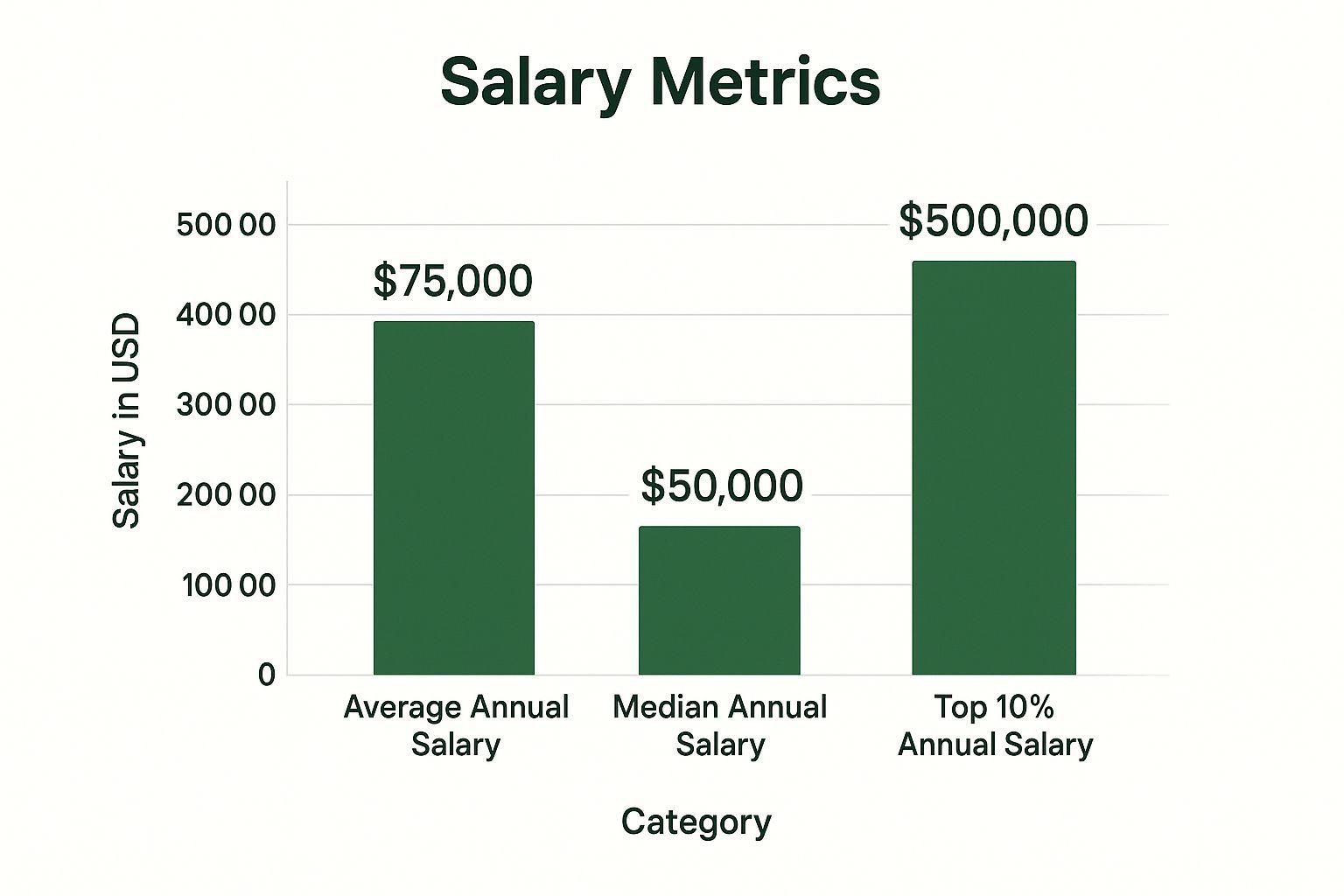
As you can see, there's a huge gap between what a median earner makes and what the top 10% of bettors bring home. This disparity really highlights how critical both skill and bankroll size are in this profession.
Estimated Annual Income Potential for Professional Bettors
To give you a clearer picture of how these numbers work in the real world, this table shows how your starting capital and win rate directly impact your potential annual income.
| Starting Bankroll | Annual ROI (Win Rate) | Annual Betting Volume (Turnover) | Estimated Annual Income |
|---|---|---|---|
| $10,000 | 3% | $200,000 | $6,000 |
| $25,000 | 4% | $500,000 | $20,000 |
| $50,000 | 4% | $1,000,000 | $40,000 |
| $100,000 | 5% | $2,000,000 | $100,000 |
These figures are just estimates, of course, but they powerfully illustrate the relationship between your bankroll, your ability to find an edge (ROI), and how much you wager over a year (turnover).
The Impact of a Growing Market
The good news is that the opportunities for making a living from sports betting are growing. With the explosion of legal sports betting in the U.S., the market has become massive—handling nearly $520 billion in cumulative wagers as of mid-2025.
Even though only a tiny fraction of people betting will achieve long-term profitability, a bigger market means more liquidity and more chances for disciplined individuals to carve out incomes exceeding $100,000 a year.
The core principle is simple: A professional bettor's salary isn't just about picking winners. It's about managing capital, identifying value, and maintaining the discipline to execute a strategy thousands of times, even during losing streaks.
This business-first mindset is what truly separates the pros from the hobbyists. Our guide on the fundamentals of professional sports betting dives deeper into what it takes to make the leap. Ultimately, a realistic salary is what you can consistently grind out from the capital you put on the line.
How Professional Bettors Actually Make Money

Let's clear something up right away. The idea that professional sports bettors hit a few lucky longshots to make their living is a complete myth. A professional sports betting salary isn't built on chance; it's the result of cold, hard math and relentless discipline.
Pros operate more like financial analysts than typical sports fans. They hunt for profitable opportunities by focusing on two concepts that drive their entire income: finding value and beating the vig.
Imagine a simple coin toss. We all know the real odds are 50/50. Now, what if a bookie offered you better than even money—say, +110—on that flip? You'd take that bet all day long. That's a "value bet" in its purest form. You have a mathematical edge because the payout is better than the true probability. Pro bettors find these kinds of pricing mistakes in sports odds and hammer them, over and over again.
Of course, it's not quite that simple. Every sportsbook charges a fee for taking your bet, which is known as the vigorish, or "vig." Think of it as their built-in commission. If you and a friend each bet $110 to win $100 on opposite sides of a game, the bookmaker takes in $220 but only pays the winner $210. That extra $10 is their guaranteed profit, and it's how they stay in business.
The Power of a Small Edge
A professional's entire job boils down to finding wagers where their own calculated edge is bigger than the sportsbook's vig. This edge is almost always tiny—we're talking 2-4% on average. It doesn't sound like much, but that small, consistent advantage is the secret sauce for long-term profit and a sustainable career.
A professional bettor is like a casino owner, but in reverse. While the casino relies on a small house edge across thousands of table game hands, the bettor seeks a small personal edge across thousands of wagers. Over time, that small percentage compounds into significant earnings.
This is why turnover is so critical. Turnover is just the total amount of money you wager over a certain period. By betting their bankroll again and again on +EV (positive expected value) wagers, pros multiply that small edge. A 3% edge on a single $100 bet is just $3. But a 3% edge on $1,000,000 in total bets over a year? That's a $30,000 profit.
Scaling Up in a Growing Market
The size of the betting market itself also dictates a pro's earning potential. In major markets like the U.S., a professional's salary is directly tied to the industry's massive scale. For instance, the U.S. market's gross gaming revenue leaped by 24% in 2024, climbing from $11 billion to $13.7 billion.
While pros don't get a direct slice of that pie, they carve out their income by consistently beating the sportsbook's "hold," which in regulated markets is often around 9-11%. When the U.S. market handled nearly $15 billion in a single month with an 11.1% hold, sportsbooks generated over $1.3 billion in revenue. A sharp bettor with a large bankroll who can find even a 1-2% edge can earn a substantial living, ranging from $50,000 to hundreds of thousands of dollars per year. You can dive deeper into these figures by reviewing the latest U.S. sports betting statistics.
Key Income Drivers
When you break it down, a professional bettor's financial engine has three main parts:
- Finding Value: This is the core skill—identifying odds that are out of sync with an event's true probability. It demands deep statistical modeling, proprietary data, and an expert understanding of a sport.
- Beating the Vig: Your edge has to be strong enough to overcome the bookie's cut. Finding a 2% edge is useless if the vig is 4.5%, because you're still losing money long-term.
- Maximizing Turnover: The more you can bet your bankroll on value opportunities, the more that tiny edge turns into real money. This means placing a high volume of bets without being reckless.
Ultimately, making a living from sports betting has nothing to do with rooting for your favorite team. It's about systematically finding bets where the odds are tilted in your favor and having the discipline and capital to exploit that advantage at scale.
Why Bankroll Management Is Your Most Critical Skill

Ask any aspiring bettor what the fastest way to go broke is, and they'll probably say a long losing streak. It’s a common misconception. While cold streaks are never fun, they're just a standard part of the business. The real career-killer—the one mistake that sends even sharp, talented bettors to the sidelines for good—is undisciplined money management.
Your professional sports betting salary isn't just about picking winners; it’s a direct result of how you manage your capital. You have to stop thinking of your betting funds as "gambling money." It's not. This is your business's operating capital, the single most important asset you have. Without it, the best sports analysis in the world is completely useless.
Proper bankroll management acts as a firewall. It protects your business from the inevitable swings of variance in sports, ensuring you have the capital to survive a downturn and bet another day.
The Tale of Two Bettors
To see why this is so critical, let's imagine two bettors, Alex and Ben.
Alex, the High-Flyer: Alex is a brilliant handicapper who consistently nails 60% of his picks. His fatal flaw? He gets cocky after a big win and chases his losses with desperate, oversized wagers. One bad weekend, where he throws 20-30% of his entire bankroll at a few "locks," is all it takes to wipe him out. Despite his talent, his career is over.
Ben, the Disciplinarian: Ben is a solid bettor, but his win rate is a more modest 54%. He lives by one ironclad rule: never risk more than 1% of his bankroll on a single game. When a losing streak hits, his capital dips slightly, but he's never in danger of going bust. Over time, that small edge compounds, turning his disciplined approach into a sustainable income.
This story highlights a fundamental truth of professional betting: your survival, and by extension your salary, hinges more on your financial discipline than on your raw win percentage. Alex’s talent meant nothing without control, while Ben’s discipline turned his modest edge into a profession.
Staking Strategies the Pros Use
Professionals don't just guess how much to put on a game. They operate with strict staking plans designed to maximize growth while keeping risk in check. The most common and foundational strategy is called flat-betting.
Think of it like a conservative investment portfolio. A wealth manager would never dump a quarter of a client's retirement fund into one high-risk stock. They'd allocate a small, fixed percentage—maybe 1-2%—across many different assets. This insulates the portfolio from a single, catastrophic failure.
Flat-betting is the exact same principle applied to sports.
By committing to a fixed unit size, typically 1% of your total bankroll, you systematically remove emotion from the equation. A big win won't tempt you into betting bigger, and a tough loss won't trigger panicked "get it all back" wagers. It is the bedrock of professional survival.
For a more granular look at setting up these financial guardrails, our complete guide to sports betting bankroll management breaks it down even further.
Ultimately, this methodical approach is what allows you to withstand the downswings that are a mathematical certainty. A ten-game losing streak is just a minor bump in the road for a flat-bettor using a 1% unit size—a manageable 10% drawdown. For an emotional, undisciplined bettor, that same losing streak could easily be a career-ending disaster.
Factors That Determine Your Betting Income
A professional sports bettor's salary is anything but standard. You could have two pros with the same starting bankroll and work ethic, yet one might earn double what the other does. Why the huge difference? It all comes down to a few key variables that dictate profit, risk, and opportunity. Getting these right is what separates the seasoned professionals from the people who flame out.
Your income potential is massively shaped by the markets you decide to focus on. Not all sports are created equal when it comes to betting, and this choice is as strategic as an investor picking between different asset classes.
Major Leagues: The Wall Street of Sports Betting
Wagering on the big leagues—the NFL, NBA, or English Premier League—is a lot like trading blue-chip stocks. These markets are incredibly efficient. Sportsbooks have armies of experts and sophisticated algorithms setting razor-sharp lines, and millions of dollars pour in on every single game.
All that attention means the odds are incredibly tight. Finding a real, mathematical edge is tough, and the margins for profit are thin. The upside is liquidity. You can get huge sums of money down without budging the line. But making a living here requires advanced modeling and a deep, almost instinctual feel for market dynamics.
Niche Sports: The Emerging Markets
On the flip side, betting on niche sports is more like investing in emerging markets. Think smaller college conferences, obscure international basketball leagues, or even eSports. These markets are far less efficient because they have lower betting volume.
So, where's the advantage?
- Less Scrutiny: A sportsbook simply doesn't put the same brainpower into setting the line for a low-profile college hoops game as it does for the Super Bowl. This leaves more room for error and mispriced odds.
- Information Gaps: If you become a genuine specialist and dig up information that isn't common knowledge, you can build a massive edge for yourself.
- Higher Potential Edges: While a sharp in the major leagues might fight for a 1-2% edge, a niche market expert could realistically find spots with a 4-5% edge, sometimes even more.
The catch? The betting limits are much lower. You can't bet nearly as much on a niche sport, so you need a higher return on investment (ROI) to compensate for the smaller volume. It’s the classic “big fish in a small pond” situation.
The Mental Game: Discipline Under Duress
Beyond choosing your market, the single biggest factor that will make or break your career is your mental game. Professional betting is a psychological marathon. You will hit brutal losing streaks—that’s a mathematical certainty. It’s during these periods of variance that most aspiring pros wash out.
When you're in a hole, the urge to ditch your strategy, chase your losses with bigger bets, or just get emotional is overwhelming. A true pro, however, treats these downswings as a simple cost of doing business. They trust the process, stick to their bankroll rules like gospel, and understand that their edge will win out over the long haul.
Maintaining discipline when your strategy is producing losses is the hardest part of this job. It requires unwavering confidence in your numbers and the emotional detachment to execute your plan flawlessly, day in and day out, regardless of recent results.
The sheer growth of the betting world shows just how big the potential prize is for those who can master these skills. In 2024, the total legal sports betting handle in the U.S. ballooned to $142.55 billion, generating $13.6 billion in gross revenue for the books. While that money goes to the sportsbooks, it proves the massive scale of the arena you're playing in. A pro’s salary is what they can carve out by consistently beating the house margin, which takes that perfect blend of market expertise and unbreakable discipline. You can learn more about how this explosive growth creates new openings by checking out these U.S. sports betting trends for 2025.
At the end of the day, your income won't be defined by your best day. It will be defined by how you handle your worst.
Calculating Your Real Take-Home Pay
Racking up $100,000 in gross winnings for the year feels incredible, but it’s a classic rookie mistake to confuse that figure with your actual salary. That number is just top-line revenue. To get to your real take-home pay, you have to think and act like a business owner, which means subtracting all your operating costs. The professional sports betting salary you actually live on is what’s left after every single expense is paid.
This is a major stumbling block for many aspiring pros. They get so caught up in the thrill of picking winners that they completely overlook the less glamorous, but absolutely essential, business side of the profession. When you don't account for your costs, you’re not just getting a fuzzy picture of your finances—you’re driving blind toward a potential financial cliff.
The Hidden Costs That Shrink Your Profit
Thinking like an entrepreneur means meticulously budgeting for every necessary expense. These aren't optional add-ons; they are non-negotiable costs of doing business that will take a significant bite out of your gross profit, revealing your true net income. A professional bettor’s budget isn't just a helpful suggestion; it’s a lifeline.
Here are the most common and significant expenses you have to plan for:
- Data and Software Subscriptions: Getting access to sharp, real-time odds and sophisticated analytics tools isn't cheap. These services can easily run from a few hundred to several thousand dollars per year.
- Advisory Services or Picks: Many bettors pay for expert picks or analysis to supplement their own work, and that subscription cost has to be factored in.
- Office and Equipment Costs: This covers everything from a powerful computer and multiple monitors for tracking live lines to the high-speed internet that makes it all possible.
Ignoring these costs is like a restaurant owner celebrating a packed house but forgetting to deduct the cost of food, staff, and rent. At the end of the day, your net profit is the only number that truly matters.
The moment you treat your betting as a business with a formal budget, you shift from being a gambler to an entrepreneur. This mindset change is fundamental to building a sustainable career and earning a real salary.
To put this into perspective, let's look at how quickly that initial gross profit can shrink.
Sample Annual Budget of a Professional Sports Bettor
| Income/Expense Item | Example Annual Cost/Amount | Impact on Net Salary |
|---|---|---|
| Gross Betting Profit | +$100,000 | Starting point; not take-home pay. |
| Odds/Data Service Fees | -$4,000 | Reduces gross profit. Essential tool cost. |
| Advisory Service Subscription | -$2,000 | Reduces gross profit. Cost of external analysis. |
| Computer & Office Equipment | -$1,500 | Reduces gross profit. Capital expense. |
| Home Office/Internet | -$1,200 | Reduces gross profit. Operational overhead. |
| Profit Before Tax | $91,300 | The amount you will be taxed on. |
| Estimated Taxes (e.g., 25%) | -$22,825 | The single largest expense. |
| Net Take-Home Pay | $68,475 | Your actual annual salary. |
As you can see, the journey from a six-figure gross to a livable salary involves navigating a minefield of expenses. And we haven't even touched on the biggest one yet.
Taxes: The Unavoidable Partner in Your Business
By far, the most significant expense separating your gross winnings from your net pay is taxes. Yes, gambling income is taxable, and how you manage this obligation can make or break your profitability. To give you an idea of the scale, states collected more than $1.8 billion in tax revenue from sports betting in fiscal year 2023 alone.
Different jurisdictions have wildly different tax laws. Statutory rates on gaming revenue can be as low as 6.75% in a place like Nevada or as high as a jaw-dropping 51% in New York. A pro bettor in a high-tax state will see their take-home pay slashed compared to someone with the exact same winnings in a low-tax state. This concept is critical, and to see just how important it is, you can read our guide on how to calculate expected value, which shows how tiny percentage points completely change long-term results.
Ultimately, your real salary is what's left after you've paid for your tools, your data, and your taxes. Meticulous record-keeping isn't just good practice; it's the only way to know if you're actually running a profitable, sustainable operation.
Here's the rewritten section, designed to sound like an experienced human expert.
Building a Sustainable Career in Sports Betting
Let's get one thing straight: turning sports betting into a profession isn't some get-rich-quick fantasy. It's about methodically building a business from the ground up. If you want to earn a real professional sports betting salary, you need patience and a long-term mindset, not a lottery ticket mentality. Taking big, foolish swings is the fastest way to go broke.
The most important first step? Keep your day job. Seriously. Your primary income keeps the lights on and, crucially, funds your initial betting bankroll. This removes the desperation factor—you won't be chasing losses with rent money, which is a recipe for disastrous decisions.
Charting Your Path to Professionalism
Once you have a bankroll you can afford to lose, the real work begins. The goal isn't to hit one massive parlay and retire; it's to prove you have a process that wins consistently over time. Think of it as your apprenticeship. You're learning a craft, and you need to be meticulous before you even think about quitting that stable job.
Your roadmap to going pro has a few non-negotiable stops:
- Track Everything: You must log every single bet. I mean everything—the sport, the odds, your stake, the result, and why you made the bet. Without this data, you're just guessing. You have no objective way to know if you're actually any good or just getting lucky.
- Find Your Niche: Don't try to be a master of all sports. It’s impossible. Instead, specialize. Become an expert in a smaller conference in college basketball, a specific tennis tour, or even a single prop market. It's far easier to gain a real edge in a less popular market than it is to go head-to-head with the world's sharpest minds on NFL sides.
- Grow Stakes Methodically: Your bet size should only increase as your bankroll grows. As you win, your standard 1% unit will naturally become a larger dollar amount. This organic growth is the key to scaling your profits responsibly without exposing yourself to catastrophic risk.
The Three Pillars of a Betting Career
When it all boils down, a lasting career that generates a real salary rests on the same core principles we've been talking about. Mastering them is what separates the wannabes from the pros who cash tickets for a living.
Discipline, Value, and Bankroll Management aren't just trendy phrases. They are the legs of the stool. If you kick one out, the whole thing comes crashing down the minute you hit your first inevitable losing streak.
This is the honest blueprint. It's a slow grind built on financial security and sharp analysis. The payoff for that hard work is the freedom to build a career on your own terms, driven by your own wits.
Frequently Asked Questions About Pro Betting Salaries

If you're seriously thinking about earning a living from sports betting, you probably have a lot of questions running through your mind. It’s a path that fascinates many but is understood by few. Let's tackle some of the most common and critical questions that come up.
How Much Money Do You Need to Start?
There isn't a one-size-fits-all answer here, but there is one non-negotiable rule: your starting bankroll must be money you can comfortably afford to lose. This cannot be stressed enough. Don't ever use funds you need for rent, bills, or groceries.
A smart approach is to first have a safety net of three to six months of living expenses tucked away. This isn't your betting money; it's your life money. With that financial cushion in place, you can then decide on a starting bankroll with whatever disposable income you have.
Can You Really Make a Living from Sports Betting?
Yes, you absolutely can. But it is incredibly difficult and has almost nothing to do with being a huge sports fan. Making a living requires a complete mental pivot from cheering for your team to running a cold, hard, data-driven business.
To even have a chance, you have to be ready to:
- Treat it like a business, complete with meticulous record-keeping.
- Embrace mathematics and statistical models over gut feelings.
- Work long, often tedious hours digging for tiny, profitable edges.
- Maintain iron-willed emotional control through brutal and unavoidable downswings.
The most common mistake people make is thinking they can just watch a lot of sports and get paid. It's a full-time analytical job that demands immense discipline, not a hobby that magically turns into a career.
What Is the Biggest Challenge for a Pro Bettor?
Finding an edge is tough, but the single greatest obstacle you'll face is psychological. The real battle is managing your own mind during long periods of variance—the inevitable and unpredictable swings between winning and losing.
Every profitable strategy will have losing streaks. Sometimes they are absolutely gut-wrenching. The pressure to abandon your system, double down to chase losses, or just make a reckless "feel" bet becomes immense.
The real test of a pro isn't how they act during a hot streak; it's how they stick to their process with perfect discipline after losing ten bets in a row. This psychological resilience is what truly separates the successful pros from the cautionary tales.
Your ability to trust your data and stay the course when everything seems to be going wrong will ultimately determine your success.
Ready to stop guessing and start making data-driven decisions? At ValueBetFactory, we provide the tools and education to help you find your edge and bet smarter. Our system identifies market discrepancies, giving you the information needed to build a winning strategy. Explore our plans today and see how ValueBetFactory can help you find your edge.