
Maximum Expected Growth explained by Dan Abrams
The MEG model comes from Dan Abrams, a respected industry voice (Pinnacle Betting Resources, The Hammer, engineering background, author of “But How Much Did You Lose?”).Before we dive into MEG, Dan Abrams is also preparing the release of his next book, Sharp Money, which is currently slated for publication in April 2026. If you’d like more information, you can reach him on Twitter at @DoctorRazzWSOP.
What is MEG?
One of the great new features of the ValueBetFactory EV Scanner tool is that, in addition to showing you an estimated EV and recommended stake size for the plays it tips, it can now also show you the MEG of each one. If you’ve never heard of MEG before or have seen it somewhere but still aren’t sure what it is or how to use it, then this article is for you! It’s one of the core concepts that I discussed in my book But How Much Did You Lose? and in online articles before that. Here are some excerpts from my book to explain what it is and how you can use it to grow your betting bankroll quicker.
Most knowledgeable bettors are already familiar with the concept of EV and how to use it. Yet, many sharps aren’t familiar with the concept of expected growth (EG). At least, they don’t realize they are. They’ve heard of the Kelly Criterion, and they know it’s supposed to maximize… something. Well, that “something” is the expected growth of your bankroll.
In short, EG is the percentage by which your entire bankroll is expected to grow or shrink when doing whatever it is you’re doing. That can be making an independent bet (one that has no connection or correlation to any other bet you have open), but it can also be making several bets that are correlated somehow, or betting in a correlated way with some of your existing bets. The standard Kelly Criterion formula only applies to that first case, where the bet you’re making has no relation to any other current or future bet. How can you figure out your expected growth for those other cases, where the potential payout of other bets has to be factored in? Well, first let’s figure out why we should want expected growth above all else.
Why Should You Want It?
Because that’s what you really need if your goal is to win long term. But, in order to win at anything, you first have to know the rules of the game, and that includes knowing where the goalposts are. In American football, for example, the first rule is that if you score more points than your opponent, then you win. But how do you score points? The most efficient way is to score a touchdown and, to do that successfully, you have to get the ball across the two-dimensional plane at the goal line.
Most long-time bettors, even very successful ones, think of the process of trying to win at sports betting in much the same way that a football team attempts to score a touchdown. They rely on just two dimensions to work out the correct play – the odds of a bet and the probability that the bet will win. And, often, they think that’s all that matters.
The cover of the book The Logic of Sports Betting by Ed Miller and Matthew Davidow has a much more apt metaphor, however. It shows a football going through the uprights on a field goal attempt. (Maybe it’s an extra point?) To be successful at field goal kicking, you have to get the ball between the uprights and across the end line, but it also must go above the crossbar. That makes it a three-dimensional problem. Because most field goal attempts have to be kicked hard enough and high enough to make it over the rushing defenders, usually this last criterion isn’t an issue. But sometimes, and especially in high payoff situations like a long field goal attempt to win the game, the extra dimension of how high the ball is when it passes between the uprights becomes critical.
This dichotomy is a lot like the difference between gaining EV and gaining EG. While most of the time (when the potential payout of your existing bets is a small fraction of your overall bankroll) there’s no difference, during the most critical times there may be a big difference. If, like most pros, your biggest problem is getting down enough money on your bets to make them worthwhile, then you’ll usually be immune to this difference. But if you’re still building your bankroll then you need to know the right protocol to protect yourself from falling short of your goals. As lame as it might sound, if you want to maximize the chance that you’ll make a lot of money betting on sports, you have to learn how to be like a clutch kicker.
So, since your goal when betting on sports is to make money, it begs the question: how much money do you want to make? This is not a trick question. If you said, “one million dollars,” then more power to you! But if all you have is $1,000 to start, then it’s going to be a tough road. Say you’re in luck; Elon Musk DMs you and says he’s willing to flip a coin with you 10 times for a 1:1 payout (+100 in American odds, or 2.0 in decimal) for any stake you like. You could flip ten times with him, going double or nothing each time you win, and have over $1 million if you win all ten. Of course, if you lose even once, you’re broke. No milly for you, not even your original $1k.
Say you’re even luckier and Elon is feeling generous; he offers you odds of +116 (2.160) on your flip instead. That would give you an 8% edge. Now you only need to win nine flips in a row to have over $1 million! Hopefully, you’re snickering by now, because you realize that trying to make a million this way is foolish. The thing is, once Elon increases the odds to anything more than 1:1, the fact that you have a positive edge means that the amount for you to bet that maximizes your EV is always 100% of your bankroll. Your theoretical earn is 8% of whatever you bet, so the more you bet the more you expect to win. If you subscribe to the theory that says your goal should be to maximize your EV, then you’d happily try to hit nine flips in a row. And, most likely, you’d go home very sad.
The problem isn’t that +EV is bad, the problem is that variance is. Simply calculating your edge only predicts your mathematical EV, but it doesn’t account for variance. Expected growth, however, accounts for this extra dimension. It seeks to balance the goodness of +EV with the badness of risk, so that your median expected bankroll size at the end is the highest. Even though staking at full Kelly (i.e., 100% of the fraction calculated by the Kelly Criterion) on independent bets can be a wild ride, it theoretically maximizes your EG if you accurately know your edge. For our independent coin flips example, your full Kelly fraction is 6.9%.
If you bet $69 on the first flip and then adjust your stake according to your new bankroll after each one, then after 2500 flips you’d expect to make a nice profit and have a median bankroll of just under $1 million. The same principle holds true for all edges, big and small. The smaller the edge, holding bet size equal, the worse the effect of variance (or, as some in the financial field call it, the “volatility tax”). The bigger the edge, the more you can risk – but within reason. Say Elon wants more action than 7% of your bankroll on each flip and now offers you 2:1 instead. That’s a whopping 50% edge! Now, say you just YOLO it and stake 50% of your bankroll on each flip, because this may be a once in a lifetime opportunity. How much should you expect to win in the long run?
Hopefully you stopped for a second to come up with your own guess. And, if you guessed nothing, then you win the trophy. As crazy as it may seem, if you overplay that massive advantage you can expect to gain nothing. Think about it like this: If you win the first flip you double your money. But, if you lose the second, then you lose half of your new bankroll. So, your net actual growth is 0 because:
It doesn’t matter if you lose the first flip and then win the second. Or you win five in a row, and then lose the next seven, and then win two more. As long as you have a fair coin and win 50% of the time, the order doesn’t matter but your stake size definitely does.
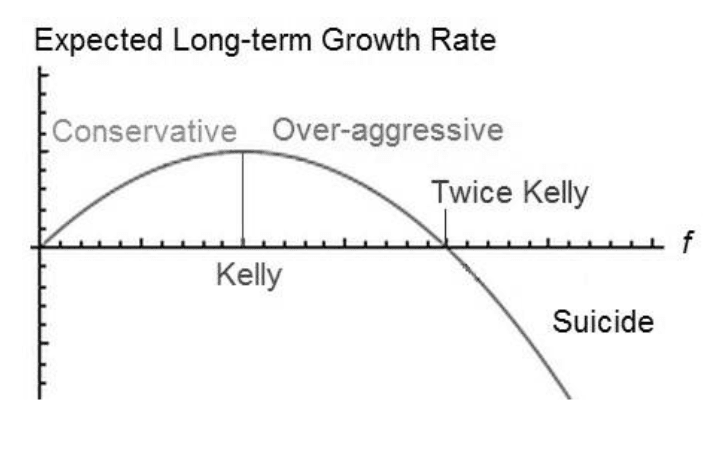
This extreme example should convince you that maximizing your EG isn’t just about feeling comfortable with your stake size. It’s about cold hard math. So, if you want to maximize your long-term growth rate in this spot, how much should you stake? Kelly will tell you the optimal fraction is 25% of your bankroll, and if you stake that much then you will average the best return possible. If you stake 50%, you will average nothing. That’s the problem with overbetting. Look at the graph below to visualize how it works. If you stake exactly twice what the Kelly Criterion advises, then your EG = 0 and you can expect to win nothing at all over time.
How Do You Measure It?
The way you normally measure EG is very, very carefully. Because your EG represents the percentage that your entire bankroll will grow by, rather than the amount you theoretically win on the amount you have at risk (like ROI does), your EG on each independent bet typically will be incredibly small. In fact, I prefer to talk about it in terms of “basis points,” which is a financial term for 1/100 of 1%. A couple of basis points here and there will add up. In fact, if you stake 2% of your bankroll on an even money bet with a 5% edge, your expected growth is only 8 bps (pronounced as bips). If you can get 40 or 50 bps from one wager, you’ve hit the jackpot!
For our original coin flip example, your EG for each +116 flip (if you stake at full Kelly) is about 27 basis points. So, after your first flip, your expected bankroll will be about $1,002.75. Great! Seriously, this is a great result because 8% edges at roughly even money are hard to find, even for Value Bet Factory subscribers! This is the first step on your journey to winning your theoretical million. The last step will be when your bankroll is at $997,250 and you expect to win roughly $2,750 on your flip. Of course, your million-dollar ending bankroll will also have some variance. There’s a 50% chance that it will be more, and a 50% chance it’ll be less. But there’s no quicker way (in terms of the number of bets you make) to grow your median bankroll to $1 million than by optimizing your EG. That’s what John Kelly proved all those years ago.
How Do You Maximize It?
As for most complex things, the answer is a little complicated. It’s different for independent bets than it is for bets that are related to your existing bets. It’s different again once you understand how your maximum EG (MEG) is changed by your other existing bets, even if they’re unrelated. So, the short answer is, you have to do the math. And it’s not enough to do the math right, you have to do the right math. If we do, then it will help us answer this question: how do you compare two or more similar lines?
John Kelly imagined a scenario where there was only one horserace you could bet on at a time, and your only choice was how much to bet on the horse you were given the tip on. But our choices are much more expansive than his. In fact, with modern sportsbooks, you’ll find markets where there are many similar, correlated options. Spreads, totals, money lines, players to get one, two, three or more shots on goal in a match, etc., are all on the menu. You can pick one or take a sampling of several similar ones. But how do you choose?
Value Bet Factory is a great resource where you can see the odds and the EV of each option to determine which line gives you the biggest edge. But will that give you the full answer? Let’s take a closer look. Say the Detroit Tigers baseball team are +130 (2.300) on the moneyline at one of your books, while Pinnacle is only offering odds of +115 (2.150) to back them and -130 (1.769) to lay. Value Bet Factory takes their sharp line and estimates the Tigers have a 45% chance of winning the game, so they calculate the EV to be 3.5%.
But, say they also tip the run lines too. The Tigers +1.5 are -140 (1.714) with an EV of 2.8%, and Tigers -1.5 are +195 (2.950) with an EV of 3.3%. If you want to choose only one of these three bets, then the answer is obvious, right? The moneyline has the biggest edge, so it must be the best bet. Case closed. On the other hand, you haven’t accounted for your risk yet. If you’re going to stake your bet according to the Kelly criterion (or any fraction of it), shorter odds will allow you to get more money down and take better advantage of that edge. So, for quickest bankroll growth, which line should you choose?
The short answer is: the one with the highest MEG. If your goal is to maximize EG, then finding the option that has the highest MEG for full Kelly staking is the way to go. It doesn’t matter that you may never actually bet the full Kelly fraction on it. If you use half Kelly, or a quarter, or any fraction you like, your actual EG will be some percentage of your MEG whichever staking fraction you choose.
So how do you calculate your MEG? To do it exactly, first you’d have to calculate your full Kelly fraction and then plug that value into the equation for EG, which is:
Are you game? Don’t all jump at once! You could easily solve this equation with a spreadsheet or special purpose calculator, but now Value Bet Factory does the work for you! And you don’t have to spend time calculating when you should be getting down. So, using the MEG, let’s take another look at those lines on the Tigers and see which one makes the most sense. For the Tigers moneyline we’d get a MEG of 4.7 bps. For the Tigers +1.5 run line, we’d get MEG = 5.7 bps. And, for the -1.5 run line, we’d get just 2.7 bps.
Now which line looks the best? It’s clearly the +1.5 run line, because, while its edge is slightly smaller than the edge on the moneyline, its odds are much shorter. Therefore, it’s less risky, so you can stake more on it and get a higher overall expectation. The -1.5 run line comes in a distant 3rd place, even though it rates in between the other two merely on the basis of its EV. In fact, given its longer odds, you’d need to estimate at least a 4.8% edge for it in order to have a higher MEG than you get for the moneyline. Do you see why?
Why Not All Three?
Now, in most cases, you don’t just have to choose one option. You can get down multiple bets, either at the same book, or by taking advantage of the best lines at several of them. But remember that this group of lines is very positively correlated. In other words, the chance that two (or all three) of them wins or loses at the same time is pretty high, although it’s not 100% of the time. So, if you bet your usual fractional Kelly on all three, then you’ll probably end up overbetting. If you want to pick just one, then the best choice is just to bet your simple Kelly fraction on the +1.5 run line or split it up between that and the money line, since they have almost the same MEG. The following table summarizes the numbers:
| Betting Line | Prob | Odds | MEG as solo | Stake all at full Kelly | Optimal combo | Alt combo |
|---|---|---|---|---|---|---|
| Tigers -1.5 | 35.0% | +195 | 2.7 bps | 1.67% | 0% | 0% |
| Tigers ML | 45.0% | +130 | 4.7 bps | 2.69% | 1.0% | 2.0% |
| Tigers +1.5 | 60.0% | -140 | 5.7 bps | 4.0% | 3.0% | 2.0% |
| MEG combo | -5.0 bps | 6.1 bps | 5.9 bps |
Based on these figures, it’s clear that splitting up your stake evenly between the money line and +1.5 run lines gets very close to your maximum theoretical MEG. But two other factors may come into play for you that can help you choose: variance and limits. As I mentioned before, staking some of your action on the moneyline will increase your variance a little, because 15% of the time the Tigers will lose by 1 and your moneyline bet will lose, but your +1.5 run line bet will win. In that case, you win a little more than one unit, but you would have won over two units had you put it all on the run line. If you want to avoid that possibility and reduce your variance, you’re really not giving up much by staking just Tigers +1.5.
On the other hand, some bettors (particularly pros and other high rollers) will be up against the limits of the book when trying to get down in these spots. Even if they want to stake only 50% of their Kelly size, they can’t bet that much on any single line. In this spot, it may be very useful to use the alternate combo, where you split your stake equally between the money line and Tigers +1.5. For example, if your book’s limits to risk are $5k, and you have a $500k bankroll, then the most you can bet on each line is 1% of your roll. Given these limits, your optimal play (assuming staking at no more than half Kelly) would be to put 1% on both the moneyline and +1.5 run line, such that you’re staking each one at half of the alternate combo Kelly size. Your expected growth by doing this, instead of only betting 1% on the money line (the one with the biggest edge), would be about 50% better. It seems that even if your bankroll has progressed beyond growth mode, you can still benefit by focusing on your EG.
You might also have only a certain amount in your account when alerts come in, and you don’t have time to redeposit in case the lines move quickly. How do you choose which wager to place first? Hopefully by now you already realize it’s the one with the highest MEG. That’s the one that will boost your bankroll the best. Then if you have enough time and enough funds, go back and make any of the other plays you fancy!