
How to Win From Football Betting A Strategic Guide
Unlock Profits with betting tips!
Winning at football betting consistently boils down to a simple formula: find odds that are better than the true probability of an outcome. This isn't about luck. It's about building a professional foundation with a dedicated bankroll, a disciplined staking plan, and a laser focus on long-term value.
Building Your Foundation for Consistent Wins
If you truly want to win at football betting, you have to stop thinking like a fan and start acting like an investor. It's a huge mental shift. Fans bet with their hearts, hoping their team pulls off a win. Investors bet with their heads, hunting for profitable opportunities regardless of who's on the pitch.
This journey starts with discipline, structure, and a rock-solid grasp of the fundamentals. Without this foundation, even the sharpest analytical skills will eventually fail. You're building a system to protect yourself from emotional decisions and catastrophic losses, which is what allows your edge to grow over time.
Before diving into complex strategies, let's nail down the non-negotiables. Mastering these three pillars is the only way to build a sustainable and profitable betting career.
The table below breaks down the absolute essentials you need to internalize. Think of this as your pre-flight checklist before you ever place a bet.
Core Pillars of a Winning Betting Strategy
| Concept | Why It's Crucial | Actionable First Step |
|---|---|---|
| Dedicated Bankroll | It separates your betting capital from your personal finances, removing emotion and protecting your livelihood. | Open a separate bank account or e-wallet and deposit an amount you are 100% comfortable losing. This is now your bankroll. |
| Disciplined Staking Plan | Prevents you from wiping out your capital on a bad run and stops you from chasing losses with reckless bets. | Adopt a simple 1-3% flat staking model. If your bankroll is $1,000, every single bet is between $10 and $30. No exceptions. |
| Value Betting Mindset | This shifts your focus from just "picking winners" to finding odds that are mathematically profitable over the long term. | Start by ignoring team names. Instead, ask: "Do these odds accurately reflect the real probability of this outcome?" |
Getting these basics right isn't just a suggestion; it's the entire bedrock of a successful strategy. Everything else you learn will be built on top of this foundation.
Separate Your Betting and Personal Finances
The first, non-negotiable rule is to create a dedicated betting bankroll. This is a specific pot of money set aside just for betting. Critically, it’s money you can afford to lose without it affecting your rent, bills, or daily life.
This does more than just protect your finances; it strips the emotion out of the game. When your betting funds are isolated, you start to see wins and losses for what they are: data points in a system, not personal financial victories or disasters. That clarity is essential.
Implement a Simple Staking Plan
Once your bankroll is set, you need a staking plan. This is just a rule that decides how much you wager on each bet. The goal? Standardize your risk and prevent a few bad results from blowing up your account.
The most effective starting point is a flat-staking model.
With this approach, you risk the exact same percentage of your bankroll on every single bet, typically somewhere between 1% and 3%. So, on a $1,000 bankroll, a 2% stake means every bet is $20. This simple method forces discipline and ensures you can survive the inevitable losing streaks that even the pros face.
A classic mistake is cranking up your stake size to chase losses after a bad run. A flat-staking plan is your best defense against this self-destructive habit. It keeps you in the game long enough for your edge to pay off.
Master the Concept of Value Betting
The entire engine behind profitable football betting is value betting. This is the art of spotting odds that are higher than the true probability of something happening. Put simply, you're looking for a price mismatch between what the bookie offers and what's likely to happen.
Think of it like shopping. If you know a TV is worth $500 and you find it on sale for $400, you've found value. Betting is no different.
If your analysis shows a team's true chance of winning is 50% (which equates to decimal odds of 2.00), but a bookmaker is offering odds of 2.20, you've found a value bet.
This concept forces a shift away from just picking winners and toward finding overpriced odds. A winning bet isn't necessarily a good bet if the odds didn't offer value. And on the flip side, a losing bet can still have been a good bet if the price was right when you placed it. This long-term mindset is what separates successful bettors from everyone else.
Mastering Your Bankroll and Staking Plan

Let’s be blunt: your bankroll is the lifeblood of your entire betting operation. Even the most perfect analytical model is completely useless if you don’t have the capital to ride out the inevitable ups and downs of sports betting. This is where we stop talking theory and get into the real, day-to-day discipline of money management.
Think of your staking plan as your shield. It’s what protects you from emotion and variance, dictating exactly how much to risk on every bet. Without a plan, it's way too easy to get greedy on a hot streak or chase losses during a downturn, both are fast tracks to a zero balance.
This structured approach is what separates the pros from the casual gamblers. Your bankroll is your business inventory, and the staking plan is your business plan. One simply can't succeed without the other.
Choosing Your Staking Model
For most bettors, especially when you're starting out, the best method is flat staking. It’s simple and incredibly effective. You risk the exact same percentage of your total bankroll on every bet, typically somewhere between 1% and 3%. This simple rule takes all the guesswork out of the equation.
For example, if you have a $1,000 bankroll and use a 2% flat staking plan, every single bet you place is for $20. It doesn’t matter if you’ve won five straight or lost five straight. That number stays the same, which is the ultimate tool for staying emotionally detached and surviving long-term.
Once you’ve got more experience, you might want to look into proportional staking models. These plans adjust your stake size as your bankroll grows or shrinks.
- Fixed Percentage Staking: You bet a set percentage (say, 2%) of your current bankroll. If your bankroll grows to $1,200, your next stake is $24. If it drops to $800, your next stake becomes $16.
- The Kelly Criterion: This is a more advanced model that calculates the perfect stake size based on both the odds and your perceived edge (the "value"). It's powerful, but it demands an extremely accurate read on probabilities, making it risky if you're not confident in your numbers.
To really dig into these methods, our detailed guide on sports betting bankroll management breaks down the math and shows you exactly how to apply each approach.
The Power of Meticulous Record Keeping
How do you actually know if your football betting strategy is working? You track everything. Keeping meticulous records isn't just a good idea; it's a non-negotiable habit for anyone serious about winning. It turns your betting history from a jumble of wins and losses into a goldmine of data.
And you need to track more than just whether you won or lost. For every single bet, you should be logging:
- Date and Time: To see how you perform over specific periods.
- Teams and Match: The exact game you wagered on.
- Bet Type: Was it an Asian Handicap, Over/Under, 1X2?
- Stake Size: The exact amount risked.
- Odds: The price you locked in.
- Bookmaker: Which site you placed the bet on.
- Result (Win/Loss/Push): The final outcome.
- Profit/Loss: The bottom line for that wager.
This data lets you analyze your performance with cold, hard facts. You might find you're crushing it on Premier League Over/Under bets but bleeding money on La Liga handicaps. That kind of insight is pure gold for refining your strategy. It tells you where to double down and what to cut out.
Tracking your bets is like a business owner reviewing their sales data. It reveals what's working, what's not, and where the biggest opportunities for growth lie. Ignoring this step is like trying to navigate without a map.
Ultimately, mastering your bankroll is about playing the long game. It's the discipline that keeps you in the action during the inevitable losing streaks, and trust me, even pros with a 55% win rate have them. With a solid plan and detailed records, you transform betting from a gamble into a calculated, strategic investment.
Finding True Value Beyond the Obvious Odds
The real, sustainable edge in football betting comes from consistently finding value where the average person sees none. This isn't about gut feelings; it's a cold, analytical process. Success isn't about picking the team you think will win. It’s about spotting odds that are mispriced relative to the actual probability of something happening.
This shift in perspective is everything. You have to learn to see beyond a team's win-loss record and dig into the performance metrics that tell the real story. This is where you outsmart the bookies and the general public, turning their biases into your profit margin.
Calculating Implied Probability
Every set of odds has an implied probability baked right in. This is the likelihood of an outcome as suggested by the bookmaker's price, and figuring it out is your first step in spotting value. It's surprisingly simple.
For decimal odds, the formula is: (1 / decimal odds) * 100
Let's say Manchester United is priced at 2.50 to win. The implied probability is (1 / 2.50) * 100, which equals 40%. The bookie is basically saying they have a 40% chance of winning the match.
Your job is to figure out if their actual chance is higher than that. If your own analysis tells you their true probability is closer to 50%, you’ve just found a value bet. This is the core principle that drives every single professional betting decision. You can dig deeper into this concept in our comprehensive guide on value betting.
The key is to consistently bet on outcomes where your calculated probability is higher than the implied probability of the odds. Over hundreds of bets, this mathematical edge is what generates long-term profit, even if some individual bets lose.
Leveraging Advanced Performance Metrics
To get a true picture of a team's strength, you need to look past the final score. Advanced stats like Expected Goals (xG) offer a much clearer view of performance. The xG metric measures the quality of a team's shots, assigning a probability value to every chance created.
A team might lose 1-0 but have an xG of 2.8 compared to their opponent's 0.4. This tells you they were incredibly dominant and just unlucky not to score. Over time, these performances tend to even out, and that's where the value lies.
A powerful extension of this is the Expected Goals Differential (xGD), which is simply a team's xG minus the xG they concede. Teams with a positive xGD over a five-match stretch often provide excellent value in both handicap and outright markets. Their underlying performance tends to correct itself. For instance, if a team consistently dominates their opponents on xGD, they are likely to offer good betting opportunities in the near future. The trick is to monitor rolling five-match xG averages rather than season-long stats to get a more accurate read on current form.
The infographic below shows how a disciplined bankroll strategy is the foundation that allows you to capitalize on these value opportunities over the long haul.
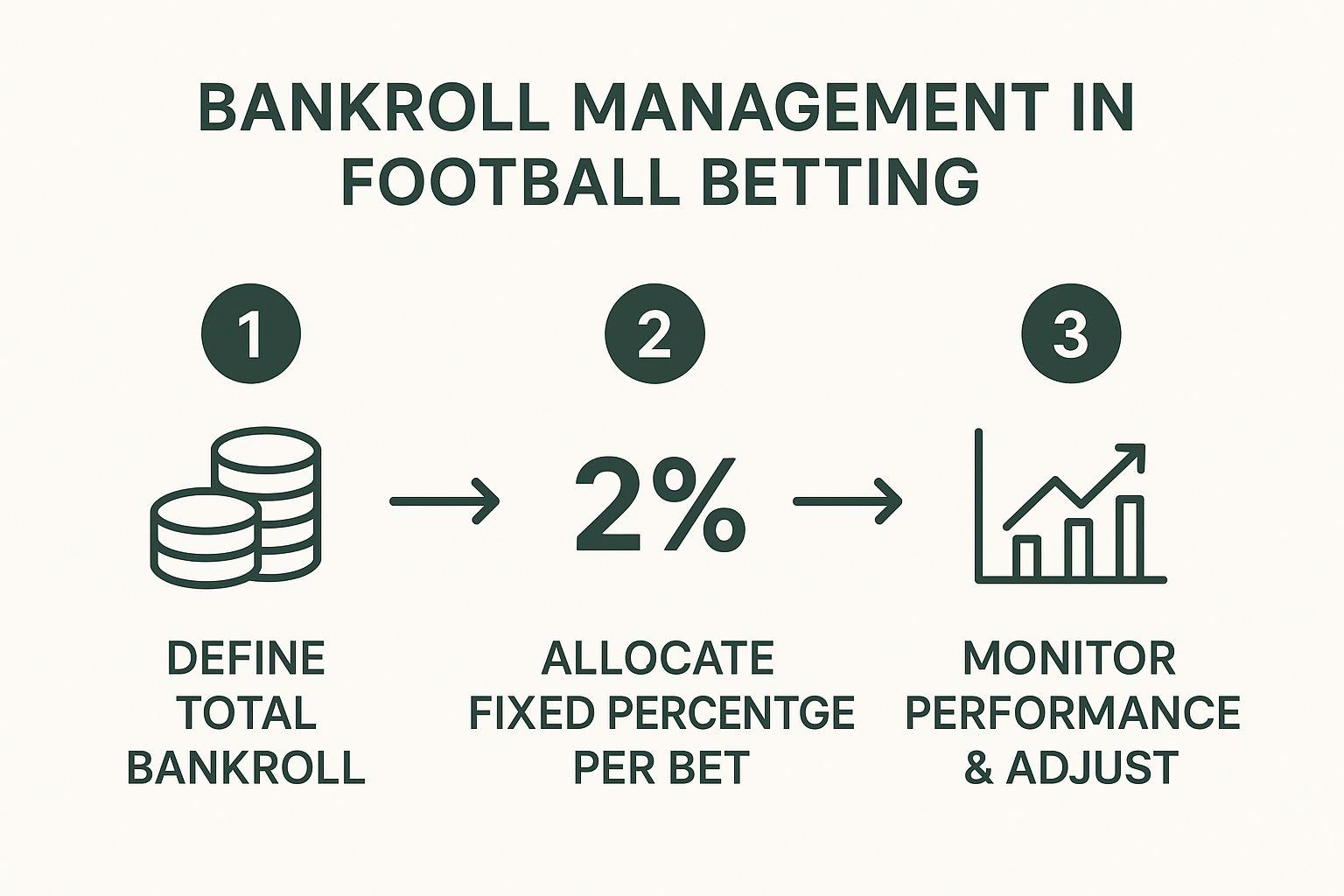
This simple flow highlights that defining your capital and sticking to a fixed staking percentage are the essential guardrails against emotional decisions. It gives your value-finding strategy the room it needs to work.
Integrating Stats Into Pre-Match Research
Having the data is one thing; knowing how to use it is another. Here’s a practical way to weave these metrics into your research to uncover those hidden betting gems.
- Scan for Mismatches: Start by looking at upcoming fixtures where the odds just feel a bit off. Maybe a mid-table team is priced as a heavy underdog against an out-of-form giant.
- Check Rolling xGD Averages: Forget season-long stats for a moment. Focus on the last five or six matches for both teams. A team with a strong positive xGD trend over this short period is likely performing much better than their recent results suggest.
- Find Performance Gaps: Look for discrepancies between what happened and what should have happened. Is Team A on a three-game losing streak but has consistently won the xG battle in each of those matches? This is a classic indicator of a team that's due for a comeback.
- Form Your Own Probability: Based on this deeper analysis, form your own opinion. Does Team A's true chance of winning seem closer to 45% than the bookie's implied 30%? If the answer is yes, you've found your bet.
By following this analytical process, you move beyond surface-level punditry and start seeing the game like a professional. You’re not just betting on teams; you’re investing in data-backed probabilities.
Using Market Sentiment to Your Advantage
Knowing where the money is flowing can be just as crucial as analyzing the teams on the pitch. Smart bettors understand that public opinion heavily influences betting lines, often creating inflated numbers ripe for exploitation. This is the art of reading the market and strategically betting against widespread public sentiment, a tactic often called "fading the public."
This strategy isn't about blindly betting against every favorite. It’s about recognizing when a team becomes overvalued due to media hype, their brand name, or a recent spectacular performance. Bookmakers know the public loves to back popular teams and high-scoring games, so they adjust the lines to protect themselves from heavy, one-sided action.
This adjustment is where your opportunity appears.
Bet Percentages vs. Money Percentages
The key to unlocking market sentiment lies in distinguishing between two critical data points: bet percentages and money percentages. While they sound similar, the story they tell is vastly different.
- Bet Percentages show the sheer volume of individual bets placed on one side of a game. If 80% of bets are on Team A, it means four out of every five betting slips are backing them.
- Money Percentages reveal where the actual cash is going. It measures the total amount of money wagered on each side.
The magic happens when you spot a significant gap between these two figures. This discrepancy is often the clearest signal of where the "sharp money" or informed, professional bettors are placing their large wagers. Sharp bettors typically risk much larger sums than the average fan, so their bets heavily influence the money percentages.
For example, if 70% of the bets are on one team to cover the spread, but only 50% of the money is on that team, it’s a massive tell. This signals that larger, more calculated bets are going against the public's favorite, creating potential value.
How to Find and Interpret the Data
So, how do you put this into practice? Let's walk through a real-world scenario.
Imagine Manchester City is playing Burnley at home. The public sees a top-tier team against a relegation candidate and rushes to bet on Manchester City to cover a -2.5 goal handicap.
The data below illustrates a classic public vs. sharp money split.
Let's say the betting data shows that 85% of the bet tickets are on Manchester City, but only 55% of the money is. This is a huge red flag. It suggests that while thousands of small, casual bets are on City, a few very large, professional wagers are landing on Burnley +2.5.
The sharps have likely identified that the line is overinflated due to public bias and see value in the underdog. This is a prime opportunity to "fade the public." Sharp money movements like this can also cause significant line changes, a phenomenon we explore in our guide on dropping odds.
Betting against the public isn't just contrarianism for its own sake. It's a calculated strategy based on the idea that heavy public action creates artificial value on the other side of the bet. You're capitalizing on market overreactions.
By learning to read these market signals, you add another powerful tool to your analytical arsenal. It allows you to move beyond your own team analysis and see where the most respected bettors in the world are putting their capital.
Developing a Disciplined Bettor's Mindset
You can have the best analytical skills on the planet, but they’re worthless if you don’t have the discipline to back them up. Your strategy, your analysis, and your bankroll management are only as good as the mindset controlling them.
This is where we get into the psychological hurdles that trip up the overwhelming majority of bettors. Master this, and you’ll understand how to consistently win at football betting. Get it wrong, and you're just gambling.
Overcoming Costly Cognitive Biases
Your brain is wired to take mental shortcuts. While that’s great for day-to-day life, it can be a total disaster for your betting P&L. These cognitive biases are subtle, powerful, and responsible for countless blown bankrolls.
Just knowing they exist is the first step to beating them.
Two of the worst offenders are:
- Confirmation Bias: This is the classic trap of only looking for info that confirms what you already believe. If you want a team to win, you’ll unconsciously hunt for stats that prove you right while conveniently ignoring anything that suggests you might be wrong.
- Recency Bias: This one gives way too much weight to recent results. A team that just smashed their opponent 5-0 looks unbeatable. A team that got hammered 3-0 seems hopeless. This leads to massive overreactions and often creates huge value on the other side of the bet.
The only way to fight these is to force yourself to be a neutral observer. Actively look for stats and arguments that go against your initial gut feeling. This forces a more balanced view and helps you see the whole picture, not just the one you want to see.
The Cardinal Sin: Never Chase Losses
Every single bettor, I don't care how good they are, will hit a losing streak. It's a mathematical certainty. How you handle that moment is what separates the pros from the amateurs.
The amateur panics. They start doubling down, desperate to win back what they just lost. This is called chasing losses, and it’s the single fastest way to set your bankroll on fire.
When you're on a bad run, logic goes out the window and raw emotion takes over. You stop analyzing and start purely gambling. You throw your staking plan in the trash and launch bigger, more reckless bets on games you haven't even looked at properly.
The second you feel that itch to "win it all back" on the next match is the exact moment you need to step away from your phone or computer. Chasing is a purely emotional reaction, and it has no place in a logical, data-driven strategy.
The antidote? Treat your betting like a long-term investment. An investor doesn’t panic-sell their entire portfolio after one bad day on the stock market; they trust the long-term process. You have to do the same. Each bet is just one of hundreds, or even thousands, you’ll place. The result of any one wager is almost meaningless in the grand scheme of things.
Know When to Take a Break
Sometimes, the smartest bet you can make is no bet at all.
If you find yourself getting frustrated, angry, or tilted after a string of losses, the best thing you can possibly do is shut down the apps and walk away. Seriously. Taking a break isn't a sign of weakness; it’s a mark of professional discipline. It gives you time to clear your head, detach from the recent bad results, and come back to your analysis with a fresh, objective mind. A day or two off can save you from making emotional mistakes that might take weeks to recover from.
Adopt a Professional, Long-Term View
At the end of the day, winning at football betting is about the process, not the outcomes. You can make a perfectly researched, high-value bet and still lose to a bit of bad luck. On the flip side, you can make a terrible, emotional punt and get lucky.
A disciplined bettor knows the difference. They judge their performance on the quality of their decisions, not the short-term results.
Here’s how to build this professional mindset:
- Trust Your Process: Stick to your bankroll and staking plan like glue. No exceptions. This is your shield against variance and emotional decisions.
- Focus on Value, Not Winners: Your job isn't to pick winners. It's to consistently find odds that are better than the true probability. If you do that, profits are inevitable over time.
- Review, Don't React: Regularly look at your betting records to find your strengths and weaknesses. Never, ever make drastic changes to your entire strategy because of a few bad beats.
Building this mental toughness is what separates the 5% of bettors who win long-term from the 95% who don't. The numbers, the stats, and the strategies are all just tools. Your disciplined mind is the only thing that can wield them effectively.
Common Questions About Winning at Football Betting
When you start treating betting like a serious investment, a few questions always pop up. It's only natural. I've heard the same ones from countless aspiring bettors who are trying to build a winning strategy and figure out how to actually profit from football long-term.
Let’s clear the air and talk about realistic profits, the time you'll really need to put in, and exactly how much cash you should start with.
What Is a Realistic Win Rate?
Let's get one of the biggest myths out of the way first: the idea of hitting 70% or 80% of your bets is a fantasy. It's just not how this works.
In reality, the best professional sports bettors in the world hover around a 55% to 60% win rate over thousands of bets. To put that in perspective, the breakeven point for a standard bet at -110 odds (1.91 decimal) is 52.4%.
This means a bettor who consistently hits 55% isn't just "good"; they are exceptionally profitable. The math is brutal; a 70% win rate over a large sample size like 1,000 bets is a statistical near-impossibility.
Your goal isn't to win every bet. It's to make consistently +EV (positive expected value) wagers. Profitability comes from a small, sustainable edge applied over hundreds of bets, not from a miraculous hot streak.
How Much Time Does This Actually Take?
Treating betting like an investment requires a consistent time commitment, but it doesn't have to take over your life. Not even close.
When you're first starting, you should probably expect to spend a few hours a week learning the ropes, getting a solid handle on bankroll management, the concept of value, and some basic analysis.
Once you’ve got a system dialled in, your weekly routine might look something like this:
- 1-2 hours for pre-match research on the upcoming slate of games.
- 30 minutes for line shopping and actually placing your bets.
- 30 minutes for logging your bets and reviewing your performance.
All in, we're talking about just a few hours a week. The goal here is efficiency. It’s about using data and tools to make smart decisions without being glued to an odds screen all day.
How Much Money Do I Need to Start?
You absolutely do not need a massive bankroll to get started. Here’s the single most important rule: only use an amount you are 100% comfortable losing.
Whether that's $100, $500, or $1,000, the starting number is far less important than the principles you apply to it.
A small $200 bankroll managed with a strict 2% staking plan ($4 per bet) is a much better foundation for long-term success than a $2,000 bankroll with no rules.
Start small. Prove your process is profitable. You can always add to your bankroll over time. The discipline you forge with a small bankroll is precisely what will allow you to succeed when that bankroll gets much, much bigger.
Ready to stop guessing and start making data-driven bets? The tools at ValueBetFactory are designed to help you find that statistical edge. Our platform scans the odds in real-time to deliver high-value opportunities directly to you. Start your free trial today.