
How to Bet on Sports and Make Money: Proven Strategies for Success
Unlock Profits with betting tips!
Making real money from sports betting isn't about having a "lucky" feeling or knowing a sport inside and out. It's a game of numbers, discipline, and finding an edge. Anyone who tells you otherwise is probably losing.
Profitable betting boils down to three things: rock-solid bankroll management, a sharp eye for finding true value in the odds, and a consistent, data-driven strategy. Get these right, and you stop being a gambler and start acting like a sharp investor.
Your Blueprint For Profitable Betting

Let's be blunt: most people who bet on sports lose money. That’s not an opinion; it's a fact baked into the very structure of the industry. Sportsbooks build an advantage right into their odds called the "vig" or "juice," which is their commission for taking your bet.
This isn't just some small service fee; it's the mountain you have to climb on every single wager. To put it in perspective, in the first five months of 2025 alone, legal sportsbooks in the US handled a staggering $57.6 billion in bets. Their average take, or "hold," was about 9.1%. That means for every $100 wagered, the house keeps $9.10 on average. You have to beat that vig just to break even, let alone turn a profit.
To get ahead, you need a radical shift in perspective. You have to stop betting like a fan and start thinking like a trader. A stock trader wouldn't dump their entire account into one speculative play based on a gut feeling, and neither should you. Every single bet needs to be a calculated part of a bigger, more disciplined plan.
The Foundation Of Smart Betting
Building that winning plan starts with mastering the fundamentals that every single successful bettor lives by. These aren't friendly suggestions they're the non-negotiable rules of the road if you're serious about making money. If you ignore even one, you're just setting yourself up to go broke.
The goal isn't to win every bet. That's impossible. The real goal is to consistently make wagers that have a positive expected value (+EV), ensuring that over the long run, your wins outpace your losses.
Your journey to becoming a profitable bettor starts with learning the ropes and applying a structured approach. To get you started, we've outlined the essential concepts you need to grasp. If you're ready to go even deeper, check out our comprehensive guide on how to make money gambling with smart betting.
This table breaks down the core concepts you absolutely must master to make the leap from a casual bettor to a profitable one.
The Three Pillars of Profitable Sports Betting
| Pillar | Core Concept | Why It's Crucial | First Action Step |
|---|---|---|---|
| Bankroll Management | Treating your betting funds like investment capital by using a strict staking plan (e.g., risking only 1-2% of your total bankroll per bet). | It takes emotion out of the equation, protects you from the inevitable losing streaks, and ensures you survive long enough for your statistical edge to pay off. | Decide on a starting bankroll you can afford to lose and calculate your standard "unit" size (1% of that total). Stick to it. |
| Value Identification | Finding odds where the bookmaker's implied probability is lower than your assessment of the actual probability of an outcome. | This is where your profit comes from. You make money by repeatedly betting on odds that are mathematically in your favor. It's your only true edge. | Pick an upcoming game. Convert the moneyline odds for both teams into their implied probabilities and see how they stack up. |
| Data-Driven Strategy | Building a repeatable process for analyzing games based on objective data and key metrics, not gut feelings or team loyalty. | A consistent process prevents emotional decisions and confirmation bias, leading to more logical and profitable choices over thousands of bets. | Choose one sport you know well and identify 3-5 key statistical metrics that strongly correlate with winning outcomes. |
Each pillar supports the others. Without proper bankroll management, even the best value-finding strategy will fail when you hit a losing streak. And without a data-driven approach, you’ll never be able to consistently identify value in the first place. Master these three, and you're well on your way.
Mastering Your Bankroll Like a Pro
I've seen it a thousand times. New bettors get hyper-focused on picking winners, thinking that's the whole game. But they completely ignore the single most important skill for long-term success: bankroll management.
It’s not the flashy part of betting, I get it. But without a solid plan for your money, even the sharpest betting strategy will eventually crash and burn. You have to start thinking of your betting funds as dedicated investment capital, not just entertainment money. This cash needs to be totally separate from your rent, groceries, and daily expenses. Getting this mindset right is your first real step toward learning how to bet on sports and actually make money.
The secret to professional bankroll management is taking emotion out of the equation. The best way I know how to do that is with the unit system.
Understanding The Unit System
So what's a "unit"? It’s simply a set percentage of your total bankroll, usually somewhere between 1% and 2%. This changes the game entirely. Instead of thinking in dollars, you start thinking in units. This flat-betting approach ensures that one tough loss or even a whole string of them won't knock you out of the game.
Let's walk through a quick, real-world example.
Say you’ve set aside $1,000 as your starting bankroll. If you decide on a conservative 1% unit size, your standard bet becomes a simple $10.
- Your Bankroll: $1,000
- Your Unit Size (1%): $10
- Your Standard Wager: 1 Unit ($10)
It doesn't matter how much you love a particular matchup; you stick to your unit size. This discipline is what protects you from making oversized, emotional bets when you're on a hot streak or, even worse, chasing your losses after a bad beat. For a deeper dive on this, check out our complete guide on sports betting bankroll management.
This image really drives home why this discipline is non-negotiable. It shows the house edge and the win rates you need just to break even on common bets.
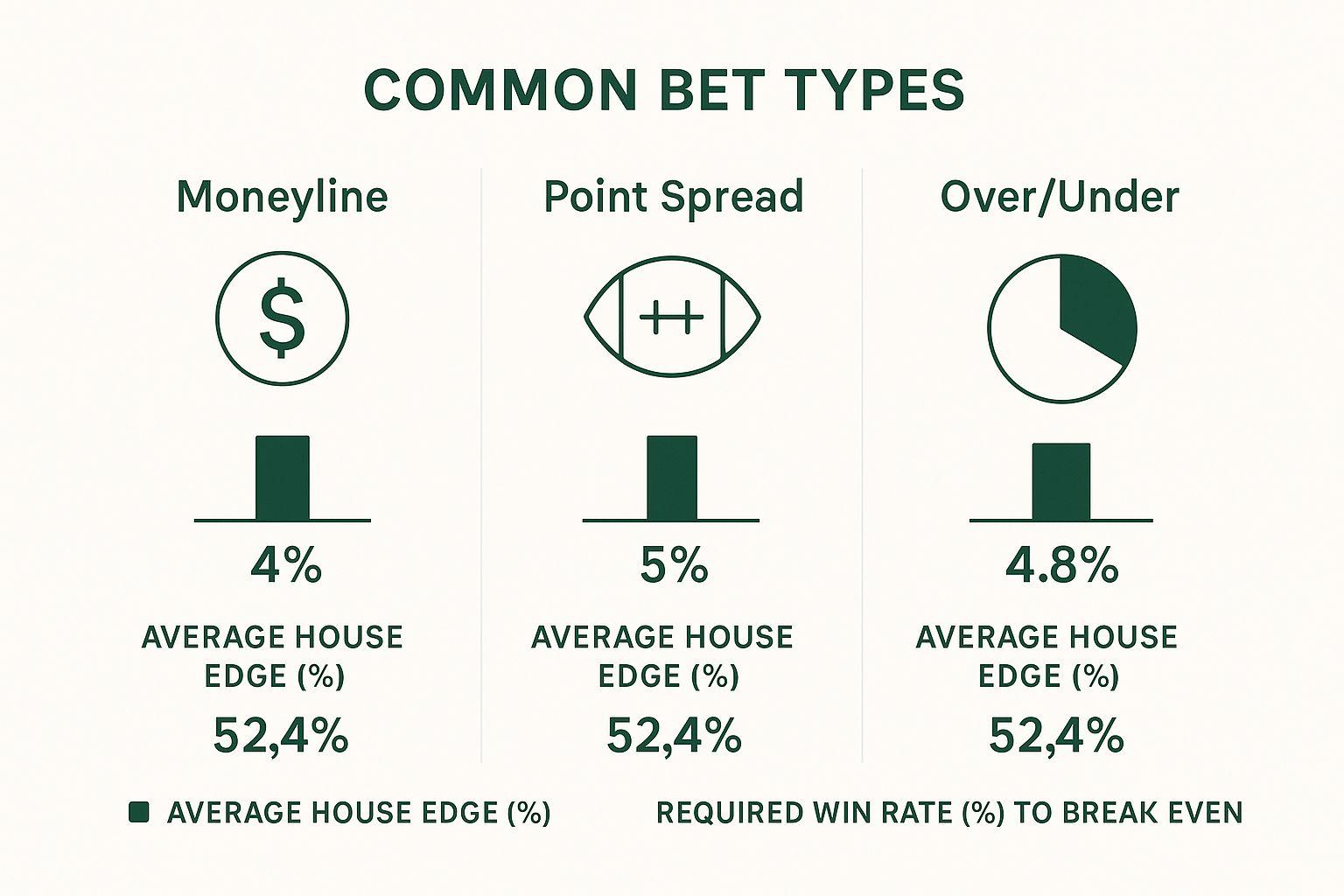
As you can see, you have to win well over half your bets just to stay afloat. That’s why a structured, disciplined bankroll approach is absolutely critical for survival.
Why Flat Betting Is Your Best Friend
Most newcomers fall into the same trap: they let their gut feelings dictate their bet size. They might throw $50 on a game they feel great about and just $10 on another. This is a recipe for disaster. It exposes your bankroll to huge swings and lets emotion run the show.
Flat betting, where you risk the same number of units on every single play, forces consistency. It’s what keeps you in the action during those inevitable cold streaks that every single bettor from novices to pros has to endure.
Bankroll management isn't about trying to avoid losses; that's impossible. It's about making sure your bankroll can survive those losses so your long-term edge has time to play out.
Think about the psychology here. When your 1-unit bet loses, it’s just a small, calculated bump in the road. But when a bet representing 20% of your entire bankroll goes down, that's a catastrophic event that triggers panic and leads to even worse decisions. The unit system is your built-in defense against that kind of emotional spiral.
Comparing Bankroll Staking Methods
To really see why the unit system is the gold standard, it helps to compare it to a few other common and much riskier methods that many amateur bettors try.
Comparing Bankroll Staking Methods
To truly appreciate the power of the unit system, it helps to see how it stacks up against other, riskier methods that many amateurs use. Each has a different risk profile and impact on your long-term success.
| Staking Method | Description | Pros | Cons |
|---|---|---|---|
| Flat Betting (Unit System) | Risking a fixed percentage (1-2%) of your bankroll on every bet. | Extremely low risk of ruin. Removes emotion and enforces discipline. Easy to track and maintain. | Slower, more gradual growth. Can feel restrictive during winning streaks. |
| Martingale System | Doubling your stake after every loss, aiming to win back all previous losses plus a one-unit profit. | Guarantees a profit if you have an infinite bankroll and no table limits. | Extremely high risk of ruin. One long losing streak will bankrupt you. Not a sustainable strategy. |
| "All-In" or High-Stakes | Betting a large percentage (e.g., 25% or more) of your bankroll on a single "sure thing." | Potential for very rapid, large gains. | The fastest way to go broke. One incorrect bet can destroy your entire bankroll. Pure gambling, not strategy. |
As the table shows, other methods might promise a faster ride, but only the flat-betting unit system gives you the stability you need for a long and profitable betting career. It forces you to think like an investor, not a gambler, by prioritizing capital preservation over chasing a quick jackpot. Master this one concept, and you'll already be miles ahead of the average bettor.
Finding Your Edge with Value Betting

If there's one thing you need to burn into your brain from this guide, it's this: sharp bettors don't just pick winners. They hunt for value. This is the absolute cornerstone of making real, sustainable money from sports betting.
It's a complete mental shift. You have to stop seeing odds as just potential payouts and start recognizing them for what they really are a bookmaker's opinion, quantified as an implied probability.
Every set of odds, no matter the format, is just a different dialect for the same language: the percentage chance of something happening. Getting comfortable translating odds into these percentages is your first real step toward finding an edge.
How to Translate Odds into Probabilities
Think of implied probability as learning to speak the sportsbook's native tongue. It lets you see past the potential winnings and get to the heart of the mathematical proposition they're offering you.
The math is actually pretty straightforward.
For negative odds (the favorites, like -150), the formula is simple:
- Odds / (Odds + 100) * 100
- So, for -150 odds: 150 / (150 + 100) = 60%
For positive odds (the underdogs, like +150), it's just as easy:
- 100 / (Odds + 100) * 100
- And for +150 odds: 100 / (150 + 100) = 40%
Once you have this down, you can instantly decode the bookie's take. A -150 line means they think that team has a 60% shot. A +150 line implies a 40% chance. This single skill is the foundation for everything else you'll do.
The Core Idea Behind Value Betting
Here’s where it all comes together. Value betting is the craft of finding wagers where your own analysis tells you the true probability of an outcome is higher than the implied probability the bookie is offering. It really is that simple, and it's incredibly powerful.
You're basically looking for pricing errors. You’re on a mission to find spots where the sportsbook has underestimated a team's or player's real chances. Every time you spot one of these discrepancies, you've found a profitable opportunity. To dive deeper into this crucial concept, check out our full guide on understanding value betting.
A Practical Example: A Tennis Match
Let's ground this in a real-world scenario. Picture a tennis match between Player A and Player B. The bookmaker has Player B priced as the underdog at +150.
From our calculation above, we know those odds carry an implied probability of 40%. The market is essentially saying that if this match were played 10 times, Player B would win 4 of them. But this is where your real work starts. You don't just accept that number you challenge it.
You start digging in with your own research:
- Head-to-Head: You discover Player B has actually won 3 of their last 5 matchups against Player A.
- Surface: The match is on clay, a surface where Player B has a much better win percentage over the past year.
- Recent Form: Player A just survived a grueling five-set marathon, while Player B is coming off an easy two-set victory.
After weighing these factors, you come to a different conclusion. You believe Player B's actual chance of winning isn't 40%; it's probably closer to a coin flip, around 50%.
That, right there, is a value bet. The market has undervalued Player B, and by betting at +150, you're getting fantastic odds on what you've identified as an even match.
Even if Player B ends up losing this one specific match, you still made the right bet. The goal isn't to win every time. It's to consistently place bets where the odds are tilted in your favor. Over hundreds of these bets, that positive expected value is what builds your bankroll.
This is the polar opposite of how most people bet. They see the same match and think, "Player A is the better player, I'll bet on him," completely ignoring the price. A profitable bettor looks at the price first and asks, "Is there value here?" That's the difference between gambling and investing.
Building Your Data-Driven Strategy
If you want to make consistent money betting on sports, you have to trade your gut feelings for a repeatable, analytical process. A solid strategy is your roadmap. It guides you toward smart decisions and, more importantly, keeps you away from those emotional, fan-driven bets that drain bankrolls.
It's about shifting from hunches to hard data and building a framework you can trust, game after game.
This approach is more crucial than ever. In 2024, the global online sports betting market hit a valuation of around $50 billion and is on track to blow past $67 billion by 2027. With nearly half the adults in the U.S. (46%) interested in betting, the market is getting sharper. But it's also richer with data, which means those of us with an analytical process can find some serious edges.
The very first move is to specialize. The betting world is massive. Trying to be an expert in everything is a surefire way to be an expert in nothing.
The Power Of Specialization
Think of it like being a doctor. A general practitioner knows a little about a lot, but for a complex heart problem, you want a cardiologist. Betting is exactly the same. When you narrow your focus, you can develop a deep, actionable knowledge base that gives you a true informational advantage over the average bettor and even the sportsbooks.
Your goal is to become a master of a specific niche. This could mean:
- Focusing on one sport: Instead of jumping between the NFL, NBA, and MLB, just live and breathe the NFL.
- Drilling down to one league: Don't just bet on college basketball; become the authority on the Big Ten conference.
- Mastering a specific bet type: Become the go-to expert for NFL player props or first-half totals.
This laser focus lets you spot trends, understand team-specific quirks, and recognize when the market has mispriced a line in your sandbox. It's how you turn general noise into profitable signals.
Moving Beyond The Box Score
Once you’ve picked your niche, it’s time to figure out which performance metrics actually matter. The final score tells you who won, but it often hides the real story of how they won. To make money, you have to dig deeper.
Standard box score stats like total yards or points per game can be incredibly misleading. A team might rack up yards in garbage time against a soft defense, bloating their stats without reflecting their true strength. You need to find the advanced metrics that provide context and have real predictive power.
Your job as a data-driven bettor isn't just to collect stats; it's to find the right stats. The ones that have a strong correlation with winning and are often overlooked by the casual betting public.
For instance, instead of just looking at total yards gained, analyze yards per play. This metric measures raw efficiency and tells a much clearer story about a team's offensive or defensive strength on a down-by-down basis.
A Practical Checklist For An NFL Game
Let's put this into practice. You're breaking down an upcoming NFL game. Instead of just glancing at the teams' win-loss records, you build a research checklist using much more insightful data points.
Here’s a sample framework you could use to get started:
- DVOA (Defense-adjusted Value Over Average): This is a gold-standard metric for rating team efficiency. It compares a team's performance on every single play to a league-average baseline, adjusted for the specific situation and opponent. A positive DVOA is good; negative is bad.
- Yards Per Play (YPP): How efficient is an offense at moving the ball? Look at both offensive YPP and defensive YPP allowed. A big mismatch here can signal a huge advantage one way or the other.
- Third-Down Conversion Rates: Which team is better at sustaining drives or, on the flip side, getting its defense off the field? This is a critical indicator of coaching and execution under pressure.
- Red Zone Efficiency: Scoring touchdowns instead of settling for field goals is a massive factor. Compare how often each team turns red zone trips into six points.
- Turnover Differential: Does one team consistently protect the ball while the other is prone to giving it away? Turnovers are game-swinging plays that can instantly flip a result.
By evaluating matchups through this data-driven lens, you're building an objective case for your bet. You're no longer guessing. You're creating a logical, evidence-based argument for why a particular side offers value, and that's the foundation for long-term success.
Putting Your Strategy into Action

Alright, you've got a solid, data-driven strategy in your back pocket. That's a huge step forward, but it's really only half the battle. A brilliant plan is worthless if you don't execute it with discipline day in and day out. This is where the real work begins turning that research into cold, hard cash.
I've seen it time and time again: what separates the pros from the amateurs comes down to a few non-negotiable habits. Think of them as the three pillars of successful betting: aggressive line shopping, meticulous record-keeping, and mastering the mental game. If you ignore any one of these, you’re just spinning your wheels.
Always Secure The Best Price
Let's start with the easiest win you can get: line shopping. This simply means having funded accounts at several different sportsbooks and taking a minute to check which one offers the best price before you place a bet.
You wouldn't buy a TV without checking prices at a few different stores, right? The same logic applies here, but the stakes are much higher over the long run. A half-point difference on a spread or a slightly better price on a moneyline might seem insignificant on a single bet, but those small edges compound into a massive difference over hundreds or thousands of wagers.
Let’s say you’ve found a value bet on the Green Bay Packers at +3.5. You check your books:
- Book A has it at -115 odds.
- Book B offers the same line at -110.
- Book C is sitting at -105.
Placing your bet at Book C is a no-brainer. You're risking less for the exact same payout. Every time you fail to shop for the best line, you are voluntarily giving the sportsbook a bigger advantage. It's like spotting them points before the game even starts.
Meticulous Record-Keeping Is Non-Negotiable
You can't manage what you don't measure. If you're serious about this, you have to track every single bet you make. This isn't about bragging when you're up or feeling bad when you're down; it's about collecting the data you need to find your strengths, plug your leaks, and make your strategy even sharper.
Think of your records as a diagnostic tool. They tell you the unfiltered truth about your performance and hold you accountable. Without this data, you're just guessing, doomed to repeat the same costly mistakes over and over.
Tracking your bets is the ultimate form of accountability. The data doesn't lie, and it will show you exactly where your strategy is working and, more importantly, where it's failing.
At a bare minimum, your betting log needs to capture these details for every wager:
- Date: When you placed the bet.
- Sport & League: Be specific (e.g., NFL, not just "Football").
- Bet Details: The teams and the exact wager (e.g., Dallas Cowboys -7).
- Stake: Your bet amount in units (e.g., 1 unit).
- Odds: The exact price you locked in.
- Sportsbook: Which book you used.
- Result: Win, Loss, or Push.
- Profit/Loss: The amount won or lost, also in units.
With this info, you can start answering the important questions. Are you crushing it on NFL underdogs? Are NBA totals a blind spot? Does one of your sportsbooks consistently have the best lines? This is the kind of insight that separates profitable bettors from everyone else.
Mastering The Mental Game
Finally, you have to prepare for the psychological grind. Even the sharpest bettors on the planet hit brutal losing streaks. It’s a mathematical certainty in a game of probabilities. The real test is how you handle them.
A bad run can trigger the impulse to "chase" abandoning your unit system to place bigger, desperate bets to win it all back in one shot. This is the single fastest way to go broke. During these storms, your disciplined strategy and your detailed records are your anchors. You have to trust the process, not your emotions.
On the flip side, a hot streak can be just as dangerous. It breeds overconfidence, tempting you to up your unit size or make sloppy bets that fall outside your system. Whether you’ve won ten straight or lost ten straight, the plan doesn't change. Discipline is what makes a professional.
Frequently Asked Questions About Sports Betting
Even with the best game plan, questions will come up. That’s perfectly normal. As you get ready to dive in, you'll probably have a few things you're still wondering about.
Let’s go over some of the most common questions I hear from new bettors. Think of this as a quick Q&A to firm up the core ideas we’ve covered before you start placing your bets.
Can You Realistically Make A Living from Sports Betting?
The short answer is yes, but it’s incredibly tough. Let me be clear: this isn't a get-rich-quick hobby. Making a living from betting is a full-time job that demands the same discipline and analytical rigor as being a professional day trader.
Anyone doing it successfully treats it exactly like a business. They’re dealing with razor-thin margins, running deep statistical models, and have the mental toughness to stick to their strategy even during brutal losing streaks. It’s a high-stress career path, and honestly, very few people have what it takes to succeed long-term.
How Much Money Do I Need to Start Betting?
There's no magic number, but here’s the most important rule: only bet with money you are 100% prepared to lose. This is non-negotiable.
For someone serious about starting the right way, I usually suggest a bankroll between $500 and $1,000. This gives you enough capital to properly use a 1%-2% unit staking plan. You can place bets that are meaningful enough to grow your roll, but you can also withstand the inevitable downswings without going broke.
Ultimately, how you manage your money is far more important than how much you start with. A bettor with a well-managed $500 bankroll will always come out ahead of someone who's reckless with $5,000.
What Are the Biggest Mistakes Beginner Bettors Make?
Almost every costly mistake a beginner makes comes down to emotion and a lack of discipline. It’s a predictable pattern, but one you can easily avoid if you know what to look for.
Here are the classic blunders that sink most new bettors:
- Reckless Bankroll Management: This is number one. They'll drop 10-20% of their entire bankroll on a single game just because they have a "good feeling" about it.
- Chasing Losses: After a tough beat, they immediately place bigger, more desperate bets to win it all back in one shot. This almost never ends well.
- Betting with Their Heart: They can't resist backing their favorite team, ignoring all the data that says it's a bad bet. Loyalty doesn't pay the bills.
- Ignoring the Price: They take whatever odds their one bookie offers instead of shopping for the best line. That's like willingly overpaying for everything you buy.
- Relying on "Gut Feelings": They have a solid strategy but abandon it the second a hunch pops into their head. Consistency is what separates winners from losers.
If you can just steer clear of these traps, you'll already be miles ahead of the average person betting on sports. Your discipline is the single greatest edge you'll ever have.
Ready to stop guessing and start finding true value in the odds? Let ValueBetFactory do the heavy lifting. Our platform uses advanced algorithms to scan the market for you, identifying profitable betting opportunities in real-time. Start your free trial today and turn your data-driven strategy into a winning one. Visit ValueBetFactory.