
A Bettor's Guide to Hedging in Basketball
Unlock Profits with betting tips!

Ever found yourself in that heart-pounding, sweat-inducing moment where a massive bet is just one game away from cashing? It's the dream scenario, but it's also a nightmare waiting to happen. This is where hedging comes in. It’s a strategic play that shifts you from a hopeful spectator to the savvy manager of your own bet.
What Is Hedging in Basketball Betting
Think of hedging as an insurance policy for your wager. In simple terms, it's the art of placing a second bet on the opposite outcome of your original one. The goal isn't to hit a home run anymore; it's to intentionally guarantee a profit or cut your losses, no matter who wins the game.

Hedging is a powerful tool because it flips your mindset. Instead of riding the emotional rollercoaster and praying for a single result, you make a calculated move to lock in a positive outcome. It’s about protecting your bankroll when you've maneuvered yourself into a strong, yet incredibly vulnerable, position.
The classic example? Imagine you dropped a small futures bet on an underdog to win the NBA championship at massive odds. Miraculously, they've battled their way to the NBA Finals. Your once-tiny ticket is now one series away from a life-changing payout... but it's also just one series away from being completely worthless.
This is the perfect time to hedge. By placing a calculated bet on their opponent to win the Finals, you can structure a scenario where you make a profit regardless of which team pops the champagne. The same exact logic applies when you're down to the final, nerve-wracking leg of a high-payout parlay.
Why Hedging Is a Strategic Choice
At its core, hedging in basketball is all about actively managing your risk versus your potential reward. Yes, you are sacrificing the maximum possible payout, but in return, you completely eliminate the risk of walking away with absolutely nothing. This trade-off is the hallmark of a disciplined and strategic bettor.
This approach is so valuable for a few key reasons:
- Securing Profit: It lets you cash in on a brilliant longshot or a complex multi-leg bet before the final whistle even blows.
- Minimizing Losses: Did a star player twist an ankle in warmups? If your analysis suddenly changes, a hedge can be a smart damage control move.
- Psychological Relief: Let's be honest, it takes the gut-wrenching, all-or-nothing stress out of the equation, allowing you to think clearly and objectively.
Hedging is about taking control. Instead of being a passive fan hoping for the best, you become an active manager of your own position, making a business decision to capitalize on the favorable spot you've created.
While hedging is a cornerstone of smart betting, it's just one piece of the puzzle. To really master it, you need to understand the broader concepts at play. You can learn more about hedging in sports betting in our detailed guide, which lays the foundation for everything we're about to cover. Knowing when to hedge and just as importantly, when not to is what separates the pros from the pack.
To give you a clearer picture of when these situations pop up, here's a quick rundown of the most common scenarios where a basketball bettor would think about hedging.
Key Hedging Scenarios at a Glance
| Scenario Type | Original Bet Example | Hedging Goal |
|---|---|---|
| Futures Bet | Placed a $50 bet on the Lakers to win the NBA title at +2000 | Lakers make the Finals; hedge to guarantee a profit. |
| Parlay Final Leg | Last leg of a 6-team parlay for a $5,000 payout | Bet on the opposite side to lock in a smaller win. |
| Live Betting | Bet on a team pre-game; they're now up 20 points | Hedge on the opponent's live line to secure profit. |
| Series Betting | Bet on a team to win a playoff series; they're up 3-1 | Place a smaller bet on the other team to protect gains. |
Each of these scenarios presents a unique opportunity to turn a strong position into a guaranteed win. As we dig deeper, we'll explore exactly how to calculate and execute these plays.
Exploring Different Hedging Strategies
Hedging in basketball isn't some rigid, one-size-fits-all tactic. It’s more like a flexible toolkit, with different tools designed for different situations. Knowing which strategy to pull out of the bag is the key to managing your risk and, more importantly, locking in a profit.
Each approach has its own rhythm. Some are slow-burn plays on long-term futures bets, while others require rapid-fire adjustments during a live game.
The four main methods you’ll come across are pre-game hedging, in-play hedging, the cash-out feature, and lay betting. While they all aim to secure value, they operate on different timelines and require totally different levels of engagement from you.
Pre-Game Hedging for Futures
This is the classic hedging scenario, most often used with long-term futures bets. It’s for those times when a wild preseason bet on a massive underdog suddenly looks like a stroke of pure genius.
Imagine you dropped $100 on the Minnesota Timberwolves to win the NBA title at +3000 odds before the season tipped off. Your potential payout is a cool $3,000. Against all odds, they’ve battled their way to the NBA Finals to face the Boston Celtics. You’re just one series away from a huge win... but you're also one series away from getting absolutely nothing.
This is exactly where pre-game hedging shines. Before the series starts, you can place a calculated bet on the Celtics to win the Finals. By betting on the other side, you build a safety net, guaranteeing yourself a profit no matter which team is popping champagne.
In-Play Hedging During the Game
In-play, or live hedging, is a much faster and more dynamic strategy that unfolds while the game is actually happening. It demands quick thinking and a sharp eye for how momentum swings can flip live betting odds on their head.
Let's say you bet on the Phoenix Suns to cover a -5.5 point spread against the Dallas Mavericks. The Suns come out blazing, building a 20-point lead by halftime. The live odds shift dramatically, making the Mavs huge underdogs to come back.
This is your chance. You can now hedge by placing a live wager on the Mavericks at their new, much larger live spread. This move locks in a smaller, guaranteed profit by covering both sides of the second half. You've just protected yourself from a classic fourth-quarter collapse by the Suns, turning a strong position into a confirmed win.
Using the Cash Out Feature
Many sportsbooks now offer a "cash out" button, which is basically a simplified, automated hedge served up directly by the bookmaker. If your bet is in a good spot, the bookie will offer you a guaranteed amount to settle the bet early.
The cash out option is the ultimate convenience hedge. It kills the need for manual calculations or shopping for odds on another site. But that convenience always comes at a cost, a built-in commission for the sportsbook. This means you’ll almost always get a slightly lower profit than if you had hedged it yourself.
Think of it as selling your bet back to the house. It's a fantastic tool for bettors who want a simple, one-click solution, but just know you're paying a small fee for that simplicity.
Advanced Hedging with Lay Betting
For more advanced bettors, especially those comfortable with betting exchanges, lay betting offers a powerful way to hedge. Instead of betting for something to happen, you bet against it.
Let's circle back to that Timberwolves example. If you placed your original futures bet on a betting exchange, you could hedge by "laying" the Timberwolves. In simple terms, you are playing the role of the bookmaker, offering odds for someone else to bet on Minnesota to win.
If the Timberwolves win, you have to pay out that other bettor, but you collect on your massive futures ticket. If they lose, you lose your original futures stake, but you win the lay bet you placed. It's just another road to the same destination: creating a profitable result no matter what happens in the game.
When to Hedge and When to Let It Ride
Making the call to hedge a bet or "let it ride" is one of the most gut-wrenching decisions in sports betting. You're standing at a crossroads, weighing the comfort of a guaranteed profit against the thrill of a monster payout. But this isn't a decision you make with your gut. It’s a calculated business move based on value, risk, and smart bankroll management.
The core principle is actually pretty simple: the bigger the potential payout and the longer the odds you overcame, the stronger the case for hedging. It's all about protecting a position when you've turned a small stake into a potentially life-changing opportunity.
High-Value Scenarios Prime for Hedging
Some situations practically scream for a hedge. These are the moments where walking away with nothing would be a devastating blow, both to your bankroll and your morale. Think of these as the "must-protect" assets in your betting portfolio.
- Longshot Futures Bets: You dropped $50 on a team to win the NBA title at +4000 odds before the season. Miraculously, they've made it to the Finals. Your ticket is now one series away from a $2,000 payday. Letting that entire win ride on the outcome of a seven-game series is a massive, unnecessary risk. Hedging here is almost always the right play.
- The Final Leg of a Massive Parlay: You've nailed five out of six legs on a wild parlay. Your initial $10 stake is suddenly staring down a $1,500 payout. Hedging the final game by betting on the opposite side guarantees you won't lose everything to a last-second bad beat.
In these spots, you're willingly sacrificing a chunk of your maximum potential profit to completely eliminate the risk of a total loss. It's the difference between locking in a great outcome and just hoping for one.
When Letting It Ride Makes More Sense
On the flip side, constantly hedging small, single bets is a surefire way to bleed your bankroll dry. Every time you hedge, you're paying the commission (the "juice" or vigorish) to the sportsbook on both sides of a bet. Do this habitually, and you're just chipping away at your long-term expected value (EV).
A classic rookie mistake is getting nervous and hedging a standard single-game bet just because your team has a nice lead at halftime. This is a losing strategy. You placed the original bet because you saw value in the odds; hedging out of fear cancels out that value and hands an extra edge right back to the bookie.
Think of it like playing defense in basketball. A well-timed defensive hedge on a pick-and-roll is a high-value play that can shut down an entire possession. In fact, data from the 2018-2020 NBA seasons showed that teams with high hedge success rates had defensive ratings that were 3-4 points per 100 possessions better than the league average.
But if a defender hedged on every single play, they’d constantly be out of position, giving up easy layups and open threes. It’s the same in betting. You can learn more about these basketball strategy insights to see how selective, strategic moves always yield the best results.
A Decision-Making Framework
To make a confident choice, you need a clear framework. The context of your original bet is everything. Before you even think about placing a hedge, ask yourself these three critical questions:
- Is the potential payout life-changing or significant to my bankroll? If the win represents a major boost (say, more than 20-30% of your total bankroll), the argument for securing a profit becomes much, much stronger.
- How much value am I sacrificing? Run the numbers. Calculate the guaranteed profit from hedging versus the maximum potential win. If hedging still locks in a return that you’d be thrilled with, it’s often worth pulling the trigger.
- What was my original thesis? Do you still have the same confidence in your original bet as when you placed it? If a star player is now injured or other key circumstances have changed, hedging becomes a perfectly logical adjustment to new information.
Ultimately, there's no magic formula that applies to every situation. Successful hedging in basketball isn't about eliminating all risk. It's about knowing when a bet has created so much value that protecting it becomes more important than maximizing it.
Calculating The Perfect Hedge Bet
So, you've decided a hedge is the right strategic move. What now? The next step is all about execution, and this isn't the time for guesswork. It’s about being precise with your numbers to lock in that guaranteed profit, no matter what happens in the game.
The process boils down to a simple idea: find the right odds on the opposite side of your original bet and then stake the correct amount. The math might look a bit intimidating at first, but it’s actually quite straightforward once you see how the formula works.
This flowchart lays out the high-level decision process. It's a great visual for when to secure a high-value payday versus letting a smaller bet ride.
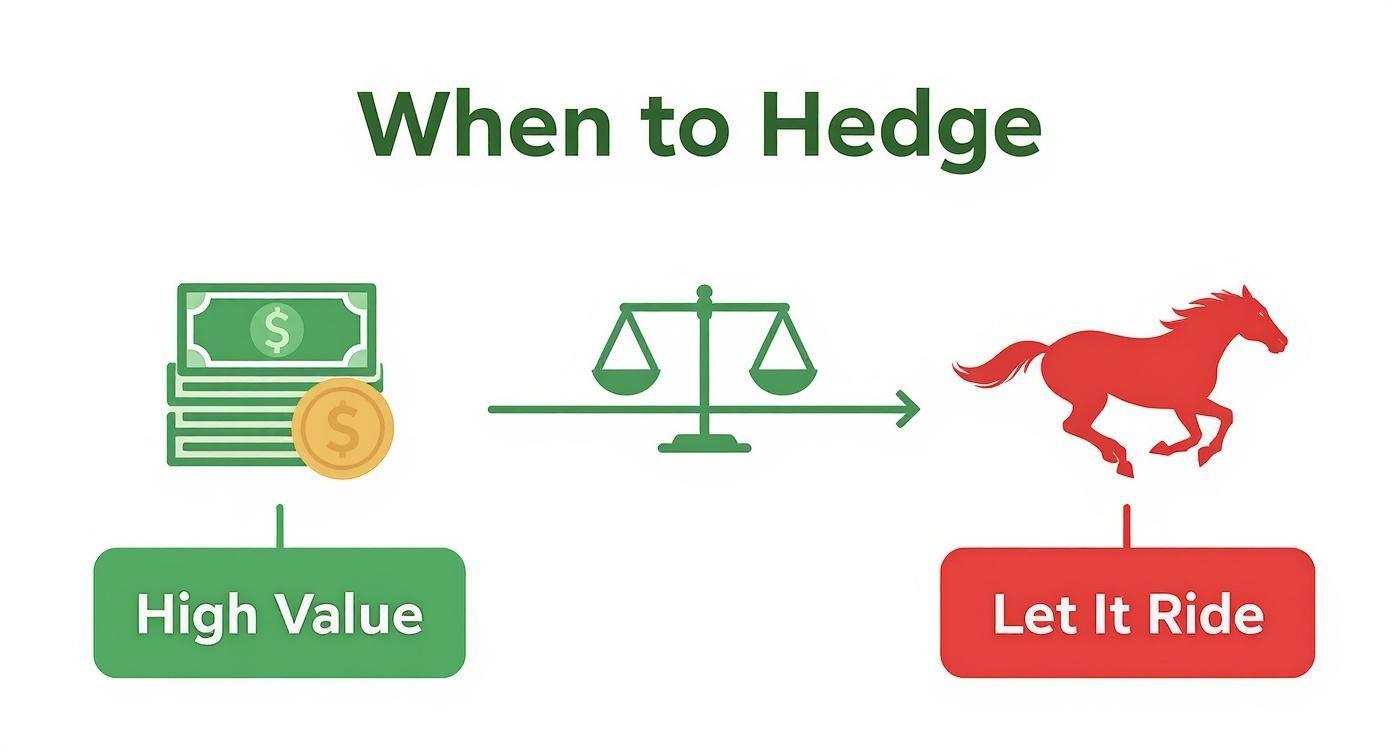
As you can see, the core principle is simple: the bigger the potential win, the more sense it makes to protect it.
The Hedging Calculation Framework
To figure out the perfect hedge, you only need three key pieces of information:
- Your Original Stake: How much you initially put down.
- Your Potential Payout: The total amount you're set to win (this includes your original stake plus the profit).
- The Odds for the Opposite Outcome: The current betting odds on the team you need to bet against.
With these three things, the goal is to calculate the ideal stake for your new hedge bet. The formula is designed to ensure you walk away with the exact same profit, regardless of which team wins.
Hedge Stake = (Potential Payout) / (Decimal Odds of Hedge Bet)
Let's run through a classic basketball betting scenario to see this formula in action.
A Real-World Parlay Example
Imagine you're staring down the final leg of a massive four-team NBA parlay. You staked just $20, but if this last game hits, you're looking at a $500 total payout. It all comes down to the Los Angeles Lakers vs. the Denver Nuggets, and your parlay needs the Lakers to win.
This is a classic spot to hedge and guarantee yourself a nice payday. You check the live odds and find the Nuggets' moneyline is sitting at +150.
First, we need to convert those American odds (+150) into decimal odds, which comes out to 2.50. Now we have everything we need to plug into the formula.
- Potential Payout: $500
- Decimal Odds of Hedge Bet (Nuggets to win): 2.50
Plugging these values in: Hedge Stake = $500 / 2.50 = $200.
This calculation tells you to bet exactly $200 on the Denver Nuggets. Now, let's look at the two possible outcomes to see how your profit is locked in:
- If the Lakers Win: Your original $500 parlay cashes. After you subtract the $200 you spent on the hedge bet, you're left with a guaranteed profit of $300.
- If the Nuggets Win: You lose your initial $20 parlay stake, but you win your hedge bet. A $200 wager at +150 odds pays out $500 total ($200 stake + $300 profit). Your guaranteed profit is, once again, $300.
No matter which team comes out on top, you walk away $300 richer.
The table below breaks down the key numbers from our parlay example, showing how each piece of information fits into the calculation.
Sample Hedging Calculation for a Parlay's Final Leg
| Metric | Value | Description |
|---|---|---|
| Original Stake | $20 | The initial amount wagered on the four-team parlay. |
| Potential Payout | $500 | The total return if the original parlay wins. |
| Hedge Bet Odds | +150 (2.50) | The odds on the opposite outcome (Nuggets to win). |
| Hedge Stake | $200 | The calculated amount to bet on the Nuggets. |
| Guaranteed Profit | $300 | The locked-in profit regardless of the game's outcome. |
This clear breakdown shows how a potentially stressful final leg can be turned into a guaranteed win. While doing these calculations by hand is good for understanding the concept, using a tool makes the process instant and error-free. You can simplify everything with our free hedge bet calculator, which handles all the number-crunching for you.
Tools and Best Practices for Smart Hedging
Executing a great hedge takes more than just good instincts; it demands the right tools and some disciplined habits. Smart hedging in basketball isn't about guesswork. It’s about combining quick analysis with reliable resources to turn a strong position into a guaranteed profit. This is how you start moving like a professional bettor.
First things first, you need the right tech on your side. Hedge calculators are a must-have, instantly figuring out the exact stake you need to lock in a profit without any costly manual errors. Just as vital are odds comparison sites, which scan multiple sportsbooks in seconds to find the best possible line for your hedge bet.
Leveraging Multiple Sportsbooks
If you're serious about maximizing your hedging results, having accounts at several different sportsbooks is non-negotiable. Sticking to a single bookmaker is like trying to build a house with just a hammer, it seriously limits your options and will almost always cost you money in the long run.
When the time comes to place a hedge, the odds can swing wildly from one sportsbook to another. Finding the absolute best line on the opposite side of your original wager has a direct impact on your guaranteed profit. Even a small difference in the odds can translate into a much bigger final payout.
- Better Odds, Bigger Profit: A tiny improvement in the odds for your hedge bet can add a surprising amount of cash to your guaranteed return.
- Availability: You can't always count on one bookie to offer the exact market you need, especially when you're trying to hedge live. Multiple accounts mean you'll always have an option ready to go.
- Avoiding Account Limitations: Placing large or unusual hedge bets can sometimes raise red flags on your account. Spreading your action across different platforms helps you stay under the radar.
Essential Hedging Best Practices
Beyond the technology, it's the professional habits that separate a smart, calculated hedge from a panicked, emotional decision. These practices will make sure you execute your strategy with precision and protect your bankroll over time.
Discipline is everything. Think about how defensive hedging in basketball has evolved. With player-tracking data available since the 2013-2014 season, teams now hedge on pick-and-roll ball-handlers about 70-75% of the time. This isn't random; it's a calculated strategic response to the explosion of three-point shooting, which now makes up nearly 40% of all shot attempts. Teams hedge with data-backed purpose, and as a bettor, you should approach your financial hedges the exact same way. You can explore more on how data has reshaped basketball strategies on nbamath.com.
Act Quickly and Decisively: When you're hedging live, odds change in the blink of an eye. Hesitation will cost you. Have your accounts logged in and ready before the moment arrives so you can pounce the second a perfect opportunity appears.
Finally, always be mindful of the hidden costs that come with convenience. The sportsbook's cash-out button might seem like the easiest way to hedge, but it almost always comes with a bigger built-in commission (the "juice") than if you placed a manual hedge yourself. Taking a few extra seconds to find a better line on another site will nearly always result in a bigger profit. This discipline is a core part of effective bankroll management. To stay on top of your results, check out our guide on how to use a bet tracker and see how your hedges are performing.
Common Hedging Questions Answered
Even after you get the hang of hedging, a few practical questions always pop up when you're in the heat of the moment. Let's walk through some of the most common ones that bettors run into, so you can make smarter, more confident decisions when it counts.
Is Hedging Always a Good Idea?
Definitely not. While hedging can feel like a safe play because it guarantees a profit, it comes at a cost: you're sacrificing your maximum potential payout. You have to save this move for the right spots.
Think of hedging as a tool for exceptional situations, like protecting the final leg of a massive parlay or a longshot futures bet that’s about to cash. Using it habitually on small, single-game bets is a surefire way to bleed your bankroll dry over the long term. You end up paying the sportsbook's commission on both sides of the bet, which steadily chips away at your expected value.
Can You Hedge a Point Spread Bet?
Absolutely. Hedging a point spread is a classic tactic, especially with the wild line movements you see in live betting. For example, let's say you bet on the Celtics -5.5 before the game. They come out firing and build a huge lead, and the live line shifts to something like Celtics -17.5.
You could then hedge by taking the other side, the underdog at +17.5. This can even open up a dream scenario known as "middling." If the Celtics win by any margin between 6 and 17 points, you cash both your original ticket and your hedge bet. It's the ultimate win-win.
The biggest mistake bettors make is hedging out of fear rather than strategy. Hedging too early or for a minimal return is a surefire way to diminish your bankroll. The best hedges are calculated decisions made on high-value tickets.
How Is a Cash Out Different From a Manual Hedge?
Think of a cash out as the sportsbook’s automated, one-click version of a hedge. It's incredibly convenient, no doubt about it. But that convenience comes at a price.
The payout a sportsbook offers in a cash-out deal is almost always worse than what you could get by placing a manual hedge yourself. Sportsbooks bake a higher commission into their cash-out offers, knowing you'll pay a premium for the simplicity. If you're willing to shop for the best odds on another site, a manual hedge will put more money in your pocket.
What Is the Biggest Mistake Bettors Make?
The most common trap is hedging too often or for too little reward. So many bettors get nervous when a bet is in a slightly good position and rush to lock in a tiny profit.
This habit is a killer for long-term profitability because you're constantly giving up the full value of your well-placed wagers. Remember, hedging in basketball is a powerful tool for special occasions, not a routine play for every bet you make.
At ValueBetFactory, we provide the tools and insights to help you bet smarter, not harder. Our platform identifies odds discrepancies and offers educational resources to sharpen your strategy. Find your edge at ValueBetFactory.