
A Guide to Hedging in Sports Betting
Unlock Profits with betting tips!
At its core, hedging in sports betting is your financial safety net. Think of it like buying insurance for your bet. You’re placing a second wager against your initial one, strategically creating a situation where you can either lock in a profit or cut your losses, no matter how the game ends.
Instead of sweating out a single outcome, you’re engineering a scenario that guarantees you walk away with something in your pocket.
The Core Idea Behind a Hedge
Fundamentally, hedging is a risk management play. Let's use a classic example. Say you dropped a futures bet on the Kansas City Chiefs to win the Super Bowl way back in the preseason, and you got fantastic odds. Fast forward a few months, and they’re in the big game. You're now just one win away from a huge payout, but you're also one loss away from getting absolutely nothing. This is the perfect spot to use a hedge.
By betting on their Super Bowl opponent, you’ve just built yourself a buffer. Sure, you're giving up some of your potential maximum profit, but in exchange, you've guaranteed you won't leave empty-handed. It’s no longer a nail-biting gamble; it’s a calculated financial move.
Why Bother Hedging?
So, why do bettors do this? It’s all about taking control of your fate instead of leaving it up to the chaos of the game. Hedging lets you adapt as the situation evolves, especially as the final event draws near.
- To Guarantee a Profit: This is the big one. Your five-leg parlay is down to its last game. By betting against that final leg, you can secure a smaller, but certain, profit. You win either way.
- To Minimize a Loss: Things aren’t looking good for your original bet. Maybe a star player got injured in warm-ups. A quick hedge can help you get your initial stake back or at least soften the financial blow.
- To Ditch the Stress: Let’s be honest, having a lot of money riding on one game is stressful. A good hedge buys you peace of mind, knowing you’ve already secured a win before the game even kicks off.
Hedging fundamentally changes your perspective. You stop being just a fan hoping for a win and start acting like an investor managing a portfolio. It's about making smart, unemotional decisions as odds and circumstances change.
To better visualize this, let's look at a simple scenario. Imagine you have a $100 bet on a team to win a championship at +500 odds, for a potential $600 payout. They make it to the final, and their opponent is listed at +110. You decide to hedge with a $285.71 bet on the opponent.
Here’s a quick breakdown of how that plays out:
Hedging Outcomes at a Glance
| Scenario | Outcome Without Hedging | Outcome With Hedging |
|---|---|---|
| Original Team Wins | +$500 Profit | +$214.29 Profit ($500 win - $285.71 hedge loss) |
| Original Team Loses | -$100 Loss | +$214.29 Profit ($314.29 hedge win - $100 original loss) |
As you can see, hedging turns a potential $100 loss into a guaranteed $214.29 profit, regardless of who wins the championship. You sacrifice the shot at the full $500, but you completely eliminate the risk of losing.
Hedging in the Modern Betting World
Hedging isn't a new concept, but it's become a go-to strategy with the explosion of online sports betting. The global market is now worth over $100 billion, fueled by instant data and live, in-game wagering. This environment is practically built for hedging, as sharp bettors can react to momentum shifts on the fly. For a more detailed look at the basics, our guide offers a complete hedging bets definition to get you started.
We saw this play out on a massive scale during events like the 2018 FIFA World Cup, where volatile odds in knockout matches created countless hedging opportunities. With the market continuing to grow—especially in football, which accounts for over 25% of all bets—hedging is an essential tool for anyone serious about making smarter wagers.
Knowing how to hedge is one thing. Knowing when to do it is what really separates the sharps from the squares. A perfectly timed hedge isn't a sign of weakness; it's a calculated financial decision that turns a hopeful gamble into a guaranteed return.
The trick is learning to spot the key moments where the risk of letting it all ride is no longer worth the potential reward. These moments don't just happen by chance—they pop up as a season, a tournament, or even a single game unfolds. If you can recognize these inflection points, you can take control of your bet's outcome.
Locking in Profit on a Futures Bet
The classic hedging opportunity, and maybe the most powerful one, comes from a long-term futures bet. Let's say you put some money down on a massive underdog to win the championship way back before the season started. The odds were incredible, maybe +5000. Now, months later, your longshot team has clawed its way to the final game.
You’re staring down a huge payday if they win, but you get absolutely nothing if they lose. This is the perfect time to hedge.
By placing a sizable bet on the other team to win that final game, you build yourself a financial safety net. It's the closest thing you'll find to a true "win-win" scenario in betting.
This isn't about getting nervous or losing your faith. It's a pure business decision. You're sacrificing a slice of your maximum potential profit to completely eliminate the risk of walking away with empty pockets.
Cashing Out a Parlay Before the Final Leg
We all love parlays for their lottery-ticket-style payouts, but that all-or-nothing structure is what makes them so tough to hit. There's no feeling quite like watching the first four legs of your five-team parlay cash. You're on the home stretch, so close to a massive win you can almost taste it.
This is probably the single most common time bettors choose to hedge.
By betting against the last leg of your parlay, you can guarantee you walk away with a profit no matter what happens in that final game. Think about it:
- If your last leg wins: Fantastic! Your big parlay ticket cashes. You'll just subtract the cost of your smaller hedge bet and still pocket a handsome profit.
- If your last leg loses: Your parlay goes up in smoke, but your hedge bet on the other team wins. You still end the night with money in your account.
You're essentially trading a high-stress sweat for a guaranteed payday. For most bettors, that's a trade they'll make every single time.
Cutting Your Losses on a Bet Gone Wrong
Hedging isn't always about securing a win; sometimes it's about damage control. Let's face it, we've all placed a pre-game bet we felt great about, only to see it start going south the second the game starts. Maybe your team's star quarterback gets hurt on the first drive, or the other team just comes out looking unstoppable.
This is where live betting becomes your best friend. As the live odds shift dramatically against your original bet, you have a golden opportunity to hedge. By placing an in-play wager on the other side, you can often get your initial stake back or, at the very least, significantly reduce your loss.
It's an active way to manage your risk in real-time. Instead of just sitting there hoping for a miraculous comeback, you’re taking smart steps to protect your bankroll.
How to Calculate Your Hedge Bet for Guaranteed Profit
The idea of doing math on the fly can feel a little daunting, but figuring out a hedge bet is much simpler than you might think. You don't need to be a math genius. All you need is a simple formula and a clear head. The whole point is to bet just the right amount on the other side of your original wager to lock in the exact same profit, no matter which side wins.
This takes the emotional rollercoaster out of the equation and turns a hopeful bet into a calculated move. Once you get the hang of the basic formula, you can apply it to almost any hedging opportunity, from a season-long futures bet to the nail-biting final leg of a big parlay.
Let's break it down into a few repeatable steps.
The Simple Hedge Bet Formula
At its heart, the calculation for hedging in sports betting is all about figuring out the perfect stake for your second (hedge) bet. Here’s the most common formula you’ll see, using decimal odds:
Hedge Bet Amount = Total Payout of Original Bet / Decimal Odds of Hedge Bet
Let's quickly define those terms:
- Total Payout of Original Bet: This is the amount you stand to win plus your original stake back.
- Decimal Odds of Hedge Bet: The odds for the opposing outcome you're about to bet on.
This formula is your key to ensuring your total payout is identical regardless of which bet hits, effectively locking in your profit.
The real power of this calculation is its simplicity. It’s a reliable tool that puts you back in the driver's seat. Instead of just hoping for the best, you're actively engineering a profitable outcome for yourself.
The infographic below shows the key data points you'll want to think about when hedging a bet, from spotting the profit opportunity to figuring out the cost.
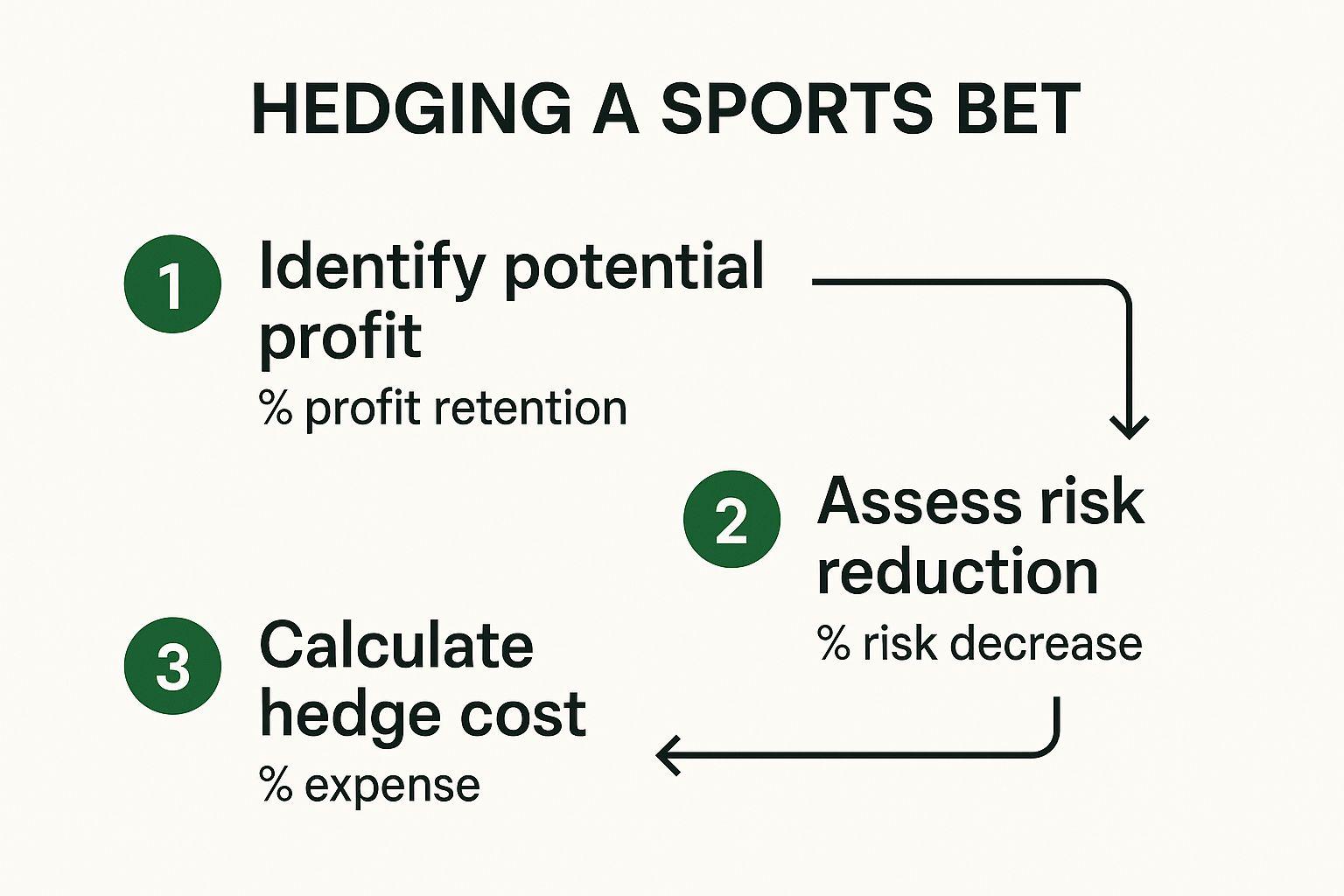
As this guide shows, a solid hedge is all about striking a balance—keeping as much profit as you can while minimizing your risk and accounting for the cost of that second bet.
Putting the Formula into Action
Theory is one thing, but let's walk through a real-world example to see how it plays out. Imagine you placed a futures bet at the very start of the tennis season.
Scenario:
- You bet $50 on Novak Djokovic to win the next Grand Slam at +1000 odds.
- He made it to the final! His opponent, Carlos Alcaraz, is listed at -120 to win the match.
First things first, we need to convert those American odds to decimal format.
- Djokovic's Original Odds: +1000 becomes 11.0 in decimal.
- Alcaraz's Hedge Bet Odds: -120 becomes 1.83 in decimal.
Your potential payout on the original Djokovic bet is $50 x 11.0 = $550. Now, we just plug that and the hedge odds into our formula:
Hedge Bet Amount = $550 / 1.83 Hedge Bet Amount = $300.55
This tells you that you need to place a bet of $300.55 on Carlos Alcaraz to win the final.
Calculating Your Guaranteed Profit
Now that your hedge bet is locked in, let's look at the two possible outcomes and see how much you've guaranteed for yourself.
If Djokovic Wins:
- Your original bet pays out: $550
- You lose your $300.55 hedge bet.
- Your total profit: $550 (payout) - $50 (original stake) - $300.55 (hedge stake) = $199.45
If Alcaraz Wins:
- Your hedge bet pays out: $300.55 x 1.83 = $550
- You lose your original $50 bet.
- Your total profit: $550 (payout) - $300.55 (hedge stake) - $50 (original stake) = $199.45
As you can see, no matter who hoists the trophy, you walk away with a guaranteed profit of $199.45. You’ve successfully turned a high-stress gamble into a sure thing.
While doing the math yourself is a great skill to have, you don't always have to crunch the numbers on your own. For quick, error-free results, you can use a dedicated online tool. To make your life easier, check out this excellent hedge bet calculator that does all the work for you. It's a fantastic resource for confirming your math, especially when you're live betting and the odds are changing by the second.
Finding Hedging Opportunities in Live Betting

While hedging futures and parlays before a game is a smart play, the real action happens in the world of live, in-play betting. This is where hedging in sports betting goes from a static calculation to a dynamic art form. The odds are constantly moving, creating a fast-paced environment that’s ripe with opportunities you simply won't find in pre-game markets.
Think of the game itself as a living thing. Every touchdown, three-pointer, or red card sends a shockwave through the odds, changing them in seconds. For a sharp bettor, these moments aren't chaos—they're signals. They are prime chances to execute a hedge and take control of your bet.
Reacting to Game-Changing Moments
The heart of live hedging is all about reacting to those pivotal moments that turn a game on its head. Maybe the pre-game favorite starts incredibly slow, or an underdog comes out with unexpected fire. This is your cue to pounce on newly inflated live odds and protect your original wager.
Let's say you bet on Team A to win a basketball game. But in the first quarter, they fall behind by 15 points, and their live odds to win suddenly shoot through the roof. By placing a smaller, live bet on Team B, you can create a scenario where you either minimize your losses if Team A can't recover or even lock in a small profit, regardless of who wins.
You have to be watching for key events that shift the odds:
- A star player gets injured: This can instantly change the entire complexion of a game and its expected outcome.
- A major momentum swing: In sports like basketball or tennis, a sudden run of points offers a brief but golden window to place a hedge.
- Unexpected weather changes: A sudden downpour in a football or soccer match can completely alter game flow, often favoring a more defensive, low-scoring style.
Locking in Profit Before the Final Whistle
Live hedging isn't just about damage control. It's also an incredible tool for securing profit when your bet is on the verge of winning.
Imagine you bet on a football underdog, and with five minutes left, they’re clinging to a three-point lead. Your pre-game ticket looks fantastic, but you know one big play could wipe it all away. This is the perfect time to hedge by placing a live bet on the favorite to make a comeback. Their odds will be generous, and a small wager can guarantee you walk away with a profit, eliminating the anxiety of a last-second heartbreaker.
Essentially, you're selling a piece of your potential winnings for the certainty of a guaranteed payout.
The rise of hedging strategies is directly tied to the explosion of live betting. This segment now accounts for a massive slice of global wagers, creating a fluid market where odds evolve with every single play. Major operators have reported handling over 140 million bets during a single tournament, showcasing the sheer volume of in-play action. This dynamic environment, with a projected compound annual growth rate exceeding 12%, is the perfect playground for hedging, allowing bettors to constantly manage risk and optimize returns. You can learn more about this trend and how advanced analytics are fueling its growth by reviewing the complete market analysis from Grand View Research.
The Keys to Successful Live Hedging
Mastering the live hedge requires more than just watching the game. The odds move so fast that you have to be prepared and decisive. There's simply no time for slow calculations or second-guessing your gut.
To pull this off consistently, you need three things:
- Speed: You have to act the second you see an opportunity. This means having your sportsbook app open, logged in, and ready to go.
- Access to Live Odds: A reliable platform with instant, real-time odds is non-negotiable. Any lag means the opportunity might vanish before you can act.
- A Pre-Game Plan: Know your numbers before the game starts. Decide on your "walk-away" profit target or the maximum loss you're willing to accept. This stops you from making emotional, panicked decisions in the heat of the moment.
Ultimately, live hedging turns you from a passive fan into an active trader. You're constantly analyzing the market, managing risk, and making moves to protect your capital and secure a return.
Real-World Hedging Strategies and Examples
Theory is one thing, but the real magic happens when you see hedging in sports betting play out in the real world. Let's step away from the abstract formulas and dive into a few stories. These scenarios show you not just how to hedge, but the thought process that turns a hopeful gamble into a calculated financial move.
By walking through these examples from the first bet to the final payout, you'll see exactly how a smart hedge can lock in guaranteed profit, no matter the outcome.
Hedging a Multi-Leg Parlay
This is the classic hedging situation and the perfect place to start. We all love parlays for their lottery-ticket payouts, but that all-or-nothing risk can be absolutely brutal.
The Setup: Imagine you’ve put together a 5-leg NFL parlay. You staked $25 at massive +2500 odds. If this miracle ticket hits, you're looking at a $650 payday ($625 profit + your $25 back).
Somehow, it happens. Your first four legs all win. Now, everything rides on the final game: the Green Bay Packers moneyline against the Detroit Lions. If the Packers win, you're golden. If they lose, you get nothing. This is the perfect time to hedge and guarantee a win. The Lions, as the underdog, are sitting at +150 odds to win.
The Hedge: You decide to protect your position by betting on the Lions. A quick calculation shows that placing $260 on the Lions at +150 creates a perfect safety net.
Let's see how this plays out:
- If the Packers Win: Your original $650 parlay cashes. You lose the $260 you placed on the Lions. Your total profit is $365 ($650 win - $260 hedge loss - $25 original stake).
- If the Lions Win: Your parlay is dead. But your $260 hedge on the Lions just won, paying out $650 ($390 profit + $260 stake). Your total profit is $365 ($650 win - $260 hedge stake - $25 original stake).
No matter who wins the game, you've locked in a $365 profit. Sure, you gave up a shot at the full $625, but you also completely eliminated the risk of walking away with nothing but a bad beat story.
Protecting a Championship Futures Bet
Futures bets are another prime candidate for hedging. You place them so far in advance that the odds can shift dramatically by the time the final event happens, creating a golden opportunity to lock in value.
The Setup: Way back before the MLB season started, you put $100 on the Arizona Diamondbacks to win the World Series at insane +8000 odds. The potential payout is a life-changing $8,100. Against all expectations, they've battled their way to the Fall Classic, where they face the Texas Rangers.
The Rangers are the clear favorites in the series, with odds of -180 to win it all. You're on the verge of a massive score, but a D-backs loss means your ticket is just a worthless piece of paper. It's time to hedge.
Hedging here isn't about losing faith in your team. It's a pragmatic financial decision to secure a significant, guaranteed return on your initial investment, removing emotion from the final outcome.
The Hedge: To secure a profit regardless of the winner, you place a large hedge bet of $4,500 on the Rangers at -180.
Here’s the breakdown of your guaranteed win:
- If the Diamondbacks Win: Your original $8,100 futures ticket cashes! After subtracting the cost of your hedge and your initial stake, your total profit is a cool $3,500.
- If the Rangers Win: Your futures bet loses, but your $4,500 hedge wins, paying out $7,000. After accounting for all your stakes, you walk away with $2,400 in profit.
You’ve successfully turned a nerve-wracking gamble into a guaranteed four-figure payday. This kind of disciplined, strategic play is a cornerstone of any successful sports betting strategy.
Using Live Odds for a Mid-Game Hedge
The explosion of live betting has opened up a whole new world for hedging. You can now react to the flow of a game and shifting momentum to protect a bet in real-time.
The Setup: You bet $200 before the game on the Los Angeles Lakers to beat the Denver Nuggets at +110 odds. The Lakers come out on fire, building a 12-point lead by halftime. Naturally, their live odds to win have tanked. At the same time, the Nuggets' odds to mount a comeback have drifted out to an attractive +250.
You still feel good about your Lakers bet, but you're a veteran fan. You know the Nuggets are famous for second-half surges. So, you decide to hedge and lock in a small, guaranteed profit.
The Hedge: You quickly place a $100 live bet on the Nuggets at +250.
Let's look at the two possible futures:
- If the Lakers Win: Your original $200 bet pays out $420. After subtracting your losing hedge, you're left with a net profit of $120 ($220 win - $100 hedge loss).
- If the Nuggets Win: Your pre-game bet loses. But your $100 live hedge on the Nuggets cashes for $350. After subtracting your original lost stake, you still make a $50 profit ($250 win - $200 original loss).
Globally, bettors in Europe have mastered these techniques. Holding over 41% of the sports betting market, the continent's sophisticated in-play platforms allow fans in places like Italy and Germany to execute these kinds of real-time hedges instantly. This advanced betting culture has led to staggering betting volumes, with over £850 million wagered during some UEFA tournaments. You can dig deeper into these global betting trends in this market research report from Econ Market Research.
Common Questions About Hedging Bets
As you start exploring the world of hedging in sports betting, it's perfectly normal to have a few questions. This strategy is incredibly powerful, but it definitely has its own quirks and common misunderstandings. Getting these cleared up is crucial if you want to use hedging effectively and responsibly.
Let's walk through some of the most frequent questions bettors ask, with straight-to-the-point answers to help you build a solid understanding of this vital risk-management tool.
Is Hedging a Guaranteed Way to Make Money?
This is easily the most common question, and the answer is a hard no. Hedging is a risk management strategy, not some secret formula for printing money. You can only hedge a bet into a guaranteed profit if your original bet has already become much more likely to win.
Think of it this way: hedging is your reaction to a great situation. Maybe your longshot futures bet is now just one game away from cashing, or your parlay is down to its final, winning leg. At that moment, your ticket is a valuable asset. Hedging is simply how you "cash out" a piece of that value for a guaranteed, smaller return.
You can't just place a random bet and immediately hedge it for a profit. The opportunity has to be created first by shifting odds and a smart initial wager.
How Is Hedging Different From Arbitrage Betting?
While they might look similar on the surface—both involve betting on opposing outcomes—hedging and arbitrage betting are fundamentally different. Their purpose and timing are worlds apart.
- Hedging is a reactive strategy. You do it to protect a bet you already made that has since increased in value. The goal is to either lock in a profit or cut your potential losses on an event that's already in motion.
- Arbitrage Betting is a proactive strategy. It’s all about finding and exploiting small differences in odds offered by various sportsbooks before an event starts. An "arber" will place simultaneous bets on every possible outcome across different books to guarantee a small, risk-free profit, no matter who wins.
The key difference is the starting point. Hedging starts with one bet that's going your way. Arbitrage starts by finding a pricing error in the market itself.
Can Sportsbooks Ban You for Hedging?
Generally, no. Sportsbooks won't ban or limit you for basic hedging. Cashing out a successful futures bet or the last leg of a parlay is seen as a normal, strategic part of sports betting. They get that you're just managing your own risk on a bet you placed.
Where you can run into trouble, however, is if your activity starts to look like arbitrage betting. Constantly placing bets on both sides of a game, especially across sportsbooks owned by the same parent company, can raise some red flags.
A one-off hedge on your Super Bowl futures ticket is totally fine. But patterns that look like you're systematically exploiting odds are what sportsbooks really don't like.
Common Mistakes to Avoid When Hedging
Even with a perfect opportunity, it's surprisingly easy to mess up a hedge. Knowing these common pitfalls is the first step to avoiding them and protecting your bankroll. A poorly executed hedge can be much worse than not hedging at all.
These errors usually boil down to bad math, bad timing, or letting emotions get the best of you.
Miscalculating the Hedge Bet
This is the most critical mistake. If you get the math wrong on your hedge stake, you can accidentally create a situation where you lose money no matter what happens. Always, always double-check your calculations, especially when you're feeling the pressure of a live game. Using a trusted hedge calculator can be a lifesaver here.
Hedging Too Early
Patience is a virtue, and that's especially true with hedging. If you hedge a futures bet way too early in the season or a parlay with multiple legs left, you slash your potential profit. You end up sacrificing a massive potential payout for a tiny guaranteed win. It's almost always better to wait until your bet is as close to the finish line as possible to get the most value from your hedge.
Letting Emotion Drive Decisions
Panic is a hedge killer. Don't rush to hedge just because your team goes down by a touchdown in the first quarter. On the flip side, don't let greed stop you from locking in a solid profit because you're obsessed with the maximum possible payout. A smart hedge is based on cold, hard numbers, not fear or wishful thinking.
Forgetting About the "Vig"
Remember, the house always takes a cut. That's the vigorish, or "vig." When you hedge, you're placing a second bet, which means you're paying the vig a second time. This built-in fee eats into your overall profit. You have to factor it in to make sure your "guaranteed" profit is still worth it after the sportsbook takes its commission from both sides.
Ready to stop guessing and start making data-driven decisions? ValueBetFactory uses advanced algorithms to find odds discrepancies and highlight valuable betting opportunities for you. Empower yourself with real-time alerts, betting calculators, and the educational resources needed to bet smarter. Explore our plans and start your free trial today at ValueBetFactory.com.