
A Bettor's Guide to Clean Sheet Odds in Football
Unlock Profits with betting tips!
Clean sheet odds are all about a team's defensive grit. Forget who wins for a moment. This popular betting market asks a much simpler question: can one team completely shut out the other and prevent them from scoring a single goal?
It's a fantastic alternative to just picking a winner because it rewards a different kind of analysis, one focused entirely on defensive strength, tactical discipline, and a team's ability to lock down a game.
What Are Clean Sheet Odds in Football Betting
Moving beyond the usual win-draw-win markets, clean sheet betting lets you focus purely on defensive mastery. In football, a "clean sheet" is exactly what it sounds like: a team finishing a match without conceding a single goal. It doesn't matter if the final score is a tight 1-0, a dominant 5-0, or a goalless 0-0 draw, if the goal line isn't breached, the defense has kept its sheet clean.
The clean sheet odds you see on a sportsbook are just the bookmaker's calculated probability of that happening. For bettors, this opens up a whole new angle. Instead of trying to figure out which team has the more explosive attack, the question becomes: which team has the more impenetrable defense?
This infographic breaks down how a team's defensive organization is the absolute bedrock of a successful clean sheet bet.
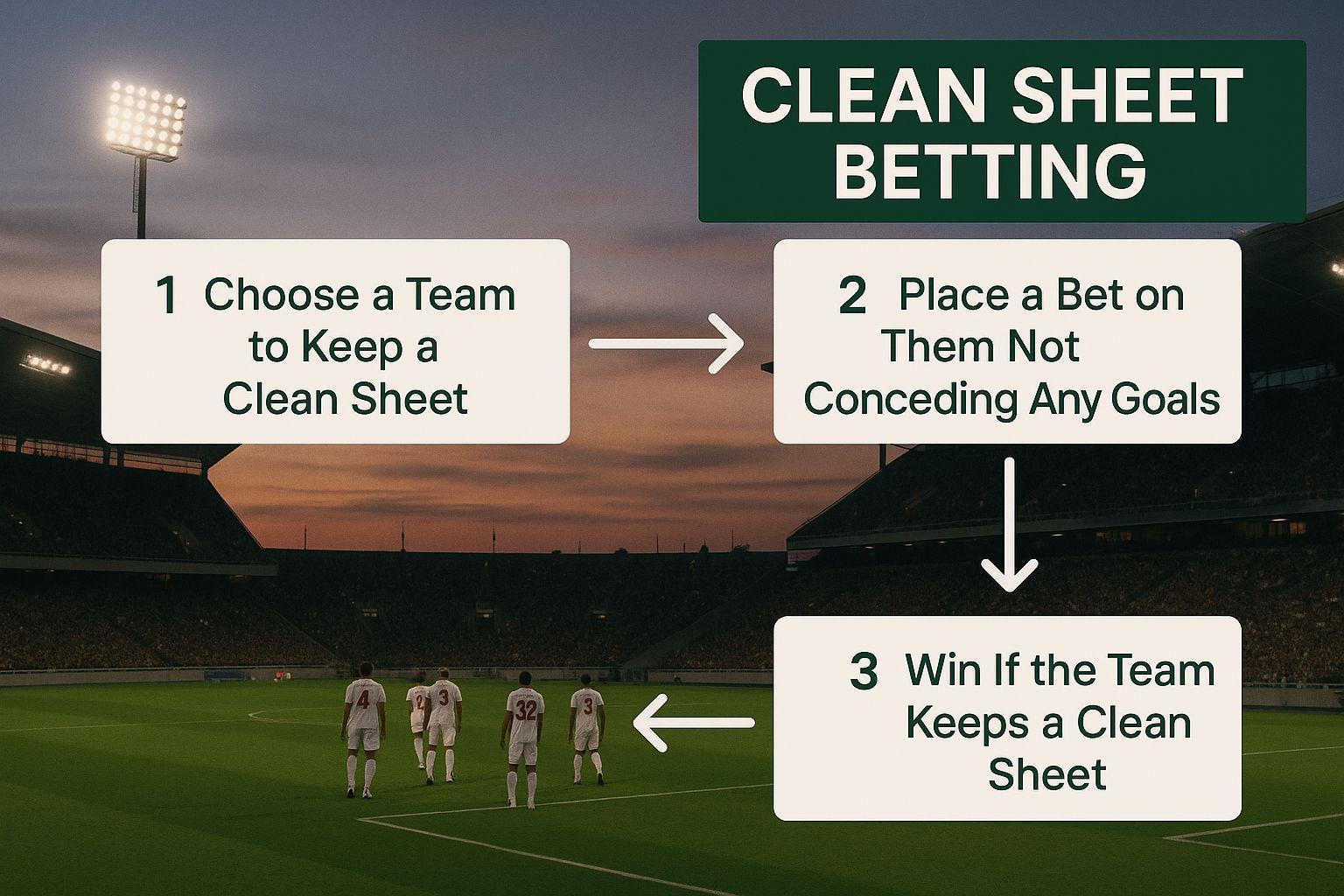
As the image shows, a successful bet here isn't about luck; it's about backing a well-drilled defensive unit. That's the core concept you need to grasp.
The Two Sides of the Bet
One of the best things about this market is its simplicity. For any given team in a match, you're faced with a straightforward "Yes" or "No" choice. This binary option makes your research focused and the outcomes crystal clear.
- Clean Sheet 'Yes': You're betting that a specific team will not concede a goal. This is a great angle when a defensively rock-solid team is playing a weak or out-of-form attacking opponent.
- Clean Sheet 'No': You're betting that a specific team will concede at least one goal. This is often a smart play in matches where both teams are known for their attacking flair, or when a strong attack faces a leaky defense.
The real appeal of clean sheet betting is its focus. It strips away all the noise of predicting exact scores or who will score first, letting you concentrate on one thing: one team's ability to defend for 90 minutes.
To get a sense of the numbers, the very best defenses in Europe's top leagues typically keep a clean sheet in about 40-50% of their matches. Over a 38-game season, that means the top teams will pull off somewhere between 15 and 20 shutouts.
On the other end of the spectrum, relegation-threatened sides often struggle to keep clean sheets in even 10% of their games. You can dig into these kinds of defensive stats on sites like WinDrawWin. This guide will teach you how to analyze these patterns to find real, valuable betting opportunities.
For a quick reference, this table summarizes the key components of clean sheet betting.
Clean Sheet Betting Quick Guide
| Concept | Description | Example |
|---|---|---|
| Market Type | A "Yes/No" wager on whether a specific team will concede any goals during the match. | Betting on "Manchester City - Clean Sheet: Yes" against Burnley. |
| Key Factors | Defensive form, player injuries, tactical matchups, and historical head-to-head records. | A team missing its star center-back and goalkeeper is a major red flag. |
| Ideal Bettor | Someone who enjoys deep statistical analysis and focuses on team tactics over individual brilliance. | A bettor who studies defensive metrics like xGA (Expected Goals Against). |
This table provides a solid foundation, showing that success in this market is built on careful analysis rather than just gut feeling.
How Bookmakers Calculate Clean Sheet Odds
Ever wonder how bookmakers come up with their clean sheet odds? They don't just pull numbers out of thin air. It’s a sophisticated process that uses complex algorithms to crunch massive amounts of data.
Think of it like a weather forecast. A meteorologist doesn't just stick their head out the window to predict rain; they analyze historical patterns, atmospheric pressure, and wind speeds. Bookies do something very similar, but instead, they're creating a "defensive forecast" for a football match.
This process kicks off with a deep dive into the stats, focusing on specific defensive metrics that truly reveal a team's ability to shut out their opponents. They aren't just looking at wins and losses.
The Core Data Points
The entire foundation of the odds is built on hard numbers. Bookmakers weigh a few key factors, with a heavy emphasis on recent performance. After all, a team's current form is a much better predictor than what they did two seasons ago.
Their models are primarily fed with:
- Goals Conceded Per Game: This is the most straightforward metric, giving a baseline for how leaky a defense typically is.
- Shots on Target Faced: This goes a layer deeper. It shows how often a team's keeper is being forced to make a save. A side that gives up very few shots on target is likely well-organized and defensively solid.
- Head-to-Head Records: History matters. Some teams just have a tactical blueprint that consistently stifles a particular opponent, and the odds will always reflect that pattern.
These stats create the initial baseline. From there, the bookmaker starts adding in the human element, tweaking the odds like a chef adjusting a recipe.
Adjusting for Real-World Factors
A statistical model on its own is never enough. The biggest adjustments to clean sheet odds come from real-time news, especially when it comes to player availability. A single injury or suspension can completely rewrite a team's defensive script.
Imagine a fortress losing its main gatekeeper. The structure is still there, but its ability to repel an attack is seriously compromised. An injury to a star center-back or an elite goalkeeper has the same effect on a football team's defense.
Bookmakers react to this kind of news in a flash. If a team's best defender is suddenly ruled out, you’ll see the odds for them to keep a clean sheet lengthen (increase) almost instantly. Why? Because the implied probability of them conceding a goal just shot up.
You can learn more about how bookies use data to set their lines and then adjust them in our guide on how we calculate no-vig fair odds. Understanding this process helps you look past the surface-level numbers and spot where the real value might be hiding, giving you a chance to capitalize on discrepancies between the bookie's price and a team's actual defensive strength.
Mastering Defensive Strength Analysis
To find real, consistent value in clean sheet odds, you need to start thinking like a defensive coordinator, not just a casual fan. The first step is to move beyond the simple win/loss record. True analysis means digging into the kind of metrics that show a team's actual ability to shut down scoring chances, not just what the final scoreboard says.

This is all about building a complete defensive profile for any team you're thinking of backing. When you start combining the right statistical indicators, you can make sharp, data-driven decisions that are miles ahead of relying on gut feelings or a team's old reputation.
Going Beyond Goals Conceded
The most basic stat, goals conceded, only gives you a tiny piece of the puzzle. A team might let in two goals from just two shots one week and still be defensively rock-solid. A much more powerful metric to start with is Expected Goals Against (xGA).
Think of xGA as a quality control report for a defense. It doesn't just tally up the goals that went in; it measures the quality of every single chance the other team created. A low xGA tells you a defense is elite at preventing high-quality shots.
A team that consistently keeps its xGA low is well-organized and tough to break down, even if they get unlucky once in a while. On the flip side, a team with a high xGA is constantly bleeding dangerous chances. They're probably a poor bet for a clean sheet, no matter what their last result was. If you want to go deeper on this, our guide on using statistics for sports betting breaks these advanced metrics down even further.
The Goalkeeper Effect
Even the most organised backline can be ruined by a shaky goalkeeper, or elevated to a whole new level by an elite one. The keeper is the final, and often most critical, line of defense. Their individual skill can have a massive impact on clean sheet odds.
A top-tier keeper does more than just stop shots. They command their penalty area, organize the defenders in front of them, and start attacks to relieve pressure. Their presence alone can be a huge psychological boost for the whole squad.
The perfect case study is Premier League legend Petr Cech. His incredible career is a masterclass in how much a world-class goalkeeper can shape a team's defensive record and their knack for securing shutouts.
- Petr Cech holds the all-time Premier League record with 202 clean sheets.
- Over his career, he averaged just under 17 clean sheets per season, a stunning display of consistency.
- To put that in perspective, most top-flight keepers are considered successful if they even hit double-digit clean sheets in a season.
Whenever you're sizing up a team's defensive strength, always factor in the goalkeeper's form and ability. An injury to the number one keeper or a sudden dip in performance should be a major red flag. By blending tactical analysis with an appreciation for individual brilliance, you build a powerful framework for finding real value in clean sheet odds.
Proven Strategies for Finding Betting Value
Alright, you've got a handle on the defensive metrics that matter. Now it's time for the fun part: putting that knowledge to work. Spotting value in the clean sheet market isn't about some secret formula. It’s about applying smart, proven strategies to find those moments where a bookmaker’s price just doesn't line up with a team's real defensive strength.
Think of yourself as a stock investor hunting for an undervalued company. The rest of the market might just see a team's ugly league position, but your deeper analysis reveals a rock-solid defensive unit that everyone else is sleeping on. This is the very heart of finding real, actionable betting value.
Bet on Defensive Underdogs
One of the most reliable ways to find an edge is to back "defensive underdogs." These are teams whose league standing might scream mediocrity, but whose underlying defensive numbers are telling a completely different story. Most people bet on reputation and league position, which often inflates the odds for these well-organized, mid-table sides.
For example, a team stuck in 14th place might have a surprisingly low Expected Goals Against (xGA) number, meaning they just don't give up good scoring chances. If they’re playing at home against another mid-table team with a hit-or-miss attack, the "Clean Sheet: Yes" odds could be a fantastic find. The market is pricing them based on their league position, not their actual defensive grit.
Fading High-Powered Offenses
This one feels a bit counterintuitive, but it can be incredibly profitable. "Fading" a team just means betting against them. In this case, you're betting that a team famous for its goal-scoring firepower will draw a blank. The trick is to pinpoint specific tactical matchups that can completely neutralize their biggest threats.
A top team that lives and dies by its speedy wingers might run into a brick wall against a deep-sitting, compact defensive block that gives them zero space to operate.
- Look for disciplined teams that set up in a low-block 5-4-1 formation.
- Check if the attacking powerhouse is missing a key creative player through injury or suspension.
- See if the attacking team has a poor track record against defensively-minded coaches.
Even the best attacks can be stifled. Just look at Arsenal, they've shown the ability to completely suffocate opponents, sometimes holding them to just three shots or less in an entire Premier League match. Finding the right defensive system to frustrate a top offense is a cornerstone of this strategy.
Capitalizing on In-Play Betting Odds
The clean sheet market doesn't just disappear at kick-off. In-play betting offers a dynamic, constantly shifting landscape where you can find value as the game unfolds. The odds react in real-time to the flow of the match, creating opportunities that simply didn't exist pre-game.
In-play betting is like a chess match against the bookmaker. You're reacting to live events, looking for moments where the odds shift too dramatically based on temporary momentum rather than a fundamental change in defensive stability.
Imagine a heavy favorite concedes an early, fluky goal against the run of play. Suddenly, the odds for their opponent to keep a clean sheet will plummet. But if your pre-match analysis told you the favorite was likely to dominate, you could bet "Clean Sheet: No" on the underdog at much better odds than you could have gotten before the match, banking on the favorite to eventually find the net. Uncovering these kinds of openings is central to the concept of value betting, which is a crucial skill to master for any serious bettor.
Of course. Here is the rewritten section, crafted to sound human-written, natural, and expert, following the provided style guide.
Sidestepping the Traps: Common Clean Sheet Betting Mistakes
Picking winners is only half the battle. The other half, the one that really separates the pros from the amateurs, is protecting your bankroll. When you're betting on clean sheet odds, a few classic pitfalls can catch even seasoned bettors off guard. Learning to spot and sidestep these mistakes is what builds the discipline needed to stay profitable long-term.
One of the easiest traps to fall into is betting on a team's reputation instead of its reality. A club that was a defensive powerhouse three seasons ago isn't automatically a fortress today. Past glories don't block shots in the present.
Forget what you think you know about a team's historic defensive strength. Instead, zero in on their current form and recent stats. How have they really looked over the last five or six matches? That gives you a much sharper, more accurate picture of their ability to shut a team out right now.
Ignoring Crucial Team News
Another huge, bankroll-draining mistake is glossing over injuries and suspensions. A team's defensive solidity isn't just about the manager's system; it's about the specific players who make that system work. Take out a key center-back or the first-choice keeper, and that once-sturdy backline can suddenly look incredibly fragile.
Before you even think about placing a bet, make checking the latest team news a non-negotiable part of your routine. A defense missing its leader is a completely different animal, and the odds might not have fully caught up to that fact. This is where you can either avoid a terrible bet or find a great one on the other side.
A team's defensive unit is like a finely tuned machine. Removing one crucial cog, like a dominant central defender, can cause the entire system to break down under pressure.
Always remember that one player's absence can be the difference between a gritty shutout and conceding a couple of soft goals. This simple five-minute check can save you from making a bet based on old, incomplete information.
Confusing Winning with Defending
This one is a biggie. It's so easy to assume that a team that wins a lot is also great defensively, but that’s a dangerous leap in logic. A top-tier club might win a match 4-2, but for a clean sheet bettor, that result is a stone-cold loser.
Winning and defending are two entirely different skills. Plenty of teams rely on simply outscoring their problems, knowing they have the firepower to win even if they concede a goal or two. Your job is to tell the difference between the high-flying entertainers and the disciplined teams that grind out tough 1-0 victories.
To avoid this trap, you have to look at the right numbers.
- Goals Conceded: How many goals are they letting in, even in the games they win?
- Expected Goals Against (xGA): Are they actually limiting good chances, or are they just getting lucky?
- Tactical Approach: Do they set up to be defensively solid, especially against tough opponents? Do they sit in a low block and invite pressure, or are they constantly on the front foot?
Focusing on these details will help you pinpoint the teams that are genuinely built to keep a clean sheet, not just the ones who are good at winning. By sidestepping these common errors, you'll protect your capital and start making much smarter, more informed bets.
Clean Sheet Odds FAQs
It’s only natural to have a few questions, even after you’ve got a handle on the main strategies. It’s a great market, but some of the nuances can be a bit tricky at first.
This section is all about clearing up those common sticking points. Think of it as a quick reference guide to help you build confidence before you put your money down.
What's the Difference Between a 'Clean Sheet Yes' and 'Clean Sheet No' Bet?
This is the core choice you'll make. A ‘Clean Sheet Yes’ bet is exactly what it sounds like: you're betting that a specific team will not concede a single goal for the entire 90 minutes plus injury time. If they win 1-0, 5-0, or even draw 0-0, your bet is a winner. As long as their goal line isn't breached, you get paid.
On the flip side, a ‘Clean Sheet No’ bet is a wager that the same team will concede at least one goal. The final score is irrelevant. Whether the team you bet against loses 2-1 or wins 4-1, your bet comes in. All you need is for their opponent to find the back of the net just once.
Are Clean Sheet Odds Better for Home or Away Teams?
As a general rule, home teams will have much shorter odds (meaning they are more likely) to keep a clean sheet. Home-field advantage is a very real factor in football, influencing everything from defensive organization and player confidence to subconscious referee bias. The comfort of familiar surroundings and the roar of a home crowd often give a defense that extra bit of steel.
Because of this, you’ll almost always find much more attractive, higher odds on an away team to keep a clean sheet. It's a tougher ask. Teams are statistically far more vulnerable on the road, which makes predicting an away shutout a riskier, but potentially much more rewarding, bet.
It really comes down to your appetite for risk. Backing a strong home favorite offers a more probable, lower-paying outcome. Finding a disciplined underdog playing away from home, however, can present a fantastic opportunity for value.
How Do Player Injuries Affect Clean Sheet Odds?
Injuries can completely blow up clean sheet odds, especially when key defensive players are involved. Losing a rock-solid starting goalkeeper or a dominant, vocal center-back can instantly destabilize a team’s entire defensive structure.
When a crucial player is ruled out, bookmakers react immediately. They'll quickly lengthen (increase) the odds on that team keeping a clean sheet because the perceived risk has shot up. This is why checking the latest team news and injury reports right before a match is absolutely non-negotiable for making a smart bet.
Can I Combine Clean Sheet Bets with Other Markets?
Yes, you absolutely can, and it's a very popular strategy. Modern sportsbooks offer features like a ‘Bet Builder’ or ‘Same Game Parlay’ that let you bundle multiple bets from one match into a single wager.
One of the most common combinations is to pair a ‘Clean Sheet Yes’ bet with a ‘Match Winner’ bet. For instance, you could place a bet on ‘Team A to Win to Nil’. This single wager requires two things to happen: Team A must win the match, and they must keep a clean sheet (e.g., win 1-0, 2-0, 3-0, etc.). Combining bets like this dramatically increases the odds and your potential payout, but it also increases your risk since both parts of the bet must be successful.
Ready to stop guessing and start making data-driven decisions? ValueBetFactory uses advanced tools to scan the odds and alert you to potential value betting opportunities in real-time. Start your free trial today and bet smarter.