
Can you make a living betting on sports: practical guide
Unlock Profits with betting tips!

Yes, you can make a living betting on sports, but let's be crystal clear: it's a reality for a tiny, brutally disciplined minority. Think of it less like a thrilling hobby and more like a data-driven business, similar to financial trading. This is not a get-rich-quick scheme; it's a demanding profession that requires immense dedication.
The Reality of Professional Sports Betting
For most people, sports betting is pure entertainment where the house almost always wins. The dream of turning a passion for sports into a steady income is powerful, but the path is littered with far more failures than successes. What separates the tiny fraction of profitable bettors from the rest isn't luck or superior sports knowledge alone; it's a fundamental difference in mindset, strategy, and execution.
A recreational bettor might throw money on their favorite team for the emotional rush. A professional, however, approaches each bet as a calculated investment, completely detached from personal bias. They operate like a business, focusing on long-term growth rather than the thrill of a single win.
To frame this discussion, let's look at the core differences between these two worlds.
Professional vs. Recreational Bettor At a Glance
| Aspect | Professional Bettor | Recreational Bettor |
|---|---|---|
| Primary Goal | Consistent, long-term profit. | Entertainment, excitement, the thrill of winning. |
| Mindset | Analytical, objective, treats it like a business. | Emotional, biased, follows gut feelings or team loyalty. |
| Bet Selection | Finds a mathematical edge (+EV), ignores everything else. | Picks who they think will win, often on popular teams. |
| Staking Plan | Strict bankroll management (e.g., Kelly Criterion). | Bets random amounts, often chases losses. |
| Success Metric | Long-term Return on Investment (ROI). | Short-term wins and losses. |
| Tools Used | Data models, odds comparison software, tracking sheets. | TV commentary, public opinion, basic stats. |
| Reaction to Loss | Sticks to the process, understands variance. | Gets frustrated, makes impulsive bets. |
This table immediately highlights the chasm between gambling for fun and betting for a living. One is a pastime; the other is a full-fledged profession demanding structure and discipline.
Why Most Bettors Lose
The entire sports betting industry is built on a mathematical advantage for the sportsbook, often called the "vig" or "juice." This built-in commission ensures that, over time, the house collects more money than it pays out. The numbers clearly illustrate this challenge.
Making a living from betting is statistically brutal. In a recent year, the legal U.S. sports betting market saw $93.3 billion wagered, with sportsbooks generating $9.27 billion in revenue. This represents a "hold rate" of about 10.1%, meaning for every $100 bet, the house keeps roughly $10. You can explore more data on US betting revenue to understand the market better.
Professionals estimate that only 1-5% of bettors achieve consistent, long-term profitability. Even for them, the returns are often modest and hard-earned.
What Makes the Top 1% Different
So, what does it take to join that elite group? It comes down to a few core principles that professionals live by, which are entirely foreign to the average gambler. These principles form the bedrock of a viable betting career.
Key differentiators include:
- Mathematical Edge: They only place bets when they have a quantifiable, positive expected value (+EV).
- Bankroll Management: They treat their betting funds as business capital, using strict staking plans to manage risk.
- Emotional Discipline: They remain unfazed by both winning and losing streaks, sticking to their process no matter what.
- Constant Analysis: They track every wager, analyze their performance, and relentlessly refine their strategies.
The professional bettor isn't trying to predict the future. They are trying to find pricing errors in the market and exploit them systematically over thousands of trials.
Ultimately, the journey to becoming a professional bettor is less about picking winners and more about mastering risk, managing capital, and maintaining unwavering discipline in the face of statistical variance.
Understanding the Math That Actually Wins
If you want to make a living betting on sports, you have to stop thinking like a fan and start thinking like a financial analyst. Forget gut feelings and team loyalty. Winning isn't about just picking who wins the game; it’s about mastering the cold, hard math that separates the pros from the 97% of people who lose money.
The entire sports betting market is built on one simple truth: the sportsbook has to make its cut. They do this with a built-in commission on every single wager, known as the “vig” or “juice.” This is the house’s advantage, and it’s the first mathematical wall every serious bettor needs to climb.
Overcoming the House Edge
Think about a simple coin flip. The real odds are 50/50, which in betting terms is even money (+100). Bet $100, win, and you get your stake back plus $100 profit. Simple. If bookies offered these "true" odds, they'd break even over the long run.
But they don't. For that same coin flip, they'll offer you odds of -110 on both heads and tails. This means you have to risk $110 just to win $100. That extra $10 is the vig. Because of this, you don't need to win 50% of your bets to break even. You actually need to win 52.38% of them. That small, almost hidden difference is the engine that guarantees sportsbooks stay profitable.
The professional's job isn't to beat the team on the field. It's to beat the math baked into the odds. You have to consistently find spots where your calculated chance of something happening is higher than the chance implied by the sportsbook's price.
This idea is the bedrock of professional betting and leads us straight to the most important principle of all.
Finding Positive Expected Value
At its core, winning at sports betting boils down to one thing: consistently placing bets with positive expected value (+EV). Expected value is just a way of measuring what you can expect to win or lose, on average, for every dollar you bet. It’s the engine that drives all long-term profit.
Let’s use another coin flip, but this time with a twist. A bookie offers you +110 odds (bet $100 to win $110) on a coin landing on heads. The implied probability of those odds is about 47.6%. But you have some inside info: this coin is slightly weighted and actually lands on heads 50% of the time.
That gap between the true probability (50%) and the bookie's implied probability (47.6%) is your edge. Making this bet over and over again is a +EV decision. Sure, you'll lose plenty of individual flips, but over hundreds or thousands of them, the math guarantees you will come out ahead. If you really want to get into the weeds on this, our detailed guide on the meaning of expected value in sports betting breaks down all the numbers.
The infographic below shows how this data-first approach, combined with rock-solid discipline, grinds out a profit over time.
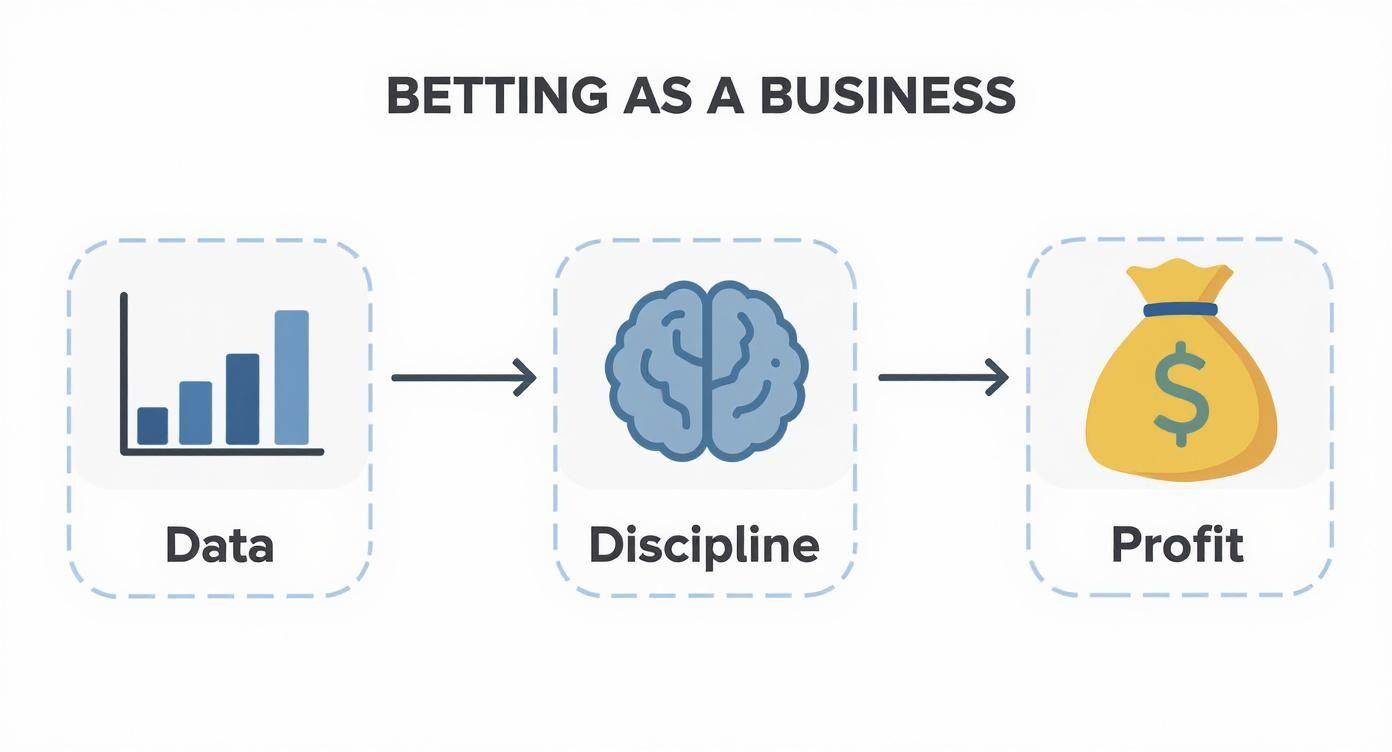
This process makes it clear: betting for a living is a systematic, numbers-driven operation, not a game of chance.
What Is a Realistic ROI?
People new to betting often dream of doubling their bankroll every other week. The reality is far more grounded. A professional bettor’s Return on Investment (ROI) is usually in the low single digits. A steady, consistent ROI of 3-5% is considered excellent and is what you should be aiming for.
A 4% ROI might not sound like much on a single $100 bet; that’s just a $4 profit. But its power comes from volume. When you apply that small edge across thousands of wagers over the course of a year, it transforms into a substantial income. It's the slow, methodical grind of exploiting a small mathematical advantage that builds a real career.
Your Bankroll Is Your Business

If finding a mathematical edge is the engine of professional betting, then your bankroll is the high-octane fuel that keeps it running. Without disciplined financial management, even the sharpest betting model will eventually crash and burn. This is the single biggest reason why most aspiring pros fail.
To make it, you have to stop thinking of your betting money as a slush fund for entertainment. A professional's bankroll is their business capital; a dedicated and protected pool of funds. It's the firewall that shields you from ruin during the inevitable downswings that every single bettor on the planet experiences.
Think of it like a business managing its inventory. A store owner wouldn't risk their entire stock on a single sale, no matter how confident they were. In the same way, a professional bettor never risks a significant chunk of their capital on one game.
Building Your Financial Firewall
Effective bankroll management isn't just a good idea; it's a non-negotiable requirement for survival. The core of this is putting a strict staking plan in place, which is just a set of rules that dictates how much you'll risk on any given bet. This is what removes emotion and guesswork from your financial decisions.
A well-defined staking plan ensures that a losing streak, which will absolutely happen, only causes a manageable dip in your funds, not a catastrophic wipeout. It keeps you in the game long enough for your mathematical edge to pay off. For a deeper dive into these strategies, you can learn more about the essentials of sports betting bankroll management and how to apply them.
Your staking strategy is the difference between a calculated investment and a reckless gamble. It's the system that protects your business from its single greatest threat: yourself.
Without this discipline, you are simply a gambler waiting to go broke. It doesn't matter how good you are at picking winners; poor financial controls will always win in the end.
Common Staking Strategies Explained
There are several proven methods for managing your capital, each with its own approach to risk. The key is to pick one and stick to it with unwavering consistency. Here are a few of the most common plans used by professionals.
Flat-Staking: This is the simplest method and often the best for beginners. You risk the exact same amount, or "unit," on every single bet, no matter your confidence level or the odds. For example, you might decide one unit is 1% of your total bankroll.
Percentage Staking: This is a dynamic version of flat-staking. Your bet size is always a fixed percentage (e.g., 1%) of your current bankroll. When your bankroll grows, your unit size increases; when it shrinks, your unit size decreases, providing a natural buffer against losses.
The Kelly Criterion: This is a more advanced strategy that calculates the optimal bet size based on both your perceived edge and the odds. The goal is to maximize long-term bankroll growth, but it can be more volatile and requires an extremely accurate assessment of your edge to be effective.
Let's compare these approaches with a simple example. Imagine you have a $10,000 bankroll.
| Staking Method | Bet Size (Unit) | Risk per Bet | Notes |
|---|---|---|---|
| Flat-Staking | 1% of initial bankroll | $100 | Simple and stable, but doesn't adapt to bankroll changes. |
| Percentage Staking | 1% of current bankroll | $100 (initially) | Adapts to wins and losses, protecting capital during downturns. |
| Kelly Criterion | Variable % based on edge | Varies | Maximizes growth but is higher risk and complex to implement. |
Regardless of the method you choose, the goal is the same: to systematize your risk. By defining your unit size as a small fraction of your total capital, typically between 1% and 3%, you build the resilience needed to withstand variance and allow your edge to materialize over the long haul. This is the bedrock of a sustainable betting career.
How to Survive the Inevitable Losing Streaks
Let's get one thing straight: even if you have a proven mathematical edge, the road to making a living from sports betting isn't a smooth, upward climb. It’s a brutal, chaotic path filled with gut-wrenching downturns. You will face long, demoralizing losing streaks that make you question every single thing about your strategy. This is the reality of variance.
Variance is just a statistical term for the natural ups and downs you find in anything based on probability. Think of a star baseball player, a career .300 hitter. Over a full season, he'll probably land right around that number. But along the way, he'll have slumps where he goes 0-for-20. He didn’t suddenly forget how to hit; he's just on the wrong side of short-term luck.
Your betting career will be no different. You can make twenty perfectly calculated, +EV bets in a row and lose fifteen of them. That’s not a sign your process is flawed; it's a statistical certainty.
The Mental Gauntlet of a Downswing
A losing streak, or "downswing," is the ultimate test of a professional bettor’s discipline. When you see your bankroll shrinking day after day, doubt and fear start to creep in. This is the exact point where most aspiring pros break. They abandon their proven strategy, start chasing losses with bigger bets, or get too scared to place any wagers at all.
Surviving this psychological gauntlet requires a level of emotional resilience that is every bit as important as your analytical skills. You have to learn to separate your process from the outcome.
A good bet can lose, and a bad bet can win. Your job is to consistently make good bets, regardless of the short-term noise. Trust the math, not your emotions.
This mental fortitude is what separates the pros from the amateurs. While the recreational bettor is strapped into an emotional rollercoaster, the pro remains steady, executing their plan with the cool detachment of a surgeon.
Why Sticking to the Plan Is Everything
When you're in the middle of a brutal losing streak, every instinct will scream at you to change something, anything. But if your strategy is built on solid math, the worst thing you can possibly do is panic. Your bankroll management and staking plan were designed for exactly this scenario. They are your storm shelter.
Just look at the enormous scale of the market you're up against. In a recent year, the commercial gaming industry raked in $72.04 billion in revenue, and that number keeps climbing. This growth isn't because it's getting easier to win; it's because more people are betting. In a single month, Americans wagered $12.1 billion on sports, and the sportsbooks kept $1.37 billion of it. That's an 11.3% hold, a massive mathematical advantage you're fighting. You can see the full breakdown in the American Gaming Association’s revenue tracker.
These numbers prove that your edge is small and will only show itself over a huge sample size. If you abandon your strategy during a downswing, you guarantee you'll never reach the long run where your edge finally pays off. You have to develop an unshakable faith in your process and the discipline to see it through the inevitable storms.
The Modern Bettor's Toolkit for Finding an Edge
Professional sports betting is no longer a world of gut feelings and intuition. Forget that. It’s now a technology-driven pursuit, and if you want to make a living betting on sports, you need to arm yourself with tools that can identify, analyze, and exploit market inefficiencies faster and more accurately than the average person.
This isn't about hunches; it's about building a data-driven operation. The modern bettor’s advantage comes from specialized software that automates research and executes bets with precision. Trying to compete without these tools is like a stock trader showing up to work without access to market data or charting software; you're flying completely blind against pros with a massive technological head start.
Automating the Search for Value
The absolute cornerstone for any serious bettor is an odds comparison tool. These platforms are constantly scanning dozens of sportsbooks in real-time, instantly showing you who offers the best price for any given bet. Consistently getting the best odds can single-handedly be the difference between a losing and a winning year.
But it goes beyond just finding the best price. Advanced software helps you find actual mathematical value. These systems use powerful algorithms to compare sportsbook odds against a razor-sharp, calculated "true" probability line. When a sportsbook’s price is significantly higher than the true odds, the software flags it as a profitable opportunity. This automates the hunt for the +EV wagers that are the absolute lifeblood of a professional. If you want to go deeper, you can find a complete explanation of how to apply the principles of value betting with these tools.
The goal isn’t just to get a good price; it’s to get a price so good that the underlying math is tilted in your favor. Technology makes finding these opportunities possible at scale.
Essential Software for Your Arsenal
Building a professional workflow isn't about finding one magic piece of software. It’s about creating a suite of tools that work together to manage your entire betting operation, from initial research right through to performance analysis.
Below is a breakdown of the essential toolkit every aspiring pro needs to build. These are the tools that turn betting from a haphazard guessing game into a systematic, data-driven business.
| Tool Category | Primary Purpose | Example(s) |
|---|---|---|
| Odds Comparison & Value Finders | Instantly find the best odds and identify +EV bets by comparing bookmaker lines to a sharp market price. | RebelBetting, Oddschecker |
| Bet Tracking Software | Automatically record and analyze every bet you place, providing crucial data on your performance and strategy. | Trademate Sports, Bet Analytix |
| Advanced Calculators | Handle complex math on the fly, such as calculating implied probability, expected value, or arbitrage. | AceOdds, various online tools |
| Data Providers | Access clean, reliable historical data for building your own statistical models and finding a unique edge. | StatsBomb, Opta |
By integrating these tools, you transform your betting into a systematic process. You’re no longer guessing; you’re analyzing your performance, identifying strengths and weaknesses in your strategy, and continuously refining your approach based on cold, hard data. This is the toolkit that truly separates the aspiring amateur from the working professional.
The Hidden Realities of a Betting Career
Figuring out how to win bets is only half the battle. If you're serious about making a living from sports betting, you have to look past the spreadsheets and algorithms. The day-to-day reality is an operational grind, filled with hurdles that have absolutely nothing to do with picking the right team.
This is the part that blindsides most aspiring pros. They master the math, build a solid bankroll, and find a real edge, only to discover that being profitable creates a whole new set of problems. These operational realities are the final filter that separates the successful pros from the frustrated amateurs.
Navigating the Legal and Tax Minefield
The legal landscape for sports betting is a messy patchwork that can change dramatically from one state to the next. What's perfectly legal where you live might be completely forbidden just a few miles down the road. To operate legally, you have to stay on top of local regulations to avoid some pretty serious penalties.
And then there's the taxman. Your winnings are not pure profit. In most places, gambling winnings are treated as taxable income. This means a hefty slice of your hard-earned profits needs to be set aside for the government, a reality you have to build into your financial planning from day one.
Failing to account for taxes is a catastrophic business error. A 30% tax bill can turn a profitable year into a losing one if you haven't planned for it, fundamentally altering the income you thought you were making.
This kind of financial discipline is non-negotiable. You have to keep meticulous records of every single wager, wins and losses, to satisfy your tax obligations and to know what your true net profit actually is.
The Unspoken Problem Winning Bettors Face
Here's the harsh truth of the industry: most commercial sportsbooks do not want consistent winners. Their business model is built on the 95% of recreational players who lose money in the long run. The moment you prove you have a consistent edge, you become a problem for their bottom line.
This leads to the single most frustrating hurdle for any professional: getting your accounts limited or banned. A sportsbook won't send you a formal letter firing you as a customer. Instead, they'll just quietly slash your maximum bet size to trivial amounts, like $5 or $10. This makes it impossible to wager meaningful sums and effectively ends your ability to profit on their platform.
This isn't a maybe; for anyone who wins consistently, it's an inevitability.
Constantly Adapting to Survive
Because of account limitations, a professional's career becomes a constant game of adaptation. You simply cannot rely on a single sportsbook account to make a living. Survival depends on a multi-pronged approach:
- Managing Multiple Accounts: Pros have to open and maintain accounts across dozens of different sportsbooks to spread their action around and delay the inevitable limitations.
- Finding New "Outs": The search for new platforms to bet on never stops. As old accounts get limited, new ones must be ready to take their place.
- Staying Under the Radar: Successful bettors often use strategies to look more like a casual player, trying to avoid the patterns that trigger a sportsbook's risk management flags.
Ultimately, making a living from sports betting demands more than just being a sharp analyst. It requires the skills of a small business owner, a legal navigator, and a strategist who is constantly working just to maintain access to the market itself.
Frequently Asked Questions
When you start thinking seriously about professional betting, the big, practical questions quickly bubble to the surface. Let's tackle some of the most common ones that every aspiring pro asks at some point.
How Much Money Do I Need to Start Betting Professionally?
There’s no magic number here, but whatever it is, it has to be money you could afford to set on fire without flinching. A professional bankroll needs to be big enough for your standard 1-2% unit size to be meaningful, but also deep enough to survive a brutal downswing of 20-30 units.
The real key is to prove your edge first. Start with a smaller, manageable bankroll and show you can consistently generate profit. Only then should you even consider investing more significant capital. Under no circumstances should you ever use money needed for rent, groceries, or any other essential living expenses.
Can I Specialize in Just One Sport?
Absolutely. In fact, many pros find that specializing is the fastest way to develop a deep, exploitable edge. Focusing on a single sport or league lets you build more accurate models and spot nuances in the market that a generalist would completely miss.
But this approach isn't without its own set of problems. You’ll have long off-seasons with zero income, and your results will be much more volatile because you're placing fewer bets overall. For this reason, most pros eventually branch out. They start with one sport to prove their process works, then slowly diversify to create a year-round flow of opportunities and smooth out those profit-and-loss swings.
Specialization can sharpen your edge, but diversification provides stability. Many successful bettors start with one sport to prove their process and then gradually expand to manage risk and ensure consistent income.
Do I Need to Be a Math Genius to Win?
You don't need a PhD in advanced mathematics, but you absolutely need a solid, intuitive grasp of probability, percentages, and core concepts like Expected Value. The skill isn't about doing complex calculus on the fly; it's about truly understanding the principles behind the numbers.
This understanding is what allows you to use modern tools effectively, interpret data correctly, and consistently spot bets that offer real mathematical value. This is a learnable skill, not some innate talent you're born with. What truly separates the long-term winners is the discipline to stick to these mathematical principles, especially when you're in the middle of a losing streak.
At ValueBetFactory, we provide the tools and data to help you find that mathematical edge. Our platform scans the market in real-time to alert you to +EV opportunities, turning the difficult hunt for value into an automated process. Stop guessing and start making data-driven decisions by exploring our platform.