
Master Your Stakes with a Betting Units Calculator
Unlock Profits with betting tips!
So, what exactly is a betting unit? Think of it as a small, consistent percentage of your total betting bankroll. For most serious bettors, this falls somewhere between 1% and 3%. A betting unit calculator is simply a tool that does the math for you, making this crucial bankroll management strategy easy and repeatable.
The whole point is to swap out emotional, gut-feeling bet sizes for a disciplined system built for long-term growth.
Why Betting Units Are Your Most Powerful Tool
We’ve all been there. You get on a hot streak and start feeling invincible, so you double your next bet. Or worse, you hit a losing skid and start throwing bigger bets at longshots to chase your money back. This is a one-way ticket to blowing up your bankroll.
This is the exact problem a betting unit system is designed to solve. When your stake is tied to a fixed percentage of your bankroll, you put a hard stop on those emotional swings.
The Big Idea: A unit system forces discipline. It makes sure no single bet—no matter how much of a "lock" it feels like—can cripple your bankroll. This structure is what allows you to survive the natural ups and downs that come with betting.
From Dollars and Cents to Strategic Value
Adopting a unit system completely reframes how you look at betting. You stop thinking, "I'm putting $50 on the Lakers," and start thinking, "This bet is worth one unit." It’s a subtle but powerful mental shift that moves you from a gambler's mindset to an investor's.
It also creates a universal language for tracking performance. A "+5 unit" profit means the same thing to a bettor with a $10 unit as it does to one with a $1,000 unit—it’s a measure of skill, not just raw cash.
Here’s why this approach works so well in practice:
- Keeps Emotions in Check: You're forced to judge every bet on its own merit, not on how you're feeling that day.
- Built-in Risk Management: Your bet size automatically adjusts with your bankroll. When you win, your unit size grows. When you lose, it shrinks, protecting you from going broke.
- True Performance Tracking: Measuring your profit and loss in units gives you an honest look at how good your strategy actually is, separate from the size of your wallet.
For a deeper dive into this foundational concept, check out our complete guide on how to manage units in betting .
Sample Betting Unit Sizes by Bankroll
To make this crystal clear, here’s a table showing how different unit percentages play out with various bankroll sizes. It’s a handy reference for seeing how a small percentage translates into a real dollar amount for your wagers.
| Total Bankroll | 1% Unit Size ($) | 2% Unit Size ($) | 3% Unit Size ($) |
|---|---|---|---|
| $500 | $5.00 | $10.00 | $15.00 |
| $1,000 | $10.00 | $20.00 | $30.00 |
| $5,000 | $50.00 | $100.00 | $150.00 |
As you can see, a conservative bettor with a $1,000 bankroll would stick to $10 per unit, while a more aggressive one might go up to $30. The key is consistency.
A betting unit calculator simply handles all of this for you. Before we get into the nuts and bolts of using one, getting this core philosophy down is what really matters. It’s the engine that drives a sustainable and strategic approach to sports betting.
How to Use a Betting Units Calculator
Putting the unit betting concept into practice is dead simple with a good betting units calculator. These tools do all the heavy lifting for you, automating the math so you can focus on what actually matters: finding good wagers. Forget fumbling with stake sizes. You just need a couple of key numbers to get a precise, disciplined bet amount every single time.
First things first, you need to know your starting point: your total bankroll. This is the pot of money you've specifically set aside for betting. And I mean specifically. This cash should be completely separate from your day-to-day living expenses. That’s just responsible gambling 101.
Next, you have to decide on your personal risk tolerance, which will set your base unit size. From my experience, a 1% stake is the perfect starting point for most people. It's a conservative approach that ensures even a nasty losing streak won't wipe you out. If you have a $1,000 bankroll, your base unit is a simple $10.
Entering the Data
Once you have your bankroll and unit size figured out, using the calculator is a piece of cake. Most of these tools are built for simplicity and will ask for just two things:
- Your Bankroll and Unit Percentage: You’ll plug in your total bankroll (say, $1,000) and your chosen unit percentage (let's stick with 1%). The calculator instantly spits out your base unit size ($10).
- The Odds: Punch in the odds for the bet you’re looking at. These calculators handle all the major formats—American (-150), Decimal (1.67), or Fractional (2/3)—so you can use whatever you're comfortable with.
Let's walk through a real-world example. Imagine you’ve found an NFL favorite you like at -150 odds. You enter those odds into the betting units calculator, and it confirms your standard stake: one unit, or $10. Simple.
Now, what if you want to take a shot on a Premier League underdog at +200 odds? You pop in the new odds, and the calculator's suggestion? Still $10. This consistency is the whole point. The unit system standardizes your risk, no matter what the potential payout looks like.
This is a great visual for how the whole process flows, from your total bankroll down to your individual bet size.
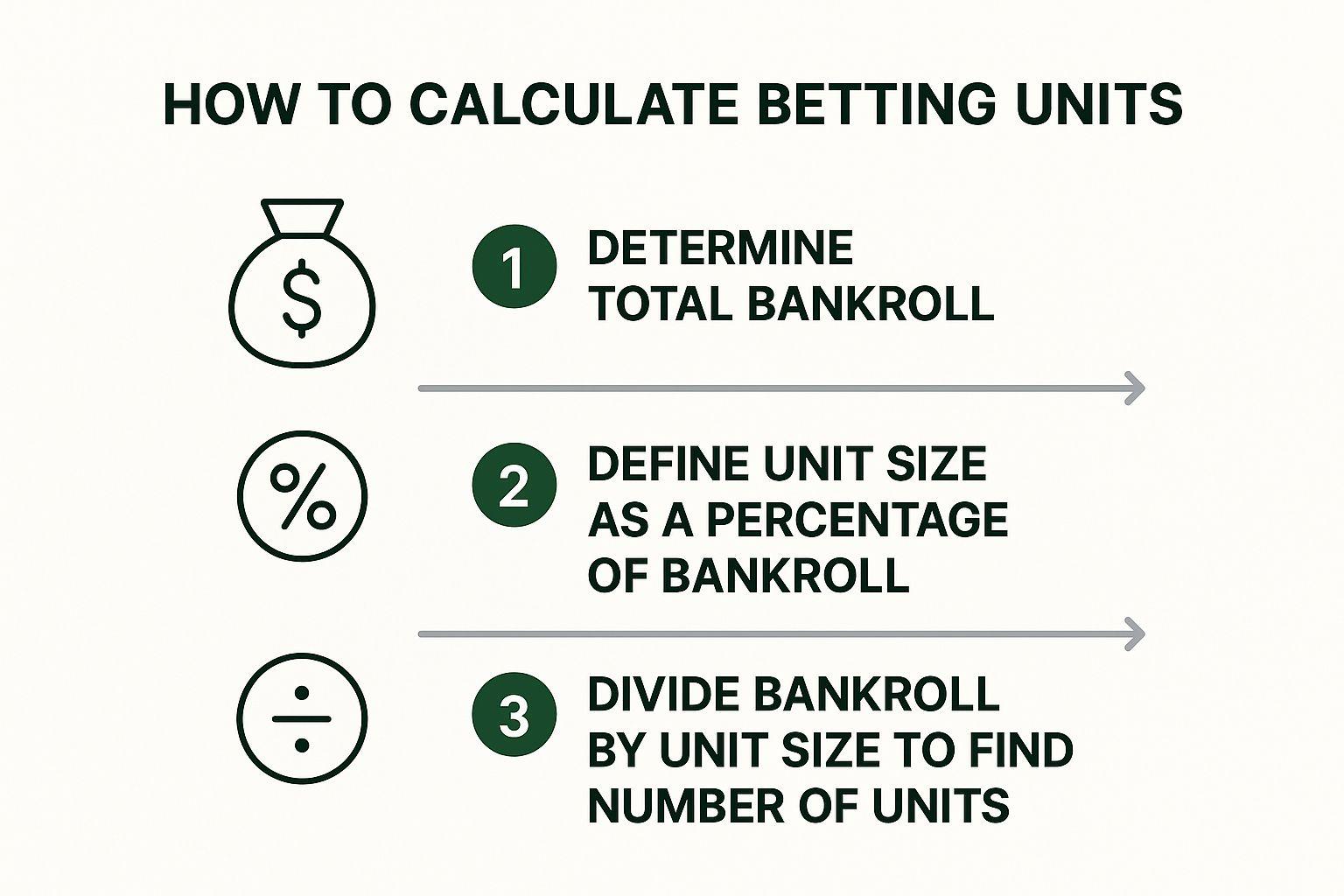
As the infographic shows, it’s a clear, disciplined method for turning a big bankroll into consistent, manageable wagers. It’s all about creating a staking plan you can stick to.
Getting a Meaningful Result
The number the calculator gives you isn't just a suggestion; it’s an instruction based on your strategy. It’s designed to eliminate the guesswork and emotional swings that trip up so many bettors—like going too big on a "sure thing" or getting scared and betting too small on a valuable underdog.
Key Takeaway: Think of the betting units calculator as your impartial enforcer of discipline. It makes sure every single wager carries the exact same level of risk relative to your bankroll. That’s the foundation for long-term survival and, hopefully, profitability.
By using this tool consistently, you build a reliable and repeatable process. Every bet you place has a clear, strategic purpose behind it, which starts to turn your betting from a series of random punts into a structured plan. Honestly, this mechanical approach is what separates casual bettors from the sharps who actually make money.
Reading the Tea Leaves: How to Interpret Your Calculator's Results

So, you've plugged in the numbers and the betting units calculator spits out your stake. Done deal, right? Not so fast. The number it gives you is just the beginning. The real art of smart betting is knowing what that number means and how to act on it.
Think of the calculator's output as your anchor to disciplined betting, not an order from a machine. It's the starting point for your decision, not the final word.
For example, let's say your standard unit is $20. The calculator will naturally suggest a $20 stake for a typical -110 point spread. This keeps your risk consistent for everyday wagers. But the magic happens when you start looking at different odds and situations, which is where your own expertise comes into play.
Following the number blindly is just math. Interpreting it is where strategy—and your edge—is born.
It's Not Just About the Numbers, It's About Context
A betting unit calculator is purely objective; it just crunches the numbers you feed it. Your job is to bring your own subjective analysis to the table. The calculator might suggest a standard one-unit bet, but maybe your deep dive into the stats and matchups gives you a ton of confidence. If your strategy allows for it, this might be a spot where you consider a slightly larger stake.
On the flip side, what about that tempting longshot? The calculator might recommend a full unit, but your gut and research tell you the odds are a little too good to be true. This is a perfect time to scale back. Instead of risking a full unit, maybe you place 0.5 units ($10). You get a piece of the action on a potentially huge payout without taking on the full risk of a standard bet.
My Two Cents: Treat the calculator's output as your risk-management baseline. Your own analysis is what tells you when to stick to that baseline and when to adjust. Never let a hot or cold streak dictate your stake—let your informed confidence be your guide, but always stay within your established unit framework.
Seeing It in Action: Real-World Scenarios
Let's make this real. Imagine you're working with a $2,000 bankroll and have set your unit size at 1%, which is $20.
Here’s how you might approach a few different bets:
The High-Value Favorite: You're scouting a tennis match and see a heavy favorite at -250. After doing your homework, you believe the line should be closer to -300. The calculator suggests a standard $20 stake. In this case, you confidently place the full unit because your own research confirms you've found solid value.
The Seductive Underdog: You see a Premier League team at +400 to pull off an upset. The payout looks juicy, but you know their star striker is nursing an injury, making the bet much riskier than the odds imply. Instead of blindly putting down a full $20 unit, you might risk just 0.25 units ($5). This lets you get in on the potential value while respecting the very real risk.
The Bread-and-Butter Bet: It's Sunday, and you're looking at an NFL point spread at -110. The calculator’s $20 recommendation is exactly what you should follow here. This is the bread and butter of your strategy, and sticking to your unit size on these bets is crucial for accurate tracking and long-term profit.
This is the kind of thinking that separates disciplined, winning bettors from gamblers just chasing a thrill. The betting units calculator is the tool that enforces discipline; your brain is what provides the winning edge.
Weaving the Calculator into Your Betting Routine
A tool is just a tool. It's the system you build around it that really matters. Getting your hands on a betting units calculator is a great first step, but its real magic happens when you make it an essential, non-negotiable part of your betting process. This is how it goes from being a simple calculator to the bedrock of your betting discipline.
The easiest way to get started is with a flat-betting model. It's simple: every single bet you place is for one standard unit. Doesn't matter if it's an NBA point spread at -110 or a longshot UFC moneyline at +150—the stake is always the same. In this system, the calculator's job is to simply confirm that one-unit stake, acting as a constant reminder to stick to your plan.
Going Beyond Flat Betting
Once you've got the hang of the flat-betting model, you can start adding a bit more nuance with a confidence-based staking plan. Now, this doesn't mean you start betting with your gut or chasing losses. It's about adjusting your stake based on the real, tangible value you've uncovered through your own research and analysis. This is where you graduate from just using a tool to becoming a true strategist.
With this model, your bets might fall into a few different tiers you set for yourself:
- 0.5 Units: Perfect for a speculative longshot or a play you like the look of but don't have rock-solid conviction on.
- 1.0 Unit: This is your bread and butter—the standard, everyday bet where the odds and your homework line up nicely.
- 1.5 to 2.0 Units: Reserved for those high-conviction plays where you genuinely believe you've found a significant edge over the market.
This is crucial: You have to define these levels before you even think about placing a bet. Never, ever decide a bet is a "three-unit lock" in the heat of the moment. Let your system dictate the stake, not your excitement.
A Real-World Staking Workflow
Let's walk through how this might look on a typical Saturday morning. You've done your homework and have three potential wagers lined up for the day's action.
- The Main Event: You've broken down a UFC fight and feel strongly that the underdog at +180 has a much better shot than the odds imply. This fits your pre-defined criteria for a high-value, 1.5-unit play. You plug it into the betting units calculator, and it confirms the exact dollar amount to risk.
- The College Football Spread: You've found a solid handicap on a -7 point spread at -110 odds. There's no massive edge here, just a solid, well-researched pick. This is a textbook 1.0-unit bet.
- The NBA Prop Bet: A player prop on points scored looks promising, but the data is a little thin. You want some action on the game but need to keep the risk in check. This is a perfect spot for a smaller, 0.5-unit wager.
By running every single one of these potential bets through the calculator, you're forcing yourself to follow your own rules. It ensures every stake is a calculated decision, not an emotional one. This kind of structured approach is what allows you to accurately track your performance over a whole season and figure out which types of bets are actually making you money.
This process works hand-in-glove with other tools, too. For example, many value betting profit calculators use historical data to forecast what you might earn. Since 2019, data from users of these tools often operates on an assumed average yield of about 3% with a stake size of 1% of the bankroll (which is one unit). This helps bettors get a feel for potential returns while still managing risk properly.
Advanced Bankroll Management and Risk Assessment

When you're ready to get serious about betting, you have to move past simply placing bets and start thinking about advanced bankroll management. This is the stage where your main job becomes defending your capital against the dreaded risk of ruin—that statistical nightmare where a bad run completely wipes you out. A strict, disciplined unit approach is your absolute best defense against that ever happening.
This shift in mindset also means getting familiar with more sophisticated staking theories. You’ve probably heard of the Kelly Criterion, a famous formula that pinpoints the perfect stake size by comparing the odds to the true probability of an outcome. It’s incredibly powerful but, let's be honest, can be a real headache to calculate for every single bet. Think of a betting units calculator as the practical, simplified version of this principle. It gives you all the structure without needing a degree in mathematics.
The Psychology of Streaks
Every bettor, no matter how good, will hit winning and losing streaks. It's just part of the game. The real danger is how these streaks mess with your head. Get on a hot streak, and suddenly you feel invincible, tempted to throw bigger and bigger stakes on the table. Hit a cold spell, and you’re likely to fall into "chase mode," desperately trying to win back your losses with bigger, emotionally-driven bets.
This is where a calculator becomes more than just a tool—it's your emotional shield. By committing to the stake it recommends, you take your feelings out of the driver's seat. It enforces logic and discipline, making sure a few bad beats don't snowball into a catastrophic financial decision. This kind of mechanical consistency is what separates amateurs from profitable, long-term bettors.
A disciplined unit approach is the only way to ensure short-term variance doesn’t end your long-term betting career. It’s about survival first, profit second.
Knowing When to Adjust Your Units
Your bankroll isn't set in stone; it's a living, breathing number. As it grows (or shrinks), your unit size needs to adapt right along with it. A common practice among professional bettors is to reassess their bankroll on a regular schedule—say, monthly or quarterly.
Here’s a simple, effective way to do it:
- Pick a schedule, like the end of each quarter, and calculate your new total bankroll.
- Recalculate your 1% unit size based on this new total figure.
- Lock in this new unit size and use it for every bet over the next quarter.
This approach lets you capitalize on your wins by slightly increasing your unit size after a profitable period. On the flip side, it protects your bankroll by shrinking your stakes after a downturn. It's a foundational concept covered in most serious guides on bankroll management.
Statistical models are fantastic for truly understanding these risks. For example, a Monte Carlo simulation running 1,000 bets with a 5% yield at average odds of 2.0 might project a total profit of around 50 units. But that same simulation will likely show a maximum drawdown of about 22 units—giving you a realistic picture of the biggest dip you can expect. Seeing the potential peaks and valleys helps you stay the course when things get choppy.
Common Questions About Betting Unit Calculators
Even when you've got a good handle on the theory, putting a new strategy into practice always throws up a few practical questions. Using a betting units calculator is pretty simple on the surface, but it's the little details and consistent application that really separate the pros from the amateurs.
Let's dive into some of the most common questions I hear to iron out any wrinkles.
One of the first things everyone asks is, "What's a good starting unit percentage?" There's no single magic number that fits everyone, but a 1% unit is the industry standard for a good reason. It’s conservative enough to shield your bankroll from those inevitable losing streaks, yet it still lets you build your capital nicely when you're on a hot run. Some more aggressive bettors might nudge that up to 2%, but I'd caution against going any higher—it dramatically increases your risk of going bust.
How Often Should I Recalculate My Bankroll?
This is a big one, and it's where a lot of bettors get tripped up. Your bankroll isn't a static number; it moves up and down, and your unit size needs to move with it. If you recalculate too often, say after every single bet, it becomes a massive chore and can lead you down the dangerous path of chasing losses. But if you never recalculate, you’re leaving money on the table when you win and not protecting yourself when you lose.
The smart, professional move is to set a fixed schedule and stick to it.
- Monthly: This is a great rhythm for active bettors who are placing wagers most days of the week.
- Quarterly: A solid choice for more casual bettors or those who prefer to smooth out the bumps of short-term variance.
Just pick a schedule that works for you and make it a non-negotiable part of your routine. When the day comes, recalculate your unit size based on your new total bankroll. This discipline keeps your staking plan perfectly in sync with your actual capital.
Key Insight: The aim isn't just to place bets; it's to survive long enough for your edge to pay off. Disciplined bankroll recalculation is a cornerstone of that survival. It’s how you systematically lock in profits and minimize the damage during a downturn.
Should I Ever Bet More Than My Model Suggests?
Ah, the classic temptation. You've spent hours on research, you've found what feels like a can't-miss opportunity, and you're itching to go big. Confidence is a good thing, but straying from your set unit structure is a very slippery slope. The whole point of a betting unit calculator is to inject discipline and take emotion out of the equation.
If your strategy involves a confidence scale (like risking between 0.5 and 2.0 units), your absolute "stone-cold lock" should still land within that predefined range. The moment you go over that, you've broken the very system you built to protect yourself.
The real question isn't about that one bet, but whether you've truly found what is a value bet in the first place. A genuine value bet has an edge your system can exploit over hundreds of wagers, not just one high-risk play. Trusting the plan, especially when it feels hard, is what makes a winning strategy actually win.
At ValueBetFactory, we're all about giving you the tools and know-how to bet smarter. Our platform is built to help you find that edge and manage your bankroll like a pro. See how our resources can sharpen your strategy at ValueBetFactory.