
A Winning Strategy for Betting on Tennis
Unlock Profits with betting tips!
If you're used to betting on team sports, you're in for a treat. Welcome to the world of tennis, an arena that strips away all the team-based chaos and offers a much purer, more direct challenge. With a global tour that runs virtually year-round, you’ll never be short of a match to analyze.

Why Betting on Tennis Is a Unique Opportunity
Tennis stands apart from giants like football or basketball, and the reason is beautifully simple: it’s one player against another. There are no teammates having an off day, no last-minute lineup changes wrecking your analysis, and no complex team dynamics to decipher. It’s a focused, analytical duel.
This one-on-one format means your research is laser-focused on just two athletes. You can dig deep into the metrics that actually matter, which allows your insights to have a much clearer and more direct impact on the bets you place.
The Individual Nature of the Sport
The head-to-head setup just simplifies so many of the variables that can muddy the waters in other sports. Instead of trying to gauge the chemistry of an entire squad, you’re comparing two players across a few crucial dimensions. It’s a much more controlled environment for analysis.
You get to zero in on what really counts:
- Head-to-Head Records: This is huge. Past matchups often expose stylistic advantages or a psychological edge one player has over the other.
- Surface Specialization: A clay-court maestro can look like a completely different player on a slick grass court. Spotting a specialist playing on their favorite surface is a massive analytical win.
- Current Form and Fatigue: Is a player coming off a grueling five-setter? Have they been flying across continents all week? Tracking their recent schedule gives you a real-time snapshot of their physical and mental state.
A Bettor’s Roadmap to Success
Think of this guide as your roadmap. We’re going to walk you through the process of moving from a casual fan to a truly strategic bettor. We’ll build your knowledge from the ground up, starting with the single most important concept in the game: value betting.
Value betting is the art of finding wagers where the odds offered by a bookie are better than the true, statistical probability of that outcome. It’s less about just picking winners and more about spotting when the market has gotten the price wrong.
From there, we’ll dive into the fundamental bet types, explore advanced in-play tactics, and nail down the disciplined bankroll management that separates the pros from the amateurs. Each section is a stepping stone, giving you the tools you need to stop guessing and start making smart, evidence-based decisions.
How To Read Tennis Odds and Bet Types
To make a real go of betting on tennis, you first need to speak the language. This means getting comfortable with reading odds and knowing what tools are in your toolbox, which, in this case, are the different types of bets. We can skip the confusing jargon; this section breaks down the most common wagers you'll encounter with simple, real-world examples.
Think of it like building a toolkit. A good carpenter doesn't use a sledgehammer for every job, and a sharp bettor doesn't stick to the same bet for every single match. Each type of wager gives you a unique angle to act on your analysis.
The Foundation: Moneyline Betting
The most straightforward wager out there is the Moneyline bet. You're simply picking who you think will win the match. That's it. It’s the purest form of tennis betting and the perfect place to start.
For example, if Novak Djokovic is playing Carlos Alcaraz, a moneyline bet is a direct wager on one of them to win. The odds will show you who the bookmaker thinks is the favorite and who's the underdog. A favorite might have odds of -150 (meaning you risk $150 to win $100), while the underdog could be +130 (you risk $100 to win $130).
Adding Nuance With Handicaps and Totals
Once you're comfortable just picking winners, you can start exploring more strategic bets that often offer much better value, especially when a match looks lopsided on paper. This is where handicap and totals betting come into play.
- Game Handicap (The Spread): This is like giving one player a head start in terms of total games won. If a strong favorite has a handicap of -4.5 games, they have to win the match by at least five total games for your bet to cash. This is a fantastic way to find value when the moneyline odds on a heavy favorite are just too low to be worth your time.
- Over/Under Total Games: Instead of picking a winner, you’re betting on the match's length and intensity. The bookmaker sets a line, say, 21.5 total games, and you bet on whether the actual total will be over or under that number. A bet on the "over" means you're expecting a close, hard-fought battle.
These bet types force you to shift your thinking from "who will win?" to "how will they win?" It's this deeper level of analysis where skilled bettors really start to find their edge. The infographic below highlights some of the core advantages that make tennis such a great sport for this kind of strategic thinking.
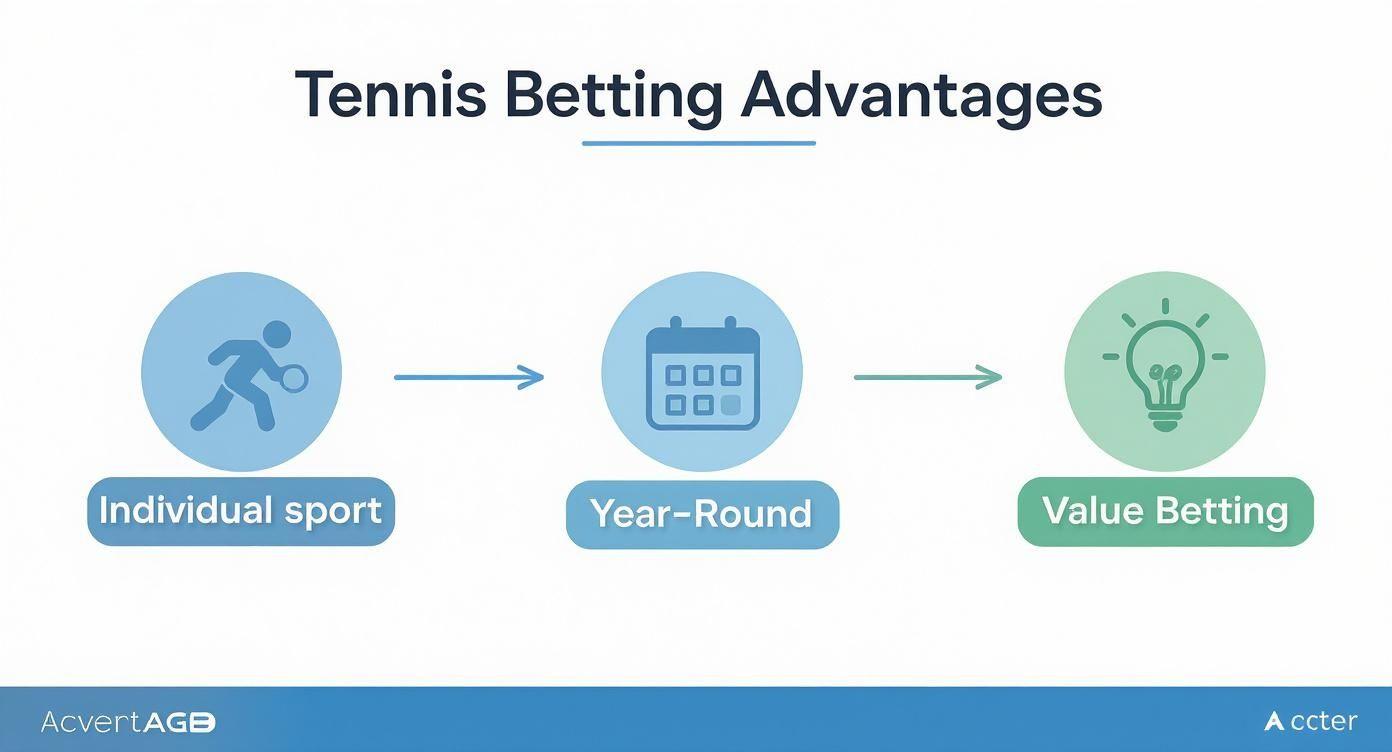
As the graphic shows, the one-on-one nature of tennis and its year-round schedule create the perfect storm for uncovering value bets.
To help you get a quick handle on these wagers, here’s a simple table breaking down the most common options.
Common Tennis Bet Types Explained
| Bet Type | What You Are Betting On | Best Use Case |
|---|---|---|
| Moneyline | The outright winner of the match. | When you have a strong opinion on who will win, regardless of the score. |
| Game Handicap | The winner of the match after a game "spread" is applied. | Finding value in lopsided matches where moneyline odds are poor. |
| Set Handicap | The winner of the match after a set "spread" is applied (e.g., -1.5 sets). | When you expect a dominant, straight-sets victory from a favorite. |
| Total Games (Over/Under) | The total number of games played in the entire match. | When you have a better feel for the match's competitiveness than the winner. |
| Set Betting | The exact final score in sets (e.g., 2-0, 2-1). | When you have a very specific read on how the match will unfold. |
This table gives you a solid overview of your main options, but remember that the key is matching the right bet to the right situation.
Advanced Bet Types For Deeper Analysis
Ready to get more precise? Set betting and proposition bets let you make highly specific predictions about how the match will play out. They demand sharp analysis but can offer some serious rewards.
A key to long-term success is moving beyond the basic wagers. The most profitable opportunities are often found in these less common markets, where your specific match analysis can give you a real advantage over the general public.
Set betting, for instance, involves predicting the exact final score in sets, like correctly calling that a player will win 2-1. This is the tennis equivalent of a chess master predicting the final few moves of a game. It's tough, for sure, but it can be incredibly lucrative when you have a strong read on how two players' styles will clash.
The sheer diversity of wagers is a huge part of what makes betting on tennis so engaging. The action goes far beyond simple match-winner markets, covering everything from tournament winners and game handicaps to point-by-point markets like ‘next point winner’ or ‘tiebreak in the set’. This variety is fueled by the sport’s packed schedule, with weekly tournaments keeping the markets active all year long. You can also check out our guide on the general types of sports bets for a broader overview.
A Bettor’s Checklist for Analyzing a Tennis Match
Winning at betting on tennis isn’t about luck or gut feelings; it’s about solid, repeatable analysis. If you want to find a real edge, you have to look past the obvious stuff like player rankings and start digging into the factors that actually decide who wins.
Think of yourself as a detective. Your job is to gather all the clues, piece them together, and build a complete picture of the matchup before you ever put a single dollar on the line. This checklist is your field guide to doing just that, helping you break down any match like a seasoned pro.

Surface Specialization Is Non-Negotiable
The first and most important clue is the ground under the players’ feet. A tennis court isn’t a one-size-fits-all battleground. The surface dramatically changes everything, the speed of the ball, its bounce, how players move, and it heavily favors certain styles over others.
Ignoring the surface is like trying to handicap a horse race without knowing if it’s on dirt or turf. It’s a completely different game.
- Clay Courts: Slow and high-bouncing, clay is a paradise for grinders and defensive masters who thrive in long, punishing rallies. Players with heavy topspin, endless stamina, and a patient game plan often rule here.
- Grass Courts: Fast, slick, and low-bouncing, grass is all about aggression. It rewards the big servers and the serve-and-volley specialists. Rallies are short and brutal.
- Hard Courts: The great equalizer. As a middle ground between clay and grass, hard courts offer a balanced bounce and favor adaptable, all-around players. Still, they can vary in speed, so it's always worth checking the specifics of the tournament.
A player who looks like a world-beater on the slow clay of Roland-Garros might be a sitting duck on the slick grass of Wimbledon. Always start your analysis here.
Uncovering Clues in Head-to-Head Records
Once you’ve got the surface figured out, it’s time to look at the players’ history against each other. The head-to-head (H2H) record is so much more than a simple win-loss tally; it’s a psychological and stylistic blueprint for the match.
Some players just have another's number. This often comes down to a stylistic mismatch where one player's strengths perfectly exploit the other's weaknesses. For example, a player with a shaky backhand will always be in trouble against a lefty whose booming forehand pounds that exact spot.
A lopsided H2H record can signal a deep-seated mental block. Even if the underdog is in better form, the memory of past beatings can create pressure that no stat sheet can measure.
Look for the patterns within their past matches. Were they all on the same surface? Were they tight, three-set wars or quick, one-sided blowouts? Answering these questions adds a layer of context that is absolutely crucial.
Gauging Current Form and Fatigue
A player’s ranking tells you what they did over the last year, but their current form tells you what’s happening right now. A player on a hot streak, brimming with confidence, is a dangerous opponent no matter what their rank says.
On the flip side, a top-ranked player who has crashed out early in their last few tournaments might be nursing an injury, fighting a crisis of confidence, or dealing with off-court distractions. A quick look at their last five to ten matches will give you a good sense of their current momentum.
And don't forget about the brutal physical toll of the tour. Tennis is a grueling, globetrotting sport.
Key Fatigue Factors to Investigate:
- Recent Match Length: Did a player just survive a three-hour, five-set marathon? Their opponent, who breezed through in straight sets, is going to have a massive recovery advantage.
- Travel Schedule: Has the player been bouncing between continents all month? Jet lag is real, and it’s a performance killer that casual bettors almost always overlook.
- Tournament Load: Is this their fourth tournament in four weeks? That kind of accumulated wear and tear, both physical and mental, is exactly what leads to shocking upsets.
By running through this checklist for every match, you start building a rock-solid analytical foundation. You move beyond just guessing winners and start spotting situations where the odds don't tell the whole story. That detective work is the very heart of successful tennis betting.
Mastering the Art of In-Play Tennis Betting
Tennis is a sport of pure momentum. A single break of serve, a shaky service game, or a crucial double fault can completely flip the script of a match. This constant back-and-forth makes it the perfect arena for the fast-paced world of in-play betting.
Pre-match analysis is vital, of course. But learning to read and react to the ebbs and flows of a live contest is where the sharpest bettors truly find their edge. This is where you transform from a passive fan into an active, analytical participant, capitalizing on temporary shifts in performance that pre-match odds could never account for.

Identifying In-Play Opportunities
The real key to successful live betting is spotting temporary market overreactions. Bookmakers' algorithms adjust odds in real-time based on the score, but they can't always capture the human element of the game: the mental side, the frustration, the fatigue. This creates fantastic windows of opportunity.
Imagine a top-seeded player known for their monster serve starts a match sluggishly. They get broken in their first service game, and suddenly their live odds, which were prohibitively low before the match, become much more attractive. If your analysis suggests this is just a slow start and not a sign of a deeper issue, this is a prime moment to find value.
Key moments to watch for include:
- A favorite losing the first set: The odds will swing dramatically, often overcorrecting for a single set loss.
- Medical timeouts: A timeout can completely disrupt a player's rhythm or signal a genuine physical issue that the odds haven't fully priced in yet.
- Visible frustration: A player arguing with the umpire or smashing a racket can signal a mental collapse, which is often a precursor to a flood of unforced errors.
Using Live Stats to Guide Decisions
While watching the match provides crucial context about body language and momentum, live statistics are your objective guide. Most betting platforms offer real-time data that can help you look beyond the score and understand why a match is unfolding the way it is.
To cut through the noise, focus on a few critical metrics:
- First-Serve Percentage: A sudden drop in this number for a big server is a major red flag. It tells you they're losing their biggest weapon.
- Break Point Conversion Rate: Is a player creating opportunities but failing to convert them? This can signal a lack of clutch performance under pressure.
- Unforced Error Count: A rising error count is a classic sign of fatigue or a loss of mental focus.
The real skill of in-play betting is combining what you see (player body language, momentum) with what the data tells you (serve percentages, error rates). This blend of observation and objective analysis leads to the most informed decisions.
This style of betting is absolutely exploding in popularity. Tennis is now the second most popular sport for in-play betting in both the UK and US, trailing only football and basketball respectively. In fact, nearly 90% of tennis bets on some major platforms are now placed during live matches, a clear shift away from pre-match markets.
The trend is so strong that the French Open, with its longer clay-court matches, has even surpassed Wimbledon in betting volume simply because it offers more in-play opportunities. You can read the full trend report from Entain on Gambling Insider.
The Discipline of Live Betting
The biggest challenge of in-play wagering isn't the analysis; it's discipline. The sheer speed of it all can easily lead to emotional, impulsive decisions. Chasing losses after one bad point or getting swept up in the excitement of a comeback is the quickest way to drain your bankroll.
You must treat each in-play bet with the same analytical rigor as a pre-match wager. Have clear entry and exit points in mind. If you bet on a player to come back from a set down, decide beforehand what score would invalidate your thesis and force you to cut your losses. By mastering this discipline, you can fully capitalize on the unique rhythm of a live tennis match. For more advanced strategies, check out our dedicated article on in-play betting tips for a deeper dive.
How to Find True Value in Tennis Betting Markets
This is where we separate the casual punters from the sharp, strategic thinkers. The real goal of betting on tennis isn't just about picking winners; it's about finding value. Winning a bet on a heavy favorite might feel good for a moment, but if the odds were terrible, you haven't actually gained any long-term advantage.
True, sustainable success comes from consistently placing bets where the odds are more generous than the actual probability of that outcome. Think of it like a stock market investor finding an undervalued company. The market price doesn't reflect its true worth, creating a golden opportunity. Your job is to become that market analyst for tennis matches.
What Is a Value Bet
A value bet exists when you believe the chance of something happening is higher than the odds offered by the bookmaker suggest. Every single set of odds has an implied probability baked right into it. For example, odds of +150 (or 2.50 in decimal) imply a 40% chance of winning.
If your own analysis leads you to believe that the player actually has a 50% chance of winning, you've just found a value bet. You're getting a better price than the real odds warrant. This is the absolute cornerstone of long-term profitability and the entire concept behind what we do. For a more detailed breakdown, you can learn more about the principles of value betting in our comprehensive guide.
This might sound a little complex, but the idea is simple: you're using your knowledge to spot inefficiencies in the market. You're betting on the odds, not just the player.
Why Tennis Is a Goldmine for Value
Tennis is uniquely suited for finding these opportunities. The sport's non-stop, global schedule creates a massive volume of matches. We're talking over 2,000 ATP and WTA professional events held every year, and that doesn't even count the Challenger and ITF tours. This constant action means betting markets are open almost every single day.
But here’s the kicker: outside of the major Grand Slams, many of these tournaments, especially in the lower tiers, get far less attention from the bookmakers. With so many matches to price, they can't possibly get every single line perfect. This leads to less efficient odds and frequent pricing mistakes.
This is where your specialized knowledge becomes a powerful weapon. A bookmaker might set their odds based on general statistics, but your deeper analysis of a player's form, surface preference, or fatigue level can give you a much clearer picture of their true winning probability.
Finding value isn't about landing one massive win. It’s about a disciplined, mathematical approach that gives you a positive expected value (+EV) over hundreds of bets. One value bet might lose, but a portfolio of them is designed to be profitable over time.
A Practical Example of Spotting Value
Let's ground this in a real-world context. Imagine an upcoming match between Player A and Player B, where the bookmaker has Player A as a slight favorite.
Your first move is to conduct your own analysis, completely ignoring the bookie's odds for a moment, and assign your own probabilities. You might conclude that Player B, the underdog, is in excellent form and playing on their favorite surface, giving them a much better shot than the market believes.
The table below illustrates this hypothetical scenario, showing how a bettor's analysis can identify a valuable opportunity.
Spotting Value A Hypothetical Example
| Metric | Player A | Player B |
|---|---|---|
| Bookmaker's Odds | -120 (1.83) | +110 (2.10) |
| Implied Probability | 54.5% | 47.6% |
| Your Assessed Probability | 50% | 50% |
| The Verdict | No Value | VALUE BET |
In this case, the bookmaker is giving Player B a 47.6% chance to win. However, your analysis concludes it's a 50/50 coin-flip match. Because your assessed probability (50%) is higher than the implied probability (47.6%), the bet on Player B offers excellent value. You're getting a great price on an outcome you believe is more likely than the odds suggest. This systematic process of uncovering market inefficiencies is the key to turning your tennis knowledge into a tangible, long-term edge.
Smarter Betting Habits and Mistakes to Avoid
Turning your sharp analysis into real, sustainable profit all comes down to discipline. It's about building a solid framework of smart habits that shield you from the common traps that bleed bettors dry. This isn't just another list of tips; it's a blueprint for betting smarter, not harder, and making sure your approach to betting on tennis is built to last.
The absolute bedrock of this entire framework is bankroll management. This is the one non-negotiable rule: separate your betting funds from your day-to-day finances, and only ever risk a small fraction, think 1-3%, on a single match. If you skip this step, even the most brilliant analysis on the planet will eventually lead to ruin. It's that simple.
Develop a Focused Betting Strategy
Another key habit of winning bettors is specialization. The world of tennis is massive, and trying to be an expert on every player, tour, and surface is a fast track to mediocrity. The real edge comes from narrowing your focus and going deeper than the rest of the market.
- Pick a Tour: Get to know the ATP (men's) or WTA (women's) tour inside and out.
- Master a Surface: Become the person who truly understands the nuances of clay, grass, or hard courts.
- Track Specific Players: Follow a small group of players so closely you understand their game, their mindset, and their weaknesses better than the bookies do.
Keeping detailed records of every single bet is a non-negotiable part of this process. Tracking your wagers, the logic behind them, and the results is the only way to get honest feedback on what's working and what isn't. This lets you refine your strategy based on hard data, not just gut feelings.
Common Pitfalls That Drain Bankrolls
Finally, avoiding the classic mistakes is every bit as important as building good habits. Countless beginners, and even some experienced bettors, stumble when they let emotion cloud their judgment or spread their bankroll too thin.
Stay away from these traps at all costs:
- Emotional Betting: Never, ever bet on your favorite players just because you're rooting for them. Your analysis has to be cold, objective, and completely separate from your fandom.
- Ignoring a Checklist: Sticking to a consistent, repeatable process for analyzing a match is your best defense against making impulsive, poorly researched bets.
- Chasing Losses: This is the single fastest way to destroy a bankroll. Resist the urge to place bigger and bigger bets to win back what you've lost. Trust your bankroll management plan, no matter what.
Frequently Asked Questions About Tennis Betting
Jumping into the world of betting on tennis always brings up a few questions, whether you're a total newcomer or have been around the block a few times. Let's clear up some of the most common ones we hear.
What Makes Tennis Different From Other Sports To Bet On?
The biggest difference? Tennis is a duel. Unlike team sports where you're trying to analyze dozens of players, coaching schemes, and complex team chemistry, tennis is just two athletes on a court.
This makes your analysis incredibly focused. Things like a player's current form, their love (or hatred) for a specific surface, and their head-to-head history against an opponent have a much clearer and more direct impact on the outcome.
Plus, the tennis world never really sleeps. While other sports have long, boring off-seasons, the ATP and WTA tours serve up matches nearly every week of the year. That means there's always a market to dig into.
Is It Better To Bet Before or During a Match?
Honestly, both pre-match and in-play betting have their moments, and smart bettors use both. Pre-match betting is your chance to do deep, unhurried research. You can crunch the numbers, analyze historical data, and find great value before the general public's opinion starts pushing the odds around.
In-play (or live) betting, on the other hand, is all about reacting to the flow of the match as it happens.
A top-seeded player might get off to a shaky start, dropping the first few games. Suddenly, their live odds become way more attractive than they were before the match. Spotting and jumping on these temporary dips is a key skill for any live bettor.
How Much of My Bankroll Should I Bet on a Single Match?
This is easily one of the most important questions in all of sports betting, and the answer is always the same: a small, consistent percentage.
The most disciplined bettors out there live by a strict bankroll management plan. They typically stake somewhere between 1% and 3% of their total bankroll on any single bet. It might not sound like much, but this approach is your shield.
It protects you from those gut-wrenching losses and ensures that one bad call or an unlucky streak doesn’t completely wipe you out. A flat-staking plan like this allows you to survive the natural ups and downs of betting so you can stay in the game long enough for your edge to shine through.
Ready to stop guessing and start making data-driven decisions? ValueBetFactory uses advanced tools to scan the markets for you, identifying valuable betting opportunities in real time. Discover your edge today at ValueBetFactory.