
How to Bet the Juice and Beat the Sportsbooks at Their Own Game
Unlock Profits with betting tips!

So, what does it actually mean when you hear someone talk about having to bet the juice? In simple terms, it means you're paying the sportsbook's built-in commission, a fee more commonly known as the "vig" or "vigorish." Grasping this concept is the first real step you'll take from being a casual bettor to a strategic one.
What Does It Mean to Bet the Juice?
Ever looked at a point spread for a big game and wondered why you have to risk $110 just to win $100 on a seemingly 50/50 proposition? That extra $10 isn't just a random number; it's the house's cut. The easiest way to think about the juice is as a small service charge, just like a broker's fee on a stock trade or a convenience fee for a concert ticket. It's the price you pay for the sportsbook to accept your wager.
This little fee is the entire engine that powers a sportsbook's business model. By tacking on a small commission to every bet, they build a mathematical advantage that ensures they come out ahead in the long run. It's also the single biggest reason why just winning half your bets is a guaranteed way to lose money over time.
The Sportsbook's Built-In Advantage
The juice is designed to create a slight imbalance that always, always favors the house. When a bookmaker offers -110 odds on both sides of a game, they collect more from the losers than they have to pay out to the winners, creating a guaranteed pocket of profit for themselves.
Let’s make it concrete. Imagine one person bets $110 on Team A (-110) and another person bets $110 on Team B (-110). The sportsbook has now collected a total of $220. No matter which team wins, the book only has to pay out $210; the winner gets their original $110 stake back plus their $100 in profit. That leftover $10 is the sportsbook’s risk-free gain.
This built-in margin has a huge and direct impact on your bottom line.
The existence of juice means that a bettor must win more often than they lose just to break even. This is the single biggest hurdle that separates casual bettors from successful sharps.
Why Winning Half Your Bets Is a Losing Strategy
Because of that juice, hitting a 50% win rate will slowly bleed your bankroll dry. The standard -110 line forces you to win approximately 52.38% of your point spread bets just to cover the cost of the vig and break even. This is a critical number every single bettor needs to burn into their brain.
To really hammer this home, let's break down exactly what's happening with that standard -110 price.
Breaking Down Standard -110 Odds
This table summarizes how the juice works in a typical point spread bet, showing the breakeven point and the sportsbook's built-in profit margin.
| Metric | Description |
|---|---|
| Odds | -110 (Risk $110 to win $100) |
| Implied Probability | 52.38% |
| Total Probability | 104.76% (52.38% + 52.38%) |
| Sportsbook's Margin | 4.55% |
| Breakeven Win Rate | 52.38% |
As you can see, the total probability adds up to more than 100%, and that extra slice is the sportsbook's profit. This reality shines a light on a few hard truths for anyone trying to make money from this:
- Profitability requires a real edge: You can't just be decent at picking winners. You have to be good enough to find wagers priced more favorably than their true probability, consistently overcoming the juice.
- The price matters as much as the pick: Getting the best possible odds on a bet is just as crucial as correctly predicting who will win.
- Discipline becomes everything: Understanding the juice forces you to become more selective. It’s the shift from casual guessing to making calculated, strategic decisions with your money.
Ultimately, to bet the juice is to simply participate in the standard sports betting market. Learning how to minimize its impact or even turn it to your advantage is the key to any kind of long-term success.
Calculating the Real Cost of the Vig
To really understand why you have to be careful when you bet the juice, you need to look past the basic idea and get into the actual numbers. The vig isn't just a tiny service fee; it's a calculated mathematical edge that slices directly into your potential profit. By breaking down the odds, we can pull back the curtain on the true cost of placing a bet and see why the house always starts with an advantage.
This infographic lays out the flow of money in a standard -110 bet, showing exactly how the sportsbook skims their commission off the top before paying out any winnings.
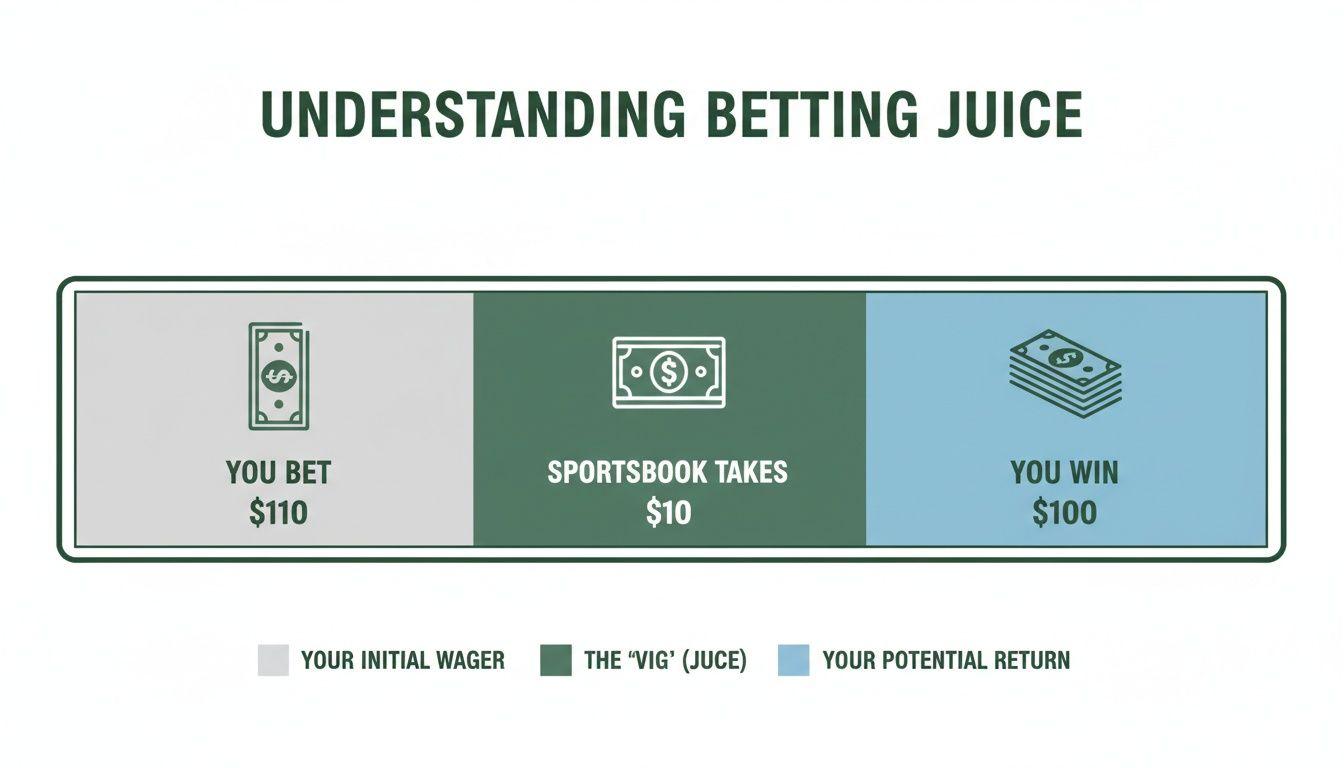
As you can see, for every $110 you wager, only $100 comes back to you as profit if you win. The sportsbook pockets the other $10 as their guaranteed cut, no matter the outcome.
Understanding Implied Probability
Every set of odds has an "implied probability" baked right into it; the likelihood of an outcome happening as suggested by the price. For a perfect 50/50 coin flip, the true, fair odds would be +100. But sportsbooks offer -110 on most point spreads, which sneakily implies a much higher probability.
To figure out the implied probability for negative odds like -110, you can use this simple formula:
Implied Probability = (-Odds) / ((-Odds) + 100)
When we plug in the standard -110 line, the math is pretty revealing:
- 110 / (110 + 100) = 110 / 210
- This comes out to 0.5238, or 52.38%
What this means is that to actually justify placing a bet at -110, you need to believe your team has a 52.38% chance of winning, not just 50%. That extra 2.38% is the hurdle the juice creates for you. For a more detailed walkthrough, you can explore our guide on how we calculate no-vig fair odds.
The Breakeven Point: Why 52.38% Is the Magic Number
Because of this built-in mathematical edge, you have to win more than half your bets just to keep your head above water. This is what we call the breakeven point. If you were to place 100 bets of $110 each at -110 odds, you'd need to win 53 of them just to squeak out a tiny profit.
Let's look at the math for 100 wagers:
- 52 Wins: You win $5,200 (52 x $100) but lose $5,280 (48 x $110), for a net loss of $80.
- 53 Wins: You win $5,300 (53 x $100) but lose $5,170 (47 x $110), for a net profit of $30.
This shows that the 52.38% breakeven threshold isn't just a suggestion; it's a hard rule. Dipping even slightly below it over time guarantees a slow, steady drain on your bankroll.
How a Juice Calculator Reveals the True Cost
A juice calculator is a simple but incredibly powerful tool that shows you the sportsbook's exact margin on any betting line. By plugging in the odds for both sides of a wager, you can instantly see the "hold" or commission percentage the book is charging.
For example, on a standard -110 / -110 line, the juice is 4.55%. But if you hunt around and find a market with -105 / -105 odds, the juice drops to just 2.38%. This might not sound like a huge difference, but over the long haul, it has a massive impact on your bottom line.
It lowers your breakeven point, which means you don't have to win quite as often to stay profitable. Calculating the vig before you bet the juice makes that hidden cost visible, empowering you to find better value and make smarter wagers.
Actionable Strategies to Beat the Juice
Realizing you have to win more than 52.38% of your even-money bets just to break even can be a tough pill to swallow. It lays bare the built-in advantage sportsbooks hold over every single bettor. But this is where the real game begins for anyone serious about making a long-term profit.
The good news is that the juice isn't some unbeatable force. You can neutralize and even overcome the sportsbook’s edge by shifting your mindset from just picking winners to actively hunting for the best possible price. This means adopting proven, practical strategies that successful bettors use every single day.
It's time to put theory into practice.
Master the Art of Line Shopping
Line shopping is the single most important and effective strategy for crushing the impact of the juice. Think of it like booking a flight or buying a new TV; you’d never just accept the first price you see. The same logic applies with even more force to sports betting.
Different sportsbooks often have slightly different odds on the same game. This happens because of their own risk, the volume of bets they've taken, or just slight variations in their predictive models. By having funded accounts at several sportsbooks, you give yourself the power to always take the best price available.
Finding a -105 line instead of the standard -110 might seem like a small win, but it literally cuts the juice you’re paying in half. That one move dramatically lowers your breakeven point from 52.38% down to just 51.22%.
Over hundreds or thousands of bets, these tiny edges compound into massive gains. Sharp bettors often only achieve a 3-7% return on investment (ROI), and they get there by relentlessly shopping for every last drop of value.
Hunt for True Value Bets
While line shopping is about finding the best price, value betting is about finding the wrong price. A value bet exists when a sportsbook's odds imply an outcome is less likely to happen than it actually is. In short, you're capitalizing on a market mistake.
For instance, a bookie might offer odds of +120 (45.5% implied probability) on a team you've analyzed and believe has a true 50% chance of winning. That gap between their price and the real probability creates positive expected value (+EV). It means if you could make that same bet an infinite number of times, you would be guaranteed to come out ahead.
A value bet isn't about finding a guaranteed winner. It's about finding a bet where the potential reward outweighs the statistical risk over the long haul.
Finding these opportunities consistently demands a data-driven approach, which is why so many bettors use tools to scan the market for them. Our deep dive on the fundamentals of value betting explains the math and mindset behind this powerful technique, which is the core philosophy of nearly every professional bettor.
Explore Advanced Tactics Like Arbitrage
Arbitrage betting, or "arbing," takes line shopping to its logical extreme. It’s a more advanced strategy that involves betting on all possible outcomes of an event across different sportsbooks, guaranteeing you a small, risk-free profit no matter what happens.
This is only possible when the odds discrepancies between sportsbooks are so large that the total implied probability of all outcomes adds up to less than 100%.
- Example: Sportsbook A has the Kansas City Chiefs at +110, while Sportsbook B has the San Francisco 49ers at -105.
- By placing perfectly calculated wagers on both sides, you can lock in a small, guaranteed profit.
Arbitrage opportunities are the unicorns of the betting world; they're rare and they disappear fast, often lasting just a few minutes. You need accounts at many different books and the ability to act instantly. While it’s a surefire way to beat the juice on one bet, it’s a tough strategy to scale.
Seek Out Reduced-Juice Sportsbooks
Finally, one of the simplest ways to pay less juice is to give your business to sportsbooks that charge less of it. While most books hang standard -110 lines on spreads and totals, some brands build their reputation on offering "reduced juice" or "nickel lines" at -105.
This means you only need to risk $105 to win $100. This seemingly minor discount is a game-changer for your breakeven point and long-term profitability. Making a reduced-juice book one of your go-to options is a smart, strategic move that gives you a consistent edge on every qualifying bet you place.
Below is a quick-reference table to help you compare these strategies at a glance.
Juice Mitigation Strategy Comparison
This table breaks down the main strategies for beating the vig, helping you decide which ones fit your style and experience level.
| Strategy | Difficulty Level | Primary Benefit |
|---|---|---|
| Line Shopping | Easy | Immediately lowers the juice you pay on every bet. |
| Value Betting | Medium | Turns the long-term mathematical edge in your favor. |
| Arbitrage Betting | Hard | Guarantees a small, risk-free profit on a single event. |
| Using Reduced-Juice Books | Easy | Provides a consistent, built-in discount on the house edge. |
By combining these four strategies, you build a powerful framework to consistently challenge and overcome the house edge. It’s how you turn a disadvantage into an opportunity.
Building a Winning Betting Workflow

Knowing how to spot value is a great first step, but the real money is made when you turn that knowledge into a disciplined, repeatable routine. A winning betting workflow is what bridges the gap between knowing what to do and actually doing it, day in and day out. It's about building a system that makes finding value, managing your money, and placing bets feel less like a guessing game and more like a data-driven process.
Without a structured workflow, it’s all too easy to slip back into bad habits; chasing losses, making emotional bets, or just getting lazy. A clear process cuts out the guesswork and builds the discipline you need to treat this like a serious investment. This is how you turn theory into tangible, long-term profit.
Setting Up Your Command Center
The foundation of any solid workflow is being prepared. This means getting all your tools and accounts ready to go before you even start hunting for bets. The goal is simple: act fast and efficiently the second an opportunity pops up.
Your setup should include:
- Multiple Sportsbook Accounts: You need accounts at several different sportsbooks, all funded and ready for action. This isn't just a suggestion; it's non-negotiable for effective line shopping.
- A Real-Time Alert System: Manually searching for value across dozens of sports and hundreds of games is impossible. A tool that pings you with real-time notifications for value bets is essential.
- A Centralized Tracking System: You have to track every single bet you make. Meticulous record-keeping is the only way to analyze your performance, spot leaks in your strategy, and accurately measure your return. If you’re not sure where to begin, our guide on how to track sports bets gives you a clear blueprint.
Implementing Strict Bankroll Management
The single most important rule in your entire workflow is disciplined bankroll management. Think of it as your defense. It protects your capital from the inevitable swings of variance and ensures you can stay in the game long enough for your edge to actually materialize.
The most common and effective principle here is the 1-3% rule. This means you only risk between 1% and 3% of your total betting bankroll on any single wager. If your bankroll is $1,000, each bet should be in the $10 to $30 range. Simple as that.
This approach gives you a few critical advantages:
- It prevents a short losing streak from completely wiping you out.
- It takes emotion out of your staking decisions, forcing consistency.
- It allows you to ride out the variance and keep betting through the downturns.
Think of your bankroll as your business's capital. The 1-3% rule is your risk management policy, making sure your business stays solvent and positioned for long-term growth.
A Step-by-Step Daily Workflow
With your setup sorted and your rules in place, your daily process becomes surprisingly straightforward. The key is to automate as much as you can so your energy is focused on analysis and execution, not endless searching.
Here’s a simple, repeatable blueprint:
- Receive an Alert: Your day kicks off when a tool like ValueBetFactory sends you a notification about a potential value bet.
- Analyze the Opportunity: Quickly review the bet. Check the teams, the sport, and the sportsbook offering the line.
- Confirm the Line: Log in to the specified sportsbook and verify that the odds are still available at the alerted price. Lines move fast, so speed is everything.
- Place the Bet: Using your 1-3% bankroll rule, calculate your stake and place the wager.
- Record the Bet: Immediately log the bet in your tracking spreadsheet or software. Include the date, sport, teams, odds, stake, and sportsbook.
This systematic approach strips emotion from the equation and ensures every bet you place is a calculated decision based on identified value. Platforms like ValueBetFactory use advanced algorithms to flag these value spots for you, where implied probabilities are out of sync with true odds, often creating edges of 2-5% per bet.
By building and sticking to this workflow, you stop gambling and start operating like a sharp. You’re no longer just mindlessly betting the juice; you’re actively managing it and exploiting the opportunities it creates.
From Losing Bettor to Profitable Sharp
Knowing the theory is one thing, but seeing it all click in the real world is what really matters. To bring these ideas to life, let’s follow the journey of a bettor we’ll call Alex. For years, Alex was your classic recreational player; betting was a fun way to have some skin in the game, but the account balance always seemed to have a slow, mysterious leak.
Alex was pretty good at picking winners, or at least it felt that way, often hitting right around the 50% mark. But the bankroll never went up. Week after week, the small tax of having to bet the juice on standard -110 lines created a constant headwind that made getting ahead feel impossible. It was the kind of frustration that makes you feel like the game is rigged just enough to keep you out of reach.
The Turning Point
The ‘aha’ moment finally came after a particularly brutal Sunday of NFL games. Despite calling several games correctly, the account was down another $50. That loss was the final straw. It sparked a deep dive into betting theory, which led Alex straight to the concepts of vig, implied probability, and the holy grail: positive expected value (+EV).
For the first time, it became crystal clear that winning wasn't just about picking the right team. It was about paying the right price. The realization hit like a ton of bricks: by blindly taking -110 odds, Alex was constantly making bad investments, even on the right teams.
This shift in perspective is the single most important step any bettor can take. It’s the transition from focusing on "who will win" to asking "is this price fair?"
This new way of thinking led to a brand-new strategy, one focused entirely on finding value and beating the closing line.
Alex's First Value Bet
Armed with this new knowledge and a trial for a value betting tool, Alex's entire approach changed. Instead of just looking at the day's schedule, Alex waited for an alert. Before long, one popped up: an NBA game between the Celtics and the 76ers.
- The Market: Nearly every sportsbook had the Celtics moneyline priced at -150.
- The Opportunity: One book, however, was lagging behind, still offering the Celtics at -135.
- The Value: The tool calculated the true "no-vig" odds to be closer to -145. This meant the -135 line was a mistake, a clear edge with a positive expected value of over 3%.
In the past, Alex might have seen -135 and just thrown a bet down based on a gut feeling. Now, the decision was driven by data. Alex quickly logged into the sportsbook with the stale line, applied a strict 2% bankroll stake, and placed the wager.
The Celtics did end up winning the game, but for Alex, the result was almost secondary. The real win was the process. It was the first bet placed not on a whim, but on a clear, quantifiable mathematical edge. By following a structured, value-focused workflow, Alex had fundamentally changed the game. This one bet was the first real step from being a perpetual depositor to becoming a disciplined, profitable sharp.
Alright, knowledge without action is just trivia. We’ve covered the theory, but now it’s time to get your hands dirty. This is where you stop just reading about beating the juice and actually start doing it.
Think of this as your personal roadmap. Follow these small, manageable steps, and you’ll start building the habits that separate the pros from the public. This is your first week of training camp.
Your First Steps This Week
Let's get straight to it with a few clear, immediate actions. This isn't about a massive overhaul overnight. It’s about making a few smart, deliberate moves that will pay off big time down the road. The goal is to prove to yourself that a structured approach is not only more profitable but far more sustainable.
Here's exactly what you need to do to get started:
Calculate the Juice on Your Next Three Bets: Before you even think about placing your next wager, grab a juice calculator and find the exact vig. Whether it’s -110 or -115, see for yourself what percentage the book is taking. This one simple act makes that hidden cost impossible to ignore and hammers home why the price is everything.
Open Two New Sportsbook Accounts: If you’re only using one or two books, your mission this week is to open and fund at least two more. This is the only way to line shop effectively, period. You can’t get the best price if you don’t even have access to it.
Commit to a Bankroll Rule for Seven Days: Define your bankroll and lock yourself into a strict 1-3% staking rule for one full week. No exceptions. If your bankroll is $500, every single bet you place will be between $5 and $15. This is how you build the discipline needed for long-term survival and growth.
The goal this week isn't to hit a massive payday. The goal is to install a professional process. Profit is just the natural byproduct of a solid, repeatable system.
By knocking out these three steps, you’re no longer just a customer passively paying the sportsbook’s tax. You are actively taking control, forcing yourself to analyze price, hunt for better lines, and manage your risk with discipline. This is the fundamental shift from being a recreational bettor to thinking and acting like a sharp.
Frequently Asked Questions About Betting the Juice
When you start digging into the real mechanics of betting, a few questions always bubble to the surface, especially around the idea of "the juice." Let's clear up some of the most common ones that bettors run into.
Is It Possible to Find Bets with No Juice?
Finding a true zero-juice bet is like spotting a unicorn; incredibly rare, but not totally impossible. These chances usually only pop up in a couple of specific situations. The first is through arbitrage betting, where you find a major price difference between two sportsbooks that lets you cover every outcome and lock in a tiny, risk-free profit.
The other time you might see it is during a special sportsbook promotion. A book might run a "no-vig" night for a big game to pull in new customers, basically turning off their commission for a short time. While these are great to jump on, they're just marketing hooks, not a reliable strategy you can count on day in and day out.
How Much of a Bankroll Do I Need to Start?
There’s no magic number here. Instead of getting hung up on a specific dollar amount, the smarter way to think about it is in percentages. The most important thing isn't the size of your bankroll; it's how you protect it.
A bettor with a well-managed $500 bankroll and a solid strategy is far more likely to succeed than one with a $5,000 bankroll who bets impulsively.
You need to commit to a strict staking plan, like the 1-3% rule, where you never risk more than that slice of your total funds on a single wager. This discipline is what lets you survive the inevitable losing streaks and stay in the game long enough for your edge to actually pay off.
Can I Beat the Juice Just by Picking More Winners?
This is a classic trap that a lot of recreational bettors fall into. While picking winners is obviously part of the game, it's only half the battle. Beating the juice is all about the price you're paying, not just the final score.
Think about it: you could consistently win 51% of your bets, which sounds pretty good on the surface. But if you’re always placing those wagers at the standard -110 odds, your breakeven point is actually 52.38%. In that scenario, you’d be slowly bleeding money over time, even with a winning record. The price you get is just as crucial as your prediction.
How Often Do Real Value Opportunities Appear?
Positive expected value (+EV) opportunities are popping up all the time; dozens, sometimes even hundreds of them, are scattered across the market on any given day. The catch? They are incredibly fleeting, sometimes lasting just a few minutes before a sportsbook corrects the line.
Trying to find these opportunities by manually refreshing websites is a fool's errand. It’s why automated tools are absolutely essential for any serious value bettor. They scan the entire market in real-time and alert you the second a mispriced line appears, giving you a chance to act before the value is gone.
Stop guessing and start making data-driven decisions. ValueBetFactory provides the real-time alerts and tools you need to find profitable value bets consistently. Start your free trial and turn the odds in your favor today.