
Your Guide to Asian Betting Handicap
Unlock Profits with betting tips!
If you've ever looked at a lopsided matchup—say, a powerhouse football club against a relegation battler—and thought the betting odds were a joke, you've already stumbled upon the reason Asian Handicap was invented. It's a clever system designed to level the playing field, making even the most predictable matches genuinely interesting to bet on.
At its core, the Asian Handicap gives one team a virtual "head start" (a goal advantage) and the other a "hurdle" (a goal disadvantage) before the game even kicks off. This simple tweak does something powerful: it completely eliminates the possibility of a draw, turning a three-outcome bet (Win, Lose, Draw) into a straightforward two-way choice.
What Is Asian Handicap Betting and Why Bother?

Let's stick with that top-tier vs. bottom-table scenario. On a traditional market, the odds on the favorite are so low they're hardly worth your time. Betting on the underdog, on the other hand, feels like throwing your money away. It’s a classic betting dead end.
This is where the Asian Handicap shines. By applying a handicap, bookmakers can balance the scales and offer odds that hover much closer to 50/50 for either side of the bet. Suddenly, betting on the heavy favorite becomes a more attractive proposition, and backing the underdog doesn't feel like such a long shot.
The Core Benefit: Balancing the Game
The real magic of the Asian Handicap is its ability to turn a one-sided snoozer into a compelling, competitive wager. You're no longer just betting on a team to win; you're betting on them to outperform their handicap.
Here’s why that matters to you as a bettor:
- Better Value: Because the probabilities are evened out, the odds are often far more competitive than what you’ll find in the standard 1X2 (Home Win/Draw/Away Win) markets.
- Reduced Risk: Some handicap lines are a bettor's best friend. They create a "push" scenario where your stake is fully refunded if the match ends in a tie after the handicap is applied. It's a built-in safety net.
- Deeper Engagement: This isn't a simple "who will win?" bet. It forces you to think more strategically. You need to analyze how a team will perform. Will they win by a landslide, or just scrape by?
Asian Handicap vs Traditional 1X2 Betting
To really see the difference, it helps to compare the two systems side-by-side. The traditional 1X2 market is straightforward, but the Asian Handicap offers a layer of strategic depth that many seasoned bettors prefer.
| Feature | Asian Handicap | Traditional 1X2 Betting |
|---|---|---|
| Number of Outcomes | Two (Win or Lose) - The draw is eliminated. | Three (Home Win, Draw, or Away Win). |
| Risk Management | Lower risk. Some lines offer a full or half-stake refund (a "push"). | Higher risk. If you don't pick the exact outcome, you lose. |
| Odds Balancing | Designed to create near-even odds (~2.00 / +100) for both sides of the bet. | Odds directly reflect the perceived lopsided nature of the match. |
| Best For | Lopsided matches where a clear favorite and underdog exist. | Evenly matched games where all three outcomes are plausible. |
This table shows how the Asian Handicap fundamentally restructures the bet, providing a different kind of challenge and, often, a smarter way to find value.
Eliminating the Draw for a Better Edge
One of the most attractive features of this system is cutting out the draw. Think about it: in a traditional bet, you have three potential outcomes. Your chance of being right is statistically 33.3%. By removing the draw, the Asian Handicap instantly boosts your chances of winning any given bet to a clean 50%.
If you want to dive deeper into the nuts and bolts, our complete guide on what is asian handicap breaks down all the different lines and rules.
At its heart, the Asian Handicap isn't about predicting the winner; it's about predicting performance. It asks a more nuanced question: will the favorite perform better than expected, or will the underdog keep the game closer than the odds suggest?
This shift in perspective is why so many experienced bettors gravitate toward it. You move past simple win/loss thinking and into the much more interesting world of performance analysis, which is where the real profits are often found.
The Unlikely Origins of Handicap Betting

Believe it or not, what feels like a modern betting innovation actually has a long and fascinating history. The core concept behind the asian betting handicap started in Indonesia, where it was known locally as "hang cheng betting." It was originally developed to do one thing: make betting on sports, especially football, more balanced and a lot more interesting.
For many years, this clever system was something of an open secret in Asian markets. Its big break on the world stage didn't come until the late 1990s, right when online sports betting was starting to explode. As bettors moved online, they wanted more than the simple win-draw-lose options, and bookmakers needed a way to offer more dynamic wagers.
The Naming and Global Adoption
The system was brilliant, but it needed a name that people outside of Asia could understand. The term "Asian Handicap" was officially coined in November 1998 by journalist Joe Saumarez Smith. His job was to translate the "hang cheng" concept for a Western audience, and the name he came up with stuck. You can read more about this moment in the history of Asian handicap betting on Wikipedia.
Giving it a clear, marketable name was the spark that lit the fire. Bookmakers across Europe and the Americas could now easily promote this new way to bet, and its popularity soared. Bettors were immediately drawn to the new layers of strategy it introduced.
The real genius of the Asian Handicap was how it used fractional goals (like +0.5 or -1.75) to fundamentally change a match. This clever bit of math completely eliminated the possibility of a draw, meaning every single bet had to have a winner.
This was a game-changer. It gave bettors better odds and, for the first time, a built-in safety net. Features like the "push," where your stake is returned if the result lands on a whole number handicap, just didn't exist in traditional betting.
From Niche Market to Global Standard
The journey of the Asian betting handicap from a regional favorite to a worldwide staple all comes down to its core benefits: it's fair, offers great value, and is strategically deep. It solved the classic problem of how to make a lopsided match interesting to bet on, turning potential blowouts into genuinely compelling wagers.
Today, it's far more than just another option. For millions of serious bettors, it’s an essential part of their toolkit—a smarter, more calculated way to engage with the sports they love. It has more than proven its worth, cementing its place as a cornerstone of modern sports betting.
Decoding the Different Handicap Lines
To really get the hang of Asian handicap betting, you first need to learn its language—the different lines. At first glance, the numbers might seem a bit random, but they actually follow a very logical pattern. Let's walk through them, starting with the simplest and building up from there.
This diagram gives you a bird's-eye view of the main handicap types, from the straightforward level ball bets to the more nuanced quarter lines.
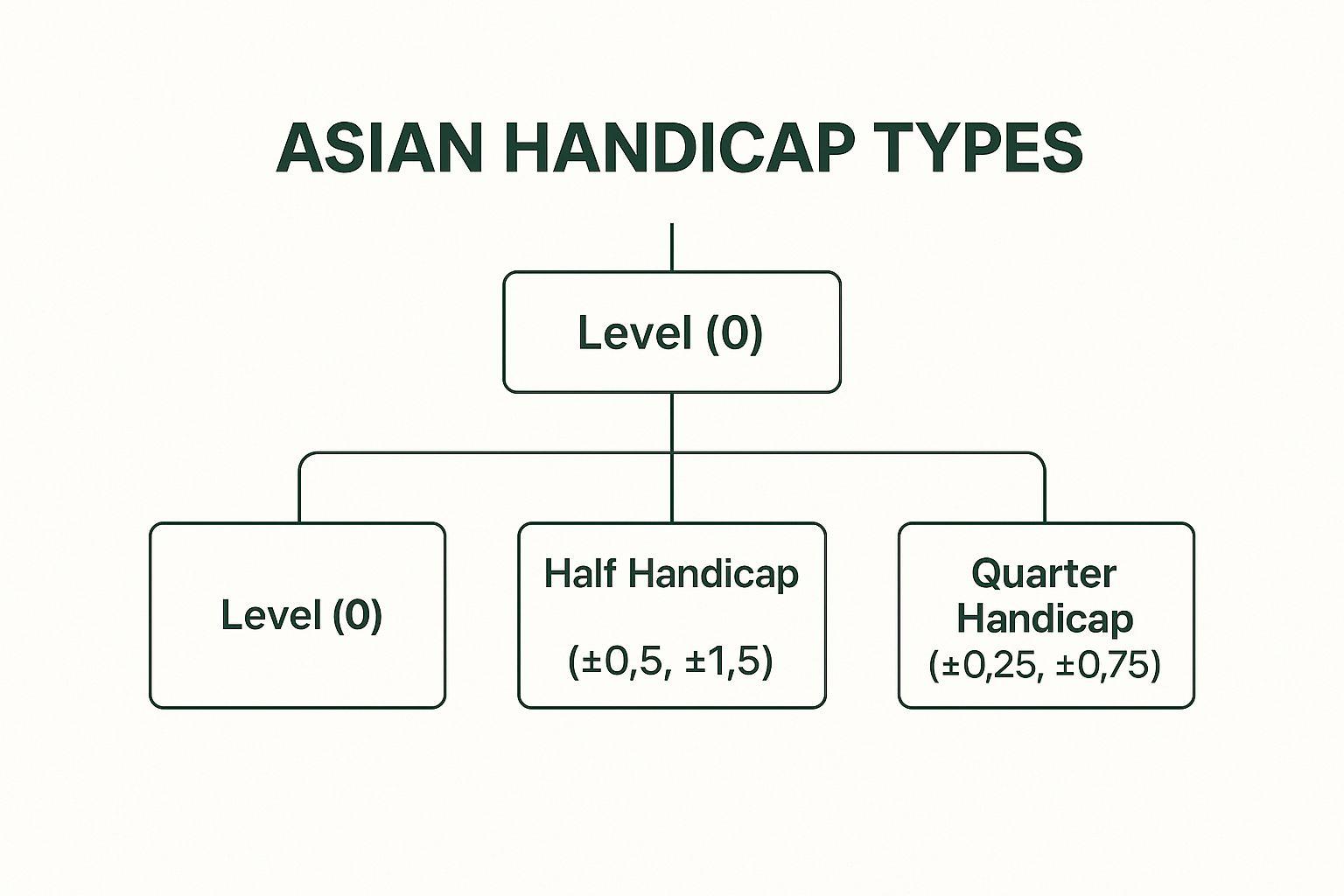
As you can see, the system branches out. Each type of line is built for different match scenarios and lets you manage your risk in a specific way.
The Foundation: Half-Goal Handicaps (±0.5, ±1.5)
Half-goal handicaps are the perfect place to start because they're clean and decisive. Since a team can't score half a goal in a real football match, these bets completely eliminate the possibility of a draw. You either win, or you lose. No middle ground.
Let's say you bet on Team A with a -0.5 handicap. This is essentially the same thing as a straight-up "to win" bet. If they win by any score, you win. If they draw or lose, you lose. It’s that simple.
On the flip side, taking Team B with a +0.5 handicap means you win if Team B wins or if the match ends in a draw. This is the same outcome as a "Double Chance" (Win or Draw) bet, but you'll often find more attractive odds in the Asian Handicap market.
Introducing the Push: Full-Goal Handicaps (±1.0, ±2.0)
Full-goal lines introduce a fantastic feature that acts as a safety net for bettors: the "push." A push happens when the final score becomes a tie after you apply the handicap. When this occurs, the bet is cancelled, and you get your full stake back.
What is a Push? Think of a push as your insurance policy in Asian Handicap betting. It happens on full-goal lines when the adjusted outcome is a draw, and it means your entire stake is refunded.
Here’s how it works. Imagine you back a heavy favorite with a -1.0 handicap.
- If they win by two or more goals: Your bet is a winner.
- If they win by exactly one goal: The adjusted score is a draw (for example, a 1-0 win becomes 1-1 after the handicap). This triggers a push, and your stake is returned in full.
- If the match is a draw or they lose: Your bet is a loss.
That "push" is a massive advantage. It gives you a buffer against those frustratingly narrow wins that would make you lose your bet in most other markets.
The Strategic Split: Quarter-Goal Handicaps (±0.25, ±0.75)
This is where Asian handicap betting gets really interesting and strategic. Quarter-goal lines are a bit more advanced because they essentially split your stake into two separate bets on adjacent handicap lines.
For example, a -0.75 handicap is actually a combination of two bets:
- Half of your stake goes on the -0.5 handicap.
- The other half goes on the -1.0 handicap.
This split opens the door to unique outcomes like a "half-win" or a "half-loss." Let's stick with that -0.75 example. If your team wins by exactly one goal, the -0.5 part of your bet wins, but the -1.0 part results in a push. So, you win on half your stake and get the other half back. It's a brilliant way to balance risk while still shooting for a decent payout.
What's really fascinating is that data from over 84,000 soccer matches shows these different lines carry slightly different bookmaker margins. Half-goal handicaps had an average loss rate of 4.16% for bettors, whereas quarter-goal lines were a bit more favorable, with a 3.6% rate. It’s a subtle but important edge for the savvy bettor.
Putting Asian Handicap Bets into Practice

Knowing the theory is one thing, but the real "aha!" moment comes when you see these handicap lines play out in an actual match. Let's move from the abstract concepts to some concrete examples to see how an asian betting handicap really works once the final whistle blows.
We'll use a few common football scenarios to walk through every possible result.
Example 1: The Half-Goal Handicap (-1.5)
Imagine a classic Premier League clash: a top-tier team hosting a mid-table side. The bookmaker might offer Manchester City at -1.5 against Crystal Palace at +1.5. This is a half-goal handicap, which is great because it leaves no room for gray areas. Your bet will either be a clear win or a clear loss.
Let's say you've put £10 on Manchester City with that -1.5 handicap. You're betting that they'll not just win, but win by a margin of at least two goals to overcome their virtual deficit. Anything less won't be enough.
Here’s how it could shake out:
- Man City wins 3-1: After applying the handicap, the score is essentially 1.5 to 1 in City's favor. Your bet is a winner.
- Man City wins 2-1: A one-goal victory isn't enough. The adjusted score becomes 0.5 to 1, meaning Crystal Palace "wins" on the handicap. Your bet loses.
- The match is a 1-1 draw: The adjusted score is -0.5 to 1. Again, your bet loses.
This example really shows the all-or-nothing nature of half-goal lines. You either cover the spread decisively, or you don't.
Example 2: The Full-Goal Handicap and the "Push" (+1.0)
Now for a full-goal line, which introduces one of the best features of Asian handicaps: the "push." This is your safety net.
Let's take a different match: Liverpool vs. Nottingham Forest. You fancy Forest to put up a good fight, so you bet £10 on them with a +1.0 handicap. In essence, you’re giving them a one-goal head start before the match even kicks off.
This opens up three potential outcomes for your bet:
- Liverpool wins 2-1: With Forest's +1.0 handicap, the adjusted score is a 2-2 draw. When the handicap results in a tie, it's called a push. Your £10 stake is simply refunded. No harm, no foul.
- Nottingham Forest draws 1-1: Add the handicap, and the score becomes 1-2 in Forest's favor. Your bet wins!
- Liverpool wins 3-1: Even with the one-goal head start, the adjusted score is 3-2 to Liverpool. Your bet loses.
The "push" is a game-changer in full-goal Asian Handicap betting. It reduces your risk by returning your stake when the outcome, after the handicap is applied, is a draw.
Example 3: The Quarter-Goal and the Half-Win (-0.75)
Finally, let's get into the slightly more complex but incredibly useful quarter-goal lines. When you see a handicap like -0.75, it means your bet is being split in two behind the scenes.
If you place a £10 bet on Chelsea -0.75, the bookmaker automatically divides your stake into two separate £5 bets: one on Chelsea -0.5 and the other on Chelsea -1.0. This unique structure creates the possibility of a "half-win" or "half-loss."
To see how this works, let's look at the possible outcomes for a bet on a team with a -0.75 handicap.
Example Bet Outcome Scenarios for -0.75 Handicap
The table below breaks down what happens to your bet based on the final score.
| Final Score (Your Team - Opponent) | Result for Your -0.75 Bet | Explanation |
|---|---|---|
| Wins by 2+ goals (e.g., 2-0) | Full Win | Your team covered both the -0.5 and -1.0 parts of the bet. You win your full stake at the given odds. |
| Wins by 1 goal (e.g., 1-0) | Half-Win | The -0.5 part of your bet wins, but the -1.0 part is a push. You get half your winnings plus half your stake back. |
| Draws or Loses (e.g., 1-1) | Full Loss | Your team failed to cover either handicap. You lose your entire stake. |
This half-win outcome is what makes quarter-lines so appealing. It rewards you when your team wins, even if it's by a slimmer margin than one part of your handicap required.
By seeing how the numbers translate into real-world wins, losses, pushes, and even partial victories, you can start to feel more confident about applying these powerful betting strategies yourself.
The Strategic Edge of Handicap Betting
Ask any seasoned bettor, and they'll likely tell you that Asian handicap markets are where they spend most of their time. There’s a simple reason for this: they offer a genuine strategic edge you just can't find in traditional 1X2 (win-draw-win) betting.
The biggest advantage is value. By effectively removing the draw from the equation, bookmakers can operate on much tighter margins. For you, this means the odds on both sides of the bet are more competitive and closer to a true 50/50 proposition. Instead of taking painfully low odds on a heavy favorite, you can get a much better price by backing them to win by a certain number of goals. This concept is the heart and soul of why the Asian handicap is such a powerful tool.
Unlocking Nuanced Betting Angles
Handicap betting forces you to think beyond the simple question of "Who will win?" and start asking the more important question: "By how much?" This shift in thinking is where real experts find their edge.
It opens up a whole new world of betting angles. You can back a powerhouse team with confidence, not just to get the victory, but to win decisively by covering a -1.5 or -2.5 handicap. On the flip side, you can find incredible value in an underdog that you believe can keep the game close. A +1.5 handicap on the underdog means your bet is a winner even if they lose by a single goal.
For a deeper dive into these strategies, our guide to soccer Asian Handicap betting can help you master the art of picking the perfect line for any match.
Superior Risk Management
Perhaps the most powerful strategic advantage is how handicap betting helps you manage your bankroll. The ideas of the "push" and the "half-loss" are absolutely fundamental here.
A "push" is your safety net. When you bet on a whole-number handicap (like -1.0 or +2.0) and the final score difference matches that number, you don't lose. Your entire stake is returned. Over the long run, this dramatically reduces your risk by saving you from those narrow results that would be losing bets in any other market.
Quarter-goal handicaps take this a step further, introducing "half-loss" or "half-win" scenarios. These features provide a level of capital protection that traditional 1X2 betting simply can't offer.
This built-in risk mitigation is a huge reason why Asian handicaps, once a regional specialty, have exploded into a global market valued in the billions. By giving the underdog a head start on the scoreboard, it creates a balanced contest with near-even odds on both sides. It’s not just another option; for many, it's a smarter way to bet on sports.
Common Questions About Asian Handicap
As you start getting your head around Asian handicap betting, you'll naturally have a few questions. It happens to everyone. Let's tackle some of the most common ones that pop up, so you can feel confident you know exactly what you’re doing.
What Happens with a -1 Handicap in a One-Goal Win?
This is probably one of the first things people wonder about, and it gets right to the heart of what makes Asian handicap betting so different. It’s all about the "push."
If you back a team with a -1 handicap and they win by exactly one goal (say, 1-0 or 2-1), your stake is returned in full. No win, no loss. Think of it this way: the handicap effectively starts your team at -1 goals. A one-goal victory just brings them back to level with their opponent for betting purposes. Since they didn't beat the handicap, the bet is a tie, or a push. It's a fantastic safety net you just don't get in traditional win/draw/win markets.
Is Asian Handicap Only for Football?
Not at all. While football (or soccer) is where it all started and where you'll see it most, the system is incredibly flexible. The core idea of evening up a contest works beautifully in any sport that relies on a point-based score.
You'll regularly find Asian handicap markets for:
- Basketball: Handicaps are set on the final point difference.
- Tennis: You can bet on handicaps for total games or even sets won.
- American Football: It works just like a traditional point spread, which is essentially the American version of a handicap.
- Ice Hockey: Goal-based handicaps here operate almost identically to how they do in football.
The principle never changes. You're betting on how a team performs against a specific margin, not just whether they win or lose.
The real value of the Asian Handicap system lies in its adaptability. It can transform any lopsided, point-based contest into a balanced and competitive wager, regardless of the sport.
How Do I Find the Best Handicap Odds?
Finding the best price is a fundamental skill for any sharp bettor. The biggest mistake you can make is sticking to just one bookmaker. Different betting sites will always have slightly different odds and lines on the same game as they try to manage their own risk and attract business.
Shopping around is essential. By comparing odds across a few different platforms, you can consistently find a better deal for your bet. A tiny difference, even just 0.05 in decimal odds, might not seem like much on a single wager, but over hundreds of bets, it has a huge impact on your long-term profit. You can even use specialized odds comparison tools that do the heavy lifting for you, showing you the best prices available in an instant.
Also, keep an eye on the popularity of the match. Big leagues and major tournaments usually have more competitive odds because the high betting volume forces bookies to tighten their margins.
When Should I Use a Quarter-Goal Bet?
This is where things get a bit more strategic. Quarter-goal bets (like -0.25 or +0.75) are for when you have a strong feeling about a match but want to manage your risk more precisely.
You’d reach for a quarter-goal line when you want to hedge your bet a little. Let’s say you’re looking at a -0.75 handicap. You’d choose this over a -0.5 or -1.0 for a very specific reason:
- You're pretty confident your team will win, but you’re not totally sold on them winning by two or more goals.
- If they win by just one goal, the -0.75 bet gives you a "half-win." You get your stake back on half the bet and win on the other half, locking in a small profit. It’s a great middle ground that protects you from the total loss you'd face with a -1.5 bet.
In short, use quarter-goal lines when you want to balance an aggressive prediction with a sensible safety net.
At ValueBetFactory, we equip you with the tools and knowledge to move beyond basic bets. Our platform uses advanced algorithms to identify valuable odds in real-time, helping you make smarter, data-driven decisions. Elevate your betting strategy by exploring opportunities with ValueBetFactory today.