
Smarter Betting with a Bookmaker Odds Calculator
Unlock Profits with betting tips!
A bookmaker odds calculator is an indispensable tool for anyone serious about sports betting. It cuts through the noise of different odds formats and complex numbers, translating everything into clear percentages and potential payouts. Think of it as your secret weapon for seeing the real story behind the numbers a sportsbook offers you.
What Is a Bookmaker Odds Calculator
At its heart, a bookmaker odds calculator is a translator. It takes the sometimes confusing language of betting odds and turns it into simple, actionable insights. This single tool empowers you to shift from just guessing which team might win to making strategic, data-driven decisions on every single wager.
Its real power is speed and accuracy. The calculator performs crucial calculations in a split second, saving you from wrestling with formulas and preventing costly manual errors. This frees you up to focus on what actually matters: your betting strategy.
Core Functions of an Odds Calculator
Any good odds calculator excels at a few fundamental tasks that are non-negotiable for a sharp bettor. These functions bring much-needed clarity to the bets you’re considering.
The most common uses for a bookmaker odds calculator include:
- Odds Format Conversion: It instantly switches between American (+150), Decimal (2.50), and Fractional (3/2) odds. This is crucial for understanding betting lines from any sportsbook around the globe.
- Implied Probability Calculation: This is the big one. The calculator reveals the exact likelihood of an outcome happening, at least according to the bookmaker's odds.
- Payout Calculation: You can quickly see your potential profit and total return for any stake, which is absolutely vital for smart bankroll management.
A great example of this is seeing how a single line can look completely different depending on the sportsbook you're using.
Odds Format Conversion at a Glance
| American Odds | Decimal Odds | Fractional Odds | Implied Probability |
|---|---|---|---|
| -110 | 1.91 | 10/11 | 52.4% |
This table perfectly illustrates how the calculator standardizes everything for you, so you're always comparing apples to apples, no matter the format.
Uncovering the Bookmaker's Perspective
A bookmaker odds calculator works its magic using the concept of implied probability. It converts the odds into a simple percentage that reflects the sportsbook's assessment of how likely an event is to happen. For example, American odds of +150 translate to an implied probability of 40%, while odds of -200 mean the bookie thinks that outcome has a 66.7% chance of hitting.
This percentage is the key to seeing the bet from the bookie's point of view. It’s their mathematical opinion on the game, baked right in with their profit margin (the "vig").
By converting odds to a percentage, you're no longer just looking at a price; you're looking at the bookmaker's expert opinion. This simple shift in perspective is the first step toward finding value in the market.
Navigating Global Betting Markets with Odds Conversion
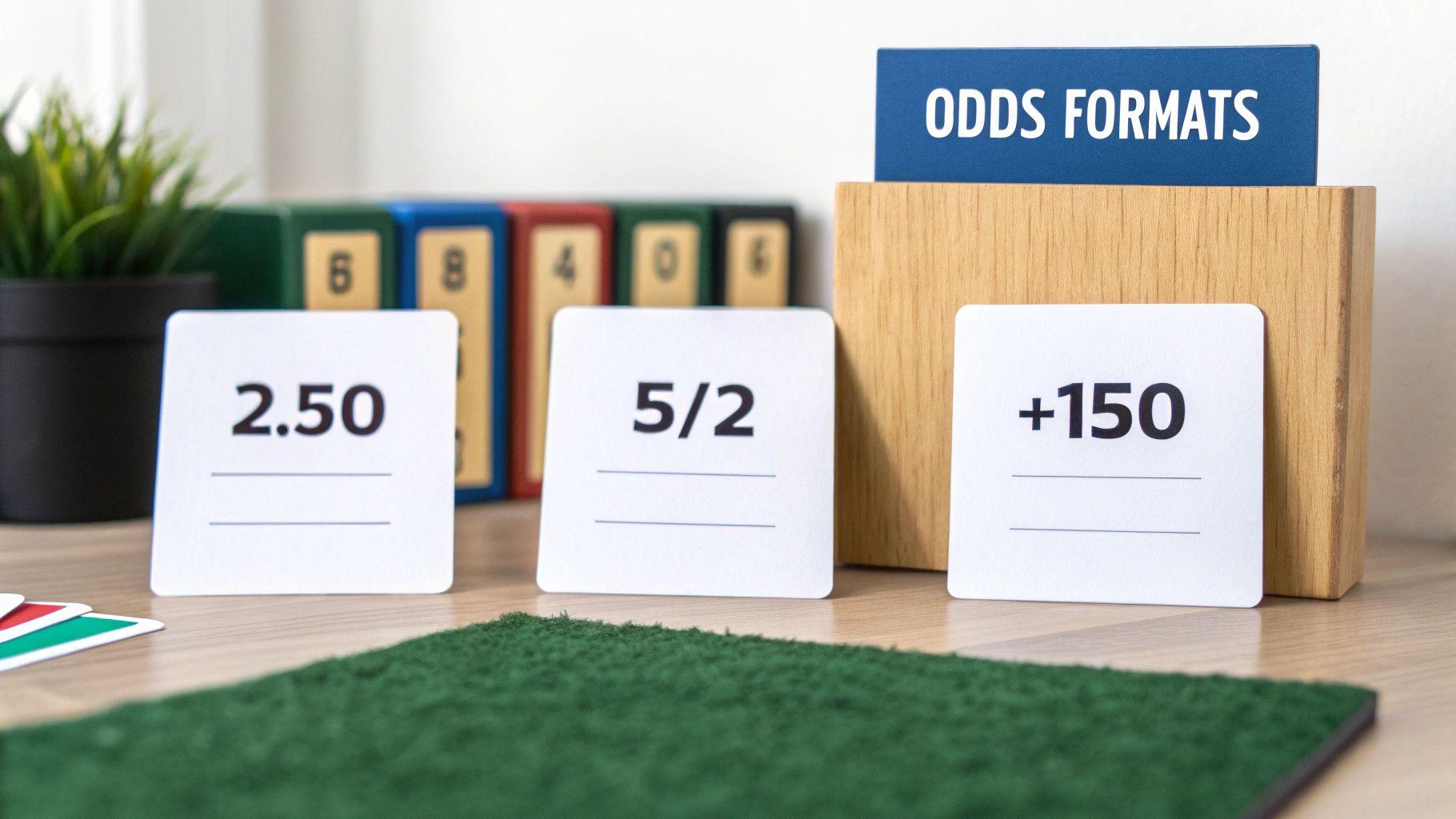
The betting world is bigger than ever, but the odds formats can feel frustratingly local. This patchwork of numbers fractionals in the UK, decimals in Europe, American odds in the US can trip up even the most experienced bettors and create a real barrier to finding the best lines.
Think of an odds converter as your universal translator. It’s the tool that lets you move seamlessly between different sportsbooks and regions without missing a beat.
You might be a UK-based punter who lives and breathes fractional odds, only to find a fantastic line on a US site showing American odds. Without a quick way to convert, that opportunity can slip right through your fingers. The main job of a bookmaker odds calculator is to wipe out that confusion for good.
From London to Las Vegas: Making Sense of the Numbers
Let's walk through a scenario I see all the time. Imagine you're breaking down a Premier League match between Manchester United and Liverpool. A UK bookie has Liverpool to win at 10/11 fractional odds.
At the same time, a US-based sportsbook prices the same result at -110, while a European site lists it as 1.91. If you're not fluent in all three formats, trying to compare these prices to find the best value is a nightmare.
This is exactly where the calculator proves its worth.
- You punch 10/11 into the fractional odds field.
- Instantly, the calculator shows the American equivalent is -110.
- It also spits out the decimal version: 1.91.
All of a sudden, three totally different-looking numbers are revealed to be the exact same price. This simple, instantaneous check gives you the confidence to shop around for the best lines, no matter where the sportsbook is located.
An odds calculator empowers you to think globally. It takes the guesswork out of the equation, ensuring you're not just betting on a team but also locking in the best possible price on the market.
A Practical NBA Example
This same principle holds true for any sport. Let's say you're looking at an NBA game where the Golden State Warriors are playing the Boston Celtics, and you think the Warriors have a great shot at covering the point spread.
A bookmaker you use regularly, which lists odds in decimal format, is offering a price of 1.95 for the Warriors to cover. But you spot another well-respected site offering -105 in American odds. Which one is the better deal?
When you plug -105 into a bookmaker odds calculator, it reveals the decimal equivalent is 1.952. It's a tiny difference, sure, but over the long run, consistently grabbing these slightly better prices is a cornerstone of profitable betting.
Without the calculator, you might have just guessed or assumed they were the same. With it, you make a precise, informed decision that directly improves your potential return. This little tool turns ambiguity into a clear mathematical advantage.
Using Implied Probability to Decode the Odds
Sure, an odds calculator is great for quick conversions. But its real power, the feature that separates casual punters from sharp bettors, is its ability to reveal implied probability.
This is the bookmaker’s own assessment of an event's likelihood, translated from confusing odds into a simple percentage. Getting a handle on this fundamentally changes how you see a bet. You stop just trying to pick a winner and start analyzing the price of the bet itself. The calculator does the heavy lifting, giving you a direct look inside the sportsbook’s mind.
What Is Implied Probability Telling You
Think of implied probability as the break-even point. If a team has an implied probability of 40%, the sportsbook’s odds are telling you that, for the bet to be profitable over the long haul, the team needs to win more than 40% of the time.
But this percentage isn't a pure prediction. It also has the bookmaker's profit margin baked right in, often called the "vig" or "juice." This is a crucial detail to remember.
Implied probability is the bookmaker's math laid bare. It shows you their assessment of an event, plus their fee for taking your bet. Understanding this is the first step toward betting like a professional, not a fan.
A Real-World Tennis Match Example
Let's make this practical. Imagine you're handicapping an upcoming tennis match. The bookmaker has Player A listed at -150 (the favorite) and Player B at +130 (the underdog).
What do those numbers actually mean? Punch them into the calculator.
- Player A (-150): The calculator reveals an implied probability of 60%.
- Player B (+130): This translates to an implied probability of 43.48%.
Suddenly, you have a clear picture. The sportsbook thinks Player A has a 60% chance to win. This gives you a hard, mathematical baseline to measure against your own research and analysis. If you think Player A's true chances are closer to 70%, you've just found a value bet.
Why the Numbers Add Up to More Than 100 Percent
You probably noticed something odd in our tennis example. Add the two probabilities together (60% + 43.48%), and you get 103.48%. That’s not a mistake that's the bookmaker’s margin in action.
That extra 3.48% is the bookmaker's built-in profit, assuming they take balanced action on both sides. A perfect, margin-free market would have the probabilities add up to exactly 100%.
By using a bookmaker odds calculator to expose these percentages, you can instantly see the "cost" of placing a bet at that sportsbook. A total percentage closer to 100% means a better deal for you. This is essential knowledge for anyone serious about finding true value in the odds.
Finding Value Bets With Your Own Analysis
This is where a bookmaker odds calculator goes from a handy tool to the core of a winning strategy. Up until now, we’ve focused on what the odds tell you about the bookmaker's opinion. Now, we’re going to flip that on its head and use that information to find spots where your own analysis gives you an edge.
We're talking about the hunt for "value," the secret sauce to long-term betting success. A value bet exists when you believe an outcome is more likely to happen than the implied probability of the odds suggests. It’s all about finding a price that is simply too good to pass up based on your own homework.
This is a critical mindset shift. You’re no longer just picking winners; you’re buying odds. When the odds are underpriced relative to the real probability, you’ve found value.
A Real-World NFL Underdog Scenario
Let's walk through exactly how this works in practice. Imagine the Miami Dolphins are playing the Buffalo Bills, and the Bills are heavy favorites. You check a sportsbook and see the Dolphins are offered at +160 American odds to win the game.
Most bettors would see that big plus sign and immediately write off the Dolphins. But a sharp bettor starts their own analysis, completely ignoring the odds for a moment.
- Your Research: You dive into the stats. You notice the Bills’ star quarterback is nursing a minor injury, and their defense has struggled against mobile quarterbacks all season. The Dolphins, on the other hand, have won three straight on the road, and their running game is firing on all cylinders.
- Your Probability Assessment: After weighing all the factors, you conclude that the Dolphins have a legitimate shot. You estimate their true chance of winning is around 45%. This is your number, based on your unique analysis.
Now, you turn to the bookmaker odds calculator. You punch in the +160 odds, and it instantly tells you the bookmaker's implied probability is only 38.46%.
This is the moment of truth. Your analysis says the Dolphins have a 45% chance to win, but the bookmaker is pricing them as if they only have a 38.46% chance. That gap is your value.
This simple process flow shows how a calculator turns raw odds into a strategic decision point.
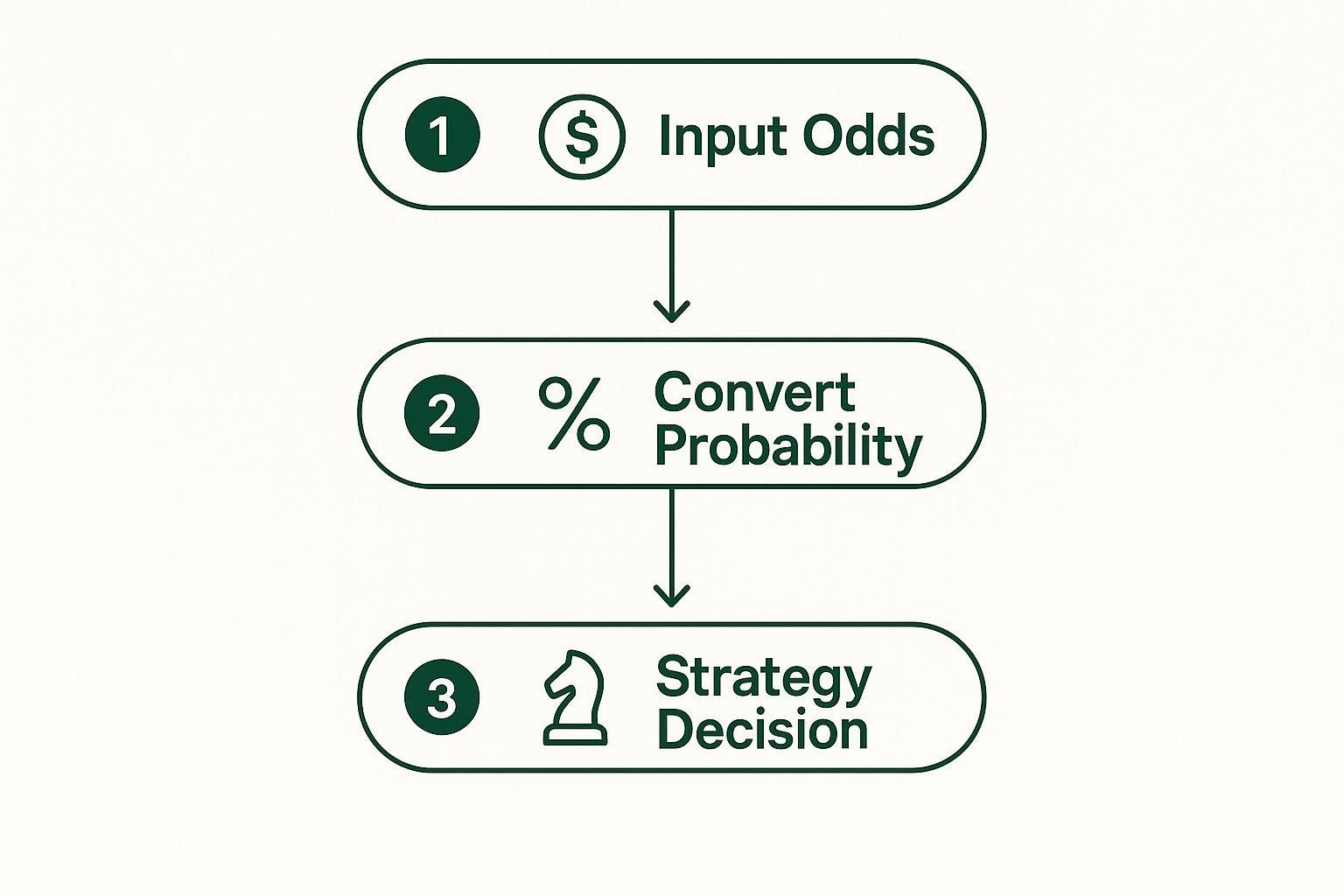
As you can see, the journey goes from raw odds to a clear probability, the final piece of the puzzle you need to make an informed betting choice.
Developing Your Analytical Edge
Finding these opportunities consistently requires a disciplined approach. With Americans wagering roughly $119.84 billion on sports in 2023 alone, finding a real edge is more crucial than ever.
Here are a few tips to start sharpening your own analytical skills:
- Specialize in a Niche: Don't try to be an expert on everything. Focus on one or two leagues you know inside and out.
- Create Your Own Power Ratings: Develop a system to rank teams that goes beyond the basic standings. This is how you spot overvalued and undervalued teams before the market does.
- Quantify Your Opinions: Stop thinking in terms of "I think this team will win." Start assigning a specific percentage, just like we did in the NFL example.
This approach transforms betting from a game of chance into a form of market analysis. For anyone serious about mastering this skill, our in-depth guide explains the core principles of value betting and how to apply them. By pairing your unique insights with the mathematical clarity of a bookmaker odds calculator, you build a repeatable process for identifying profitable wagers.
How to Calculate the Bookmaker's Margin
Every bettor needs to understand a fundamental truth: you’re not just betting against another team or player. You're playing against the house, and the house always has a built-in mathematical advantage.
This edge is the bookmaker's margin, often called the "vig" or "juice," and it's precisely how sportsbooks guarantee they make money over the long haul.
A bookmaker odds calculator is the best tool for making this invisible margin visible. It cuts through the complexity of the odds and shows you exactly what the sportsbook is charging you to place a bet. This is the reason why the implied probabilities for all outcomes in a single event always add up to more than 100%.
That little bit extra is the bookmaker's margin. A lower margin means you're getting a better price and higher potential returns, making it a critical number to check before you ever lock in a wager.
Uncovering the Vig in Action
Let's take a classic example from American sports betting a point spread where both sides are priced at -110 odds. This is one of the most common lines you'll ever see.
When you punch -110 into a bookmaker odds calculator, it will tell you that the implied probability for each side is 52.38%.
- Team A (-110): 52.38% implied probability
- Team B (-110): 52.38% implied probability
Add those two percentages together, and you get a total of 104.76%. The amount over 100% is the bookmaker's margin, which in this case is a pretty hefty 4.76%. This is the "cost" of doing business.
Think of the bookmaker's margin as the price of admission for betting. By calculating it, you can 'shop around' for the sportsbooks that charge the lowest fee, directly boosting your bottom line over time.
Why This Calculation Matters
Figuring out the vig isn't just a neat math trick; it's a fundamental part of a sound betting strategy. The margin directly squeezes the odds, and therefore, your potential profit.
The reality is that these margins are a massive revenue engine for sportsbooks. In the United States during 2024, monthly sportsbook gross revenues have bounced between approximately $790 million and $1.74 billion. Their hold percentages, or margins, have ranged from 5.8% all the way up to 11.4%. You can dig into more of these industry figures and betting revenue trends on Covers.com.
By consistently using an odds calculator to find and bet at sportsbooks with lower margins, you give yourself a much better mathematical shot at success. To take this a step further, you can use our no-vig calculator to determine the "true" odds once the bookmaker's juice has been stripped away. This skill is non-negotiable for anyone serious about making their betting profitable.
Common Questions About Odds Calculators
Even when you get the hang of a new tool, a few questions always pop up. It's totally normal. Let's tackle some of the most common things bettors ask about using a bookmaker odds calculator.
Getting these details ironed out will help you use the tool with more confidence and make your analysis that much sharper. Think of this as a quick-fire Q&A to clear up any lingering doubts.
Are All Bookmaker Odds Calculators Accurate?
For the most part, yes. The good news is that the math behind odds conversion is universal. Whether you're switching from American to decimal or fractional to implied probability, the formulas are standardized.
The vast majority of odds calculators you'll find online are perfectly accurate. Any tiny differences you might spot are usually just rounding discrepancies; we're talking fractions of a percent that won't impact your strategy. The real challenge isn't finding an accurate bookmaker odds calculator; it's finding one with a clean interface that you enjoy using.
Can an Odds Calculator Guarantee Winning Bets?
Not a chance. And it's crucial to understand this distinction. An odds calculator is a powerful analytical tool, but it's not a crystal ball. It can't predict a game's outcome or magically make your bets win.
Its real job is to do the heavy lifting for you translating confusing odds formats into simple, actionable numbers like implied probability and potential payouts. The calculator empowers you to make smarter decisions by showing you exactly what the bookmaker thinks the chances are.
An odds calculator helps you find better prices, not guaranteed winners. Winning still comes down to your ability to analyze games, manage your bankroll effectively, and identify valuable opportunities.
Ultimately, the calculator is a vital part of a professional betting process, but it’s just one piece of the puzzle.
How Often Should I Use an Odds Calculator?
Honestly? You should be running the numbers for every single bet you're seriously thinking about placing. No exceptions.
By making it a mandatory step in your process, you build a powerful habit of constantly evaluating the odds on offer. This simple practice ensures you always understand the risk and reward in clear mathematical terms. It makes comparing lines across different sportsbooks a breeze and stops you from ever placing a bet blind. Even the pros rely on calculators to stay sharp, especially with more complex wagers.
And if you're serious about finding spots where the odds are tilted in your favor, understanding what makes a value bet is essential.
Is There a Difference Between a Betting and an Odds Calculator?
You'll often see the terms used interchangeably, but there can be a subtle difference.
An "odds calculator" typically sticks to the core functions: converting odds formats (American, decimal, fractional) and calculating implied probability. It's focused on the fundamental analysis.
A "betting calculator" is often a more expansive tool that does all of that plus calculating payouts for more complex wagers like:
- Parlays
- Teasers
- Round robins
For most strategic bettors focused on finding value in single bets, a standard odds calculator has everything you need to get the job done.
Ready to stop guessing and start calculating? At ValueBetFactory, we provide the tools and insights to help you make smarter, data-driven betting decisions. Our platform identifies discrepancies in odds, giving you the edge you need. Find your next value bet with us today. Learn more at ValueBetFactory.