
Your Guide to a Betting Exchange
Unlock Profits with betting tips!
Ever wonder what it would be like to bet without a traditional bookmaker calling all the shots? That’s exactly what a betting exchange offers. It's a peer-to-peer marketplace where you bet directly against other people, not a company. Think of it less like a shop and more like a stock market for sports, where you can back an outcome to happen or lay an outcome you think won't.
A Smarter Way to Wager Without a Bookmaker
For the longest time, betting was a one-way street. You went to a bookmaker, took the odds they gave you, and hoped for the best. The bookie always had their profit margin baked right in. A betting exchange turns that old model inside out.
At its heart, an exchange is just a platform that connects two people who disagree on the outcome of an event. It gets out of the way and lets the market work, creating a far more transparent and dynamic environment. Instead of taking what a company offers, you're interacting with a worldwide community of fellow bettors.
The Power of Peer-to-Peer Betting
The real magic of an exchange comes from this direct, peer-to-peer setup. When you’re betting against another person, the odds are shaped by simple supply and demand—not by a bookie trying to guarantee a profit no matter what happens. This almost always results in better prices for you, the bettor.
A betting exchange doesn’t just let you place a bet; it turns you into a market participant. You can set your own odds and even play the role of the bookmaker.
This opens up a whole new layer of strategy built on two key actions:
- Backing a bet: This is what most people think of as betting. You're putting money on an outcome you believe will happen, like backing Manchester United to win.
- Laying a bet: This is where things get interesting. You're betting that an outcome will not happen. If you lay Manchester United, you win your bet if they lose or if the match ends in a draw.
A Growing Arena for Smart Bettors
It’s no surprise that this model has exploded in popularity. As the broader sports betting market has grown, savvy bettors have flocked to exchanges. Just look at the United States, where gross gaming revenue shot up from $0.9 billion to $13.7 billion between 2019 and 2024.
By 2023, the total amount wagered legally in the US was nearly $120 billion. You can explore more on the scale of the US betting market to see just how massive this shift has been. For bettors, this move toward platforms like exchanges is about gaining control, finding better value, and using smarter strategies that go way beyond just picking a winner.
Getting to Grips with Back and Lay Betting
Every single bet placed on an exchange comes down to two sides of the same coin: backing and laying. Think of it as a simple, two-sided argument. One person says, "I believe Team A will win," while another counters, "I'm willing to bet they won't." The betting exchange is simply the platform that lets these two people put their money on the line.
Getting these two concepts down is the first real step to understanding how exchanges work.
Backing a Bet: The Classic Wager
If you’ve ever placed a bet with a traditional bookie, you already know how to back a bet. It’s the most common form of betting there is. You’re simply putting your money on something to happen.
Let's say Manchester City is playing Arsenal. If you back Manchester City, you’re betting on them to win the match. You win if they win. You lose your stake if they draw or lose. It's straightforward and the starting point for everyone.
Laying a Bet: Playing the Bookmaker
Now, here’s where things get interesting. Laying a bet is the unique feature that sets exchanges apart. When you lay a bet, you are taking on the role of the bookmaker. You are betting that a specific outcome will not happen. In essence, you're accepting another person's back bet.
Sticking with our example, if you lay Manchester City, your bet wins if they lose or if the match ends in a draw. Any result other than a Man City victory means you win. This powerful ability to profit when something doesn't happen is what makes betting exchanges so dynamic.
Laying a bet isn't just a different type of wager; it's a completely different mindset. You are no longer just predicting a winner—you are identifying outcomes you believe are overvalued or unlikely to occur.
Understanding Your Liability When You Lay
When you back a bet, your risk is capped. The most you can ever lose is the stake you put down. Laying a bet is different. Your potential loss is known as your liability.
The liability is the amount of money you stand to lose if the event you bet against actually happens. It's the cash the exchange temporarily holds from your account to cover the backer's winnings if they're right.
Let's break it down with a simple scenario:
- Someone wants to back Manchester City to win with a £10 stake at odds of 3.0.
- You decide to lay this bet, effectively taking their £10 wager.
- Your potential profit is the backer's £10 stake (before commission).
- Your potential loss (liability) is calculated like this: (Backer's Stake x (Odds - 1)).
In this case, your liability is: (£10 x (3.0 - 1)) = £20.
The exchange will lock £20 from your account balance. If Man City wins, you lose that £20 (which goes to the winning backer). But if Man City fails to win (they lose or draw), you win the backer’s original £10 stake, and your £20 liability is returned to you. Getting comfortable with this calculation is absolutely crucial for managing your risk on an exchange.
Why Exchanges Beat Traditional Bookmakers
When you're deciding where to put your money, the choice between a betting exchange and a traditional bookmaker is a big one. They might look similar on the surface, but the way they operate is fundamentally different—and that difference has a huge impact on your ability to turn a profit. With a bookmaker, it's simple: they set the odds, and you can either take them or leave them.
A betting exchange, on the other hand, is a completely different beast. Think of it less like a shop and more like a stock market for sports. It's a platform that connects bettors with opposing opinions, allowing the odds to find their natural level based purely on supply and demand. This peer-to-peer setup creates a much more transparent and, frankly, fairer place to bet.
The Hidden Costs of Bookmakers
So, how do traditional bookmakers make their money? They build a profit margin, often called the "overround" or "vig," right into the odds. This is their built-in safety net, ensuring that no matter who wins, the house always has a statistical edge in the long run.
Here's the kicker: the odds you get from a bookmaker are never the true odds. They’ve been shortened just enough to guarantee the bookie's profit, which means you get less value on every single bet you place.
Betting exchanges don't care who wins or loses. Their business model is completely different. They simply charge a small commission, usually between 2-5%, and here's the important part—it's only on your net winnings for a given market. If you end up with a net loss, you pay nothing. This is a game-changer because it means the platform only makes money when you do.
The image below gives you a great visual of how this works, showing how bettors place "back" and "lay" bets against each other.
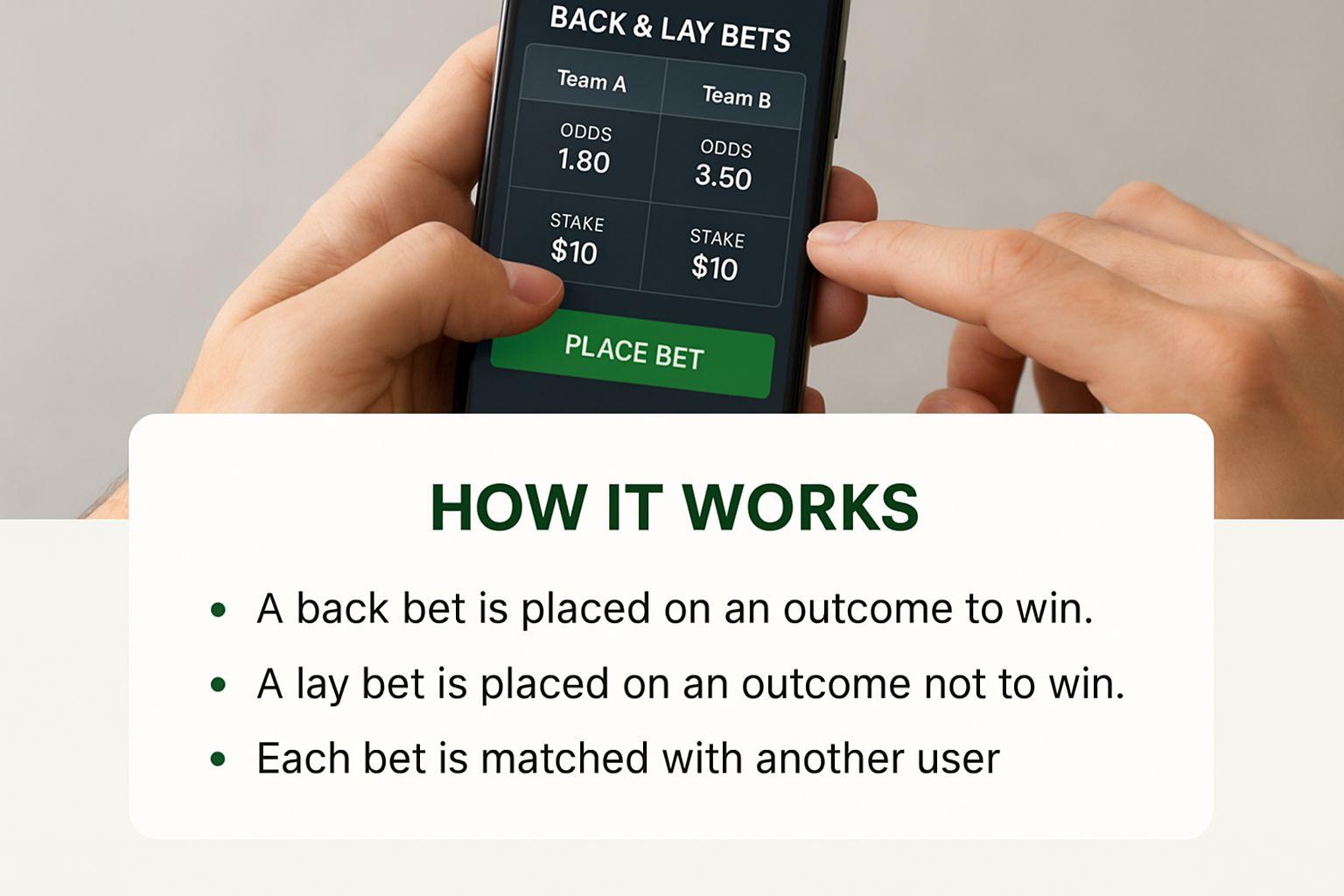
It perfectly illustrates that peer-to-peer dynamic, where one person's bet for an outcome is directly matched by someone else's bet against it.
Betting Exchange vs Traditional Bookmaker A Head-to-Head Comparison
These structural differences create real, tangible advantages for you, the bettor. Let’s lay it all out side-by-side to see how they stack up.
| Feature | Betting Exchange | Traditional Bookmaker |
|---|---|---|
| Odds Source | Set by users in a free market | Set by the bookmaker with a built-in margin |
| Revenue Model | Small commission on net winnings | Hidden profit margin (overround) in odds |
| Betting Options | Back (betting for) and Lay (betting against) | Only Back bets are available |
| Winning Bettors | Welcome, as they create market liquidity | Often restricted or have accounts closed |
| Transparency | Fully transparent; you see all money available | Opaque; odds are fixed and margins hidden |
Even after you account for the small commission, the odds on a betting exchange are almost always better. Why? Because they reflect the true market price, free from the artificial margin a bookie needs to build in. If you want to dig deeper into this, you can learn more about why Betfair Exchange often provides superior value.
Ultimately, the choice comes down to this: do you want to play in a closed system designed to profit from your losses, or an open marketplace that gives you the tools to succeed? For any serious, strategic bettor, the exchange's better odds, greater flexibility, and fairer structure make it the clear winner.
Turning Exchange Features Into a Winning Strategy
Knowing how a betting exchange works is the first step. The real magic happens when you start using its unique features to build a genuine strategic edge. This isn't about simply picking winners like you would with a traditional bookie. It's about shifting your mindset to that of a market trader, giving you far more control and opening up new avenues to profit.
These advantages aren't just small perks; they're game-changers that you just can't find anywhere else. Mastering them is what separates the casual bettor from a serious, data-driven individual who knows how to consistently find an edge.
Gaining an Edge with Superior Odds
The most immediate and powerful advantage you'll notice on an exchange is the odds. They're almost always better. Why? Because you're not betting against a bookmaker who needs to build a fat profit margin into every price. Instead, you're in a free-market environment, betting against other people.
On an exchange, you stop being a price-taker and become a price-maker. The platform is just the middleman connecting you with thousands of other bettors, creating a fairer and more efficient marketplace driven by supply and demand.
This dynamic is a huge reason why the sports betting world, now a massive global market, has grown so much. This kind of innovation is at the forefront of its expansion. In fact, you can read the full research on this market's growth trends to see just how big this shift is.
The Power to Lay Bets: Betting on What Won't Happen
Here's where things get really interesting. On an exchange, you can lay a bet, which means betting against an outcome. You get to play the bookie. Think a heavily favored team is a bit shaky and might not win? You don't have to pick between them losing or drawing.
You can just lay them. If they fail to win—meaning they either lose or draw—your bet wins. This completely flips how you approach a game. You’re no longer just hunting for winners; you can now profit by identifying overrated teams or outcomes that you feel are highly unlikely.
This single feature unlocks a whole new playbook:
- Profit from Doubt: Got a feeling a hot favorite is vulnerable? Lay them.
- Cover the Field: In a horse race with three main contenders, laying the favorite is the same as backing the other two with one simple bet.
- Use Your Expertise: Your deep knowledge of a sport can help you spot teams whose odds are too short, making them a great lay opportunity.
Trading and Hedging for Guaranteed Profit
The pinnacle of exchange strategy is treating it like a stock market. Odds move constantly, both before an event starts and live in-play. This allows you to trade your position to lock in a profit or cut your losses, no matter what the final result is.
This is called hedging or "greening up." Let's say you back an underdog team to win at high odds. They score an early goal, and suddenly, their odds to win plummet. You can now place a lay bet on that same team at their new, much lower price. By doing this, you guarantee yourself a profit, regardless of whether they hold on to win, draw, or lose.
You've just turned a speculative bet into a calculated trade, securing your winnings long before the final whistle.
How to Find an Edge in Exchange Markets

Getting your head around how a betting exchange works is the first step. But the real challenge—and where the money is made—is learning how to consistently find an edge in those markets. The advantage isn't just about getting slightly better odds; it's about spotting opportunities where the market has simply gotten it wrong.
This is the entire art of finding "value."
A value bet is the absolute foundation of any serious betting strategy. Think of it this way: it’s a bet where the odds you’re offered are higher than the actual probability of that outcome. By consistently making these kinds of bets, you're stacking the mathematical odds in your favor. Over the long haul, this turns betting from a simple gamble into a calculated investment.
Finding a value bet is like finding a £20 note on the pavement and only having to pay a fiver for it. You're not just hoping it's real; you know it's underpriced. The same exact principle applies to odds on a betting exchange.
This is where sharp thinking and the right tools come into play. Experienced bettors and sophisticated software are constantly scanning the exchange markets. They compare the live odds against their own statistical models to find those little gaps between price and reality. The goal is simple: pinpoint these value bets and get your money down before the market wakes up and the price corrects itself.
Spotting Value with Smart Tools
Let's be realistic. Trying to manually hunt for these opportunities across thousands of global markets is practically impossible. It’s why specialized tools have become non-negotiable for anyone serious about gaining a long-term edge. They do all the heavy lifting for you.
This is exactly what platforms like ValueBetFactory are built for. They run powerful algorithms that scan exchange markets 24/7, flagging odds that are statistically out of line. So, instead of burning hours staring at screens, you get real-time alerts pointing you directly to potential value bets.
This completely flips the script, moving your strategy from reactive to proactive. Here’s a quick look at how it works under the hood:
- Continuous Market Scanning: The software is always watching odds as they move across countless events and exchanges.
- Probability Analysis: It uses huge datasets and performance models to calculate what the "true" odds should be.
- Discrepancy Identification: When the exchange odds are significantly higher than the calculated true odds, it flags a value opportunity.
- User Alert: You get a notification with all the details: the event, the specific odds, and exactly how much of an edge it represents.
By bringing a tool like this into your workflow, you’re no longer just guessing. You're equipping yourself with a data-driven method for finding and acting on market inefficiencies. And that, right there, is the secret to building a profitable strategy on any betting exchange.
The Future of Betting Exchanges
The world of peer-to-peer betting never sits still. It's constantly evolving, pulling in new technologies and expanding into new arenas. If you think exchanges are powerful now, just wait. The exchange of tomorrow will be sharper, quicker, and more deeply connected to emerging competitive scenes, creating brand new opportunities for savvy bettors.
One of the biggest waves crashing into the betting world right now is esports. This isn't some niche hobby anymore; it’s a full-blown global sensation that’s bringing in a younger, more digitally fluent crowd of bettors. The high-speed, unpredictable nature of competitive gaming is a perfect fit for the live, constantly shifting odds you find on an exchange.
The Rise of Esports and AI
The money flowing into esports betting is genuinely eye-opening. Experts predict that revenues will climb to $2.8 billion by 2025. What's more interesting is that the average bet size is significantly larger than what we see in traditional sports. In esports, bettors are putting down about €29 per wager, which dwarfs the typical €5 bet on a football match. You can dive deeper into the numbers and discover more insights about esports betting statistics to see just how fast this space is growing.
Beyond new markets like esports, the other major force shaping what's next is Artificial Intelligence. AI is quickly becoming the brain behind the next generation of exchange features and improvements.
Exchanges are using AI for much more than just managing their own risk. They're building a more personalized and intuitive experience that helps you find the markets and information that actually matter to you.
Here’s what that looks like in practice:
- Smarter Tools: Imagine AI algorithms that can scan market movements, flagging potential value bets and predictive insights for you in real-time.
- Personalized Experiences: The platform itself can adapt to your habits, showing you the sports, markets, and data that align with your betting history.
- Enhanced Risk Management: On the backend, AI helps keep the exchange fair for everyone. It can spot strange betting patterns or suspicious activity, protecting the integrity of the market.
For those of us willing to adapt, the future of the betting exchange looks incredibly promising. It’s pointing toward a more intelligent, dynamic, and opportunity-rich environment for everyone involved.
Common Questions About Betting Exchanges
Even after you've got the hang of back and lay betting, it's completely normal to have a few questions. Stepping onto a betting exchange for the first time is a different world compared to a traditional bookie, so let's clear up some of the most common queries to get you started on the right foot.
Is a Betting Exchange Safe to Use?
Absolutely. Any betting exchange worth its salt is licensed and heavily regulated by official bodies like the UK Gambling Commission. This isn't just a piece of paper; it means they operate under strict rules for financial security and fairness.
A crucial part of this regulation is that your funds are kept in protected, segregated accounts. This means your money is held entirely separate from the company's day-to-day operational funds. So, in the unlikely scenario that the exchange runs into financial trouble, your cash is safe. Stick to the big, well-known platforms, and you'll be in good hands.
A key thing to remember is that an exchange only makes money when you win. Unlike a traditional bookmaker, their entire business model is built on taking a small commission—usually 2-5%—on your net profit from a given market. If you end up with a net loss on that market, you pay zero commission.
What Happens If My Bet Is Not Matched?
If nobody takes the other side of your bet, it simply sits there as an 'unmatched' bet. You're not stuck, though. You have a few choices: you can leave it active and hope someone comes along and matches it, you can tweak the odds to make your offer more attractive, or you can cancel it outright and get your stake back immediately.
What if the event starts and your bet is still sitting there unmatched? The exchange will automatically cancel it and return your stake. You never lose money on an unmatched bet. This kind of flexibility is at the very heart of the exchange experience, giving you total control over your wagers. Learning how to manage your positions is a big part of professional sports betting and is a skill you'll develop over time.
Ready to stop betting against the house and start finding real value in the market? Join ValueBetFactory today and let our powerful tools find the edge for you. Explore our plans and start your journey to smarter betting at ValueBetFactory.